What's the difference?
Ford's small hatch, the Focus, is criminally under-bought in Australia. The latest model is one of the best hatchbacks on the road and when you chuck in the decent price, impressive equipment and absurdly powerful engine for its size, it's a winner.
But you lot? You don't buy it in nearly the kinds of numbers it deserves. Partly because there isn't a bait-and-upsell boggo model to lure you in, partly because it's got a badge that is not exciting Australians any more and partly because it's not a compact SUV.
Or is(n't) it? Because alongside the ST-Line warm hatch is the identically priced and therefore technically a co-entry level model; the Focus Active. Slightly higher, with plastic cladding, drive modes and a conspicuous L on the transmission shifter, it's a little bit SUV, right?
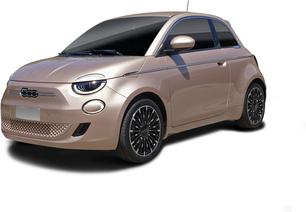
You wouldn’t know it to look at it, but this is a brand-new — as in really and truly all-new — Fiat 500.
That has got to be a big deal for fans of Fiat’s pint-sized city car, with a genuinely all-new 500 about rare as spotting Halley’s Comet soaring over Turin. The last time was way back in 2007, by the way, and that car will remain on sale alongside this new one for the foreseeable.
But that’s not the only surprise. This 500 is also entirely electric, properly modern inside, and it has actual technology in its cabin and on its safety list.
Fiat reckons this is a big reset for the 500. And that there will never be another all-new petrol model again.
So, how does this new 500e stack up against the recent flood of small EVs, predominantly from China?
Let’s go find out.
Ten years ago, the idea that the higher-riding version of a hatchback would be a good city car would have been laughable. The Focus Active is pitched as a kind of SUV with its different low-grip driving modes, which you'll never touch if you stick to the city.
The Ford Focus is genuinely a brilliant car, no matter where you take it. The Active takes a terrific chassis, tweaks it for comfort but, ironically, doesn't lose much of the speed.
A fun, funky EV which will no doubt appeal to lovers of Italian style, but also one which struggles a little on the range and price front.
Still, there’s no doubt that electrification has improved the Fiat 500 formula.
For a fairly conservative hatchback, the Focus came under fire for what some termed its derivative styling. I quite like it, and not just because the styling work was led by an Australian. The front end is very much family Ford, as long as it's the European arm of the family, fitting in with its smaller sibling, the Fiesta. The Active scores the usual black cladding, higher ride height and smaller diameter wheels, in exchange for more compliant, higher-profile tyres. All of that takes nothing away from a design that I think looks pretty good.
The cabin is well put together, with just that oddly angled touchscreen causing me a bit of a twitch. The design is a fairly steady Ford interior with a lot of switchgear shared with the Fiesta, but it's all quite nice. The materials feel mostly pleasant and the hardwearing fabric on the seats feels right for this kind of car.
It looks, well, it looks like a Fiat 500.
It’s actually bigger in every dimension than an ICE cinquecento, but it doesn’t really look like it, which is a good thing.
The 17-inch wheels look great, and big against the very small Fiat, and I like the hidden doorhandles, which make the already smooth-looking 500’s flanks look a little smoother still. But I can take or leave the little DRLs up front that are meant to act as little illuminated eyebrows for the headlights, which come over a bit too cutesy.
But I think the highest compliment I can pay it is that it looks like a regular Fiat 500 — one of the most successful reincarnations of a timeless design ever — and not some modern, eco-friendly version that would have killed the look.
In the cabin, however, it’s definitely a more modern affair, with the big screen, the horizontal push-button gear selector, and the nifty push-button door openers.
Still, it’s all pretty familiar Fiat 500, only a little nicer, even if some of the plastics are far too hard and scratchy for a vehicle this expensive.
There are five colours available: Ice white, Onyx black, Rose gold, Ocean green and Celestial blue.
The Focus is quite roomy compared to other cars in its class. The rear seat has good leg and headroom, with the feeling of space accentuated by large windows. Annoyingly, though, all that work put into making the rear a nice place to be is ruined by a lack of amenities like cupholders, USB ports or an armrest.
Front-seat passengers fare better with two cupholders, a roomy space at the base of the console for a phone and a wireless-charging pad. The front seats are very comfortable, too.
The boot starts at a fairly average 375 litres - clearly sacrificed for rear-seat space - and maxes out at 1320 litres with the seats down. While you have to lift things over the loading lip and down into the boot, it's one of the more sensibly shaped load areas, with straight up and down sides. Ironically, the smaller Puma has a noticeably larger boot.
The 500e is 29mm taller, 61mm longer and 56mm wider than the current ICE Fiat 500 (now 1529mm, 3631mm and 1683mm respectively), and it rides on a longer wheelbase, too .
That means more front-seat room and head room, but there’s still not oodles of space in the four-seat cabin, and especially in the back, where things are pretty tight.
I’m 175cm tall, and my head touches the ceiling in the back, and if I had another full-size human in the back with me, I’d want it to be someone I know well, because we’d be well and truly aquatinted by the time we got to our destination.
The front seats are more accomodating, but there is a strange tightness to the pedal area for the driver. It’s so tight, in fact, that when you rest your left foot, you have to be careful not to accidentally clip the brake pedal when driving.
The boot is a small 185 litres, too. But you’re not buying this for practicality perks, are you?
The Focus Active wears a $30,990 sticker but the several people I know who bought one haven't paid that much, so Ford dealers are obviously keen to do deals. Even at that price, it's got a fair bit of stuff. The Active has 17-inch wheels, a six-speaker stereo, dual-zone climate control, reversing camera, keyless entry and start, front and rear parking sensors, cruise control, auto LED headlights, LED fog lights, sat nav, auto wipers, wireless hotspot, powered and heated folding door mirrors, wireless phone charging, a big safety package and a space-saver spare.
Ford's SYNC3 comes up on the 8.0-inch screen perched on the dashboard, which weirdly feels like it's facing away from you slightly. It has wired Apple CarPlay and Android Auto, sat nav, DAB+ and also looks after various functions in the car.
The panoramic sunroof is a stiff $2000 and includes an annoying perforated cover rather than a solid one.
The 500e is not cheap by modern small EV standards — we’re looking at you, China — but it does arrive in one well-equipped trim level, called La Prima, with paint the only available option.
It's also, quite shockingly for anyone who has driven an ICE Fiat 500 lately, stacked with some truly high-tech kit.
There’s heated seats for the first time ever, for example, and there’s 10.25-inch central screen with Apple CarPlay and Android Auto, and wireless charging.
There’s a digital driver display, too, plus there’s faux-leather on the seats and dash, a panoramic glass sunroof and fancy push-button front doors (though with a mechanical back-up lever hidden in the door pockets should something go pear shaped).
Outside, you’ll find 17-inch alloys, as well as LED lightning all around, including the DRLs, and there’s keyless entry and push-button start, too.
But, and it’s a significant but, the 500e lists at $52,500 before on-roads , which — when you consider its size, battery and range — really edges it into the premium EV space.
A similar-sized EV from China can be had for under $40k, which means you are going to have to really love the 500e to drop that extra $15k or so.
Ford does an excellent range of small turbo engines. The "normal" Focus range (such as it is, now the wagon has disappeared from the market) comes with a 1.5-litre turbocharged three-cylinder engine. Bucking the SUV-this-size trend (yes, I know it's not really an SUV), this punchy little unit delivers an impressive 134kW and 240Nm. They're both very decent numbers for such a small engine.
The big numbers continue with the transmission boasting eight gears, a number you don't often find in a hatchback. It's a traditional torque-converter auto, too, so those of you who have bad memories of Ford's old PowerShift twin clutches should worry no more.
Power goes to the front wheels only and you'll get from 0 to 100km/h in 8.7 seconds.
A single front-mounted electric motor delivers the power here, with 87kW and 220Nm on offer. Enough, Fiat says, to knock off 100km/h in 9.0 seconds. But it does feel quicker than that in real life, thanks to the way electric vehicles deliver their power.
There’s the usual EV single-speed gearbox, too, with power sent to the front wheels.
Ford's official testing for the big window sticker delivered a 6.4L/100km result on the combined cycle. In my time with the Focus, I got 7.2L/100km indicated on the dashboard, which is a pretty solid result given the Focus spent a good deal of the time on suburban or urban roads.
With its 52-litre tank, you'll cover around 800km if you manage the official figure, or just over 700km on my figures.
The Fiat 500e’s 42kWh battery provides a smallish 311km driving range on paper, but when we got in it was more like 290km at 96per cent charged. A city car, then, rather than a long-distance hauler.
When it does come time to charge, you’re set up for 85kW DC fast charging which should take you from zero to 80 percent in 35 minutes.
Despite the very mild off-road pretensions, if it's a comfortable city ride you're after, the Active is the Focus to have. While the ST-Line isn't uncomfortable - not by a long way - the Active's more compliant tyres and higher ride height (30mm at the front and 34mm at the rear) iron out the bigger bumps without sacrificing much of the sportier car's impressive dynamic prowess, even with the low-rolling-resistance tyres.
The cracking 1.5-litre turbo is responsive and well-matched to the eight-speed auto. The big torque number pushes you along the road and makes overtaking much less dramatic than a 1.5-litre three-cylinder has any right to.
Ford's trademark Euro-tuned quick steering is also along for the ride, making darting in and out of gaps a quick roll of the wrist, which has the added benefit of meaning you rarely have to take your hands off the wheel for twirling. That darting is aided and abetted by the engine and gearbox, with the turbo seemingly keeping the boost flowing with little lag. It's almost like they planned it that way.
You have good vision in all directions, which almost renders the fact that the blind-spot monitoring is optional acceptable. Almost. It's very easy to get around in, easy to park and, just as importantly, easy to get in and out of. Compared to, say, a Toyota Corolla, the rear doors are very accommodating.
This is the probably the best-driving example of the Fiat 500 I’ve ever climbed into. Sure, it’s not quite as engaging as self-shifting a perky little manual, but it’s smoother, easier and more comfortable, and a whole lot better than ICE vehicles fitted with Fiat's odd dual-logic automatic gearbox.
The EV transition genuinely suits the little Fiat, admittedly sapping a little character, but also thoroughly modernising the drive experience, with smooth, constant acceleration, sharp-enough steering and a ride that’s mostly settled, only really becoming crashy over the bigger road imperfections.
The small dimensions here also help the EV reincarnation. Yes, it’s heavier than you might expect, weighing in at 1290kg (tare), with the batteries adding several hundred kilograms to the equation, but the 500e still doesn’t feel overly heavy, with the little Fiat remaining pretty light on its feet.
There are three drive modes on board, including the catchy Sherpa mode (because it will help get you where you’re going), which, when you’re running low on battery, kills the climate control and anything else it needs to preserve range and get you home.
But you can’t shake the feeling that the 500e is a little expensive for such a specialist tool. It’s unashamedly a city car, but one that will cost you more than $50k, and which doesn’t feel quite premium enough in the cabin to justify that asking price.
The Active has six airbags, ABS, stability and traction controls, forward AEB (low speed with pedestrian avoidance and highway speeds), forward collision warning, lane-departure warning, speed-sign recognition and active lane-keep assist.
Annoyingly - and I can't for the life of me work out why this is a thing - despite some advanced safety features in the base package, you have to pay $1250 extra for blind-spot monitoring, reverse cross traffic alert and reverse AEB, which are part of the Driver Assistance Pack. No, Ford is not the only company to do this.
The back seat has two ISOFIX points and three top-tether anchors.
The Focus scored five ANCAP stars in August 2019.
There’s a heap of active safety stuff on board (again, unusual for a 500), with active cruise control, traffic sign recognition, front, rear and side parking sensors, blind-spot monitoring, AEB with pedestrian and cyclist detection, and more.
Still, the 500e only secured a four-star ANCAP safety rating, scoring just below the five-star cut off in Adult Occupant Protection, Child Occupant Protection and Safety Assist, with a lack of a centre airbag not helping.
Ford offers a five-year/unlimited-kilometre warranty and a roadside-assistance package that consists of a membership to your local motoring organisation.
The first five services cost $299 each and also include a free loan car and a 12-month extension to your roadside assist membership for up to seven years.
The fly in Fiat’s ointment is its ownership proposition, with a three-year, 150,000km warranty now way below par in Australia these days, even if the battery is covered for the standard eight years.
Servicing is every 12 months or 15,000kms, and will cost $250 a pop for the first eight years, which is commendably cheap.