What's the difference?
You’re a city dweller on the hunt for a small hatch, but the usual suspects just don’t do it for you. Time for a trip down the urban road less travelled.
The Citroen C3 fits the bill in terms of scale, but brings something extra when it comes to personality. A fun-sized European with the ability to surprise and delight.
It comes at a price, though. So, is the promise of some extra excitement in your motoring life worth it? Read on to find out.
There are two ways to look at the Lexus CT200h; as either the cheapest model in the Japanese company’s range, or as a planet-saving hybrid.
Either way, the four-door, five-seat CT200h hatch – which has been updated for 2018 – differs from the rest of the Japanese luxury brand’s lineup for a number of different reasons.
The Citroen C3’s plus column contains some big ticket items like a solid standard equipment list, design flair, generous interior space, an eager engine, good safety and a comfy suspension. However, the minus side of the ledger isn’t exactly empty, with entries like steep price, marginal perceived quality, poor cabin storage, sub-par refinement, okay economy, and high ownership costs.
But there’s no doubt this car delivers a different, adventurous take on the city-sized hatch, and for you, that alone may count for more than any of those things.
The cheapest Lexus of them all isn’t chasing badge snobs with the CT200h as blatantly as Mercedes-Benz, BMW and Audi do with their entry level cars… but it’s perhaps not quite the Lexus you’d expect it to be.
It has a lovely front-of-cabin, for example, but there’s a lot of last-gen Prius in plain sight in the rear of the cabin.
The hybrid powertrain, too, is noble in concept, but the day-to-day reality is that it’s not as nice to drive, especially town to town, as a regular petrol-powered car of similar size.
The foot brake, silly multimedia joystick and odd gearshifter also spoilt the party a bit.
Empty nesters who are looking for a nice city runaround with a tinge of greenwash about it will love it… and if the current Prius is anything to go by, the next CT will be a very good thing indeed.
If Citroen is known for anything it’s daring, innovative design. From the idiosyncratic 2CV, via the sleek DS, to the ultra-cool SM, and angular BX, Citroen boasts a 100-plus year back-catalogue of stunning automotive breakthroughs.
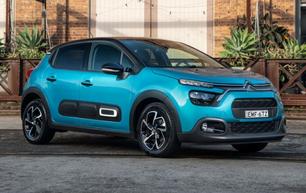
And true to form, the C3 sits left-of-centre with a determined, almost angry expression defined by chrome borders extending from its signature ‘double chevron’ logo above the grille.
A mix of carefully radiused curves, soft organic shapes and whimsical decoration define the rest of this SUV-ish hatch. Rounded rectangles and squares (squircles?) are a recurring theme, forming part of a dent-resistant panel along the car’s flanks and embossed into the door cards inside.
Our white test example sported a (no-cost) contrast red roof colour, the same shade picking out details like the front fog light surrounds, exterior mirror caps and side scuff panels.
The interior is less bold with a multi-tone grey colour palette broken up by light green contrast stitching on the seats, as well as piano black finish on the centre console and satin chrome highlights around the air vents, instrument panel and door handles.
Plus, the squircle still makes its presence felt in everything from the directional air vents to the speaker grilles and sections of the dash.
Functionality and ergonomics are good with sensible touches like a physical knob for audio volume control (big tick) as well as easy-to-navigate controls for audio, phone and more on the steering wheel.
An unexpected highlight, and regular talking point with people in the car during my week with it, is what Citroen calls ‘Luggage-inspired’ front interior door handles.
Check out the interior photos. The straps look amazing, are easy to use, and remind me of the handle on my mum’s circa-1965 Olympia portable typewriter.
There are some light external revisions for the latest update of the compact Lexus CT200h. New grey 17-inch alloys are unique to the Sport Luxury, along with a black roof treatment, new L-shaped LED driving lamps that match new-design LED tail-lamps, while Lexus designers have also added its new spindle grille to the brand’s smallest model.
It manages to be inoffensive, but it doesn't really reflect the brand's latest design language of 'real world concept cars' like the NX and the LC ranges.
Inside, a couple of new leather colour options are available for the CT200h, while the addition of the wide-format 10.3-inch screen to the top of the centre console is the single largest change. Interestingly, the steering wheel controls appear to have regressed a little from the previous model, no doubt brought about by the addition of the new driver aids.
At a fraction under 4.0m long, just over 1.8m wide, and close to 1.5m tall, the C3 is a small hatch that, in terms of practicality, does well in some areas and could do better in others.
On the plus side, there’s plenty of space for the driver and front seat passenger, and rear room is surprisingly generous. Sitting behind the driver’s seat, set for my 183cm position, I had more than adequate head, leg and knee room.
Three full-size adults across the rear is a short-journey proposition only, but a trio of up to mid-teenage kids will be fine.
The space-efficiency carries over to the boot, with 300 litres of volume available (below the parcel shelf) with the 60/40 split-folding rear seat upright. But beyond that number, the space has been carefully sculpted to maximise usability.
We managed to fit our three-piece (36L, 95L, 124L) luggage set in there, with a small cheat of removing the divider, and could swap them out for the bulky CarsGuide pram, with room to spare. Fold the rear backrest down and available space increases to an impressive 922 litres.
The downside is storage and concessions to comfort elsewhere in the car. As in, a lack of them.
For a start, the dual cupholders in the front centre console confirm the French’s affection for Espresso. You’ll struggle to locate an average size take-away coffee cup in one of those dainty receptacles.
The front door bins are long but relatively narrow, and lack a designated spot to hold bottles upright, so I found myself laying drink bottles horizontally along them, which is awkward.
Plus, there’s no lidded storage box between the front seats, so no centre armrest, either. Rather an open tray behind the handbrake lever.
The glove box is modest, there’s a small open cubby below the central multimedia screen that isn’t big enough to hold a phone, there’s just one USB-A port for connectivity/power and a single 12V outlet.
No fold-down centre armrest in the rear, either. There are map pockets on the front seat backs, a single (again, small) cupholder at the end of the front centre console for back-seaters to share, and while rear door pockets are welcome, they’re petite.
Yes, the boot is commodious, but it lacks tie-down anchors to secure loose loads, and the flimsy carpet in there is prone to moving around.
On a more positive note, the spare is a 15-inch space-saver, which is streets ahead of the all-too common inflator/repair kit.
The CT200h basically replicates a small hatchback in terms of interior size. It'll seat five, but if you try to put three adults across the back, they won't be particularly happy about it.
The roofline is quite low and the car’s waistline is high, which makes the glasshouse feel small. Room in the front is adequate, but only just for taller drivers; the sunroof, as fitted to our test example, takes away a good chunk of headroom, despite the CT200h standing just 5mm lower than a Corolla overall.
The seats themselves, too, are mounted just a touch high to be comfortable for taller drivers, while rear seaters will complain bitterly about being stuck behind my (184cm) driving position. However, my more diminutive wife pronounced herself very comfortable behind the wheel and in the passenger seat.
A nice, small steering wheel sits in front of a single-dial dash that sports two digital screens either side. The left-hand screen changes when you change the drive mode dial between Eco, Normal, and Sport. And there's also a full EV mode button in handy reach.
Two cupholders are line astern between driver and passenger, although storage is at a premium thanks to the size of the car. Climate and multimedia controls - and even an old-school CD player – flow right through underneath the centre console, which steals away valuable space. There are no extras like wireless charging bays, nor is there Apple CarPlay or Android Auto.
There are bottle holders in the door, but don't try and stash anything that's over one litre in size because it just won't fit.
It's quite an austere proposition for rear-seat passengers, with no bottle holders in the doors, no cup-holders and no charging points. There are fixed vents under the front seats and on the right side of the rear area, so it's not a complete desert, and there are ISOFIX mounts for two child seats in the rear.
Another practicality issue that's unique to the CT200h is the gear shifter. It operates as a spring-loaded joystick, and unless you're watching the dash indicator, it can be tricky to know which gear you're in. Other car makers have actually recalled cars with this style of transmission stick, and it's certainly something that you have to get used to.
Likewise, the old-school foot brake is certainly an anachronism in something like a Lexus.
Based on the previous generation Prius, the nickel-metal hydride battery for the CT is hidden underneath the rear seat, so it doesn't steal away too much boot room. However, the boot floor is still quite high, and the area is rather small at 375 litres with the seats up. There is 985 litres available when you drop the seats, but the aperture is short and narrow, so larger items will be a squeeze. There is a space-saver spare nestled away underneath the boot floor, too.
Another practicality note in the negative column is Lexus's insistence on the odd joystick control for its multimedia system. It's simply not very good. It’s imprecise when compared to a touchscreen, the action and feel of our test unit was very much less than premium, and it’s just awkward and clumsy to use. The CT is not the only Lexus to use it, but we wish the company would just see the light and ditch it all together.
The Citroen C3 is offered in a single Shine grade, and lines up against a slew of similarly city-sized hatches from China, Europe, Japan and South Korea. Think Kia Rio, Mazda2, MG3, Suzuki Swift, Toyota Yaris, and VW Polo.
But when it comes to its price - $32,267, before on-road costs - you’re looking at primo competitors only, like the Suzuki Swift Sport Turbo ($30,990), Toyota Yaris ZR Hybrid ($32,200), and VW Polo Style ($31,250).
And to tempt you away from those more mainstream options, Citroen loads up the C3 with a solid list of standard equipment.
Aside from the safety tech covered later in the review, this small hatch features keyless entry and start, cruise control, a 10-inch colour multimedia touchscreen (with voice recognition across multiple functions), climate control air, a leather-trimmed steering wheel, six-speaker audio (with digital radio as well as Bluetooth, Apple CarPlay and Android Auto connectivity), built-in sat nav, LED headlights and daytime running lights, rain-sensing wipers, and 16-inch alloy wheels.
Not too shabby, but bear in mind, as is often the case in this class, the trim is cloth, the front seats adjust manually and the instruments are conventional analogue.
At this point, it’s important to mention ‘perceived quality’, a term used in various industries to describe the look, touch and feel of a product. And it’s here that the C3 suffers.
Open the tailgate, look to the pillar on the right-hand side of the rear windscreen (from the inside) and you’re confronted with more than half a dozen spot weld craters that have creased the sheet metal to varying degrees. Not to mention a crude fold of the outside panel onto this interior piece. Perfectly functional, but not a good look.
The elastic cords suspending the cargo divider at the top of the boot space feel as insubstantial as the thin metal hooks they’re attached to, and the finisher matt sitting on top of the engine looks like it won’t stand the test of time.
There are other examples, but suffice it to say, the overall feel is not in the same league as this car’s main competitors.
The 1.8-litre petrol-electric CT200h comes in three different flavours – the Luxury, the F-Sport as tested here, and the Sport Luxury. The range now kicks off at $40,900 (up $2150) and peaks at $56,900 with the Sport Luxury (up $810).
The F-Sport may be a little lacking in the actual ‘sport’ department, but it’s is pretty flush with flash kit, including not one but three motors (one petrol and two electric), auto lights and wipers, a wide 10.3-inch multimedia system, leather seats, dual-zone climate control and new 17-inch alloys.
At $50,400 plus on-roads, the F-Sport has jumped in price by $1960, but it’s gained a host of new gear, including a new driver aid system that adds auto emergency braking (AEB), pedestrian-detecting pre-collision warning system, lane departure warning with steering assistance and adaptive cruise control.
There are also LED headlights and taillights, as well as revised styling for the front and rear bumpers.
The CT will be cross-shopped against other premium tiddlers like the Mercedes-Benz A-Class, Audi’s A3 and the BMW 1 series. Comparing it like-for-like in the hybrid category, there’s the top spec Toyota Prius i-Tech, while Nissan’s Leaf could theoretically be lumped in both on price and on environmental grounds.
The Citroen C3 is powered by a small-capacity (1.2-litre), turbo-petrol, three-cylinder engine, driving the front wheels through a six-speed automatic transmission.
This little unit punches well above its weight thanks to tech like direct injection, and dual variable valve timing to enhance pulling power. The lightweight (all-alloy) unit produces 81kW of power at 5500rpm and a substantial 205Nm of torque at just 1500rpm.
The 1.8-litre twin-cam petrol engine makes a relatively low 73kW and 142Nm, while a 60kW, 207Nm electric motor that’s also connected to the front wheels chips in its share.
Combined, the system produces 100kW, while the torque figure translates to around the 150Nm mark. That juicy 207Nm doesn’t come into play, sadly, given that the petrol engine – which is built to run cooler than a traditional Otto cycle engine, and therefore more efficiently – does most of the work.
Throw in a transaxle for the electric motor and a power inverter, and things are getting complex. However, if the Prius is any indication, the CT200h’s drivetrain is durable and relatively serviceable, with batteries estimated to last ten years or longer.
Citroen’s official fuel economy number for the combined (ADR 81/02 - urban, extra-urban) cycle is 5.2L/100km, the 1.2-litre three-cylinder emitting a modest 118g/km of CO2 in the process.
Our time with the car included mainly city and suburban trips, with some freeway running thrown in, and the result was a (dash-indicated) average of 8.0L/100km. Not exactly miserly, and points to the turbo triple having to work pretty hard to keep up around town.
Minimum fuel recommendation is the relatively pricey 95 RON premium unleaded, but you’ll need just 45 litres of it to fill the tank. Using the official consumption figure, that translates to a range of 865km, dropping to around 560km using our real-world number.
Here’s the odd thing – over 220km of largely highway driving, I couldn’t get the CT200h under a dash-indicated 10.4 litres/100km, against a claimed combined fuel economy figure of 4.4L/100km.
I topped the tank off with 18 litres of fuel, which works out at a closer 8.8L/100km… but it still ain’t anything like 4.4.
Another owner I spoke to, though, said he regularly records high fives with his CT200h in mixed conditions.
It runs a 45-litre tank that’ll happily take 95 RON fuel.
The C3’s compact footprint and relatively light weight (1090kg) make it an urban-friendly option and outputs from the 1.2-litre turbo-petrol engine are exceptional.
Maximum torque of 205 Nm is plenty of pulling power from such a tiny unit, and with that number arriving at just 1500rpm it should be ideally suited to stop-start traffic.
And yes, with enthusiast use of the right pedal the C3 gets up and goes pretty well, but refinement isn’t its strongest suit.
The throttle can be jumpy unless you’re super smooth with it, the three-cylinder engine’s typically coarse note makes its presence felt under load, and the brakes need to be dealt with gently to avoid an overly aggressive stop.
Sure, familiarity and practice will help you get in tune with the car but it’s not a smooth ‘plug-and-play’ drive like the majority of its competitors.
That said, in true Citroen fashion, steering feel is good, the front seats are as comfortable as they are supportive, while the suspension manages to blend plush compliance with excellent dynamic response. Another Citroen hallmark.
The six-speed auto shifts smoothly, with a press of the Sport button encouraging it to shift up later and down earlier for a more urgent response. But the zig-zag (my term, not Citroen’s) shift pattern makes for an awkward shuffle between D, N and R when parking. No doubt you’d get used to it, but I’m not a fan.
Speaking of parking, the C3's diminutive size makes it easy to slot into even tight spots, the standard front and rear proximity sensors, as well as a decent resolution reversing camera helping out, too.
If you've ever driven a Prius, then you'll be very familiar with the way that the CT drives. Based around a 73kW Atkinson cycle petrol engine which focuses on fuel efficiency rather than outright power, a 60kW electric motor (the pair combine to produce 100kW in total), a nickel-metal hydride battery array and a CVT gearbox, the CT200h – like the Prius – is a bit different to a regular hatch.
Under light throttle, the CT is quiet and moves along quite well, and you can even use full Electric Vehicle mode at speeds under 45km/h for a brief amount of time, (slightly less than two kilometres), and with a very gentle right foot.
The battery array is recharged via the petrol motor as well as regenerative braking (where heat energy is captured and directed back to the electric system) – but unlike a petrol-electric plug-in hybrid, there’s no way to stick a 240v cable into the CT to top up the battery.
It has the unusual whines and odd noises that you would associate with a partly electric car, but the petrol motor sounds just like a regular old four-pot petrol unit, and it’s running most of the time.
One issue with the drive of a hybrid is its ability, or the lack thereof, to get off the line in any sort of hurry. You really have to mash the throttle to get going, which takes some getting used to. There’s also some hesitation and un-Lexus like thumps from the drivetrain if you confuse it by almost stopping then taking off again.
The CT200h’s biggest bugbear is that the fourth generation Prius exists. Built on a more sophisticated newer-generation platform and with a more refined drivetrain, the new Prius is a great insight into how good the next CT will be – and what the shortcomings of the current one currently are.
The CT works well in high-traffic city environs, where a light throttle foot helps get the best out of the unusual drivetrain. Lots of lag from rest is an annoyance, as is an excess of CVT whine under hard efforts, but the CT200h pootles around town very well.
Its small size does play against it when it comes to keeping out road noise at freeway speeds, though the CT is superior to most other similarly sized cars in this regard. As an aside, its build quality is nothing short of amazing, with minimalist panel gaps, a tight interior and lashings of paint on every surface.
The Citroen C3 scores four out of five ANCAP stars courtesy of testing dating back to 2017.
The sticking point was a sub-par result in Pedestrian Protection, one of the independent safety body’s four main assessment areas (beside Adult Occupant Protection, Child Occupant Protection, and Safety Assist).
Specifically, potential pedestrian head injuries resulting from contact with the base of the windscreen and “stiff” windscreen pillars.
But Citroen hasn’t left the C3 standing still with active (crash-avoidance) tech fitted to the current model including the usual suspects like stability and traction controls as well as more sophisticated systems like ‘Autonomous Emergency Braking’ (AEB), forward collision warning, blind-spot monitoring, lane departure warning, ‘Driver Attention Alert’, a reversing camera (with zoom function), and tyre pressure monitoring.
That said, although there are parking sensors front and rear, there’s no cross-traffic alert (front or rear), no adaptive functionality on the cruise control, and no lane change assist. Arguably unrealistic to suggest all of these should be included at this price point but it’s worth noting not all boxes are ticked.
If a crash is unavoidable there are six airbags on-board (driver and front passenger front and side, plus full-length side curtain). The hazard lights automatically activate when emergency braking force is applied, but multi-collision brake, which reduces the chances of further impacts after an initial crash, is missing-in-action.
There are three top tethers for child seats or baby capsules across the back seat, with ISOFIX anchor points in the two outer rear positions.
Part of the update for 2018 is the addition of several driver aid systems, including AEB across the range, lane departure control with steering and adaptive cruise control.
The F-Sport also has reversing camera and eight airbags as standard, ensuring the maximum five-star ANCAP safety score it managed in 2017.
Citroen covers the C3 with a five year/unlimited km warranty, which is cost-of-entry now in the mainstream market, and roadside assistance is included for the duration.
Service is scheduled for 12 month/15,000km intervals, with costs capped for the first five workshop visits. The average annual figure over that period is $505, which is way more than double the $205 you’ll pay annually for servicing a Toyota Yaris ZR Hybrid. Sacre bleu!
Lexus sells the CT with an unusual four-year/100,000km warranty, which includes roadside service coverage. The battery pack has an eight-year/160,000km warranty, while Lexus would like to see you back for a service every 12,500km or 12 months.
It’s not just about a warranty or a service interval with Lexus, though. For decades now, its customer service record has topped all industry measures, and everyone we know who has bought a Lexus with their own money has raved about the quality of the service received.
As well, it’s a level of service that’s provided across the range. It’s a tangible benefit of buying a CT200h.