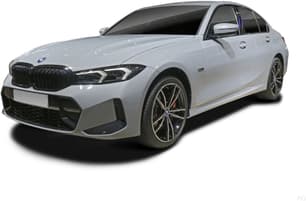
What's the difference?
Back in the day, the 3 Series sedan was often the entry to the brand for first time BMW owners, and for good reason. They offered practical interior space without compromising on engine performance.
And they simply looked good, no boring nanny design elements. Then the 1 Series came along and price points bumped up, so how does the ‘entry’ BMW 320i M Sport live up to its long-standing reputation?
With an updated dashboard that brings the interior and tech up to market and a sharper exterior design, it more than holds its own at the table of luxury sedans, despite hard competition from the likes of the Audi A4, Mercedes-Benz C200 and Jaguar XE.
However, if the Merc is a placid and well-behaved mare… the BMW is the barely-broken-in bronco and it takes a certain kind of ‘rider’ to enjoy what the 320i has to offer.
I’ve been discovering just that this week with my family of three. What did we find out? Read below!
Giant carmakers seem like pretty sober sorts of places. Everything goes through endless committees, every decision has to be signed off, sent in, sent back, subjected to endless scrutiny to make sure it will make money.
Sometimes, a brand will do something odd like BMW's i3 which is like sending up a flare to get people talking.
Hyundai, for many years, seemed to be trying to emulate Toyota. After a brief flourish in the '90s when it did for curves on cars what Kim Kardashian did for curves on grubby internet sites, the company lost its bottle and tried to go full mainstream. Never go full mainstream, that's for the old folks.
Then, out of the blue, came the Veloster. It's probably one of the most wilfully weird cars in decades (apart from various Citroens, but that's a special case).
One long door on the driver's side, two shorter doors on the passenger side. When BMW did something similar with the Mini Clubman, right-hand drive markets didn't get their own version of the kerb-side door, but Hyundai isn't like that.
Making the Veloster properly in right-hand drive is a wonderful gesture from a company that worked out being itself was a better idea than being Toyota.
I thoroughly enjoyed my time in the BMW 320i M Sport. It’s fun to drive and I felt connected to what the car was doing on the road. The harder ride may not appeal to some but I didn’t mind it. The cosy back seat and boot mean it will probably suit a smaller family best and one which doesn’t have to worry about carrying a lot of gear around regularly, but it suited my needs just fine.
I reckon this is a car for those drivers who don’t want to compromise on performance but still have a kid or two. If you’re after the cushioned comfort of a Merc, this won’t appeal but I didn't want to give this one back and happily give it a firm 8/10.
My son liked the sports car looks and enjoyed the amenities in his row. He gives it a 10/10.
Another good bit of Berry wisdom was the idea that the Turbo is the sweet spot of the range. While the Premium is indeed packed with goodies, they're not must-haves - the Turbo has everything you need while the Premium adds the wants.
So, at its core, this Turbo Premium is good warm hatch fun in a wacky, head-turning body, wrapped around a good cabin that could be a little less plasticky. Best of all, the fun design matches the fun-to-drive personality. It's a thoroughly modern Hyundai and I want (even more) to drive the full-fat bonkers N version we look like we're not going to get.
Sharper than its predecessor, the new 320i has LED everything with the rear lights being longer and curving around to the sides of the car.
The classic 'kidney' grille is darkened and more pronounced, with the black panelling extending to the rear to create an unapologetically sporty presence. A presence that’s accentuated by the twin exhausts.
The batcave interior with its black headliner, black seats… black everything, looks smart and stylish.
You do have a fair bit of harder touchpoints throughout but the customisable ambient lighting helps to soften the overall effect.
With its 2068mm width, 4709mm length and 1435mm height, the sedan makes its presence known without feeling cumbersome to manoeuvre. Urban dwellers need not fear their local car park!
You do not have to find the Veloster pretty to think it's cool. You can see echoes of the i30 donor car that lurks under the more interesting metal, with a big grille, sharper headlights and plenty of black bits to up the aggro for the Turbo model.
The rear bumper sports a pair of drainpipe-sized exhausts that aren't afraid to bellow a bit.
It's different from right to left in profile, with the rear door almost disappearing into the rear haunches on the passenger side. The high rear glass may not be great for seeing out of but it helps keep the Veloster identifiable and influential - there are more than a few cars getting about sporting a similar high rump with big lights.
The cabin is, like its predecessor, fairly restrained and very i30-like. It's all put together very well and is only let down by the centre console's plastics being a bit hard, scratchy and insubstantial.
For such a sleek looking sedan, it’s generous up front with plenty of head and legroom.
You can adjust the seat to sit quite low and both front seats have extendable under-thigh supports, which should excite taller drivers.
My 189cm (6’2”) brother has the 328i and is very comfortable but taller front passengers will encroach on back seat passenger comfort.
The front seats are quite firm on the backside, they also lack adjustable lumbar support, so expect to stretch the kinks out on a longer trip.
The amenities and tech feel well thought out and easy enough to use. The 12.3-inch touchscreen multimedia system looks great and has the best-looking graphics I’ve sampled.
The BMW system is intuitive to use once you get used to it. If you’re not interested in using the touchscreen, you can also utilise the rotary-wheel for menu selections.
There’s also Bluetooth connectivity, wireless Apple CarPlay and Android Auto plus built-in satellite navigation.
The 12.3-inch digital instrument panel is customisable and the information displayed simply but you won’t really look at it because of the head-up display.
Front occupants enjoy a wireless charging pad for their smart phone, a USB-A and USB-C port plus a 12-volt socket. Rear passengers get a couple of USB-C ports, too.
The storage is good for this size sedan but overall passenger room takes priority, but the glove box and middle console will suffice for everyday use.
While it may not excite others, I love the big bottle holders in the doors. They’re large enough for my big 1.5L bottle and angled for easy access. These are found in the rear doors as well.
Back seat passengers enjoy climate control, directional air vents, two cupholders, netted map pockets and reading lights.
My six-year old was happy with the amenities and lower ground clearance because he felt comfortable and had his independence.
The boot offers a good capacity of 480L and the aperture isn’t too narrow, so you can comfortably access items if they roll to the back.
I had plenty of room for my little family’s needs but if you’re a larger family, you may need to get strategic with gear storage.
Being a base model, you do miss out on a powered tailgate, which is a shame but not too much of an issue given this is a sedan and the lid isn’t heavy.
There’s also no spare tyre or even a puncture repair kit but you have run-flats, so you should be able to limp to a service centre if need be.
I think the Veloster is very clever. M'colleague Richard Berry thinks the third door is a bit silly - say, like a third armpit. I'm of the opinion it's an exceptionally clever solution to a problem: how do I have a funky car without throwing the baby out with the bathwater?
Something like a three door hatch (yes, I know they're out of vogue) makes moving people about difficult even if you only do it occasionally. The Veloster's third door provides relatively easy access to the two back seats for people under about 150cm, and you can get okay access to a baby seat. Try that in an 86.
The new door aperture is quite a bit bigger than the old car and there is a bit more rear headroom which I'd still call marginal for my 179cm frame. Leg and knee room are okay, sitting behind my own driving position.
The boot is a useful if not staggering 303 litres. You have four cupholders across the two rows and door pockets in the front doors. Ahead of the gear selector you'll find a tray with the Qi charging pad and two USB connections, but only one will work with the stereo and is marked as such.
There are seven variants for the BMW 3 Series sedan and our model is the base model for the petrol variants.
There is a plug-in hybrid version, the 330e, if you’re after a more fuel-efficient option but it will up the price by about $20K.
As it stands the 320i M Sport is $78,900, before on-road costs. Our model has been finished in 'M Brooklyn Grey', which adds $1539 to the price.
That puts it at a similar price point as its rivals. You get a well-specified package with the M Sport but it doesn’t have the same sense of cushioned comfort as the Merc does, but more on that later.
Still, the sporty and streamlined interior is headlined by BMW’s dual 12.3-inch screens that sit propped on the dash like a futuristic cockpit.
The mix of synthetic leather and cloth seats are electric and have adjustable side bolsters for when you want to go hard in a turn.
The interior also boasts a sunroof and wireless Apple CarPlay and wired Android Auto. There are some other highlights like the 18-inch alloy wheels, leather steering wheel and the crystal-clear head-up display, to name a few.
Remarkably, Hyundai has just dropped the second-generation Veloster in Australia. I was convinced it would be a one-hit wonder, but here we are with the replacement for the SR Turbo of the first-generation, the $41,990 Veloster Turbo Premium with a seven-speed dual-clutch auto transmission.
It also has 18-inch alloys with sticky Michelin Pilot Sport 4 tyres, an eight-speaker stereo, sat nav, electric windows and mirrors, keyless entry and start, climate control, reversing camera, rear parking sensors, auto LED headlights, auto high beam, auto wipers, heated and ventilated electric front seats, sunroof, Qi wireless charging pad, head-up display, leather trim and a space-saver spare.
A 7.0-inch screen on the dash runs the media system, with a sat nav, Apple CarPlay and Android Auto. It all works very nicely and the generally ho-hum Infinity speakers do a solid if unspectacular job of filling the cabin with noise.
The 320i M Sport has the ‘baby’ engine in the 3 Series line-up but the 2.0-litre, four-cylinder turbo-petrol powertrain still delivers on power with a maximum output of 135kW/300Nm.
This is a rear-wheel drive and has an eight-speed auto-transmission which delivers very smooth gear changes.
Despite having the smaller engine, it can still go from 0-100km/h in just 7.4 seconds.
The 1.6-litre turbo-petrol four-cylinder is a familiar sight in Hyundais, in this case offering up 150kW at 6000rpm and 265Nm between 1500 and 4500rpm, which is a nice wide torque curve. Power goes to the front wheels via a seven-speed dual-clutch automatic transmission.
Performance is swift rather than startling, with the Veloster's 1350kg cracking the ton in the 7.1 seconds, 0.6 seconds quicker than the manual.
In a world with rising fuel prices, the efficiency of this decently powered sedan should excite you.
The official combined fuel cycle is 6.5L/100km. Real world testing saw my figure at 7.4L/100km after a mix of open-road and urban driving this week.
I thought that was great for how hard I drove it and for the power, you won’t be wincing when you put your foot down. I would expect it to be higher in an urban setting.
The 320i has a 59L fuel tank and based on the official combined cycle figure, you should get just over 900km of driving range, which is great, especially if you do 'roadies' like me!
Hyundai claims you'll get 6.9L/100km on the combined cycle. As ever, Hyundai is unusually close to real world figures, with my indicated average landing at a very respectable 8.2L/100km in a fairly urban kind of week.
There's a lot that I like about how this performs but a highlight is how eagerly the car responds when you accelerate.
However, it’s not unbridled power. There’s no bucking at the front or shuddering through the steering wheel. It’s controlled but still very fun.
The lower centre of gravity and coupe-like height of this does mean it handles corners well and the bolstered seats hold you firmly into place, meaning you can be free to drive this a little harder than you might normally. Which I did and can confirm it handles itself well.
This has the M Sport suspension, which means it’s stiff, but you feel very connected to the road.
You do get a lot of talk-back from bumps in the road but unless you hit a big pothole, you never feel rattled by them.
But it is a harder ride than other luxury models, which doesn’t bother me as I like the handling, but if you want limo-like comfort, look elsewhere.
The cabin is very nice to spend a lot of time in and relatively quiet, even at higher speeds.
The 11.4m turning circle and sleek dimensions makes it very handy to park, even in tight car parks. The nose is long but the front and rear parking sensors take out any ‘will I make it’ moments and the super clear reversing camera is great.
I was fortunate enough to have some time on my hands, so I volunteered to take the base spec Veloster to Hyundai to swap into the Turbo. And look, it's fine, but in the same way the second-to-last-Celica was fine - nothing to write home about, more show than go. Comfortable, quiet, hatchy.
And the Turbo is many of those things. Except, as in the i30, when you step up to the turbo engine it wakes up a chassis that is truly terrific.
While it rides really, really well, it also piles through corners with even more enthusiasm than a similarly powered i30 N-Line, which is no slouch.
The Veloster is lower and slightly lighter, adding to the fun. And it doesn't spend half the time hitting the bump stops like the old car.
There are almost no duds in the Hyundai range when it comes to ride and handling, but the steering is in another league compared to the outgoing model's.
It's quick and points the car where you want, the front end digging in and tracking clean and true. It's terrific fun.
But, like just about every other Hyundai, its compliance and daily drivability is super-impressive. Only bad roads upset the rear suspension but the front is largely unflappable.
Flappable is the dual-clutch transmission. It occasionally hunts around looking for a gear and I spent a lot of time pulling the paddles to get it to do the right thing.
It was particularly recalcitrant downshifting without manual intervention, no matter what drive mode I chose. It can also clunk a bit when it's confused. I reckon I'd take Richard's advice and stick with a manual.
The safety list includes a suite of features and the following come as standard: adaptive cruise control, auto emergency braking (operational from 5.0-210km/h), blind-spot monitoring, speed sign recognition, forward collision warning, SOS emergency call button, daytime running lights and rear cross-traffic alert.
I like the intelligent seatbelt reminder and that the bonnet is considered 'active', meaning it will lift up and away from the engine if the sensors detect that a pedestrian has been hit.
However, I have to call out the lane departure and keeping aids. It’s a hit or miss system and I tested it extensively this week once I noticed it.
You can customise the sensitivity levels and even on the highest sensitivity, it works too sporadically for my liking. BMW should improve this system for future instalments.
The 3 Series has been awarded a maximum five-star ANCAP safety rating but it was done a while ago in 2019. It only has seven airbags and is missing the newer front centre airbag.
There are ISOFIX child seat mounts on the outboard seats and three top tether anchor points but the back seat is a bit too narrow to comfortably fit three child seats side by side.
You'll be able to fit a 0-4 rearward facing child seat but may struggle if you're a tall family.
This Veloster arrives with six airbags, ABS, stability and traction controls, lane keep assist, blind spot warning, rear cross traffic alert, forward collision warning and forward AEB with pedestrian detection.
Although not rated by ANCAP at the time of writing, the Turbo and Turbo Premium are likely to score a maximum five stars.
The lower grade - as with other newer Hyundais with the lower spec AEB - is probably going to drop a star.
Both rear seats score an ISOFIX and top tether anchor point.
The 320i comes with a five-year/unlimited km warranty, which is standard for this class.
You can choose between a three- or five-year capped-priced servicing plan. The five-year plan costs just $2150, or $430 a year, which is competitive for this class.
Like other BMWs, servicing intervals are condition-based, with the car letting you know when it needs to be serviced.
As always, Hyundai's solid five year/unlimited kilometre warranty is along for the ride. Slightly annoyingly, you'll need to return to your dealer every 12 months or 10,000km for scheduled service and prices are capped.
Four of the five services cost $299 with the fourth year at $375. Over the first five services, you'll average $314.