What's the difference?
In an era where internal combustion power appears to be rapidly disappearing into the rear-view mirrors along comes Audi, casually wheeling out a new RS5.
But the pride of Ingolstadt hasn’t completely sidelined its e-tron-style electrification, because while a fire-breathing 2.9-litre twin-turbo-petrol V6 sits under this newcomer’s bonnet, it’s now supported by a grunty electric motor in its eight-speed auto transmission and another on the rear axle to manage torque vectoring.
The result is mega-power and massive torque with all-wheel-drive quattro grip offered in four-door sedan and Avant wagon form.
And CarsGuide was invited to a launch drive program on Tasmania’s east coast, home to some of the best driving roads in the country, with a quick fang around the Symmons Plains race circuit included.
Time to see what this new, plug-in hybrid, 630hp beast has to offer.
I know, picture Ferrari and you'll likely be conjuring images of potent V12 or V8 engines, a scenery-shaking exhaust bark on start-up and a fuel bill that would make a Sheikh wince.
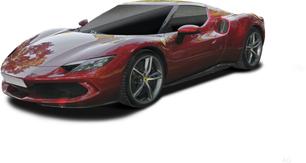
But this one, the 296 GTS, doesn't have, or do, any of those things. In fact, it doesn’t so much explode into life as it does kind of whirr gently, as though you’ve just switched on a photocopier.
And yet, people I trust on these matters reckon this just might be the best Ferrari to have ever worn the badge. So, I guess we better get to figuring out what the hell is going on with this plug-in Prancing Horse.
Audi says this car’s shift to a plug-in hybrid powertrain represents a “defining moment” for Audi Sport enhancing the RS5’s character and performance.
After this first drive we can only agree. Its power, driving dynamics, refinement and quality apply a fierce blowtorch to the belly of its European hot rod rivals.
Note: CarsGuide attended this event as a guest of the manufacturer with travel, accommodation and meals provided.
Anyone who says electrification somehow muddies the Ferrari formula is wrong. This plug-in Prancing Horse is among the most potent and direct vehicles I’ve ever driven, and the electric motor only adds to the experience.
The new RS5 sedan and Avant wagon are beautifully proportioned, with big rims and rubber, pumped guards and a visual balance that matches a close to 50/50 front to rear mechanical weight distribution.
Instantly recognisable as an Audi, big ticket elements include a huge 3D honeycomb grille, front wheel-arch exit vents, a rear spoiler on both versions and RS-specific OLED tail-lights with a chequered flag signature.
Beauty is always in the eye of the beholder but I think this car exudes equal parts sophistication and menace.
Inside, the RS5 is all business, from the configurable multi-screen displays (including a lap analysis tool) to the flat bottom and top steering wheel as well as the beautifully sculpted seats and obvious attention to detail.
The driver’s the main event here and the interior treatment extends the exterior’s intense personality perfectly.
It is hard not to swoon when you gaze upon the 296 GTS, and I say that with no bias - I don’t think all Ferraris have looked this good.
But this is Ferrari at its dreamy, sweeping best, from the tarmac-kissing front — which generates so much downforce and cooling it negates the need for active aero — to its swollen haunches and the glass-topped engine window.
So what’s the difference between this and the GTB? Largely it is the ability to drop the folding roof, meaning you can feel the wind in your hair and that exhaust in your soul. To be honest, though, I reckon it looks better top up...
It’s a cockpit-style driver’s set-up inside, and there’s lots I love and some things I don’t. But let’s start with the steering wheel, which might be one of the best in existence.
It feels magic under the touch, as do the giant flappy paddles which remain fixed in place as you turn the wheel.
It’s also surprisingly comfortable in the figure-hugging sports seats, though climbing in and out of them is not necessarily something you want to do in front of a crowd.
Downsides? There is plenty of tech in the 296 cabin, but it’s all controlled from the steering wheel, making it fiddly and annoying to use.
Also, there are F1-levels of complexity on the control-everything steering wheel, and if I’m being honest, there are some buttons or switches, the function of which I still don’t fully understand.
In terms of space and practicality, in the front, at 183cm tall I’ve got plenty of breathing space.
And for storage, there are pockets in the doors big enough to hold large bottles as well as a couple of cupholders in the centre console.
A tray ahead of the gearshifter is for wireless charging but if your phone isn’t in there it doubles as an oddments tray and there are two USB-C ports and a 12-volt socket inside it.
There’s a fairly shallow lidded storage box between the seats which doubles as an armrest between driver and passenger and there’s a medium-size glove box.
In the back, I’ve got plenty of foot and legroom although without too much effort I can touch my head on the roof lining, so I’d call that marginal.
For storage, there are decent bins in the doors, big enough for bottles. There’s a pull-down armrest in the centre, again with a pair of cupholders.
There are netted pockets on the front seatbacks, adjustable air vents with temperature control as well as another pair of USB-C outlets to keep everyone happy and charged up in the back seat.
Boot space is passable for a car of this size, with the sedan offering 331 litres VDA with five seats up and the Avant wagon at 361L in the same configuration.
Both feature a 40/20/40 split-folding rear seat for extra flexibility and space - 1170L with the second row folded in the sedan and 1302L in the wagon.
There are tie-down anchors, bag hooks as well as numerous extra storage spaces and braked trailer towing capacity is a handy 2.1 tonnes.
But there’s no spare wheel of any kind. A repair/inflator kit is your only option, which in this market, isn’t good enough.
What do you want to know around practicality? We’re talking two seats, about 200 litres of cargo space total and a couple of smallish storage spaces in the cabin. And… that’s about it.
Next question, please.
Before we get behind the wheel, it’s prudent to check in on cost-of-entry.
Sitting at $179,827, before on-road costs for the sedan and $182,827, BOC for the Avant, this third-generation RS5 is a relatively modest, roughly seven per cent step up in price from the second-gen Coupe and Sportback models it replaces.
Obvious rivals include fellow Bavarian, the BMW M3 (from $169,600) as well as the Mercedes-AMG C63 S E Performance ($193,100) with the Alfa Romeo Giulia Quadrifoglio (from $174,200) lurking in the shadows.
Aside from the performance and safety tech we’ll get to shortly, standard equipment highlights include:
Suffice it to say this machine meets the market when it comes to included features.
Okay, hold your breath for a moment. The 296 GTS lists at $668,146, which is a sizeable jump over the hard-top GTB, which is more like $551,800. But what price a little open-air freedom?
What you get for that investment is a two-part (solid) folding roof, of course, but also what might be Ferrari’s most high-tech offering to date, with a plug-in hybrid system delivering potent performance rather than a usable EV driving range, a mega-clever braking system and an almost telepathic six-way 'Chassis Dynamic Sensor' designed to link the car’s key functions to make the experience, and the driver, somehow better.
Elsewhere, there are sports seats, Matrix LED headlights, 20-inch alloys, keyless entry and a very cool engine start touch-button on the even cooler steering wheel.
Oh, and there's wireless charging and Apple CarPlay, both thankfully standard in Australia, the latter controlled through the steering wheel and digital driver display.
It's all beautifully finished and a joy to behold and sit in.
The RS5 is powered by an updated version of the previous model’s all-alloy 2.9-litre, twin-turbo petrol V6 engine which produces 375kW/600Nm all on its own.
It features direct-injection and variable geometry turbos as well as variable intake and exhaust cam timing. And now it’s supported by an electric motor integrated into the eight-speed auto transmission that tips in 130kW/460Nm.
A mighty combination with overall outputs of 470kW/825Nm. Enough to propel either version of this car from 0-100km/h in a blistering 3.6 seconds.
Now we're talking. The powertrain here is both tremendous and terrifying, pairing a 3.0-litre twin-turbo-petrol V6 with a rear mounted electric motor, and a 7.5kWh battery, to deliver a total 610kW and 740Nm. That power is fed through an eight-speed dual-clutch auto transmission.
Those are, frankly, scary numbers, and enough, Ferrari says, to dispatch 100km/h in just 2.9 seconds, and to push on to a top speed of 330km/h.
Claimed combined cycle (urban/extra-urban) fuel economy is a miserly 4.2L/100km for the sedan and 4.4L for the Avant, which is amazing for a car with this much performance potential.
But it’s worth noting that number rises to (a still impressive) 10L/100km when the battery’s depleted.
On an enthusiastic section of the launch drive we saw an average of 17L/100km which dropped to 7.0L on a cruisier section.
What’s more, thanks to a 25.9kWh lithium-ion battery, it can cover 78km in EV-only mode at up to 140km/h if you’re game.
Charging capacity is 11kW AC, for a full top-up in two and a half hours and minimum fuel requirement is 98 RON premium unleaded.
With the battery fully charged you can expect a combined cycle range of around 1200km, which is more than useful.
As well as the ability to start up and slink away silently, the Ferrari 296 GTS’s little battery will deliver a 25km EV-only driving range, and contribute to the overall claimed fuel use of just 6.5L/100km.
Charging is AC only, and the the brand reckons it takes around 90mins to top up using an 11kW charger. The self-charging is on-point, though, with the Ferrari able to quickly recoup energy from braking and the like to top up the battery without needing to plug in.
This RS5 has 40 per cent more power and 40 per cent more torque than the model it replaces, which was no slouch. It is properly fast.
We gave it a red-hot go on the circuit and the car remained predictable, balanced and sharp.
The drivetrain, including the quattro all-wheel-drive system, centre diff and torque-vectoring across the rear axle keeps everything in hand and quietly turns you into a superhero.
The eight-speed auto transmission is a conventional torque converter type, and it’s quick on the up-change but it’s half a beat slower to pick up a ratio on the down-shift relative to a dual-clutch. Not much in it, but it’s there.
So, we’ve established this car’s fast; capable of accelerating from 0-100km/h in 3.6 seconds. But if you want full weapons-grade in an instant while cruising, try pressing the bright red Boost button on the steering wheel. Everything immediately goes to maximum and for 10 seconds you’ve got it all.
The RS Sport exhaust is an active, variable system, tuned specifically for the RS5, constantly adjusting according to your driving style.
Cruise along and it remains quietly civilised, but pin the throttle and all of a sudden you’re hearing that wonderful growl from the V6 engine.
Suspension is by multi-links at the front and the rear and there are dual-valve adaptive dampers all around. The car rides very nicely with three set-up choices - Sport, Balanced and Comfort.
We were in Balanced most of the launch drive program on fairly coarse B-roads as well as some main highways and we were surprised by the (285/30) Pirelli P Zero R tyres and how quiet they are. Exceptionally grippy on the circuit but very quiet on the open road.
And wind noise is minimal. So, as a GT this car is very comfortable, quiet and refined.
The steering is progressive rate and speed-dependent and it is just beautiful. Accurate and feelsome, you’ve got a great connection with the front wheels without any undue feedback coming up to your hands.
You can feel this car’s roughly 2.4-tonne weight, but it always feels buttoned-down, agile and responsive.
The Dynamic Torque Control system complies with the classic swan on the lake syndrome. Serene and calm on the surface but furiously doing its thing underneath. It keeps everything on track, almost magically.
It delivers 8.0kW and 40Nm, acting as a high‐voltage actuator within the rear transaxle, redistributing torque differences between the rear wheels within milliseconds.
And the quattro system features a redesigned centre diff with integrated preload function for continuous torque distribution, delivering sharper response during rapid throttle transitions.
When it comes to slowing, the brakes are professional grade. You’ve got dinner plate-size ventilated rotors (420mm fr - 400mm rr) and 10-piston callipers up the front.
You can stand the car on its nose as it washes off speed rapidly and progressively with fantastic pedal feel.
Under the heading of miscellaneous observations, the sports front seats look and feel fantastic. Comfortable after hours behind the wheel. But also, when you’re pushing on the open road, or really having a go on the circuit, their side bolsters are just right, providing enough support without pinching you or proving uncomfortable.
The engine is undoubtedly a highlight, and we’ll get to that in a moment, but I first want to talk about the steering in this car.
It might sound like a weird point to get hung up on, but it is sensational, and maybe the best I’ve ever experienced. Generally speaking, super-responsive steering can risk feeling overly sharp and uncomfortable when cruising, but somehow the 296 manages to feel super natural, super responsive, and super engaging, without every feeling sharp or darty. It’s just predictable, responsive, and spectacular.
Honestly, it is a highlight of a drive experience filled with highlights, with another being the dual-nature of this drop-top supercar. Long before I got anywhere near a twisting road I needed to navigate the usual nightmare that is Sydney, tackling traffic, suburbia, freeways, tunnels and expansion joints galore, and the 296 never felt uncomfortable.
Instead, the 296 slipped into a comfortable kind of lope, never jarring or rough, and eminently easy to get along with. And yet, when you arrive on the right road that veil of sensibility drops, and the Ferrari quickly reminds you of its potential.
For a start, the acceleration is properly, startlingly aggressive. Engage the 'Qualification' drive mode (which unlocks the full might of the Ferrari's electrified powertrain) and flatten your right foot, and you'll find the world suddenly hurtling past your windows, and your knuckles will no doubt whiten as you feel the rear tyres fighting for traction against the onslaught should you try it on anything but the straightest of roads.
It's addictive, but it's just one element of a near-perfect combination on offer here, with the 296 GTS the stiffest Ferrari drop-top to date, which becomes immediately clear as you start to attack corners with ever-growing confidence.
Grip, stability and stiffness in spades, the GTS delivers. And all accompanied by an exhaust howl so angry and evil it’s hard to believe it’s being generated by a V6.
It’s a thing of very near perfection.
The RS5 has not been assessed by ANCAP, but all the expected safety boxes are ticked, including but not limited to:
There are eight airbags, sadly not including a front centre bag. But for child seats there are three top tethers across the second row with ISOFIX lower anchors on both outboard positions.
The numerous advanced driver assistance systems (ADAS) are effective without being overly intrusive. Not always an easy balancing act to achieve.
Not much chance of the 296 GTS being crash-tested in Australia — you’d be able to hear the Italians weeping across the ocean.
You do get front and side airbags parking sensors, a reversing camera, auto high beam and tyre pressure monitoring.
The RS5 is covered by Audi’s five-year, unlimited km warranty, which lags the mainstream market but is still par for the course at the top end.
The traction battery is covered for eight years/160,000km and there’s a 12-year corrosion warranty.
Service interval is 12 months/15,000km and a five-year service plan is $3650 which isn’t outrageous for this kind of car in this part of the market.
Audi has more than 50 dealerships across Australia covering every state and territory as well as key regional and rural centres.
Standard is a three year warranty, but you can extend that for up to five years. Then, if your car has less than 90,000km on the clock, you can opt into the 'New Power15', which gives you up to 15 years total warranty coverage and is fully transferable.
The first seven years scheduled maintenance is free-of-charge.