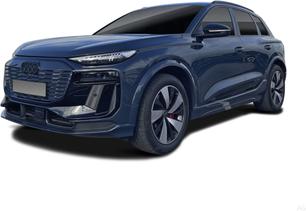
What's the difference?
Here’s a fun fact.
Audi has only ever offered two rear-wheel drive (RWD) production cars in its entire 116-year history… the spectacular R8 supercar and the electrifying e-tron GT.
Now there’s this, the Q4 e-tron – a small-ish medium-sized SUV electric vehicle (EV), and Audi’s overdue response to the BMW iX1 and iX2, Polestar 4, Volvo EX40, Mercedes EQA and, of course, the Tesla Model Y.
Overdue? It’s been in production since March, 2021, making it very, very late to Australia.
But, you know what? You might be very glad the local team waited, because this MY25 update might be the premium medium electric SUV to buy right now.
To find out, read on.
Sharing the same Volkswagen Group PPE platform as its main rival, the Porsche Macan 4S, the newly launched Audi SQ6 e-tron has promised both efficiency and performance.
Is it a combination that can be achieved in real life? My family of three have been testing it out this week to find out for you.
Audi is famous for sticking doggedly to front-wheel drive and quattro AWD, but clearly, when it puts its mind to it, the few RWD machines it has produced over its 116 years have been exceptional.
While not as exciting as the R8 or as supersonic as the e-tron GT, the Q4 e-tron is an impressive machine. Thoroughly engineered and thoughtfully designed to be a friendly, refined, comfortable, safe and capable family SUV, it deserves to be on your shortlist.
With a couple of choice option packages, the base 45 seems remarkably complete, but there’s plenty to enjoy in the hot-shot 55 quattro as well. Either way, Audi seems to be on a winner.
Note: CarsGuide attended this event as a guest of the manufacturer, with travel, accommodation and meals provided.
When it comes to a performance electric SUV, the Audi SQ6 e-tron is a fine example and showcases a masterclass in design. It drives and handles beautifully, even if it’s not as fun as I expected.
The technology looks amazing and I'm sure the little bumps we experienced will be ironed out with a software update.
The SQ6 will suit a smaller family best but the decent driving range and fast charging capabilities means regional families might like it too.
Whether talking about the SUV or Sportback, the Q4 e-tron is an excellent example of Audi’s recent design prowess.
Beautiful proportions, crisp surfaces, exquisite detailing and undeniable elegance are all present in spades. And the Sportback is a rare example of a graceful-looking coupe SUV, though it is not in the otherworldly Polestar 4’s league aesthetically.
However, where is the originality? You’d never know these are rear-motored and predominantly RWD vehicles. Yes, the Single Frame grille execution is amongst the best-yet from the brand, while the wheelarch ‘blisters’ are an (albeit questionable) homage to the seminal Ur-Quattro of the 1980s, but the Q4 e-tron could be any contemporary Audi SUV from the Q3 up. Its design is the opposite of daring.
Still, maybe the Q4 e-tron’s classy, relatable conservatism explains why the Brits made this car their second-best selling EV of 2024, representing everything that the number one Model Y is not.
Plus, with current global automotive interiors stalling behind over-illuminated and oversized screens full of greasy fingerprints, glitchy electronics and reflections of their frustrated operators, a bit of old-school Audi cabin presentation knowhow can only be a good thing, right?
The SQ6 has a distinct look compared to the other mid-size SUVs in Audi’s stable with panelling that lacks some of the severe pleating of its cousins, instead incorporating swoopy lines and a more pronounced moulding around the base of the car.
The sporty S styling is seen in the large 21-inch alloy wheels and red calipers but the customisable light designs inside and out really make this stand out.
The interior is sumptuously styled with Nappa leather and suede upholstery and trims, and sports front seats, while the use of displays in the dashboard makes the SQ6 feel like a spaceship.
However, the main panel curves towards the driver and it still feels accessible and intimate for a cockpit. The cabin looks as expensive as what you’d want it to look like at this price point.
Unlike most of its German competitors (and the Volvo EX40), the Q4 e-tron is built on a dedicated EV platform known as MEB, and shared with other Volkswagen Group models, like the Skoda Enyaq and Volkswagen ID.4.
Consequently, the Audi feels a wee-bit narrow inside, as the MEB SUV family are on the smallish side for medium-sized SUVs. This is not a criticism, just an observation.
And there is no lack of interior space, either. Entry/egress is easy via large doors, there’s plenty of space for heads and shoulders and legroom is generous. All are an upshot of the EV-only platform.
Despite some obvious packaging links with the other VW MEB interiors, the dashboard is very Audi-esque in styling, layout, functionality and quality.
From the ‘Virtual Cockpit’ electronic instruments and crisp multimedia screen, to the feel of the buttons and logical, easy locations of the controls, the Q4 e-tron is completely and utterly on-brand. And that means high standards. Looks posh. Works well. Nice to touch. No bewildering endless screen-menu search and rescue frustration here.
Plus, the Audi is practical. We’ve already talked about ample room, but even the standard, non-sports seats cosseted and supported over a few hours of testing; different and unexpected levels of storage (including a nifty bottle holder ahead of the forward door jam – brilliant); superb ventilation and, especially in the Sportback 55 e-tron quattro sampled, a banging audio system, complete a suave and sophisticated interior experience.
Issues? No too many, really.
There is quite a lot of quality plastic material visible, which might offend some sensitive souls. There is some road-noise intrusion over coarse surfaces, perhaps reminding owners of the Q4 e-tron’s shared architecture; and rear vision in the Sportback is hampered by fat pillars and slim back glass.
However, no spare wheel exists. Nada. Just the occasionally ineffective and always-infernal tyre inflation kit, that renders the tyre and kit useless afterwards and so makes for expensive replacements. And just because almost everybody else does it, this is not good enough for Australia.
The corollary of that is quite generous luggage capacity, with the Sportback’s 535 litres somehow beating the more-upright SUV’s 520L VDA capacity, though with the rear seatbacks folded that switches to 1460L and 1490L respectively. Both are gorgeously lush and quite practically shaped.
And what about the storage compartment up front?
The cabin's primary objective seems to be one of passenger comfort. Everything you touch feels soft under hand and while seat padding is on the firmer side, all but the rear middle seat is comfy on a longer journey because of their extra functions.
The rear-row back rest has two recline positions and the seat beds offer long under-thigh support. The middle seat bulges up, and coupled with the compromised legroom, it won't be a nice seat for an adult.
The front row offers the best legroom and there is enough space in the rear for my six foot three brother to squeeze into (somehow) but I wouldn't want to be in the rear for a longer journey if you're super tall.
Access is good for each row with wide door apertures and seats that aren't positioned too high. There will be no groans getting in and out of the SQ6.
Up front the glovebox and middle console shoulder most of the storage burden but there is a handy flip-down drawer at the driver's knee for a wallet and a centre console with the charging stuff but it is an awkward space that could have been better utilised. Things tend to move around in there if not secured.
In the rear there are a couple of net map pockets, storage bins and a total of four drink holders but that's about it. The other amenities back there soften the lack of storage options as you get directional air vents, climate control, heated outboard seats and a couple of USB-C ports.
The technology on a whole looks amazing and the touchscreen multimedia display is responsive and logically laid out. You'll be able to figure it out quickly and I like that important functions, like climate control, and shortcuts are pinned to the screen as it makes it easier to access them when on the go. The Audi voice assistant can be activated by 'Hey Audi' if you don't want to fiddle with screens on the road.
The wireless Apple CarPlay was simple to set up but at the beginning of the week it did tend to get booted whenever the climate or massage functions were activated. This was annoying as you'd have to reselect CarPlay and jump back into whatever app you were in and when you're using the Map app, it feels disjointed. However, this sorted itself out by the end of my week.
On the whole, all the screens and their functions are user friendly but there were a couple of gremlins that needed a car restart to fix. Randomly, my volume became useless and the touchpad/buttons on the steering wheel stopped working.
I do like a normal button over touchpad controls as I find them more responsive but the touchpad controls on the driver's door were really easy to use and I like the family-friendly option of being able to individually apply the child-lock to the rear doors.
Rounding out the cabin is the large 526L boot which offers a level loading space and the ability to adjust the height via the adaptive S air-suspension from buttons in the rear.
The rear row has a 40/20/40 split, which opens up storage options again and there is a deep under-floor storage pocket that houses the tyre repair kit. A handsfree-powered tailgate comes standard, which I always appreciate and the massive frunk (64L) takes care of all of the cable storage.
The Q4 e-tron is available in two body shapes – a handsome if quite conservative wagon SUV style, as well as a sleeker coupe-SUV derivative that Audi calls Sportback.
The latter is expected to be the slightly more popular of the two designs, despite costing about $1600 more.
Obviously slotting in between the smaller Q3 and larger Q5, the Q4 e-tron almost shadows the latter size wise, and is available in either 45 RWD or 55 quattro all-wheel drive (AWD) guises.
Since both share the same, largish (82kWh) battery, Audi reckons most buyers will choose the 45, especially as its pricing in either body style slips under the Australian Federal Government’s Luxury Car Tax (LCT) threshold.
Kicking off from $84,900 before on-road costs, the base grade includes a full suite of safety tech such as full stop/go adaptive cruise control, an electronic instrument display, heated front seats, three-zone climate control, a gesture-controlled powered tailgate and 19-inch alloy wheels.
These come on top of the LED headlights, an 11.6-inch touchscreen, full wireless multimedia connectivity, a premium audio system, electric driver’s seat adjustment, navigation, folding/heated/kerb-side-view mirrors, roof rails and automatic parking.
From the Sportback 45 and up, the S-Line package is standard, bringing with it 20-inch alloys.
All the essentials then.
But, on the base 45s, be prepared to spend extra for luxuries like bolstered “sports” seats, a head-up display, a powered front passenger seat, driver’s side memory settings, a 360-degree camera instead of the regular rear-only view and privacy glass.
The 55 quattro grades from $105,900 include most of these, along with an extra electric motor for AWD and considerably more muscle, as well as variable-ratio steering, Matrix LED headlights, dynamic indicators, extra lane-assist intervention and the aforementioned S-Line trim shod with 20-inch alloys.
Now, against the remodelled Tesla Model Y Juniper, the Audi costs considerably more, but it is also a more upmarket (and less conspicuous) luxury brand that prioritises quality.
The iX1, iX2, EQA and EX40 cost around the same as the Q4 e-tron, but aren’t quite as large, offer smaller batteries (Volvo-aside), are based on other internal combustion engine (ICE) models compared to the Audi’s ground-up dedicated-EV architecture and, except for the BMWs, are getting somewhat long in the tooth.
Conversely, fresh designs, bespoke electric platforms and bigger batteries set the larger yet less-expensive Polestar 4 as well as the more-compact yet loaded Genesis GV60 apart against the Audi’s aforementioned competitors, but neither challenger brand is as established as all the others. Finally, Lexus’ UX300e is too compact while the larger RZ450e has priced itself out of contention here.
So, why the delay getting the Q4 e-tron to Australia? Especially when the brand has offered the bigger and much-more expensive Q8 e-tron SUV since the beginning of this decade?
Initially, demand in Europe was through the roof and supply could not keep up. Then Audi elected to wait for an update that debuted globally in September 2023, ushering in a raft of changes, to make its most important EV ever more competitive in a wildly shifting market.
These include efficiency gains leading to more range thanks to an upgraded motor and battery, stronger performance, faster charging, retuned steering, comfier suspension and improved safety spec.
Not that you’d be able to spot the differences comparing new Q4 e-tron with old. Nor even against sibling SUVs…
The launch of the flagship SQ6 e-tron brings the Q6 line up to three before a high-performance RS hits our shores sometime in the future. However, this new variant is priced at $151,400 before on-road costs and that's a hike of $28,900 over the mid-spec Q6 e-tron quattro.
Is it worth the jump? Mostly because this model has almost every feature that is found as an at-cost extra or pack for the other variants but it does miss out on a ventilation function for the front seats and at this stage Audi is saying it's not available to add, which is odd for a top model grade.
With the motor outputs and performance tweaks, the SQ6 competes in the world of the Porsche Macan 4S as they are mechanically related but you can pick up the 4S for $149,300 MSRP and the SQ6 can't match it's torque output of 820Nm.
The most exciting thing about the Q6 range in general is the technology and the SQ6 is no different. The dashboard is a visual feast for the eyes with a 14.5-inch multimedia display, an 11.9-inch digital instrument cluster, and a 10.9-inch touchscreen for the front passenger.
There is wired/wireless Apple CarPlay and Android Auto, built-in satellite navigation and because the system is run by Android Automotive there are a whole bunch of downloadable apps like Spotify, YouTube and Amazon Alexa voice assistant on top of the connected Audi App. These apps are accessible from the passenger display, which means they can scroll the news or watch a video on a longer trip.
There is also the upgraded 3D Bang & Olufsen surround sound system, a colour augmented reality head-up display (the screen is basically a dynamic 3D setup) and three-zone climate control.
Charging is taken care of with four USB-C ports (2/2), a 12-volt socket that moonlights as an actual cigarette lighter (complete with an nearby ashtray) and a wireless charging pad with its own 'arm' that secures your phone.
The LED lights at the rear can be customised with different light signatures which are downright cool and the front LED lights also have animated individual pixels that do a little light show when you turn on the car (to the delight of my child).
Other highlights include front sports seats with heat and massage functions, wine-red Nappa leather upholstery and black suede trims, a heated steering wheel, panoramic sunroof, heated rear outboard seats, and a handsfree powered tailgate.
Audi also includes three charging cables and a one-year subscription for Chargefox public charging stations for free, as well as installing an at-home 7kW charger, which is a nice way of making a new owner feel valued.
Unlike the Model Y, there's no storage up front. That space is instead reserved for auxiliaries and, in the 55 quattro versions, the second electric motor that drives the front axle for AWD.
In all versions, a permanently excited synchronous motor sits on the rear axle driving the rear wheels via a single-speed transmission.
Tipping the scales at 2145kg, the 45s produce 210kW of power, to offer a power-to-weight ratio of 98kW per tonne, while the 2235kg 55s’ 250kW output ups that to 112kW/tonne. Both Q4 e-trons deliver a healthy 545Nm of torque.
No slouch, the 45s manage the 0-100km/h sprint in a rapid 6.7s, while the 55 quattro’s extra motor chimes in when extra traction is required, shaving another 1.3s off that, for a 5.4s time. Top speed in both is limited to 180km/h.
Adding a bit more driver involvement, the 55s have variable ratio steering, while MacPherson-style struts up front and a four-link independent rear suspension setup out back help keep everything under control.
The SQ6 is a fully electric all-wheel drive and has two motors, one located on each axle. Together they produce up to 380kW of power and 580Nm of torque, which means this can do a 0-100km/h sprint in just 4.3 seconds when the launch control is activated.
There are three regenerative braking levels and a one-pedal mode which can be selected by sliding the gear-selector into 'B' otherwise the other two modes can be selected via the paddles on the steering wheel. You'll get the best efficiency when B is selected but it does take a beat to get used to and if you time your stops right, it can function as a proper one-pedal action.
Built on a 400V architecture, the Q4 e-tron uses an 82kWh Lithium-ion battery pack, offering a useable capacity of 77kWh. It only charges to 80 per cent full to help preserve battery life.
Now, driving most of the available versions over a 200km launch route from Adelaide airport to wine country, we averaged between 17.5 and 19.5kWh/100km, with the lighter RWDs obviously being the more economical of the drivetrains.
In ascending order, the official combined average figures are 16.9kWh/100km (Sportback 45), 17.4kWh/100km (45 SUV), 17.5kWh/100km (Sportback 55 quattro) and 18.1kWh/100km (55 quattro SUV).
Despite weighing about the same, the Sportback uses around 0.5kWh/100km less electricity than the SUV version, due to better aerodynamics.
That translates to about 15km of extra distance, with the Sportback 45 going the furthest, delivering a WLTP range of 540km. That’s followed by the 45 SUV, Sportback 55 quattro and 55 quattro SUV with 524km, 503km and 488km respectively.
To aid with recharging, the driver has three modes of battery energy recuperation via steering-wheel paddle shifters.
Plugged in at home, the battery needs about 40 hours to completely recharge, or over 12 hours using an optional 7kWh Wallbox. Maximum AC charging capacity is 11kW.
With a maximum of between 135kW (RWD) and 175kW (AWD) of DC charging capacity, however, 10-80 per cent charge using a 50kW DC public charger needs fewer than 70 minutes, or just 40 minutes if you find a 100kW station.
The SQ6 has a lithium-ion battery with a large 100kW capacity and can accept up to 270kW on DC power, which is excellent. There are two Type 2 charging ports (on either side of the car) and one has a CCS enhancement which means you can charge this from 10 to 80 per cent capacity in as little as 21 minutes on a 270kW ultra-rapid DC charger.
It is more common to see a 50kW DC charger though and that charge time sits closer to an hour and 20 minutes.
On a home 7.4kW charger, you'll get the same percentage after 15 hours, perfect for an overnight recharge.
With a claimed WLTP driving range of up to 568km and energy consumption between 17.5 and 18.6kWh/100km, the daily commute and odd family road trip is more than covered with this model.
My average consumption popped out at 18.1kWh based on the trip computer and that’s a good result for how hard I’ve pushed it over country roads, in the city and on the highway.
Audi might be late to the affordable electric SUV party, but it’s certainly been worth the wait from behind the wheel, because the Q4 e-tron drives exactly how you would expect an Audi to.
The 45 in either body shape has ample oomph, as its impressive 6.7s 0-100km/h times prove, providing a decent amount of instant speed the moment you put your foot down. This is a smooth, strong and muscular performer.
The steering is nicely modulated and precise, for easy, flowing handling, even when the speed is taken up a few notches. Note that while it may seem a little light, it can be configured for a more dynamic feel.
However, slightly stronger single pedal braking would be appreciated. The Audi EV’s brakes do a great job stopping the car, but they do feel a bit on/off at first. Maybe even a bit wooden.
All the Q4 e-trons we drove on the launch around the Adelaide hills rode on steel springs. That said, and to our surprise, the suspension is more than comfortable enough, soaking up many of the bumps we encountered without breaking a sweat.
Plus, except on coarse bitumen, there's not much of any type of noise coming through inside the cabin. These are agreeably comfortable and refined cruisers.
Meanwhile, the 55 quattro version is a slightly different proposition, with measurably stronger acceleration across the board and more eager throttle response. Actually, even on bone-dry roads at the height of summer, there’s almost too much torque coursing through the axles, so just be wary of this EV’s considerable power.
Still, the twin-motor Audi feels like a relaxed yet brawny grand touring SUV, with plenty in reserve for fast overtaking and quick getaways. Even the RWD model provides exceptional roadholding and control, but that extra AWD grip when things become a bit slippery would certainly be a bonus.
Plus, kudos to the Germans for delivering user-friendly driver assist safety systems. Nuanced and largely unobtrusive, they keep you safe without driving you to distraction. China and Polestar in particular, are you listening?
On the flip side, you do feel the extra weight of the second electric motor (about 100kg more), and so it doesn't quite have the agility and alacrity of the standard 45 RWD machine.
Indeed, there isn’t quite the athleticism or connection of driver-focused alternatives (like BMW), but the Q4 e-tron rarely puts a foot wrong, either.
Impressively capable and dynamic, Audi’s more-affordable electric SUV has been worth the wait.
Outside of the initial acceleration thrill, I have to say that the SQ6 sort of drives like a lot of the other Audi SUVs I’ve sampled. Which is fine because it’s dynamic and handles beautifully on the highway or city but it’s just not as fun as what I was hoping it would be. The power will satisfy everyone though.
The different driving profiles and adaptive S air suspension really personalises the on-road experience when you want it and my favourite profile is Dynamic as the suspension and steering feels more performance focused, which I prefer.
Ride comfort is up there with the best and you won’t really be bothered by the bumps in the road, even with the stiffer suspension, but road noise does creep in at higher speeds.
The visibility all round is good despite thicker pillars but the rear visibility is narrow even before a car seat or passengers are back there. A digital rearview mirror would have been handy here.
Just something interesting to note is that when you accelerate from a full stop, there can be a small lurch as if it’s rolled backwards or the brakes have held a tad too long. It’s so quick when it happens that it’s not annoying but it is noticeable in stop/start traffic.
The SQ6 is really simple to park and navigating small car parks feels like a dream. The dimensions are forgiving and the 360-degree camera system is top notch.
Tested back in 2021, the Q4 e-tron managed a five-star ANCAP crash-test rating, and possesses most of the driver-assist safety systems expected nowadays in this class of car.
This includes Autonomous Emergency Braking (AEB, dubbed Audi Pre-Sense in corporate-speak), lane departure warning/assist, rear cross-traffic alert, blind-spot warning, on-coming traffic turn-and-swerve collision avoidance, exiting-vehicle alert tech, adaptive cruise control (with active lane assist in the 55s), driver attention monitor, tyre pressure indicators, 360-degree cameras, and light and rain sensors.
AEB operating parameters vary. Car to car, it’s between 5km/h and 250km/h. For pedestrian/cyclist/back-over, it’s from 5km/h to 85km/h. And the lane support systems work between 60km/h and 250km/h.
All outboard occupants also enjoy full airbag coverage – front, front side/centre, and full-length curtain airbags.
A trio of child-seat anchorage points are fitted across the back seat, along with ISOFIX child-seat anchorages in the front passenger seat and two in the rear outboard positions.
The SQ6 is covered by a maximum five-star ANCAP safety rating from testing done in 2024, and features nine airbags which includes side chest airbags for the second row but it’s more common to see those just on the first row so it's nice to see on a family car.
There’s a host of safety equipment included but standouts are the emergency call capability, and safe exit assist which will delay your door from opening if it detects a car or cyclist which is a handy feature if you have a kid that throws open their door like mine.
Other equipment includes driver attention warning and alert, blind-spot monitoring, tyre-pressure monitoring, intelligent seatbelt warning, adaptive cruise control with stop/go function, lane departure warning, lane keeping assist, emergency lane keeping, park assist, front/rear parking sensors, 360-degree camera system, rear cross-traffic alert, and traffic sign recognition.
There is auto emergency braking (AEB) with forward collision warning, car, pedestrian, cyclist and junction turning assist which is operational from to five to 250km/h.
There are ISOFIX child seat mounts on the rear outboard seats and three top-tether anchor points but two seats will fit best. Front passenger space might get cosy when a rearward facing child seat is installed but I had no issue fitting my big booster seat this week.
Audi’s warranty remains the same as before, at five years with unlimited kilometres, with the battery covered for eight years or 160,000km. Six years of roadside assistance is also included.
Service intervals are every two years or 30,000km. Nothing special here nowadays.
But the Q4 e-tron owner can buy a six-year service plan for a total of $2050, while gaining 12 months of free electricity at Chargefox stations. They can also purchase a JET Charge home installation charger from $800.
The SQ6 is covered by Audi’s five-year/unlimited kilometre warranty and the battery is covered by an eight-year or up to 160,000km warranty, which are all standard terms for the class.
Audi also offers six years of complimentary roadside assistance and a servicing program for six years that costs $2080, which is competitive, and servicing intervals are at every two years or 30,000km.
Audi includes the installation of a 7.4kW AC home charger, three charging cables and a one-year Chargefox public charging subscription with this model.