What's the difference?
The Subaru Outback has a lot to answer for. Way back in 1994 the Japanese brand created the high-riding wagon scene - and while the idea never really took off with most mainstream makers, European luxury brands seemingly loved the idea of a rugged estate. It’s another niche to fill, after all.
This led to the Volvo V70 Cross Country in 1997, and Audi followed suit with the A6-based Allroad quattro back in 1999.
Other luxury brands have entered the fray since then, and obviously the market has proliferated with SUVs… but they’re not the same as a high-riding station wagon.
There has been evolution in the Audi Allroad line-up over time: in 2015 the company added the smaller A4 Allroad, while the original larger A6-based Allroad wagon continues to cop the rough-and-tumble treatment, as it has for decades now.
So, since the all-new Audi A6 Allroad has just arrived in Australia, we thought we’d see what it’s like. And perhaps more pertinently, maybe we’ll be able to answer the question that many of you probably have: Should you buy a high-riding wagon? Or is it smarter to just buy an SUV?
If Holden had a dollar for every time someone had criticised the new and international flavour of Australia’s formerly home-grown hero, it would surely have more than enough spare cash to blow the dust of that vast South Australian factory and restart local Commodore production immediately.
Hell, there’d probably be enough left over to relaunch the Camira while they were at it. And maybe even knock out a new Gemini or two.
So we’re not going to do that again here. The all-new Commodore, in this case the Calais Tourer, is now here - granted having travelled further than the one it replaces - and so we’ll be playing this review with the straightest of bats.
Because the truth is, if you peel the badging - and thus the swirling emotion - off its elongated rump, then you’ll find this German-built Tourer is, really and truly, a very good thing.
I was thoroughly impressed by the Audi A6 Allroad 45 TDI quattro 2020 model. It is excellent on road, resolved and comfortable on unsealed surfaces, and very well packaged for family touring.
I’d personally have it in a heartbeat over a Q7 or any SUV, for that matter. I can understand why some buyers wouldn’t consider it, but if you’re someone who likes to think outside of the boxy SUV, then be sure to take a look at the Audi A6 Allroad.
A best-of-both-worlds option that should have us questioning our SUV obsession, the Calais Tourer delivers plenty of practicality perks and a higher ride height in a dynamic and car-like package. The equipment levels are spot on, including the comprehensive safety package, and it you act smartly, you'll get a hugely long warranty to boot.
It sure is thirsty, though, and we can't help but think plenty of owners would be happier with a smaller, more-efficient engine.
If this isn’t the best looking genre of car, I must have been blindfolded since birth. You might think differently - be sure to let me know in the comments section below.
But for me, I just love the idea of a station wagon that is beefed up with SUV styling cues, and the Audi Allroad formula has been en pointe for generations now. This latest A6 Allroad doesn’t disappoint, either, with all the elements you’d expect.
Things like the bulging contrasting wheel-arch liners, the rugged underbody protection bash plates, and even the silver roof rails and silver metallic side sill protectors with ‘quattro’ emblazoned upon them - it just all works.
And being an Audi A6 wagon underneath the glittery bits, it’s a sizeable vehicle. The dimensions read like so: length - 4951mm; wheelbase - 2925mm; width - 1902mm; height - 1458mm, though that depends on the height of the air suspension.
The A6 Allroad sits about 45 millimetres higher than the standard A6 Avant wagon (not sold in Australia). And the ground clearance also varies depending on the air suspension height setting, but it is officially recorded at 139mm - which isn’t very high at all, but that’s for the regular driving setup. In its raised height, that jumps by 45mm to 184mm. Nowhere near an off-road Toyota, but still high enough to stop the belly from scraping.
And there are other hardware bits to help you out if the going gets tough - out of sight is Audi’s ‘quattro’ all-wheel drive system with a self-locking centre differential that the brand says provides “superior traction and its high level of safety and agile handling”. There is hill descent control, and the infotainment screen can display the location, elevation, compass and driving angles, too.
As for the design of the interior? It’s high-tech Audi opulence and comfort at its best. Check out the interior pictures to see what I mean.
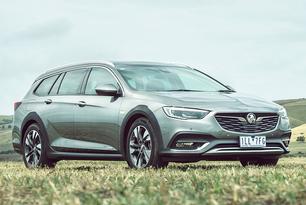
Less an SUV (happily), and more a high-riding wagon, the Calais Tourer borrows a little from the Subaru XV in its exterior design, sporting the same plastic cladding over each wheel arch. Clearly there is a whole heap of shared DNA between the Sportwagon and Tourer, and so it offers similar perks; like its SUV-shaming boot space.
Elsewhere, the Tourer shares the same soft and rounded edges as the rest of the Commodore range, and while it is genuinely quite handsome from most angles, it is at its best viewed front on, where a simple front-end is bookmarked at each corner by a narrow headlight on top, and an encased fog light below. It’s all a touch understated, sure, but it looks sharp in the metal.
Inside, it’s a clean and functional cabin design, with most of the touchscreen functions controlled by a simple row of four horizontal buttons, and with a gloss-black surround encasing the centre console. The thin leather wheel feels lovely under the touch, and the contrasting door trims and soft-touch materials find their way into the backseat, too.
Technical. Practical. Glorious. Three words I’d use to describe the cabin of the Audi A6 Allroad.
The cockpit isn’t anything out of the ordinary for an Audi of the modern era, and as such it will feel familiar to you if you’ve been in or around any of its more recent stablemates. It also means that you’ll find yourself in a high-end, high-tech and highly pleasant interior. The materials used are beautiful and of a high standard. They look very nice and it is an extremely pleasant place to be. And you can hate on me if you want, but I’m sold on brown leather. Yummo!
It will take some time for you to get to grips with the dual-touchscreen layout of the cabin, but once you get the hang of it, it becomes second nature.
The media screen is very easy to use, the menus are simple to learn, and over my week there were absolutely no issues with Apple CarPlay - either when connected via USB, or when used wirelessly.
The second screen below controls a lot of the main functions of the air conditioning system, and while I’m not a huge fan of using a screen to touch through temperature and fan controls, this one has haptic feedback and is well positioned - it’s not as much of a glance away from the road as in, say, a Land Rover or Range Rover. There’s also a volume knob which is good, and quick buttons for Drive Select and demister for front and rear windscreens.
In terms of the practicalities, there are bottle holders in the doors, a pair of cup holders between the front seats, a covered centre console bin with Qi wireless phone charging (remember not to leave your phone in there!) and there are two USB ports in there, plus a SIM card slot and SD card slot as well.
The seat comfort is very good - there’s electric adjustment on both seats with lumbar adjustment, and the driver’s seat gets memory settings as well. The electric steering wheel adjust is a nice touch as well, and there’s a remote boot release trigger, too.
There are twin sunroofs, and the front one can tilt and slide while the rear one is fixed. It helps lighten things up a bit if you have the optional dark headlining, which I personally wouldn’t choose.
Rear seat space is excellent. Sitting behind my own 182cm driver’s seat position, I had easily enough legroom, headroom and shoulder room - in fact, the rear pew is so accommodating, it could easily fit three of me across - but foot space is a little tight due to the large transmission tunnel.
Those in the back are well catered for – there are 2x USB ports, a pair of large door pockets with bottle holders, twin mesh map pockets, a flip down armrest with storage and cupholders, and our car had quad zone climate control (as part of the optional Premium Plus package - standard is three-zone climate), plus there are centrally mounted directional air vents and in the door pillars at face height. Our tester also had those optional manual sunblinds, which would certainly help those in the back get some shut-eye on longer trips.
The centre section of the rear seat can be split folded down on its own as well – so you have 40:20:40 rear seat folding, which is great for skis or snowboards. Plus there are two ISOFIX child seat attachments and three top-tether points available for baby seats. And one of the most excellent additions to any car ever – illuminated seat belt buckle receivers. It just makes it that much easier to see at night.
If you need to fold down those rear seats, there are boot-mounted triggers. That’ll help expand the luggage capacity from the standard 565 litres (VDA) to an expansive 1680L (VDA). The cargo hold easily fit the three CarsGuide suitcases (124L, 95L and 36L) with room to spare.
There is no Audi Allroad seven seater, though. And that’s potentially where something like a Q7 makes more sense, depending on your intent.
The Tourer serves up identical storage space to its Sportwagon near-enough twin, with 793 litres of storage (to the roof line) with the rear seats in place, and 1665 litres with the rear seat folded down. That’s about 200 litres more than the regular Commodore hatchback.
Where the Tourer does differ from the Sportwagon is in its exterior dimensions, measuring 5004mm in length (versus 4986mm in the Sportwagon) and 1525mm in height (versus 1483mm). Width and wheelbase are identical, though (1871mm and 2829mm), and so the interior space dimensions - like headroom and legroom - are identical no matter which of the estate-style Commodores you opt for.
The key dimension here, though, is ride height, with the Tourer offering 20mm more ground clearance (42mm greater height overall) than the Sportwagon. That, combined with the on-demand all-wheel-drive system, allows for some light off-roading - though you won’t be conquering Everest.
Up front, expect two cupholders hidden under a gloss-black cover, as well as power and USB connections located in a central cubby. The back seat is home to two extra cupholders hidden in a pulldown divider, and there is room in each of the doors for bottles. The back seat is also home to air vents (but no temperature controls) and two USB charge points located just below the vents.
Before we consider what else you could buy, let’s consider what the situation is for the A6 Allroad.
It comes as just one variant in Australia, the 45 TDI, which is priced from $109,500 plus on-road costs (MSRP/RRP). It might not seem affordable, but Audi Australia claims there’s an additional $15,000 of extra value over the previous version of the A6 Allroad, which listed at $114,700.
So what gear do you get for your money?
The standard equipment list is extensive, and includes adaptive air suspension, Matrix LED headlights, 20-inch Audi Sport alloy wheels, LED puddle lights, a hands-free power-operated tailgate and dynamic LED tail-lights.
Inside, you get dual touchscreens (10.1-inch for media and 8.6-inch for climate and car controls), satellite navigation with Audi Connect online data, Android Auto and wireless Apple CarPlay support, a 12.3-inch digital instrument cluster, a head-up display, wireless smartphone charger, four USB ports, three-zone climate control, front sports seats with heating, extended Valcona leather upholstery and stainless-steel pedals feature.
As you may expect of a luxury family-focused car there’s a raft of advanced safety tech fitted as standard, too - read the safety section below for more detail.
Our particular test vehicle had metallic paint (Gavial Green metallic, which looks amazing but costs as much as painting an apartment, at $2200), and the interior was treated to manual rear sunblinds ($450) and black cloth headlining ($750).
The car also had the $8900 Premium Plus package, with HD Matrix LED headlights, 21-inch alloy wheels, rear privacy glass, a Bang & Olufsen 3D sound system, dual sunroof (front opening, rear glass roof), four-zone climate control and LED ambient lighting. Lovely. But expensive.
If you’re wondering about colours, only Brilliant Black is a no cost option. The optional metallic paint finishes are: Glacier White, Floret Silver, Vesuvius Grey, Mythos Black, Gavial Green (seen here), Firmament Blue, Diamond Beige, Seville Red, Soho Brown, Typhoon Grey and Avalon Green. All the metallic options add $2200 to the price.
Rivals for this type of high-riding wagon include the attractive and attractively priced Volvo V90 Cross Country (from $80,990), the Mercedes-Benz E-Class All-Terrain ($115,500) or, ahem, the Subaru Outback (from $37,440).
Thinking outside the box-y wagon, you could consider the slightly smaller Audi Q5 (from $66,900) or the seven-seat Audi Q7 (from $101,900). And I can totally understand why the latter is a better choice for many buyers out there. But it’s just not a wagon, right?
The Calais has long formed the most luxurious rung of the Commodore ladder, and the wagon-ish Tourer is without doubt the most practical version. It will set you back $45,990 ($47,990 drive-away) in the guise we’ve tested here, and $53,990 In Calais V specification.
Not to be sneezed at, then. But it does arrive with plenty of stuff to help justify your investment.
Outside, you’ll find 18-inch alloys, a handsfree auto-opening boot, heated mirrors, keyless entry with push-button start, a remote start function, rain-sensing wipers and automatic headlights with LED DRLs. Inside, expect leather seats that are heated in the front, a leather-wrapped wheel, dual-zone climate control, standard satellite navigation and a wireless charging pad for compatible phones.
On the technology front, an 8.0-inch touchscreen pairs with an eight-speaker stereo, and it’s both Apple CarPlay and Android Auto equipped. There’s also a genuinely impressive standard safety package, too, but we’ll drill down on that under the Safety sub-heading.
Under the bonnet of the Audi A6 Allroad is what Audi labels the ‘45 TDI’ - a 3.0-litre turbo-diesel V6 engine that produces 183kW of power (from 2750-4500rpm) and 600Nm of torque (from 1500-3000rpm).
The engine is only available mated to an eight-speed torque-converter automatic transmission and Audi’s renowned ‘quattro’ all-wheel-drive (AWD) system.
Audi claims this 1980kg wagon can run from 0-100km/h in just 6.5 seconds, on its way to a top speed of 250km/h. It is a hummer of an engine - more on that in the driving section below.
Towing capacity is pegged at 750kg for an unbraked trailer, and maxes out at 2500kg for a braked trailer.
Should Aussies feel short changed when it comes to the engine options here? Arguably, yes - and that’s despite the powertrain offered here still being a stormer.
There’s only one spec available Down Under, and even it doesn’t get the most up-to-date emissions tech. There isn’t AdBlue urea treatment (meaning this is a Euro 5 engine), and our cars have essentially been de-specced to miss out on the latest 48-volt mild-hybrid tech, which is standard on all grades of the A6 Allroad in Europe. Maybe that is part of the reason the cost is down, this time around.
And while the outputs of the 45 TDI in Australia are pretty decent, other markets have the A6 Allroad offered in 50 TDI (210kW/620Nm) and 55 TDI (257kW/700Nm) trims. Remember, though - this is a very niche player here.
A really rather good 3.6-litre V6 engine Is parked under the bonnet, feeding 235kW at 6800rpm and 381Nm at 5200rpm to all four wheels as required, thanks to an on-demand all-wheel-drive system. The suspension is tuned specifically for its high-riding antics, too.
The grunt is fed through a nine-speed automatic, and while Holden doesn’t quote a specific zero-to-100km/h time, it’s no slouch from the lights.
The 3.6-litre engine means a braked towing capacity of 2100kg, and an unbraked max of 750kg.
Audi claims the 45 TDI powertrain in the A6 Allroad will use 6.6 litres per 100 kilometres. That’s the official Australia fuel consumption figure on the combined-cycle test. CO2 emissions are claimed at 174g/km.
During my time in the Audi A6 Allroad I saw an average fuel use return of 7.4L/100km - which was taken over highways, back roads, unsealed roads and twisty bits. There was even some urban stop-start in there, too. I think that’s pretty darn good for a car of this size.
Fuel tank capacity is 63 litres, meaning a real-world range of 851km based on my fuel consumption.
As mentioned above, the A6 Allroad is a mild hybrid model in other markets, but not in Australia. We don’t even get the Euro 6-compliant version here, as there’s no incentive for it to be offered locally - as in, there’s not even AdBlue treatment.
There’s no electric version (though you might want to look at the all-new Audi e-tron) or plug in hybrid, and no petrol model either.
Not so good, I’m afraid. The offical number is on the high-side at 9.1 litres per 100 kilometres on the claimed/combined cycle (though that's less than the equivalent Subaru Outback), but we were averaging a smidge under 14.0L/100km after what was admittedly quite a lot of city driving. Still, that’s high.
Emissions are pegged at 212g/km or C02, and the Tourer’s 61-litre tank will accept cheaper 91RON fuel, or an E10 blend.
Here’s where the A6 Allroad separates itself from, say, an Audi Q5 or Q7. It’s a low-slung wagon, made for touring on country roads, doubling down on dirt backtracks and cruising comfortably on the freeway.
It’s not as upright as a Q5 or Q7, and that means it has a lower centre of gravity - so it feels more hunkered down, more settled into the surface below.
And in the case of the A6 Allroad, there’s adaptive air suspension all around to cushion the car from what lies beneath. For the most part, that air suspension is superb - it absorbs big bumps and lumps very well, though the oversized 21-inch optional wheels can’t disguise sharp edges from those in the cabin.
The general compliance is very good, and as I found out first hand, you can easily soak up hundreds of kilometres without feeling the affects of the road underneath you - even over bumpy country back roads and lumpy dirt sections.
The steering could be better; it’s a little bit vague and heavy on centre at higher pace, but at lower speeds it is light and amicable. Very easy to park despite its size, and easy to manoeuvre around town, too.
The engine builds pace with superb linearity, and it’s very quiet and refined as well. There is a tiny bit of turbo lag at lower speeds or from a standstill – but it is completely manageable and never feels like it’s sluggish at all. The 0-100km/h claim of 6.5 seconds seems achievable, too.
The eight-speed automatic transmission was mostly very smart and well sorted - although in other VAG models with this engine family/eight-speed auto, the transmission never felt quite as busy at higher speeds. I noticed it shuffling between seventh and eighth gears more than I was expecting, given how much torque the engine has. It’s not annoying at all, and nor is it unrefined, and could well have something to do with attempting to save fuel rather than leaving it in top gear.
During night driving, the optional HD Matrix LED headlights were exceptional - among the best headlight technology that I’ve ever encountered. The ‘matrix’ technology means they can blank out oncoming traffic or cars in front of you while keeping the high-beam on in other areas. The auto headlights with auto high beam worked very well, too.
The plan was never to do a serious off road review, but I did do some driving on unsealed roads and found the Allroad to be excellent.
Through slippery unsealed corners it exhibited excellent traction, though you can feel the weight of the car shifting from side to side when you pivot through corners. There was a touch of skittishness over mid-corner bumps, but again that could be more to do with the big wheels than anything else.
I came away thinking that if you had your eyes closed, you wouldn’t even know that you were on dirt or gravel. It really is an exceptional car across sealed and unsealed roads.
Really very good. That 3.6-litre engine (why they haven’t offered the Tourer with the smaller and smarter turbo engine is something of a mystery) might be a touch old-school and a touch thirsty, but it’s a rich and powerful thing, and it gives the Calais-stamped Tourer a perky personality that defies its dimensions.
The Calais Tourer was built in Germany, and fitted with an engine and transmission from the USA, before undergoing local tuning here in Australia (think bespoke steering and suspension tunes calibrated both at the company’s testing facility and after a 200,000km test on Aussie roads), and it’s the last of those Dr Frankenstein ingredients that have had the biggest impact here.
The Tourer’s ride is fantastic, perfectly poised between firm composure and everyday comfort, and - like most good wagons - it will honestly leave you wondering why so many people are clamouring aboard the SUV train when you can all the space with better dynamics in a humble estate.
The nine-speed ‘box is smooth and sharp in its operation, too. But the fuel use is a concern. Sure, we spent the bulk of our time in the city, where stop-start traffic naturally uses more fuel. But then, surely so would most owners?
The Audi A6 was awarded a five-star ANCAP crash test rating in 2018 testing, and according to the documentation on the ANCAP site, the rating applies to all variants from August 2019 in Australia - though strangely, the 45 TDI Allroad is missing from the list of variants.
Even so, the A6 Allroad is loaded with advanced driver-assist systems, including autonomous emergency braking (AEB) that works from 10km/h to 250km/h, and also incorporates pedestrian and cyclist detection which is operational from 10km/h to 85km/h.
There is also lane keeping assistance and Active Lane Departure Warning that can steer you back into your lane (between 65km/h and 250km/h). Further, there's blind-spot monitoring, rear cross-traffic alert with rear AEB, and adaptive cruise control with stop and go functionality - which happens to be the best example of the breed that this tester has yet sampled.
There are other safety helpers like Turn Assist and Intersection Crossing Assist, both of which monitor oncoming and surrounding traffic and can warn you of potential danger, plus Audi’s Exit Warning System that can warn occupants of oncoming cars and cyclists and delay door opening.
It is fitted with a configurable surround-view camera (360-degree camera with 3D animation), front and rear parking sensors, semi-autonomous self parking, driver fatigue monitoring, and there are eight airbags fitted (dual front, front side, rear side, full-length curtain).
You’ve got to hand it to the Lion for the standard safety package here, which includes the Holden Eye camera system as standard, adding auto emergency braking (AEB), lane keep assist, lane departure warning and forward collision warning. You’ll also find semi-autonomous parking, a reversing camera and rear parking sensors.
The Calais Tourer adds blind-sport monitoring and rear cross-traffic alert to that pretty comprehensive package. All of which helps the Commodore range qualify for the maximum five-star ANCAP safety rating.
Finally, you can add six airbags and two ISOFIX attachment points to the mix.
Audi offers a three-year/unlimited kilometre warranty, which is as good as BMW, but not as good as Lexus (four years/100,000km) or Mercedes-Benz, Volvo and Genesis (five years/unlimited kilometres). It’s falling behind in the luxury sphere.
The company offers reasonably priced capped price ownership plans for maintenance. Purchasers can roll in the cost of either a three-year service plan ($2170) or a five-year plan ($3300). That covers off the usual service items due every 12 months/15,000km.
Roadside assist is included for the period of the new car warranty.
Holden has recently relinquished the initial warranty offering, now including the Commodore in its seven-year, unlimited-kilometre warranty program, meaning it mixes with the very best in the aftercare business. For now, at least; normally, the Commodore carries the brand's standard three year/100,000km warranty. But be on the lookout for the return of this deal if you miss out this time.
Service intervals are pegged at 12 months or 12,000kms, and the Commodore falls under Holden’s extensive capped-price servicing program, and it will cost between $259 and $359 for each of the first seven annual services.