What's the difference?
The Subaru Outback has a lot to answer for. Way back in 1994 the Japanese brand created the high-riding wagon scene - and while the idea never really took off with most mainstream makers, European luxury brands seemingly loved the idea of a rugged estate. It’s another niche to fill, after all.
This led to the Volvo V70 Cross Country in 1997, and Audi followed suit with the A6-based Allroad quattro back in 1999.
Other luxury brands have entered the fray since then, and obviously the market has proliferated with SUVs… but they’re not the same as a high-riding station wagon.
There has been evolution in the Audi Allroad line-up over time: in 2015 the company added the smaller A4 Allroad, while the original larger A6-based Allroad wagon continues to cop the rough-and-tumble treatment, as it has for decades now.
So, since the all-new Audi A6 Allroad has just arrived in Australia, we thought we’d see what it’s like. And perhaps more pertinently, maybe we’ll be able to answer the question that many of you probably have: Should you buy a high-riding wagon? Or is it smarter to just buy an SUV?
Mercedes has long been the leader in niche filling, and we’d argue that no other model encapsulates that more than the CLA four-door coupe.
Now in its second-generation form, the CLA is based on Mercedes’ MFA2 small car platform that also underpins the A-Class small car range, B-Class tallboy hatchback and GLA crossover, but is actually dimensionally longer than the one-size up C-Class.
However, while the C-Class might offer more conventional styling, Mercedes says the CLA is targeted towards a younger demographic that puts more weight on design and aesthetics.
The previous generation CLA was topped by a hardcore 45 version, which makes a return here, but new this time around is the less-potent, but still AMG-badged, 35 variant to plug the gap between mainstream grades and the range-topper.
After living with the car for a week, here are our thoughts on the new baby AMG CLA.
I was thoroughly impressed by the Audi A6 Allroad 45 TDI quattro 2020 model. It is excellent on road, resolved and comfortable on unsealed surfaces, and very well packaged for family touring.
I’d personally have it in a heartbeat over a Q7 or any SUV, for that matter. I can understand why some buyers wouldn’t consider it, but if you’re someone who likes to think outside of the boxy SUV, then be sure to take a look at the Audi A6 Allroad.
Is the Mercedes-AMG CLA 35 the perfect choice in the sleek sedan’s line-up?
Well, if you are after outright performance, then the answer still clearly lies with the CLA 45. But for those that just want a little more pep compared to the standard CLA range, the 35 is undoubtedly the one to get.
It’s not without its flaws, though, commanding a $15,000 price premium over the CLA 250 and a tougher-than-we’d-like ride, but if you value a more engaging drive and a brisk 0-100km/h time, the CLA 35 should definitely be on your shopping list.
If this isn’t the best looking genre of car, I must have been blindfolded since birth. You might think differently - be sure to let me know in the comments section below.
But for me, I just love the idea of a station wagon that is beefed up with SUV styling cues, and the Audi Allroad formula has been en pointe for generations now. This latest A6 Allroad doesn’t disappoint, either, with all the elements you’d expect.
Things like the bulging contrasting wheel-arch liners, the rugged underbody protection bash plates, and even the silver roof rails and silver metallic side sill protectors with ‘quattro’ emblazoned upon them - it just all works.
And being an Audi A6 wagon underneath the glittery bits, it’s a sizeable vehicle. The dimensions read like so: length - 4951mm; wheelbase - 2925mm; width - 1902mm; height - 1458mm, though that depends on the height of the air suspension.
The A6 Allroad sits about 45 millimetres higher than the standard A6 Avant wagon (not sold in Australia). And the ground clearance also varies depending on the air suspension height setting, but it is officially recorded at 139mm - which isn’t very high at all, but that’s for the regular driving setup. In its raised height, that jumps by 45mm to 184mm. Nowhere near an off-road Toyota, but still high enough to stop the belly from scraping.
And there are other hardware bits to help you out if the going gets tough - out of sight is Audi’s ‘quattro’ all-wheel drive system with a self-locking centre differential that the brand says provides “superior traction and its high level of safety and agile handling”. There is hill descent control, and the infotainment screen can display the location, elevation, compass and driving angles, too.
As for the design of the interior? It’s high-tech Audi opulence and comfort at its best. Check out the interior pictures to see what I mean.
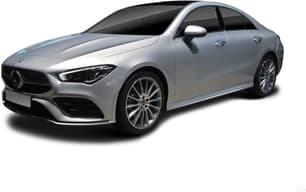
From the front, the CLA 35 exterior oozes style and luxury.
Up front, the sleek and slender headlights emphasise the width of the fascia, while the large Mercedes logo sits proudly front and centre of the CLA’s nose.
There are subtle hints to the CLA 35’s sportiness too, with a slightly bulging bonnet and chiselled lower chin.
The grille is also unique on the 35, with a dual-horizontal slat design instead of the non-AMG CLA’s diamond pattern or the CLA 45’s Panamericana grille.
To my eye, the front of the CLA 35 is actually a bit too tame in styling for an AMG model. I prefer the in-your-face aggression of the CLA 45’s widened track and front grille, while the CLA 35 opts for more subtle styling cues. To each their own, though.
The silver paintwork of our test car probably doesn’t help, and if it was my choice I'd pick 'Sun Yellow' or 'Denim Blue' to stand out a bit more from the sea of black, grey and white German cars out there.
Move to the rear of the car though, and a large rear diffuser, big dual-exhaust outlets and a bootlid spoiler are much more befitting an AMG model.
Step inside the CLA and you will see it adopts the same dashboard design as all new-generation Mercedes vehicles built on the MFA2 platform, with the 'MBUX' dual-screen layout, large air-vents and central touchpad.
Our car was specced out with red-leather interior, which is a bit too loud for my tastes, but a two-tone black leather/titanium grey combo can also be had at no extra cost.
Sitting inside the CLA 35, you can tell it’s a modern car thanks to the clean layout of all the controls, while the screen-heavy dashboard definitely makes it feel tech-focused.
Technical. Practical. Glorious. Three words I’d use to describe the cabin of the Audi A6 Allroad.
The cockpit isn’t anything out of the ordinary for an Audi of the modern era, and as such it will feel familiar to you if you’ve been in or around any of its more recent stablemates. It also means that you’ll find yourself in a high-end, high-tech and highly pleasant interior. The materials used are beautiful and of a high standard. They look very nice and it is an extremely pleasant place to be. And you can hate on me if you want, but I’m sold on brown leather. Yummo!
It will take some time for you to get to grips with the dual-touchscreen layout of the cabin, but once you get the hang of it, it becomes second nature.
The media screen is very easy to use, the menus are simple to learn, and over my week there were absolutely no issues with Apple CarPlay - either when connected via USB, or when used wirelessly.
The second screen below controls a lot of the main functions of the air conditioning system, and while I’m not a huge fan of using a screen to touch through temperature and fan controls, this one has haptic feedback and is well positioned - it’s not as much of a glance away from the road as in, say, a Land Rover or Range Rover. There’s also a volume knob which is good, and quick buttons for Drive Select and demister for front and rear windscreens.
In terms of the practicalities, there are bottle holders in the doors, a pair of cup holders between the front seats, a covered centre console bin with Qi wireless phone charging (remember not to leave your phone in there!) and there are two USB ports in there, plus a SIM card slot and SD card slot as well.
The seat comfort is very good - there’s electric adjustment on both seats with lumbar adjustment, and the driver’s seat gets memory settings as well. The electric steering wheel adjust is a nice touch as well, and there’s a remote boot release trigger, too.
There are twin sunroofs, and the front one can tilt and slide while the rear one is fixed. It helps lighten things up a bit if you have the optional dark headlining, which I personally wouldn’t choose.
Rear seat space is excellent. Sitting behind my own 182cm driver’s seat position, I had easily enough legroom, headroom and shoulder room - in fact, the rear pew is so accommodating, it could easily fit three of me across - but foot space is a little tight due to the large transmission tunnel.
Those in the back are well catered for – there are 2x USB ports, a pair of large door pockets with bottle holders, twin mesh map pockets, a flip down armrest with storage and cupholders, and our car had quad zone climate control (as part of the optional Premium Plus package - standard is three-zone climate), plus there are centrally mounted directional air vents and in the door pillars at face height. Our tester also had those optional manual sunblinds, which would certainly help those in the back get some shut-eye on longer trips.
The centre section of the rear seat can be split folded down on its own as well – so you have 40:20:40 rear seat folding, which is great for skis or snowboards. Plus there are two ISOFIX child seat attachments and three top-tether points available for baby seats. And one of the most excellent additions to any car ever – illuminated seat belt buckle receivers. It just makes it that much easier to see at night.
If you need to fold down those rear seats, there are boot-mounted triggers. That’ll help expand the luggage capacity from the standard 565 litres (VDA) to an expansive 1680L (VDA). The cargo hold easily fit the three CarsGuide suitcases (124L, 95L and 36L) with room to spare.
There is no Audi Allroad seven seater, though. And that’s potentially where something like a Q7 makes more sense, depending on your intent.
Measuring 4695mm long, 1834mm wide, 1399mm tall and with a 2729mm wheelbase, the CLA 35 is definitely a sizeable sedan in the metal.
This actually makes the CLA 35 slightly longer and wider than a non-AMG C-Class sedan that measures 4686 and 1810mm respectively, but don’t expect the same level of practical interior space.
With a heavily sloped roofline, rear-seat comfort takes a hit. My 183cm (6.0ft) frame could not sit upright behind my driving position without tilting my head, while legroom was also slightly lacking.
With such large C-pillars and a small rear window, the second-row can actually feel a little claustrophobic for full-sized adults, but will seat children quite comfortably.
Second-row amenities include air-vents, two USB-C ports, back-of-seat storage nets, bottle holders in the doors, and two cupholders in the fold-down arm rest.
Just like at a music concert though, the best seats in the CLA 35 are up front, with plenty of room for heads, shoulders and legs.
The cabin is also much more light-filled up front, making for a more pleasant experience.
The front seats are electronically adjustable, as is the steering column, but the headrests are fixed.
Storage options include sizeable door bins, a centre console cubby, glove box, two cupholders and a wireless smartphone charger.
Boot space is 460 litres, but can expand with the rear split-fold 40/20/40 rear seats stowed.
Though the boot looks small and shallow on the outside, the aperture is actually quite large, and can easily accommodate a large suitcase with plenty of room to spare.
Before we consider what else you could buy, let’s consider what the situation is for the A6 Allroad.
It comes as just one variant in Australia, the 45 TDI, which is priced from $109,500 plus on-road costs (MSRP/RRP). It might not seem affordable, but Audi Australia claims there’s an additional $15,000 of extra value over the previous version of the A6 Allroad, which listed at $114,700.
So what gear do you get for your money?
The standard equipment list is extensive, and includes adaptive air suspension, Matrix LED headlights, 20-inch Audi Sport alloy wheels, LED puddle lights, a hands-free power-operated tailgate and dynamic LED tail-lights.
Inside, you get dual touchscreens (10.1-inch for media and 8.6-inch for climate and car controls), satellite navigation with Audi Connect online data, Android Auto and wireless Apple CarPlay support, a 12.3-inch digital instrument cluster, a head-up display, wireless smartphone charger, four USB ports, three-zone climate control, front sports seats with heating, extended Valcona leather upholstery and stainless-steel pedals feature.
As you may expect of a luxury family-focused car there’s a raft of advanced safety tech fitted as standard, too - read the safety section below for more detail.
Our particular test vehicle had metallic paint (Gavial Green metallic, which looks amazing but costs as much as painting an apartment, at $2200), and the interior was treated to manual rear sunblinds ($450) and black cloth headlining ($750).
The car also had the $8900 Premium Plus package, with HD Matrix LED headlights, 21-inch alloy wheels, rear privacy glass, a Bang & Olufsen 3D sound system, dual sunroof (front opening, rear glass roof), four-zone climate control and LED ambient lighting. Lovely. But expensive.
If you’re wondering about colours, only Brilliant Black is a no cost option. The optional metallic paint finishes are: Glacier White, Floret Silver, Vesuvius Grey, Mythos Black, Gavial Green (seen here), Firmament Blue, Diamond Beige, Seville Red, Soho Brown, Typhoon Grey and Avalon Green. All the metallic options add $2200 to the price.
Rivals for this type of high-riding wagon include the attractive and attractively priced Volvo V90 Cross Country (from $80,990), the Mercedes-Benz E-Class All-Terrain ($115,500) or, ahem, the Subaru Outback (from $37,440).
Thinking outside the box-y wagon, you could consider the slightly smaller Audi Q5 (from $66,900) or the seven-seat Audi Q7 (from $101,900). And I can totally understand why the latter is a better choice for many buyers out there. But it’s just not a wagon, right?
Priced at $85,500 before on-road costs, the CLA 35 sits $15,300 upstream of the CLA 250 but is $25,700 cheaper than the $111,200 CLA 45.
Standard equipment includes leather interior, dual-zone climate control, electronically adjustable front seats with heating and memory function, keyless entry and push-button start, 64-colour ambient lighting, and a wireless smartphone charger.
AMG specific appointments include 19-inch wheels, a flat-bottomed steering wheel, sports exhaust, high-performance brakes with silver-painted calipers, blacked-out exterior highlights, sports suspension, a racy bodykit and speed-sensitive steering.
Instrumentation is displayed on a 10.25-inch screen, which can be customised and features AMG readouts.
The multimedia system, which includes satellite navigation, digital radio and Apple CarPlay/Android Auto connectivity, is also outputted to a 10.25-inch screen, with inputs including touch, voice commands, centre touch pad or steering wheel controls.
Our test car also came with a ‘Mojave Silver Metallic’ paint finish and 'Vision Package', adding $1190 and $990 to the bottom line each.
The Vision Package adds LED headlights with adaptive high beams, a panoramic glass sunroof and surround-view monitor.
Straddling the lines between a small- and mid-size sedan, the CLA 35 doesn’t really have any direct competitors, which is reflected in its pricing that slots it between the Audi S3 and S4 sedans.
Though the CLA 35 features a long list of equipment, it is still a sizeable chunk of coin, costing more than the C300 sedan and Volvo S60 T8 PHEV, the latter boasting higher engine outputs.
Under the bonnet of the Audi A6 Allroad is what Audi labels the ‘45 TDI’ - a 3.0-litre turbo-diesel V6 engine that produces 183kW of power (from 2750-4500rpm) and 600Nm of torque (from 1500-3000rpm).
The engine is only available mated to an eight-speed torque-converter automatic transmission and Audi’s renowned ‘quattro’ all-wheel-drive (AWD) system.
Audi claims this 1980kg wagon can run from 0-100km/h in just 6.5 seconds, on its way to a top speed of 250km/h. It is a hummer of an engine - more on that in the driving section below.
Towing capacity is pegged at 750kg for an unbraked trailer, and maxes out at 2500kg for a braked trailer.
Should Aussies feel short changed when it comes to the engine options here? Arguably, yes - and that’s despite the powertrain offered here still being a stormer.
There’s only one spec available Down Under, and even it doesn’t get the most up-to-date emissions tech. There isn’t AdBlue urea treatment (meaning this is a Euro 5 engine), and our cars have essentially been de-specced to miss out on the latest 48-volt mild-hybrid tech, which is standard on all grades of the A6 Allroad in Europe. Maybe that is part of the reason the cost is down, this time around.
And while the outputs of the 45 TDI in Australia are pretty decent, other markets have the A6 Allroad offered in 50 TDI (210kW/620Nm) and 55 TDI (257kW/700Nm) trims. Remember, though - this is a very niche player here.
Powered by a 2.0-litre, turbo-petrol four-cylinder engine, the CLA 35 punches out 225kW/400Nm.
Drive is sent through a seven-speed dual-clutch automatic transmissions to the road via Mercedes’ '4Matic' all-wheel-drive system, enabling a 0-100km/h sprint in the 1603kg sedan in just 4.7 seconds. Top speed is electronically limited to 250km/h.
Though I didn’t get a chance to test the latter, the former certainly feels accurate when taking off from a freeway on ramp, however, there is some hesitation from the turbo in getting on boost.
Peak power comes in at 5800rpm, while maximum torque is available from 3000-4000rpm.
Audi claims the 45 TDI powertrain in the A6 Allroad will use 6.6 litres per 100 kilometres. That’s the official Australia fuel consumption figure on the combined-cycle test. CO2 emissions are claimed at 174g/km.
During my time in the Audi A6 Allroad I saw an average fuel use return of 7.4L/100km - which was taken over highways, back roads, unsealed roads and twisty bits. There was even some urban stop-start in there, too. I think that’s pretty darn good for a car of this size.
Fuel tank capacity is 63 litres, meaning a real-world range of 851km based on my fuel consumption.
As mentioned above, the A6 Allroad is a mild hybrid model in other markets, but not in Australia. We don’t even get the Euro 6-compliant version here, as there’s no incentive for it to be offered locally - as in, there’s not even AdBlue treatment.
There’s no electric version (though you might want to look at the all-new Audi e-tron) or plug in hybrid, and no petrol model either.
Officially, the CLA 35 sips 7.5 litres per 100km on the combined cycle, but we managed a 9.9L/100km figure in our week with the car.
The majority of our driving was done in inner-city environments, with the two trips down the freeway to seek out twisty country rounds.
Minimum fuel grade in the CLA 35 is 98 RON.
Here’s where the A6 Allroad separates itself from, say, an Audi Q5 or Q7. It’s a low-slung wagon, made for touring on country roads, doubling down on dirt backtracks and cruising comfortably on the freeway.
It’s not as upright as a Q5 or Q7, and that means it has a lower centre of gravity - so it feels more hunkered down, more settled into the surface below.
And in the case of the A6 Allroad, there’s adaptive air suspension all around to cushion the car from what lies beneath. For the most part, that air suspension is superb - it absorbs big bumps and lumps very well, though the oversized 21-inch optional wheels can’t disguise sharp edges from those in the cabin.
The general compliance is very good, and as I found out first hand, you can easily soak up hundreds of kilometres without feeling the affects of the road underneath you - even over bumpy country back roads and lumpy dirt sections.
The steering could be better; it’s a little bit vague and heavy on centre at higher pace, but at lower speeds it is light and amicable. Very easy to park despite its size, and easy to manoeuvre around town, too.
The engine builds pace with superb linearity, and it’s very quiet and refined as well. There is a tiny bit of turbo lag at lower speeds or from a standstill – but it is completely manageable and never feels like it’s sluggish at all. The 0-100km/h claim of 6.5 seconds seems achievable, too.
The eight-speed automatic transmission was mostly very smart and well sorted - although in other VAG models with this engine family/eight-speed auto, the transmission never felt quite as busy at higher speeds. I noticed it shuffling between seventh and eighth gears more than I was expecting, given how much torque the engine has. It’s not annoying at all, and nor is it unrefined, and could well have something to do with attempting to save fuel rather than leaving it in top gear.
During night driving, the optional HD Matrix LED headlights were exceptional - among the best headlight technology that I’ve ever encountered. The ‘matrix’ technology means they can blank out oncoming traffic or cars in front of you while keeping the high-beam on in other areas. The auto headlights with auto high beam worked very well, too.
The plan was never to do a serious off road review, but I did do some driving on unsealed roads and found the Allroad to be excellent.
Through slippery unsealed corners it exhibited excellent traction, though you can feel the weight of the car shifting from side to side when you pivot through corners. There was a touch of skittishness over mid-corner bumps, but again that could be more to do with the big wheels than anything else.
I came away thinking that if you had your eyes closed, you wouldn’t even know that you were on dirt or gravel. It really is an exceptional car across sealed and unsealed roads.
The CLA 35 might not offer the outright thrills or breadth of capability of the CLA 45, but don’t think the cut-price AMG offers up a cut-rate driving experience.
From the driver’s seat, one of the cool things about the CLA 35 is that it doesn’t actually look any different from its more expensive sibling.
The drive-mode selector that is now embedded on the steering wheel is fantastic, a feature first seen on the Mercedes-AMG GT 4-door, and makes changing the driving dynamics on the fly an absolute breeze.
In fact, we think all cars where you can select drive modes should have a selector on the steering wheel like this, which lets you quickly and easily dial it up or down while keeping your hands on the wheel.
'Comfort', 'Sport', 'Sport+' and 'Individual' modes are available, while the transmission can also be put into manual mode independently for those that prefer to use the flappy paddles.
Suspension settings can also be tweaked regardless of which drive mode you are in, and it’s this level of customisability that we appreciate.
You want loud exhaust pops and the engine in full attack with manual shifting and the softest suspension? Sure, that’s doable here in the CLA 35. And toning it down to its most comfortable settings is just a flick of the wrist away.
The steering feels a little numb on centre and at slower speeds, though feedback picks right up with speed and is communicative enough when the road starts to get twisty.
Fitted with wide and sticky Michelin rubber, as well as the aforementioned all-wheel drive system, the CLA 35 is certainly not lacking in grip.
The suspension does an okay job of absorbing bumps, but uneven surfaces, like Melbourne’s tram tracks, can send uncomfortable jolts into the cabin if travelling quickly.
In fact, we think the ride comfort of the CLA 35 is probably its weakest aspect, offering not enough variability in its Comfort and Sport settings, and instead settling somewhere in between, regardless of drive mode.
The CLA 35 is ultimately still a fun and engaging sports sedan, though there are some sacrifices made to get it there.
The Audi A6 was awarded a five-star ANCAP crash test rating in 2018 testing, and according to the documentation on the ANCAP site, the rating applies to all variants from August 2019 in Australia - though strangely, the 45 TDI Allroad is missing from the list of variants.
Even so, the A6 Allroad is loaded with advanced driver-assist systems, including autonomous emergency braking (AEB) that works from 10km/h to 250km/h, and also incorporates pedestrian and cyclist detection which is operational from 10km/h to 85km/h.
There is also lane keeping assistance and Active Lane Departure Warning that can steer you back into your lane (between 65km/h and 250km/h). Further, there's blind-spot monitoring, rear cross-traffic alert with rear AEB, and adaptive cruise control with stop and go functionality - which happens to be the best example of the breed that this tester has yet sampled.
There are other safety helpers like Turn Assist and Intersection Crossing Assist, both of which monitor oncoming and surrounding traffic and can warn you of potential danger, plus Audi’s Exit Warning System that can warn occupants of oncoming cars and cyclists and delay door opening.
It is fitted with a configurable surround-view camera (360-degree camera with 3D animation), front and rear parking sensors, semi-autonomous self parking, driver fatigue monitoring, and there are eight airbags fitted (dual front, front side, rear side, full-length curtain).
The CLA 35 has not been tested by ANCAP or Euro NCAP, but the standard CLA range was awarded a five-star rating in September 2019.
Standard safety equipment in the CLA 35 includes autonomous emergency braking, automatic high beams, nine airbags, drive attention alert, blind-spot monitoring with exit warning, lane-keep assist, traffic sign recognition and tyre pressure monitoring.
The standard CLA also comes with these features, and was awarded 96 and 92 per cent respectively in ANCAP adult occupant and child occupant protection tests.
For the vulnerable road user and safety assist examinations, the standard CLA scored 91 and 76 per cent respectively.
ANCAP says the AEB system works from seven-200km/h.
Of note, adaptive cruise control is not standard in the CLA 35 like it is in the CLA 45. Instead, buyers will have to tick the 'Driving Assistance Package' box for the feature, which also comes bundled with cross-traffic alert and lane change assist.
Audi offers a three-year/unlimited kilometre warranty, which is as good as BMW, but not as good as Lexus (four years/100,000km) or Mercedes-Benz, Volvo and Genesis (five years/unlimited kilometres). It’s falling behind in the luxury sphere.
The company offers reasonably priced capped price ownership plans for maintenance. Purchasers can roll in the cost of either a three-year service plan ($2170) or a five-year plan ($3300). That covers off the usual service items due every 12 months/15,000km.
Roadside assist is included for the period of the new car warranty.
As with all new Mercedes-Benz models, the CLA 35 comes with a five-year/unlimited kilometre warranty, which is one of the best assurance periods offered by a premium carmaker.
It also comes with five years of roadside assist.
Scheduled service intervals are every 25,000km or 12 months, whichever comes first.
A three-year service plan is available for $2150 for new CLA 35 buyers, saving $500 when priced individually.
Four- and five-year plans are also available, and are priced at $4200 and $4950 respectively.