What's the difference?
The Volvo EX30 Twin Motor Performance Ultra is the first Volvo model designed as an EV from the ground up and the Chinese-owned Swedish carmaker is making some pretty cool claims about it.
Including that it is the smallest but fastest Volvo ever (a bit of a strange combo) and it has been truly designed with a greener footprint in mind, all the way to the materials used in the cabin.
It's a niche market - a small but super punchy EV that features a luxury price tag - so rivals are few and far between but the closest at the moment are the Cupra Born, Hyundai Kona Electric, Peugeot E-2008 and Tesla Model Y.
Is Volvo carving out a new little segment with this cute EV? Is this segment needed? I've been driving it for the last week with my family to find out.
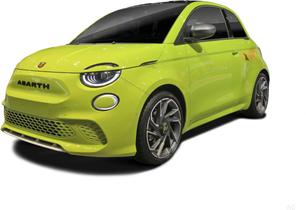
Meet the Abarth 500e, the mad-hatter sibling to the very good and all-electric Fiat 500e, and the Italian brand's first attempt at a bonafide EV hot hatch.
It's tiny, tough and – despite the lack of engine and exhaust – it burbles manically when you fire it up.
So does this mean Italy’s pint-sized, petrol-powered icon has a future in the all-electric era? Let’s go find out.
Volvo has taken a bit of a risk because I'm not convinced that the EX30 knows who its audience is. However, our Twin Motor Performance Ultra test model is well-specified and the overall owner experience (from driving, usability and ongoing ownership costs) is great. This is a fun car and it looks super cute.
It’s not perfect, but it’s everything a hot hatch should be in the electric era — engaging, exciting, and, above all, fun.
The EX30 is gorgeous. It has an interesting shape that makes it look larger than it is and it's unique enough to attract users who might not love the Volvo aesthetic.
You can still see that it's part of the Volvo family with its crisp pleating in the panelling and 'Hammer of Thor' LED headlights, but its look is new and fun.
Large Volvo badging is framed by rectangular LED lighting at the rear and our test model's Cloud Blue paintwork is offset by a sporty black roof and frameless side mirrors.
The interior aesthetic is very pared back - think simple and classic lines, no buttons or dials and large air-vents.
The dashboard is headlined by a 12.3-inch touchscreen multimedia system, which also houses all of the info you'd expect to see on a digital instrument cluster because there's no head-up display or cluster in this model and it does take a while to get used to.
At first the simplicity is a bit too much to wrap the head around but once you do, the interior is incredibly intuitive to use and as a driver, it felt a little Zen-like.
There are four interior design choices Breeze, Mist, Pine and our test model's Indigo which couples 50 per cent recycled denim jeans for its accents, a grey and blue Nordico (synthetic fabric) upholstery and lots of recycled soft/hard plastics in various tones of blue and greys.
To be honest, the materials didn't always work for me but the cabin is still pleasant to look at.
I’m just going to come right out and say it — I love the look of the Abarth 500e, even if the colour of our test car should be renamed Acid Trip, rather than Acid Green.
I love its perfectly proportioned, hunkered-down hot-hatch styling, the new ABARTH lettering on the body, and the new scorpion logo pasted to the side.
Basically, if you can look at the Abarth and not smile, then you need to find more fun in your life.
Inside, it’s a predictably cramped-feeling space, but it’s all nicely laid out, and the more I use them, the more I like the horizontal drive controllers that don’t eat up the little space you have with a traditional shifter. The materials are a bit hit and miss, though.
The cabin up front features plenty of leg- and headroom as well as cleverly designed storage options.
The rear row is surprisingly comfortable for space behind my driving position but I'm only 168cm tall and it might get squishy if you're behind taller front occupants. It's best to think of this car as a four-seater for adults though, the middle seat is an emergency seat.
The seats themselves are very comfortable for long trips, and both are powered and feature heat functions. My favourite feature inside are the door handles - easy to use and they look great too.
Like I mentioned earlier, the design is rather intuitive to use for every day. The only controls in the cabin are the window buttons and they're discreetly placed on either end of the middle console. The front only feature two buttons but you can switch them over for the rear window use via a little touchpad.
Individual storage is great for the class, with a large open centre console that features a dual opening lid with a shallow cubby, which is perfect to hide away any charging cables for the two USB-C ports.
There is a dedicated phone storage space in the form of a 'lean-to' scenario which also features the wireless charging pad and it's large enough to accommodate bigger devices like an iPad.
There is a sneaky glove box which is located underneath the multimedia screen but it irks me that you can only open it via the screen. It's large enough to hold a manual.
The other sneaky but super handy element is the retractable cupholder shelf that slides away into the middle console. You can also position it so only one cupholder is available or slide the cupholder insert backwards for a large cubby.
The rear gets large storage bins in each door, a drawer from the centre console but it's disappointing that the rear row misses out on cupholders or an armrest for added comfort. It does get two USB-C ports.
There is a 7L frunk storage plus the boot is adequate for overnight luggage or a grocery run with its 318L of capacity but that can jump up to 904L if you fold the rear row.
The multimedia system is fairly easy to use but you have to get used to it as it's a bit different from other Volvo systems I've sampled in the past. You also have to get used to accessing everything for the car, even for turning the car off, via the screen. I do like having buttons/dials but not having them in the EX30 mostly works.
While I like the addition of the central screen, it’s surprisingly annoying to use — I found myself jabbing at the buttons again and again before it reacts. You need a Stephen Hawking-level intellect to figure it all out.
I was trying to turn off the Abarth Sound Generator, which I'm reliably informed is possible, but after about five minutes digging through sub-menus, I abandoned all hope.
Normally I’d spend a bit of time exploring the back seat, but frankly, once in there I didn't really feel like spending excess time back there.
The Abarth 500e is only around 3.6m long, 1.7m wide and 1.5m tall, and suffice it to say, the space is tight, and you’ll only be using the two seats in the back in an emergency, or for the smallest of kids.
The boot is pretty tiny, too, starting at 185 litres (VDA) with the rear seats up, but growing to 550L (VDA) with the split-fold rear seat lowered.
So, not much to write home about. But criticising the tiny Abarth for a lack of practicality is like criticising a horse because it can’t swim – it’s not really in its job description.
There are three grades for the EX30 and our model on test is the Twin Motor Performance Ultra, which is the top-spec version. It is priced from $71,290 before on-road costs and that positions it as the most expensive compared to its nearest rivals.
The popular Tesla Model Y Long Range all-wheel drive is $69,900 MSRP, the Cupra Born (5 Seat) is one of the most affordable at $59,990 MSRP, and the Hyundai Kona Electric Premium N Line at $71,000 MSRP is the closest rival for price.
The EX30's price point and cute size means it's carved out a little niche for itself - little being the operative word as the rivals above are not apples for apples comparisons. The EX30 could be at risk of not knowing what its audience is - the design is fun, which signals a younger crowd, but the price point might rule them out.
Having said that, the EX30 wants for nothing really and manages to be very well-specified.
Standard items include, a 12.3-inch touchscreen multimedia system, wired Apple CarPlay and Android Auto, Google Services (Assistant/ Maps/ Play), Spotify/YouTube apps, 5G Module, over-the-air updates, satellite navigation, dual-zone climate control, four USB-C ports, wireless charging pad, Bluetooth, and DAB+ Digital Radio and a Digital Key.
Luxury and practical items include heated and powered front seats, powered tailgate, heated steering wheel, a premium nine-speaker Harman Kardon sound system which features a long soundbar and a huge panoramic sunroof.
Annoyingly though the keyless entry is truly keyless ... there are no buttons on the key and it sometimes glitches when you try to open the door despite the key being in your hand!
Ok, so bonkers thing number one: This Abarth 500e might look like it could fit in your pocket, but it is priced like a much bigger vehicle, starting at $58,900 plus on-road costs for the Turismo variant, increasing to $60,500 for the limited-edition Scorpionissima.
Outside, either trim gets 18-inch diamond-cut alloys, LED lighting all around, a fixed glass roof, the new e-latch front doors (meaning you can just push a button to open the door) from the 500e, along with some performance-focused add-ons, like a front splitter, greyed-out mirror caps, rear disc brakes and new front and rear bumper treatments.
Inside, there’s a leather-and-Alcantara steering wheel, sports seats, aluminium pedals and climate control, while on the tech front, a central 10.25-inch central screen pairs with a wireless charger and wireless phone mirroring, while a second 7.0-inch Driver Display Screen gives you all your driving data.
Oh, and there’s what the brand calls an Abarth Sound Generator, which is all kinds of crazy, but we’ll touch on that in a moment.
The difference between the Scorpionissima and the Turismo, by the way, is style led, with Abarth decals down the sides, and a certificate of authenticity confirming yours is one of 1949 vehicles sold around the world.
The Twin Motor Performance Ultra grade is an AWD with twin electric motors which combine to produce 315kW of power and 543Nm of torque (115kW front/200kW rear) + (200Nm front/323Nm rear).
The EX30 has a single-speed auto transmission and can go from 0 -100km/h in just 3.6-seconds - making it the fastest Volvo.
There’s a single front-mounted electric motor providing the go here, with a total 113.7kW and 235Nm on offer fed through the single-speed gearbox, which is enough to push the 500e from 0-100km/h in 7.0 seconds.
Happily, the way that power is delivered makes it feel faster, and that Sound Generator does a pretty good impersonation of a petrol-powered hot hatch, rising and falling with your inputs.
The EX30 Twin Motor Performance Ultra has up to 445km (WLTP) driving range, which felt pretty accurate this week despite throwing some heavy open-road trips into the mix.
This variant has a 69kWh nickel manganese cobalt battery and an official energy consumption figure of 18.0kWh/100km (WLTP). After doing some urban and longer trips I saw my trip computer flitting between 19.0kWh and 22.0kWh/100km.
The EX30 has a Type 2 CCS charging port, which means you can hook it up to a DC charger and it will accept up to 175kW on a DC charging system.
On an AC 2.4kW standard domestic plug port, expect a long charging time of around 38 hours to get up to 80 per cent.
On an AC 11kW system, you can go from 0-100 per cent in eight hours (again, a little slow but reasonable enough for overnight charging).
On a DC 175kW system, you can go from 10-80 per cent in around 28 minutes.
Right, there’s one obvious downside to the Abarth experience, and that is that it is fitted with a 42kWh battery that delivers a claimed 253km of driving range.
It’s worth noting that there are three Drive Modes — Turismo, Scorpion Street and Scorpion Track — and that only the first one will deliver the maximum range, because it limits inputs to 100kW and 220Nm.
Engage the other two — I’ve had it locked in Scorpion Track, for example, which gives you all of the power and deactivates one-pedal driving — and you can expect those numbers to drop.
When it comes time to charge, the Abarth 500e is set up for 85kW DC fast charging, which should take you from flat to 80 percent charged in around 35 minutes, as well as a maximum 11kW AC charging, which takes just over four hours to get to fully charged. Or you can plug it into a regular socket, which means more like 15 hours to recharge.
One last caveat: I actually wasn't able to get it to charge, which curtailed my adventures a little bit. I tried three chargers, all of which conjured an error message on the screen, and after a quick call to the folks at Abarth it transpired that a quick software update is required.
Driving the EX30 Ultra is a mostly fun and lighthearted experience but it's not cutesy, no matter how adorable the external design is.
The twin motors deliver serious power and you can fully expect 'tummy-sucking' moments of pure enjoyment whenever you put your foot down.
Coupled with a graceful on-road presence which assures you that the car will stick to the road like glue, and you have the fun-factor.
The lightheartedness comes from how nimble and easy the EX30 is to manoeuvre. The steering firmness can be customised and its compact dimensions makes it your best friend in tight city lanes.
You can't customise the regenerative braking, or at least, I couldn't figure out an easy way to do so outside of selecting the one-pedal drive option.
The cabin is mostly quiet and there's a refinement to longer journeys because of it. You get occasional wind noise at higher speeds and a little bit of road feedback too but longer journeys are lovely.
My only real nag is that there is no head-up display or instrument panel for your speedometre and I found my eyes directed away from the road because of it. You can find your speed info on the central multimedia system but I prefer something in front of me.
Parking my little blue cloud this week has been easy as pie because the 360-degree camera system is clear and the large windows provide excellent visibility.
Remember what I said about how just looking at the Abarth should put a smile on your face? Well, driving it paints on an even bigger grin, and it starts as soon as you fire it up.
While most EVs start silently, leaving you wondering if they're on at all, the Abarth takes a different approach, instead leaning on its sound generator, modelled on the exhaust note of the 695, to give you a throaty rumble when you fire it up. It even revs! And yes, you can turn it off (apparently), but why would you?
On the road, electric drive has actually improved the Abarth experience, I reckon, because all the harshness of the drivetrain has been ironed out, instead just leaving this smooth, potent flow of power every time you plant your right foot, with no gear changes or harsh vibrations to get in the way.
The steering is predictably direct, too, and the whole vehicle feels nimble and quick to react to your inputs.
It’s honestly the kind of car that’s fun driving anywhere, be it suburban streets or twisty backroads, and despite having a couple of options parked at my house, I found myself pulled to the Abarth for all of my trips.
Downsides? The ride is firm but comfortable on most roads, but downright uncomfortable when you clang over bumps or road imperfections. You’ll have to decide if that’s a price to high to pay, but I can live with it for the trade off. And while the cabin tech looks nice, but is fiddly and annoying to use.
Finally, the range relegates the Abarth to a second car, or for those who rarely leave the city. Which is a big ask at the price point.
At the time of this review, the EX30 has not been tested by ANCAP and is unrated but it has all of the safety equipment you'd expect of a Volvo.
Standard equipment includes, blind spot monitoring, driver attention alert, safe exit warning, rear occupant alert, tyre pressure monitoring, tyre mobility kit, rear collision warning, forward collision warning, rear cross-traffic alert, lane departure alert, lane keeping aid, hill start assist, traffic sign recognition, intelligent seatbelt warning, adaptive cruise control, parking assist, a 360-degree view camera system as well as front and rear parking sensors.
The EX30 is also fitted with seven airbags and the Volvo-designed whiplash injury protection system (WHIPS) which helps to reduce the risk of whiplash injury if your car is hit from behind. On impact, the entire front backrest and head restraint moves with the occupant to support the neck.
Like other Volvos, the EX30 also has side impact protection (SIPS), which helps protect you and your passengers in a side collision. The body's steel framework displaces the impact of a side-collision away from the occupants to other parts of the car body.
The EX30 has ISOFIX child seat mounts on the rear outboard seats plus three top tethers but only two child seats will fit. If you have an extra-large booster seat, like me, then expect some of the back window visibility to be compromised when it is installed.
The Abarth 500e is fitted with six airbags, and decent suite of active safety stuff, like AEB, Lane Keep Assist, Traffic Sign Recognition, Blind Spot Warning, auto high beam and and an attention monitor. It’s all pretty subtle, though, and it didn't bing or bong at me once, which was wonderful.
It scored four stars when tested by Euro NCAP.
The EX30 is covered by Volvos five-year/unlimited km warranty and the electric battery is covered by an eight-year term - both are normal terms for the class.
What endears the EX30 to me is that servicing is included, which is very rare for a luxury brand to offer. Servicing intervals are reasonable at every two years or 30,000km, which ever occurs first.
It’s an interesting ownership proposition, because the car is covered for three years or 150,000km, which is underwhelming and then some compared to the warranty offerings of its competition, but there is capped-price servicing, at $300 per visit, required every 12 months or 15,000km, which lasts 10 years.
The battery is covered for eight years or 160,000km.