What's the difference?
Thinking of a Toyota GR Supra, eh? Well, come on in, your timing is perfect.
See, up until halfway through last year the Toyota GR Supra only came with an automatic transmission, so I was jumping up and down to drive this version with the six-speed manual.
To me, it’s the way the Supra should be. Not having a manual gearbox in a car like this is like spending the day at an amusement park but not going on any rides.
Not only that but the Supra now has more power than it did when this generation launched in 2019.
See what I mean about your timing?
In a lot of ways the Supra is now complete.
Well that was what I wanted to verify when I tested the entry grade GT, along with what it was like to live with daily, the fuel consumption, warranty and even its practicality; fitting all of me and my stuff.
KGM – formerly SsangYong – has revised its seven-seat Rexton range for 2026, with some minor changes throughout the Australian line-up and a name-change for the Adventure, which has now become the Advance.
The Advance is a seven-seat large SUV with high and low-range gearing, an auto-locking rear differential and 3.5 tonne towing capacity.
Is this a value-for-money rival for the likes of GWM Tank 500, Mahindra Scorpio and LDV D90, or could it be a viable (cheaper) alternative to the Isuzu MU-X, Toyota Fortuner, Mitsubishi Pajero Sport or even Ford Everest?
The Toyota GR Supra GT is a superb sports car that’s relatively easy to live with in the city even with the manual gearbox and incredibly fun to drive out where the roads are free from traffic.
Not only is the GT great for the price compared to rivals but it’s the pick of the Supra range.
The KGM Rexton Advance is a large 4WD wagon packing an adequate amount of appeal.
It’s nice to drive on the open road, it’s comfortable and it signals continued incremental progress for KGM in terms of quality and functionality.
It’s fine for light off-roading but its 4WD efficacy is lacking. While it's not in the same class as something like the Ford Everest in terms of refinement, comfort, and general quality, ultimately, a lot of its rivals represent greater value for money and all-round driveability as family vehicles.
And even though it does offer owners a chance to take their urban-focussed SUV into the bush, its price is climbing, and other rival vehicles offer a more refined overall driving experience.
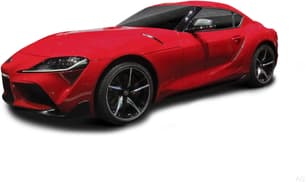
Perhaps it’s just me but I think the Supra looks exactly how it should look - like a Hot Wheels car.
Seriously, how good does the back view look? I love the spoiler that angles up like a crazy ski jump and the tail-lights integrated underneath it.
I love the huge rear hunches swollen like they’ve been stung by an enormous wasp. Check out the roof - see how it’s curved? And that bonnet with the vent above the wheel arches, I love the styling of every millimetre of this car.
But my neighbour doesn’t. I pulled up and said, “How good does this look?” And he gave me this stare like I was bonkers.
I don’t know, maybe you and I have the same excellent taste, but if there’s anything I hate it's anything that’s boring.
To me the BMW Z4 ‘twin’ is getting very close to the boring end in the styling department.
Talking of BMW, the Supra's interior is very BMW from the indicators stalks to the media system and climate control set-up.
It’s a modern and minimalist cabin… if only there wasn’t a cupholder right where my elbow goes. That’s a good place to stop and talk about the Supra GT’s practicality.
The Rexton remains essentially unchanged from the previous generation and so it stays pleasant enough but generically inoffensive as are most other SUVs on the market.
Even for a city-focussed SUV, the body-on-frame Rexton looks low and while its 203mm of ground clearance is okay for daily driving it’s less than ideal for off-roading.
The only change to this Rexton over the previous generation? Pull-up sun blinds on the rear doors. Not a design change per se, but worth mentioning.
Does it set itself apart enough from other similar SUVs? Not really, but does that even matter to you?
The good news is that if you’re tall like me (189cm) and mainly legs then you’ll have more than enough legroom and headroom because the footwells are impossibly deep and the seats can be lowered to what feels like ground level.
Actually, you are almost at ground height in this car so the bad news if you’re as tall as me you’ll probably have to crawl out of the car on all fours.
The cabin of the Supra doesn’t do the storage space thing well. Sure there are two cupholders but their location is the same place my elbow frequents while changing gears and resting.
The wireless phone charging area is good and easy to access, but the door pockets are as thin as post box slots so if it’s letters you’re storing there you’re in luck.
If it’s anything thicker than that you’ll be left looking around for a place to put your purse or wallet and end up throwing it in the phone charger space if the passenger seat is taken.
You could always ask your co-pilot to hold onto your things which reminds me to tell you that the Supra is a two-seater only. There are no back seats, and there’s no option to have back seats.
If you’re looking for a sports car with rear seats (although space will be limited) for the same money then there’s the Audi A4 45 TFSI and at an even lower price is the Ford Mustang GT.
If you look over your left shoulder while in the driver’s seat of the Supra GT you’ll see into the boot - there’s no wall separating the cabin from the cargo area. This is handy for throwing a school bag in as I did for my son on the morning drop off, but also means your items may make an unexpected visit to the cockpit if you stop suddenly.
The boot is large for a sports car at 296 litres (VDA) and it managed to fit our large CarsGuide suitcase with space to spare as you can see in the images.
This Korean SUV has a nice but unspectacular interior, although it does have a low-key premium look and feel about it and the cabin is comfortable.
It has a familiar ease of functionality and there’s a family-friendly mix of durable plastic and soft-touch surfaces throughout the cabin.
The 2026 KGM Rexton range is a seven-seat 4WD wagon in a two-, three- (second row) and two-seat (third row) 50/50 configuration.
The leather-look seats are comfortable enough and the front seats are heated, ventilated and power-adjustable; the second-row outer seats are also heated.
The multimedia system with its 12.3-inch screen is okay to use, but I had no luck getting Apple CarPlay paired to my not-so-smart phone. And, believe it or not, that hasn’t happened to me for a long time. Note: other people were able to pair their phones to this Rexton with no problems during my week of testing.
Otherwise, functionality, storage and charge points around the cabin are satisfactory, including two USB-C ports up front (centre console) and a 12V power outlet.
The second-row seats – a 60/40 configuration, which folds, reclines and tumbles – are supportive without being overly so.
In the second row, as mentioned earlier, the only changes evident to this Rexton over the previous generation are the pull-up sun blinds on the rear doors.
There’s actually a decent amount of space for passengers in the third row here, but an adult still wouldn’t love to spend too much time back there.
The rear cargo area space of the 2026 KGM Rexton range is listed as 236 litres (with all three rows of seats in use), 641 litres (with third row stowed away), and 1806 litres (with second and third row stowed away).
There’s a 12V power outlet in the cargo area.
This new Rexton offers reasonable practicality but rivals such as the Mahindra Scorpio and LDV D90 offer just as much, sometimes more, all-round family suitability but for $5000-$10,000 less, depending on the variant.
The Toyota GR Supra GT with the manual gearbox lists for $87,380 and you’ll pay the same price for the same car with the automatic transmission.
Yes, almost $90K might sound like a lot of money for a Toyota (unless it’s a LandCruiser) but it’s actually a bargain considering the GTS grade above costs $10K more and has the same engine plus pretty much the same features apart from a fancier stereo, head-up display and 19-inch alloys (rather than the 18s on this GT).
Also, if you didn’t know already the Supra is a BMW/Toyota joint venture model aligned with the BMW Z4, and if you want the Beemer version with the same engine as the Supra GT you’ll pay $139,800 for it.
So see, it’s a bargain in comparison.
The standard features list of the GT has pretty much everything you need. There’s a proximity key, LED headlights with adaptive high beam, active cruise control, sat nav, wireless Apple CarPlay and Android Auto, a 10-speaker stereo, wireless phone charger, heated and power adjustable seats, shifting paddles and sports pedals.
Great features, but let down only by a small 8.8-inch screen for your media and nav. Still, that absolutely shouldn’t be a deal-breaker for you.
The rivals? Well, clearly the BMW Z4 which is way more expensive, but also there is the Nissan Z which costs between $70-$80K and is also a hoot to drive.
Add the Ford Mustang GT to your research list, as well. It’s not as agile as the Supra but it’s quick, fun and sounds better to my ears.
The KGM Rexton is available in four variants: ELX, Advance, Ultimate – and the Ultimate with the optional Rexton Sport Pack.
The Advance as standard has recommended drive-away pricing of $58,200 (correct at the time of writing and includes $700 Marble Grey metallic paint). But our test vehicle also has a $1842 tow bar fitted, and a $665 electronic brake controller fitted, pushing its as-tested price to $60,707.
Standard features in the Advance include C-type design LED daytime running lights, a 12.3-inch touchscreen multimedia system (with Apple CarPlay and Android Auto), a 12.3-inch digital LCD instrument cluster, leather-accented heated and ventilated, power-adjustable front seats, ambient interior mood lighting, walk-away automatic door locking, a power tailgate, 18-inch 'diamond cut' alloy wheels and a suite of driver-assist tech including a tyre pressure monitoring system, but it misses out on the higher grades’ 360-degree surround view monitor.
The only change to this Rexton over the previous version? Pull-up sun blinds on the rear doors.
This new Rexton has plenty going for it, in terms of standard features, but rivals such as the GWM Tank 300, Mahindra Scorpio and LDV D90 offer just as much onboard but for $5000-$10,000 less, depending on the variant.
Exterior paint choices include Grand White, Marble Grey (metallic paint), Pearl White (metallic paint), and Space Black (metallic paint). Metallic paint is available for $700 on all grades, but is included in the price of the Sport Pack.
You’re looking at a Supra that could be the peak of its model evolution because since the generation’s arrival in 2019 Toyota has increased the power of the 3.0-litre turbo-petrol in-line six-cylinder from 250kW to 285kW (torque remains the same at 500Nm) and introduced a six-speed manual.
This 3.0-litre six-cylinder turbo-petrol is the only engine you can have with the Supra, there are no four cylinders or V8s - now there’s an idea.
Toyota says the 0-100km/h time for the GR Supra with the manual gearbox is 4.4 seconds and 4.1 seconds for the automatic which comes with a ‘launch control’ feature.
Of course, all Supras are rear-wheel drive.
The entire KGM Rexton line-up has a 2.2-litre four-cylinder turbo-diesel engine producing 148kW of power and 441Nm of torque.
It has an eight-speed automatic transmission, part-time 4x4 with high and low range, and an auto-locking rear differential.
This is a sluggish combination and not a particularly efficient powertrain, but it does the job, albeit in a lacklustre fashion.
Drive modes include Normal, Sport and Winter modes.
Toyota says the 3.0-litre six-cylinder straight-six turbo-petrol engine in the Supra GT paired with the six speed manual gearbox should use 8.9L/100km after a combination of open and urban roads.
I did a week’s worth of city commuting and then a couple of hundred kilometres on country roads, but no motorways and the trip computer told me I was averaging 10.3L/100km.
Not bad for a big engine in a car tuned for performance, driven by a big kid who feels like he’s playing with somebody else’s toys.
Premium 95 RON fuel is recommended, although 'standard' 91 is acceptable. A 52-litre fuel tank translates to a theoretical range of around 580km, dropping to approximately 500km using our real-world number.
Official fuel consumption for the Rexton is listed as 8.7L/100km.
On this test, I recorded 10.6L/100km, but I have done a chunk of high and low-range, four-wheel driving.
The Rexton has a 70-litre fuel tank. So going by that on-test fuel figure from a full tank, you could reasonably expect a driving range of about 660km.
But remember, I'm travelling with just me and some vehicle recovery gear. You'll be traveling with your kids, your mates, your pets, your camping gear, your sporting gear, all that sort of stuff. And that extra weight will have an impact on the vehicle's fuel consumption, so just keep that in mind.
Ah, but what about living daily with a manual? As a car enthusiast most of the cars I’ve owned have been manuals and I’ve rarely cursed them because I love to drive.
But there were times when they were a pain, such as in traffic, or in traffic on steep streets and in traffic in shopping centres. Did I mention in traffic, also?
But on the nice roads with bends and dips, hills and sweeping corners, hairpins and twisty parts in places without traffic, then all is forgiven.
And so it goes with the manual version of the Supra.
Making life easier in the Supra GT is a clutch pedal without much travel so you don’t feel as though you’re at the gym doing a one-sided leg press.
I found the shifts themselves, while short, to be less than smooth. At first, I thought that the clunky changes might have been because the gearbox hadn’t been run in yet, but the odometer was saying 7500km, so this could just be the nature of the gearbox and after a few days I became used to it.
The rev-matching feature of this gearbox is a nice touch, especially on those sporty drives when you change into a gear and you’re thrown straight back into the power band again.
Superb balance, great steering with a nose which points exactly where you want it to and that magnificently smooth turbo-petrol in-line six posting all its meaty grunt to the rear wheels just behind your shoulders makes for a sports car that’s fun, talented and quick.
Good brakes (348mm ventilated rotors with four piston calipers at the front and 330mm discs with single piston calipers at the rear) and grippy Michelin Pilot Supersport tyres (255/40 fr - 275/40 rr) complete a great package.
A ride that’s still comfortable over bad Sydney roads and surprisingly good visibility made the Supra easy to live with in the city, from parking to school drop offs.
Yes, used it each day for the school run with my older child and the grocery shopping.
The Rexton is 4850mm long (with a 2865mm wheelbase), 1960mm wide and 1825mm high with a listed kerb weight of 2136kg.
With a turning circle of 11m, the Rexton is quite nimble around town.
On road, it’s okay. It's reasonably quiet and comfortable, and though it’s not particularly dynamic – the engine and auto make for a sluggish pairing – the Rexton is sufficiently driveable all round.
Its suspension – double wishbones and coil springs at the front, independent multi-link and coil springs at the rear – is firm, mostly controlled, but ride becomes jittery on irregular sealed surfaces and that characteristic is only amplified on even mildly corrugated dirt tracks.
And it’s in the dirt where the Rexton’s limitations are quickly exposed.
The Rexton is best considered a light-duty four-wheel drive: it is quite low; its stock tyres – Nexen NPriz RH7 (255/60R18 108H) – though marketed as “all season” aren't well suited for four-wheel driving. And the Rexton’s 4WD mechanicals and off-road traction control feel dated in operation, they just don't feel as effective as they should in a very competitive SUV market.
It doesn't have a lot of ground clearance or wheel travel and its shallow off-road angles – approach (20.5 degrees), departure (20.5) and ramp over (20) – are best suited to light-duty off-roading (i.e. well-maintained tracks in national parks in dry weather).
There's a decent spread of revs here, but there's not a lot to work with in terms of how effective the Rexton is as an off-road package so if you are here for a hardcore 4WD review with tyres-ripping-the-dirt action you're in the wrong place, because the Rexton just isn't up to that. And that's perfectly fine because people won't be using it for that purpose.
Having said that, the Rexton does reasonably well with what it has on board: there’s a decent amount of torque across a spread of revs; steering has a direct feel and nice liveliness to it; throttle response is quite sharp; and there is plenty of visibility forward over the bonnet.
Its auto rear diff lock is clunky in operation, disengaging abruptly, sometimes when you’re not even up, over or through the particular off-road challenge you’re tackling. I’ve noted similar issues with the Mahindra Scorpio in the past.
But driven with careful consideration the Rexton may do – at a stretch – the type of terrain you might not think it would be capable of.
And a decent set of all-terrain tyres would also help the Rexton, but it is what it is: a light-duty, four-wheel drive.
If you're thinking of using your family go-mobile as a touring vehicle, it’s worth noting the payload is 824kg, gross vehicle mass is 2960kg and gross combined mass is 6460kg.
Towing capacity is 750kg (unbraked) and 3500kg (braked).
The GWM Tank 300, Mahindra Scorpio and LDV D90 have similarly old-school type powertrains and 4WD set-ups, but the Tank is more comfortably capable off-road and yields a better general driveability than the Rexton and those others.
The GR Supra GT has not been crash tested by ANCAP, but its BMW Z4 twin scored a maximum five stars when it was tested by the European equivalent Euro NCAP.
Still, the Supra has seven airbags, there’s AEB with pedestrian and cyclist detection, lane keeping assistance and blind spot warning, plus front and rear parking sensors. There are seven airbags on board.
There’s no spare wheel, but there is a tyre inflation kit which should get you out of trouble.
The Rexton does not have an ANCAP rating because it has not been officially tested.
As standard, it has nine airbags, auto emergency braking (AEB), adaptive cruise control, forward collision warning, lane keeping assist, blind spot warning, lane change-collision warning, rear cross-traffic warning, trailer sway control, driver attention alert, front vehicle start alert and more.
Though it doesn’t have an ANCAP rating, the Rexton holds its own in terms of driver-assist tech against rivals such as GWM Tank 300, Mahindra Scorpio and LDV D90.
Toyota covers the GR Supra GT with its five-year, unlimited kilometre warranty. Servicing is required every 12 months or 15,000km and is capped at $415 per service.
The warranty is the industry standard in terms of time and kilometre length, and the capped service prices are very reasonable - a lot more affordable than a car with a prestige badge on the bonnet, too.
The MY26 Rexton range is covered by a seven-year/unlimited kilometre new-vehicle warranty, and five years of roadside assistance.
A service is required every 12 months or 15,000km, whichever occurs soonest with cost per service either $418 or $522.
KGM Australia has more than 50 dealerships across the country with a decent spread across metro and regional areas. Rextons can be serviced at those dealers or at approved workshops.
The Rexton offers a competitive warranty when pitched against the likes of the GWM Tank 300 (seven-year/unlimited kilometre), Mahindra Scorpio (seven-year/150,000 km) and LDV D90 (seven-year/200,000km warranty).