What's the difference?
Thinking of a Toyota GR Supra, eh? Well, come on in, your timing is perfect.
See, up until halfway through last year the Toyota GR Supra only came with an automatic transmission, so I was jumping up and down to drive this version with the six-speed manual.
To me, it’s the way the Supra should be. Not having a manual gearbox in a car like this is like spending the day at an amusement park but not going on any rides.
Not only that but the Supra now has more power than it did when this generation launched in 2019.
See what I mean about your timing?
In a lot of ways the Supra is now complete.
Well that was what I wanted to verify when I tested the entry grade GT, along with what it was like to live with daily, the fuel consumption, warranty and even its practicality; fitting all of me and my stuff.
You want a V12 Ferrari, but you have growing responsibilities. A strictly two seat supercar just isn't quite right when kids start to arrive.
Sure, you can add a Ferrari F12 to your collection, and pick up a Merc-AMG family truckster to cover the functional stuff.
But it's not the same. You want to have your Italian torta, and eat it, too. Enter the Ferrari GTC4Lusso, the prancing horse’s latest take on a rapid, luxurious, four seat coupe, able to leap continents in a single bound without so much as a bead of perspiration forming on its forehead.
It's fast, suitably furious, and able to accommodate family or friends on a fast blast to anywhere you choose to go. And as usual with Maranello’s finest, the name says it all.
'GT' stands for Gran Turismo (or Grand Tourer), 'C' is short for Coupe, '4' relates to the number of people it accommodates, 'Lusso' means luxury, and of course, Ferrari is Italian for fast.
The Toyota GR Supra GT is a superb sports car that’s relatively easy to live with in the city even with the manual gearbox and incredibly fun to drive out where the roads are free from traffic.
Not only is the GT great for the price compared to rivals but it’s the pick of the Supra range.
The Ferrari GTC4Lusso is a properly fast, beautifully composed, and supremely luxurious four-seat coupe.
Sadly, evermore stringent emissions regulations have put atmo V12's on the knife edge of extinction, with Ferrari, Lamborghini, Aston Martin and a few others hanging on for grim death.
In fact the twin-turbo V8 Lusso T (powered by the same engine used in the California T and 488) will arrive and be sold alongside this car in Australia later this year.
But we’d like to propose a captive breeding program to keep the big V12s alive because this engine’s soundtrack and the GTC4Lusso’s overall driving experience is magnificent.
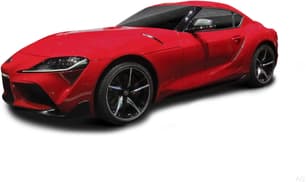
Perhaps it’s just me but I think the Supra looks exactly how it should look - like a Hot Wheels car.
Seriously, how good does the back view look? I love the spoiler that angles up like a crazy ski jump and the tail-lights integrated underneath it.
I love the huge rear hunches swollen like they’ve been stung by an enormous wasp. Check out the roof - see how it’s curved? And that bonnet with the vent above the wheel arches, I love the styling of every millimetre of this car.
But my neighbour doesn’t. I pulled up and said, “How good does this look?” And he gave me this stare like I was bonkers.
I don’t know, maybe you and I have the same excellent taste, but if there’s anything I hate it's anything that’s boring.
To me the BMW Z4 ‘twin’ is getting very close to the boring end in the styling department.
Talking of BMW, the Supra's interior is very BMW from the indicators stalks to the media system and climate control set-up.
It’s a modern and minimalist cabin… if only there wasn’t a cupholder right where my elbow goes. That’s a good place to stop and talk about the Supra GT’s practicality.
Revealed to the world at last year's Geneva motor show, the GTC4Lusso is a substantial evolution of the out-going FF, and follows classic Ferrari GT form, with a glorious, 6.3-litre, naturally aspirated, V12 sitting majestically in its nose.
The car's proportions echo that configuration with a long snout and rear-biased, gently tapered cabin maintaining essentially the same silhouette as the FF. But Ferrari has remodelled the nose and tail; tweaking the aero detailing at the same time.
There's a host of new vents, ducts and louvers contributing to a claimed six per cent improvement in drag coefficient.
For example, the diffuser is a work of aerodynamic art, following a keel shape, with vertical fences channeling air flow towards the centre to reduce drag and increase downforce.
A wide, single-piece grille dominates a smoother front end that moves from upright to a distinct forward lean, with a neat chin spoiler enhancing the racier look.
Larger, triple-blade vents in the front wings add more aggression, and the treatment of the rear side glass and tailgate have been refined and simplified.
Always a subjective call, but we think the restyling work, done in-house by Ferrari Design, has made an already distinctive car even more appealing.
Ferrari says the interior was developed around a 'dual cockpit' concept, to “enhance the shared driving experience”, and the cabin is beautiful.
There's a new 10.3-inch colour touchscreen, with the interface for the climate control, sat nav and media all refreshed. It's backed up by a more powerful 1.5Ghz CPU with 2GB of RAM, and it’s much, much better.
'Our' car also boasted the optional ($9500) 8.8-inch ‘Passenger Display’ incorporating performance read-outs, and now, the ability to select music and fiddle with the nav.
The attention to design detail and the quality of its execution is breathtaking. Even the slender sunvisors in our test example were hand-stitched leather. And the pedals are drilled alloy. Not alloy covers, or some other faux creation – real aluminium, right down to the passenger footrest pad.
The good news is that if you’re tall like me (189cm) and mainly legs then you’ll have more than enough legroom and headroom because the footwells are impossibly deep and the seats can be lowered to what feels like ground level.
Actually, you are almost at ground height in this car so the bad news if you’re as tall as me you’ll probably have to crawl out of the car on all fours.
The cabin of the Supra doesn’t do the storage space thing well. Sure there are two cupholders but their location is the same place my elbow frequents while changing gears and resting.
The wireless phone charging area is good and easy to access, but the door pockets are as thin as post box slots so if it’s letters you’re storing there you’re in luck.
If it’s anything thicker than that you’ll be left looking around for a place to put your purse or wallet and end up throwing it in the phone charger space if the passenger seat is taken.
You could always ask your co-pilot to hold onto your things which reminds me to tell you that the Supra is a two-seater only. There are no back seats, and there’s no option to have back seats.
If you’re looking for a sports car with rear seats (although space will be limited) for the same money then there’s the Audi A4 45 TFSI and at an even lower price is the Ford Mustang GT.
If you look over your left shoulder while in the driver’s seat of the Supra GT you’ll see into the boot - there’s no wall separating the cabin from the cargo area. This is handy for throwing a school bag in as I did for my son on the morning drop off, but also means your items may make an unexpected visit to the cockpit if you stop suddenly.
The boot is large for a sports car at 296 litres (VDA) and it managed to fit our large CarsGuide suitcase with space to spare as you can see in the images.
For once we can mention Ferrari and practicality in the same breath because the Lusso offers generous accommodation in the front and rear. Forget '2+2', the back seats are for grown-ups.
With all its drive and dynamic tech on board it's hard to think of a more elegant and capable four-seater for your next trip to the chalet for a cheeky weekend skiing off piste.
In fact, Ferrari says the FF attracted a new, younger batch of owners that make greater use of their cars.
Admittedly, Ferraris don't generally rack up huge kays, but clocking mileage 30 per cent higher than average is significant.
Front seat passengers slip easily into generous and intricately sculpted sports seats, with slim map pockets in the doors and space for bottles, a single large cupholder in the substantial centre console, as well as a lidded storage box (which doubles as a centre armrest) housing 12 volt and USB outlets.
There's also a decent-sized glove box, and a second tray sits further towards the dash to store your black credit cards, Vertu phone(s), and assorted jewellery. Its leather trimmed, double-door closure is reminiscent of the finest Milanese cabinet.
The long, leather-wrapped transmission tunnel continues uninterrupted through to the back, dividing the individual rear bucket seats. A pair of jet fighter style vents sit in the centre, slightly ahead of another two cupholders and a small oddments box containing additional USB ports.
But the big surprise is the amount of head, leg and shoulder room on offer back there. The door aperture is enormous and the front seats quickly tilt and slide forward with the flick of a single handle, so entry and egress is relatively easy.
It's an ultra-comfortable and relaxed place to be, and at 183cm I could sit behind the front seat set to my position with heaps of headroom and three to four centimetres of knee clearance. Finding space for your toes under the front chair is more of a challenge, but an extended journey in the back of the Lusso would be fine.
The only caveat there is the test vehicle’s optional 'Panoramic Glass Roof' ($32,500!), which essentially removes the roof lining, and it would be interesting to sit in a car without it.
Cargo space is real-world useful, with a substantial 450 litres on offer with the rear seats upright, and a full 800 litres available with them folded down.
There’s no spare tyre; a 'can of goo' repair kit being your only option.
The Toyota GR Supra GT with the manual gearbox lists for $87,380 and you’ll pay the same price for the same car with the automatic transmission.
Yes, almost $90K might sound like a lot of money for a Toyota (unless it’s a LandCruiser) but it’s actually a bargain considering the GTS grade above costs $10K more and has the same engine plus pretty much the same features apart from a fancier stereo, head-up display and 19-inch alloys (rather than the 18s on this GT).
Also, if you didn’t know already the Supra is a BMW/Toyota joint venture model aligned with the BMW Z4, and if you want the Beemer version with the same engine as the Supra GT you’ll pay $139,800 for it.
So see, it’s a bargain in comparison.
The standard features list of the GT has pretty much everything you need. There’s a proximity key, LED headlights with adaptive high beam, active cruise control, sat nav, wireless Apple CarPlay and Android Auto, a 10-speaker stereo, wireless phone charger, heated and power adjustable seats, shifting paddles and sports pedals.
Great features, but let down only by a small 8.8-inch screen for your media and nav. Still, that absolutely shouldn’t be a deal-breaker for you.
The rivals? Well, clearly the BMW Z4 which is way more expensive, but also there is the Nissan Z which costs between $70-$80K and is also a hoot to drive.
Add the Ford Mustang GT to your research list, as well. It’s not as agile as the Supra but it’s quick, fun and sounds better to my ears.
At $578,000, the GTC4Lusso is in serious money territory, and as you’d expect, the standard features list is equally imposing.
Highlights include, bi-xenon headlights with LED indicators and daytime running lights, LED tail-lights, 20-inch alloy rims, electric cargo door, front and rear parking sensors plus rear parking camera, cruise control, dual zone climate control air, integrated peripheral anti-theft system (with anti-lift), keyless entry and start, the 10.3-inch touchscreen interface managing 3D navigation, multimedia and vehicle settings, eight-way adjustable electric seats with heating, pneumatic bolsters and lumbar adjustment, plus three memories, carbon ceramic brakes, electric steering column adjustment with memory and ‘easy entry’ function, a tailored car cover and even battery conditioner.
And that’s before you get to the 'usual' stuff like a herd’s worth of leather lining the interior, cranking nine-speaker audio system, electric windows and mirrors, and all the dynamic and safety tech we’ll get to shortly.
Then, there’s the options list.
There’s a persuasive theory that says once you cross a certain car purchase dollar threshold, let’s say $200k, those options had better be pricey or owners won’t have anything to brag/complain about when introducing their latest acquisition to colleagues in the yacht club car park.
“You know how much that sunroof cost me… just the sunroof? Yep, 32 grand… I know, right!”
By the way, the price of that ‘Low-E’ glass roof will buy you a Subaru XV Premium that Richard tested recently… complete with standard sunroof!
Short story is ‘our’ car featured $109,580-worth of extras, including the roof, forged rims ($10,600), ‘Scuderia Ferrari’ shields on the fenders ($3100), ‘Hi-Fi premium’ audio ($10,450), and a (must have) front and rear suspension lift system ($11,000).
The carbon-rich steering wheel with F1-inspired LED shift lights is a lazy $13k, and the super-cool enamel badge under the lip of the rear spoiler is $1900.
You can point fingers and feign shock at numbers like these, but it all goes to the ultimate personalisation process that is the Ferrari purchase experience; to the point where the factory is now installing a sizeable plaque in each of its cars, listing the options fitted and confirming its original specification for evermore.
You’re looking at a Supra that could be the peak of its model evolution because since the generation’s arrival in 2019 Toyota has increased the power of the 3.0-litre turbo-petrol in-line six-cylinder from 250kW to 285kW (torque remains the same at 500Nm) and introduced a six-speed manual.
This 3.0-litre six-cylinder turbo-petrol is the only engine you can have with the Supra, there are no four cylinders or V8s - now there’s an idea.
Toyota says the 0-100km/h time for the GR Supra with the manual gearbox is 4.4 seconds and 4.1 seconds for the automatic which comes with a ‘launch control’ feature.
Of course, all Supras are rear-wheel drive.
The Lusso is powered by a 6.3-litre, 65-degree, naturally aspirated V12 producing a monumental 507kW (680hp) at 8000rpm and 697Nm at 5750rpm.
It features variable valve timing on the intake and exhaust side, the rev ceiling is a lofty 8250rpm, and revisions from the FF installation include redesigned piston crowns, new anti-knock software, and multi-spark injection, for a four per cent gain in power and two percent rise in maximum torque.
Also new for the Lusso is the adoption of six-into-one exhaust manifold with equal length pipes and a new electronic bypass valve.
The Lusso features an insanely rapid-shift, seven-speed 'F1 DCT' dual-clutch transmission, working in parallel with Ferrari’s new and improved '4RM-S' system, which combines all-wheel drive, and now, four-wheel steering to enhance power down and dynamic response.
The drive and steering tech is integrated with Ferrari's fourth-gen side slip control, as well as the 'E-Diff' electronic differential and 'SCM-E' suspension damping syste.
Toyota says the 3.0-litre six-cylinder straight-six turbo-petrol engine in the Supra GT paired with the six speed manual gearbox should use 8.9L/100km after a combination of open and urban roads.
I did a week’s worth of city commuting and then a couple of hundred kilometres on country roads, but no motorways and the trip computer told me I was averaging 10.3L/100km.
Not bad for a big engine in a car tuned for performance, driven by a big kid who feels like he’s playing with somebody else’s toys.
Premium 95 RON fuel is recommended, although 'standard' 91 is acceptable. A 52-litre fuel tank translates to a theoretical range of around 580km, dropping to approximately 500km using our real-world number.
In case you're interested - and if a Lusso is genuinely on your shopping list, you're almost certainly not - claimed fuel consumption is reassuringly voracious.
Ferrari’s claimed figure for the combined (urban/extra urban) cycle is 15.0L/100km, emitting 350g/km of CO2 in the process. And you'll need 91 litres of premium unleaded to fill the tank.
Ah, but what about living daily with a manual? As a car enthusiast most of the cars I’ve owned have been manuals and I’ve rarely cursed them because I love to drive.
But there were times when they were a pain, such as in traffic, or in traffic on steep streets and in traffic in shopping centres. Did I mention in traffic, also?
But on the nice roads with bends and dips, hills and sweeping corners, hairpins and twisty parts in places without traffic, then all is forgiven.
And so it goes with the manual version of the Supra.
Making life easier in the Supra GT is a clutch pedal without much travel so you don’t feel as though you’re at the gym doing a one-sided leg press.
I found the shifts themselves, while short, to be less than smooth. At first, I thought that the clunky changes might have been because the gearbox hadn’t been run in yet, but the odometer was saying 7500km, so this could just be the nature of the gearbox and after a few days I became used to it.
The rev-matching feature of this gearbox is a nice touch, especially on those sporty drives when you change into a gear and you’re thrown straight back into the power band again.
Superb balance, great steering with a nose which points exactly where you want it to and that magnificently smooth turbo-petrol in-line six posting all its meaty grunt to the rear wheels just behind your shoulders makes for a sports car that’s fun, talented and quick.
Good brakes (348mm ventilated rotors with four piston calipers at the front and 330mm discs with single piston calipers at the rear) and grippy Michelin Pilot Supersport tyres (255/40 fr - 275/40 rr) complete a great package.
A ride that’s still comfortable over bad Sydney roads and surprisingly good visibility made the Supra easy to live with in the city, from parking to school drop offs.
Yes, used it each day for the school run with my older child and the grocery shopping.
Although the big V12's maximum torque doesn’t arrive until close to 6000rpm, 80 per cent of it is available from just 1750, and that means the Lusso is flexible enough to dawdle around town or storm towards the horizon with massive acceleration available via a single twist of the right ankle.
We were able to burble up more than gentle inclines (at reasonable speed), in seventh gear, with the engine more or less ticking over at 2000rpm. In fact, in auto mode, the dual clutch is always keen to march towards its highest ratio.
But if the mood is a little more urgent, despite its substantial, 1.9-tonne kerb weight, (with the help of ‘Performance Launch Control’) this family-friendly force of nature can storm from 0-100km/h in just 3.4 seconds, 0-200km/h in 10.5, and on to a staggering maximum velocity of 335km/h.
From a gruff blare on start-up, through a muscular bellow in the mid-range, to a heart-pounding howl at the top end, pushing the Lusso towards its 8250rpm rev ceiling is a special event… every time.
Channelling all that forward thrust into lateral force is the job of the double wishbone front, multi-link rear suspension, with magnetic dampers and other electronic gee-whizzery in support.
Despite the 4WD system, weight balance is an ideal 47 per cent front, 53 per cent rear, with the 'SS4' torque vectoring set-up distributing torque to the front axle when required even faster than the FF.
The 20-inch Pirelli P Zero rubber grips like a Donald Trump handshake (as do the sports front seats), and the monster brakes - ventilated carbon discs front and rear - are mega.
Even in tight, first gear corners the Lusso turns in quickly and progressively thanks to the four-wheel steering and excellent electric assistance set-up, remains neutral mid-corner and slams its power down on exit.
Switch the wheel-mounted Manettino dial from 'Sport' to 'Comfort' and the Lusso settles into an impressively supple mode, deftly soaking up even sharp imperfections.
In short, this is a big beast, but point-to-point, it's a fearsomely rapid, surprisingly agile and hugely entertaining drive.
The GR Supra GT has not been crash tested by ANCAP, but its BMW Z4 twin scored a maximum five stars when it was tested by the European equivalent Euro NCAP.
Still, the Supra has seven airbags, there’s AEB with pedestrian and cyclist detection, lane keeping assistance and blind spot warning, plus front and rear parking sensors. There are seven airbags on board.
There’s no spare wheel, but there is a tyre inflation kit which should get you out of trouble.
You could easily characterise the Lusso’s entire drivetrain as one big active safety system with the all-wheel drive, four-wheel steering, side slip control and E-Diff keeping even the most determined attempts to overdrive the car under control.
Add in ABS, EBD, 'F1-Trac' traction control, and tyre pressure monitoring system, and it's safety fast all the way. But a big black mark has to sit next to the lack of AEB.
If you do manage to overcome all of that and engage in a crash, there front and side airbags for the driver and front seat passenger, but no curtains front or rear. Sadly, not good enough for a car in this performance and price bracket. There are ISOFIX child restraint location anchors in each of the rear seat positions though.
The GTC4Lusso has not been tested by ANCAP.
Toyota covers the GR Supra GT with its five-year, unlimited kilometre warranty. Servicing is required every 12 months or 15,000km and is capped at $415 per service.
The warranty is the industry standard in terms of time and kilometre length, and the capped service prices are very reasonable - a lot more affordable than a car with a prestige badge on the bonnet, too.
Ferrari offers a three year/unlimited km warranty, the latter part of that equation being somewhat hilarious because most Ferraris don't travel very far… ever.
Service is recommended every 12 months or 20,000km, and the seven year 'Genuine Maintenance' program covers scheduled servicing and labour along with genuine parts, oil and brake fluid for the original owner (and subsequent owners) for the first seven years of the car's life. Brilliant.