What's the difference?
What to say about the Toyota Prius in 2021? A car that was once a technology trailblazer seems now to have become properly retro, even while it’s still being built and sold.
The awkward-looking wedge, an eco-punk icon, not only brought Toyota’s hybrid synergy drive to the masses, it also debuted the brand’s excellent TNGA architecture and set the scene for the company's absurd hybrid success, which now sees the RAV4 version topping the sales charts.
So, after all these years (25 to be precise), is the Prius’s time finally over? Or does this quaint hybrid hero still have more to offer? I took a top-spec I-Tech for a week to find out.
For those merely gazing up to the lofty, ivory-tipped towers of high society, it would be easy to think that the mere ownership of a plush, premium vehicle, like the Lexus LC 500h for example, is a reward in and of itself.
The truth, though, is that Australia's premium manufacturers then sweeten the ownership pot even further, often inviting new owners into a secret club filled with tickets to exclusive events, seats at the fanciest of dining tables and concierge-style car maintenance, to name but a few of the perks on offer.
Lexus, though, sits atop the pile when it comes to offering ownership perks to its owners, and now more than ever, with the brand's existing Encore Club today welcoming a new and more-exclusive tier, called Encore Platinum.
We'll circle back to all of this under our 'Ownership' sub heading, but the short answer is that anyone who has bought a RC F, GS F, LX, LS or LC, like this 500h, since January 1 this year is automatically signed up, and is in line for some serious goodies.
Perhaps the most pressing question, though, is will it be the new ownership program that lures customers into a LC 500h? Or can the luxurious Lexus performance coupe stand on its own four wheels?
Let's find out.
The Prius can rest its weary head. The Age of the Hybrid has begun. Even though this iconic eco car might have lost its ultimate purpose to more mainstream models in the last few years, it’s still the best execution of Toyota’s hybrid tech on the market and if you can look past its divisive-as-ever looks, it’s comfortable and practical, too.
The brand’s Australian division promises the Prius will stick around in one form or another, so we’re keen to see what its next iteration will look like. Plug-in? Fully electric? Time will tell.
A truly fuel-efficient performance car, who’d have thought? There are some obvious trade-offs for trying to exist in two seperate worlds, but the Lexus LC 500h largely handles its dual roles with aplomb.
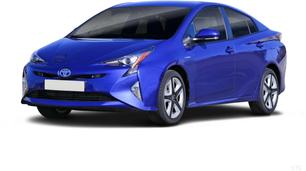
The Prius is the very visage of economic motoring. Derided by big-engine lovers, and adored by the eco-crowd, the fact that the Prius’s wedge-shaped frame is more about function than form tells you everything you need to know about this car.
It blends with Toyota’s latest design language, the face and bodywork containing some subtle nods to other models that would launch after it, like the Corolla, Camry, and C-HR.
What always surprises me about even this top-spec Prius is its dorky ride height. For a car with such a low drag coefficient, it sits so far off the ground! The 17-inch wheels look almost out of alignment with the body in those wheelarches.
Round the back, the Prius’s integrated spoiler and glasshouse bodywork are as divisive as ever, with more extreme pointed light fittings leaning into the effect created by its boxy, rear three-quarter view and mirroring the shape of the LED headlights at the front.
Of course, this car is less about being looked at as it is about its drag coefficient of 0.24 Cd, which is one of the lowest on any production car.
Inside, things again prove divisive, with a minimalist dash, a swoopy gloss highlight piece that frames the central vents and multimedia screen, and an odd, centrally mounted dash cluster, which is a usability faux pas.
In the case of the I-Tech at least there’s a holographic display which can put up useful information to help prevent your eyes from drifting too far from the road. Still, I can’t help but feel like this whole interior ethos is futuristic for the sake of being futuristic, with a little less thought given to how practical it is, compared to the brand’s other models.
The leather-appointed trim across the wheel and soft plastics in the door and dash-topper are appreciated, and there’s attention to detail in the little ‘Prius’ logos on the vents. However, I found the dull multimedia screen to be susceptible to glare during the day, and the big integrated panel in which it sits is made from a tinny gloss plastic, which will easily to get covered in fingerprints and scratches.
It's a little curious, the LC 500h. For mine, it's stunning from a distance. All gleaming alloys and bulging rear arches and sharp snout angled downward like its caught the scent of its prey.
But weirdly, it can start to look a little less impressive the closer you get to it - a little swollen and vague in its lines. It's very likely it's eye-of-the-beholder stuff (fellow CarsGuide scribe Richard Berry adores it from every angle, for example).
Inside, the front of the cabin is a busy but stylish space, with multiple textures layered on top of each other to produce a premium-feeling, sporty space. The low-feeling dash juts out, giving the front passengers an ensconced, cockpit feel.
Everything is predictably leather-wrapped and lovely, and while it's not as streamlined as, say, an Audi interior, it's not without a genuine sense of Japanese charm in the cabin.
If nothing else, all of the Prius’s edgy design gives it plentiful interior space. Toyota granted this generation of Prius a low seating position and tall roof, which combine with the distant dash elements to make for a spacious cockpit for the front two occupants.
The seat design in the top-spec I-Tech is also cushy, reminiscent of the seats in high-spec Camrys, and I had absolutely no trouble finding a comfortable driving position. If there’s one thing to be said for the annoying, centrally mounted instruments, it’s that you don’t need to consider the position of the wheel interfering with their visibility.
The Prius’s total glasshouse grants superb visibility out the front and sides, with large wing-mirrors, too. The only downside is that integrated spoiler at the back, which makes for a distracting view out the rear mirror that I’m sure any owner will quickly become accustomed to.
Soft trims across the doors and centre console, even in the back seat, make the Prius cabin a comfortable place to be, too.
Ergonomics have not been forgotten, with the multimedia screen and climate unit having useful and easy-to-reach physical dials and toggles for all the key functions. Even changing gear is a breeze in the Prius, with its odd little rosebud-shaped shifter simply a flick of the wrist from where your arm sits.
I do wish Toyota had made better use of the large area under the climate unit, however. The front part of the centre console is exclusively for the wireless-charging bay alone, and the rest of the space is constructed from a smoothly contoured gloss-finish plastic panel. It has looks to match the Prius aesthetic, but it’s no good for storing anything other than a single phone. It would have been better to make a large bay here with a rubberised finish.
Thanks to the lack of a physical handbrake in the centre or any other buttons or functions, there are two large bottle holders with variable edges.
A huge centre-console box and large door bins round out the Prius’s front-seat storage options.
Room in the rear seat is excellent, my 182cm tall frame had stellar amounts of space for my legs and head, as the roofline continues through to that raised rear spoiler. The comfy seat trim continues, although the padding in the base is notably not as good as it is in the front.
There are some useful pockets on the backs of the front seats and a drop-down armrest with cupholders for rear passengers, too.
Finally, the awkward rear of the Prius makes for a fantastic boot capacity, one advantage this car still holds over its hybrid Toyota stablemates. Capacity for the I-Tech is a mid-size-SUV rivalling 502-litres (VDA), which easily consumed our CarsGuide test luggage set and is even bigger than the base Prius, at the cost of the space-saver spare wheel. The I-Tech only has a repair kit to go with its larger alloys.
It's not really. Especially in the backseats, which would make more sense if they were painted on. I'm no giant, but even my 175cm-tall head was pushed into the ceiling, and while there’s ample shoulder space for two adults, you’re unlikely to be able to convince two to get back there.
Lexus has included something called the "Easy Access" function for 2020, which sees the front seats slide forward automatically to help with accessing the rear seats, and they do lower the Cirque du Soleil antics required to get back there, but this realistically not a car for carrying more than two adults, save an emergency. There are two ISOFIX attachment points in the rear, so child seats can be locked in there.
That's not necessarily a drawback, though. This is a two-door sporty coupe, after all, and elsewhere, the sizeable dimensions (4770mm length x 1920mm width x 1345mm height) provide plenty of space for up-front riders.
You'll also find hidden cupholders, bottle holders in the doors, and all the power and connection points you need.
A word on the tech, though. The LC 500h is crying out for a touch screen, though the brand's traditional mousepad system is improving.
This Toyota Prius in top-spec I-Tech form costs a whopping $45,825 before on-road costs, which is a tall order, especially given the fact that the technical advantage this car once had to help justify its price-tag has been lost to the rest of Toyota’s range.
An equivalent Corolla hybrid, even in top ZR trim, can be had from just $34,695, and even the much larger Camry in its highest hybrid SL trim is more affordable, at a suddenly cheap-looking $42,790. All three Toyotas are sourced from Japan.
Not a good start in the value battle, then, especially since those other Toyotas are not just hybrids, but great cars in their respective segments.
The Prius I-Tech’s most direct rival is the similarly shaped and sized Hyundai Ioniq Premium, which can be yours from $40,390 with competitive equipment. Hyundai is not only hunting Toyota with this car, but flexing its deep pockets by selling the Ioniq in Australia as not just a hybrid, but a PHEV and a full EV, too.
Thankfully, the I-Tech comes with some decent gear, sporting 17-inch alloy wheels, a 7.0-inch multimedia touchscreen with Apple CarPlay and Android Auto connectivity, digital radio, a 4.2-inch digital information display, a holographic head-up display, full LED lighting with auto-levelling, leather-appointed seat trim, auto dimming rear vision mirror, wireless phone charging, 10-speaker audio, and improved interior trims over the base car.
The I-Tech also scores a larger boot capacity and an improved safety suite compared to the base Prius. More on that in later sections of this review.
Is the Prius “good value” then? It's still a no, as all of this equipment can be had in bigger, more mainstream Toyota models, and far more affordable rivals. It’s a shame Toyota hasn’t brought the Prius’s cost down in the five years since this generation launched, because in today’s market it makes less sense than ever.
That said, there is a certain niche audience for this car. One that will always love its little innovations, like the fact that it has one of the lowest drag coefficients on the market, its stellar fuel-consumption number, and its claimed 40 per cent thermal efficiency.
Value is all about perspective, of course, and viewed the right way, the $195k sticker price of the Lexus LC 500h does provide a certain amount of value.
Yes, it's a lot of money. But Lexus' flagship coupe doesn't just get a performance-focused hybrid setup (pairing with a thumping V6 engine), but also just about every high-end feature the brand has in its deep bag of tricks.
It starts outside with giant 21-inch alloys, a glass roof with a sun blind, LED headlights with cornering lights, hidden door handles, keyless entry, and rain-sensing wipers.
Inside, you'll find leather-accented seats, a colour head-up display, a 10.3-inch multimedia screen with Apple CarPlay and Android Auto, another 8.0-inch screen in the driver's binnacle, a heated steering wheel, heated and cooled front seats, DAB+, satellite navigation system with live traffic, and a killer 13-speaker, 918-watt Mark Levinson stereo.
It wouldn’t be a Prius without Toyota’s signature hybrid synergy drive technology. In this most original case it consists of a 1.8-litre four-cylinder petrol engine, which uses the more thermally efficient but less powerful Atkinson combustion cycle, producing 72kW/142Nm, paired to a set of electric motors on the front axle, which can produce up to 53kW/163Nm.
Combined system output is rated by Toyota at 90kW, driving the front wheels only via a continuously variable automatic transmission (CVT). This system is the same one now also employed in the C-HR and Corolla hybrid grades.
The Prius’s electric motors source their power from an older design nickel-metal hydride battery (instead of the more modern lithium-ion setup) located under the boot floor.
The LC 500h is powered by a hybrid setup that combines a 3.5-litre V6 engine with a 650-volt "Lexus Hybrid Drive" system and a lithium-ion battery. That setup delivers 264kW of power, and somewhere north of 350Nm in torque when the engine and motor outputs combine.
That power is sent to the rear wheels via a CVT automatic, and will produce a sprint to 100km/h of around 5.0 seconds.
According to Lexus, 10 clear improvements were made the way the 2020 LC 500h drives, including a new transmission tune, more structural bracing added for rigidity, new suspension components and spring rates, and altered stabiliser bars.
Has it made a difference? Read on.
The Prius’ sandpapered hybrid drive, low drag number, weight reductions, and low-rolling-resistance tyres add up for a stellar official/combined fuel-consumption figure of just 3.4L/100km. While its signature hybrid tech might be available on other Toyota’s, it’s here where the Prius still shines, undercutting the others by almost a whole litre every 100km.
But can it live up to that promise in the real world? Over my week of what I would consider to be reasonable ‘combined’ driving conditions; with plenty of traffic, freeways, and suburban driving, the Prius returned a stellar figure of just 4.0L/100km. This is not just one of the lowest figures I have ever achieved on a test car, it is even lower than the Corolla Hybrid that I tested over a three-month period. I couldn’t get that car below 4.9L/100km, despite by best attempts.
For a true rival comparison, my week-long test of the Ioniq hybrid in 2019 had the Korean managing a fuel number of 4.6L/100km.
You need not worry about kWh energy consumption for the Prius, as its hybrid system’s software manages the state of battery charge on the fly. It will simply run the engine to charge the battery if levels drop too low, although it always feels good to make the most of the motor’s regenerative braking to keep the battery topped up.
It’s clear that the Prius is still the king of hybrid, then. At least for the time being. All Prius models have 43-litre fuel capacities and are able to consume base-grade 91RON unleaded.
Lexus says the LC 500h will sip 6.8 litres per hundred kilometres on the combined cycle - very impressive for what is ostensibly a performance coupe - and emit 152g/km.
The LC 500h is equipped with an 82-litre fuel tank.
The Prius was responsible for popularising Toyota’s Hybrid Synergy Drive, and fittingly, it still feels like the best execution of the technology on the market. That instantly available torque from the electric motor is sleek, quiet, and easy. It feels as though the Prius can make more extended use of purely electric drive than not only its rivals, but all other Toyota and Lexus hybrid products.
Despite its awkward exterior looks, the ride and handling of the Prius are excellent, thanks to its robust TNGA-C underpinnings (in fact, the Prius was the car to debut this platform for Toyota). It tilts into corners nicely, despite a frumpy ride height, and deals with bumps in its stride. This is a comfortable car, and the Lexus influence here is undeniable. The steering characteristics are also smooth and responsive. I wouldn’t go so far as to say the Prius is fun to drive, but it is certainly comfortable and compliant.
What the Prius lacks is the lower, firmer, and more aggressive ride and handling characteristics of its Hyundai Ioniq rival, perhaps a telling insight into the trajectory of each brand.
These characteristics add up to an around-town driving experience that really is a breeze. It’s quiet in the cabin and at times genuinely hard to tell whether the car is using its electric motors or the engine. When it comes to bursts of acceleration, the Prius might surprise you. Using both the motor and engine in tandem, I found that the Prius can sprint from the line with an alarming urgency, more so than its Corolla sibling. With the same tech behind the accelerator pedal, it’s hard to imagine why.
Once the electric motor has reached its strictly defined limit, though, the engine breaks in with a vengeance, and this car does have an anaemic follow-through when the electric components fall to the wayside. As in other applications of this drivetrain, the 1.8-litre Atkinson-cycle petrol engine can be thrashy and noisy when a lot is asked of it.
Of course, driving in such a sporty manner is hardly the point of the Prius, and where it really excels is in that day-to-day traffic grind, where the hybrid system works largely in the background to maximise the time spent with the engine off. The best part? While you can really fall into the hybrid system’s addictive fuel-saving displays, which really encourage hypermiling, this is a set-and-forget system. You can drive the Prius like any other car, and it will be trim on fuel consumption anyway. It’s not like I was trying awfully hard to attain my weekly figure of 4.0L/100km, so I’m sure it can do better over the long term.
There’s something very strange about hitting the start button in what is ostensibly a sports car, and being greeted not by the bark of an exhaust, but by the gentle whirring on the car’s electronics coming to life.
But then, the Lexus LC500h is not your average performance car.
It essentially trades the out-and-out grunt of its V8-powered sibling (which produces a monstrous 351kW and 540Nm) for a kind of best-of-both-worlds approach that pairs the punch of the V6 engine with the fuel efficiency of a hybrid powertrain.
If that sounds like an compromised approach to pure performance, you're right. But reframe the way you look at the LC 500h and it all starts to make a bit more sense.
Remember, this isn't a track-attack weapon, but a potent on-road bruiser, and the flow of power on offer always feels ample, and you never want for too much more off-the-line pace on public roads.
Among the biggest selling points of the LC 500h is the sheer distance between its various personalities. Engage Eco, or even Normal, drive modes, and it’s a quiet, mostly very comfortable (though it can be unsettled by bigger bumps) kilometre-eater, but engage Sport or Sport Plus and it rightly transforms into something significantly angrier.
It might not be the absolute sharpest tool in the performance car shed, but the LC 500h does bristle nicely when those modes are engaged, the hybrid factor seemingly replaced by a satisfyingly meaty exhaust note and an accelerator that’s suddenly far more sensitive to the touch.
The steering feel is nice and the inputs direct, but there is something about the car’s 1980kg weight that doesn’t inspire the deepest of confidence, at least not on the rain-slicked roads we were travelling along .
A pure performance coupe? Perhaps not. But a sporty, stylish and, when you want it to be, comfortable cruiser with the ability to turn the volume up when you come across a twisting road? Bingo.
The Prius wears a maximum five-star ANCAP safety rating to the 2016 standards, although even in today’s market it has a great active-safety suite.
Standard modern active features on all Prius models include freeway-speed auto emergency braking with pedestrian and daytime cyclist detection, lane-keep assist with lane-departure warning, adaptive cruise control, traffic-sign recognition, and auto-high beams. Our top-spec I-Tech adds blind-spot monitoring and rear cross traffic alert, for an overall excellent suite.
All Prius varaints are also equipped with seven airbags consisting of the standard front, side, and head, as well as a driver’s knee airbag, and the standard array of electronic stability and brake controls are also present.
The Lexus LC 500h is yet to be ANCAP tested (the price would likely prove a sticking point), but the Japanese brand has fine form in attracting top marks, and there's certainly no shortage of safety features on offer here.
There's a total eight airbags and a reversing camera and parking sensors, as well as a host of high-tech kit like AEB, Lane Keep Assist, Blind Spot Monitoring, active cruiser control and a bonnet that will sense pedestrian and pop up before impact in an attempt to minimise injury.
Toyota’s range-wide warranty currently stands at five years or unlimited kilometres, which is really the accepted industry standard and matches its key Ioniq rival.
Annoyingly, however, the Prius needs to adhere to six-monthly or 10,000km service intervals. Said intervals are capped to $165 per visit for the first six visits under Toyota’s “service advantage” program, after which time you fall back to Toyota genuine servicing with significant price hikes to $221.97, and $425.47 for the next two services covering four years or 80,000km.
A year of roadside assist is included, after which time you will need to subscribe to Toyota’s program, from $89 a year.
While Toyota’s offering is on par with many, it’s hardly the cheapest or most comprehensive we’ve seen.
So, to ownership. Let's start with the basics first, before we move onto the new Encore Platinum benefits.
The LC 500h is covered by a four-year/100,000km warranty, and servicing (capped for three years at $595 a pop) is required every 15,000km.
You will know already the Lexus's stellar Encore ownership program includes handy features like valet (pick-up and drop-off) servicing, but the new Encore Platinum level for owners of its more exclusive models unlocks some seriously cool stuff.
One is a new On Demand service, which allows owners to book a different style of car when heading off on a holiday or business trip. So, say you own the LC 500h, but want to take the family to the snow and need a seven-seat 4WD like the RX L, then Lexus will lend you one at no charge, which you can keep for eight days.
The loans are available in your state or somewhere else in Australia if you're travelling, with your car waiting for you at Qantas Valet for you when you arrive.
The One Demand service is available on four occasions over your first three years of ownership (which is also the length of the Encore Platinum membership).
The Platinum level also provides eight examples of free valet parking at select shopping centres, as well as hotel and restaurant benefits, and invitations to Lexus' drive days around the country.