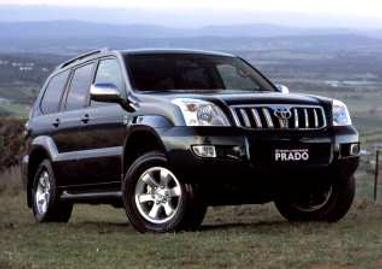
Are you having problems with your 2007 Toyota Prado? Let our team of motoring experts keep you up to date with all of the latest 2007 Toyota Prado issues & faults. We have gathered all of the most frequently asked questions and problems relating to the 2007 Toyota Prado in one spot to help you decide if it's a smart buy.
A sensible cross between a full-on 4WD and a passenger carrying SUV, the Toyota Prado is built by the Japanese company that’s now in its sixth decade in the off-road field in Australia.
It's not unusual for them to have injector issues, which usually shows up by heavy knocking when the engine is cold and is fixed by replacing the injectors. If it only occurs on a slope, however, I would be making sure it isn't an oil pickup problem, and I would have the oil pickup in the sump checked to make sure it isn't partially blocked.
You could make a claim for the cost of the 120,000 km service to be refunded, because it wasn’t done correctly, but you don't have much of a case for the engine repair. As the previous owner serviced the car and not Toyota, and the seals weren’t changed, Toyota has a perfect out.
It's not an uncommon problem. It starts with a leakage past the fuel injector seals and ends with the oil pick-up in the sump blocked by a carbon build-up. Eventually the engine loses oil pressure and the engine is destroyed. Toyota recalled and fixed affected vehicles in other countries, but chose not to do anything here. You could try approaching the company to get some compensation for the cost of replacing the engine, Toyota has done it for others who have pressed their case. If that fails you could consult your state consumer affairs people.
If the engine hasn't sustained any damage then I would keep it. But having been warned about the problem I would be very careful about the servicing going forward. The fuel-injector seals are meant to be replaced every 40,000 km service and it's crucial that they are. If they're not fuel can leak into the oil and carbon deposits can develop. The problem is that the carbon can ultimately block the oil pickup in the sump, which is what can cause your engine to seize. If you do decide to keep the Prado have your mechanic check the oil pick-up to make sure there isn't anything that could lead to blockages in the future.
I doubt that your engine had a problem with the cooling system; it sounds like a major meltdown, perhaps due to oil starvation, or a problem with the fuel system that has caused it to severely lean out and damage the pistons. I would suspect it's the latter. Whatever has caused the problem you are up for a new engine, and I would go for a new one over a reconditioned one. While it's more expensive your car has only done 118,000 km so it's still relatively new. I would suggest you remove the aftermarket computer chip and return the computer to factory stock. The chip could well be the cause of your problem. As for assistance you can only consult mechanics, in this case I would consult one that's experienced in Toyotas and Prados.
I haven’t heard of a local class action against Toyota for this problem. It’s a mistake to assume that Australian and USA consumer laws have too much in common, so what happens in North America regarding recalls and fixes isn’t always mirrored here. But it is a fact that Toyota in the USA and Canada has agreed to repaint some of its models that were originally painted in either of two shades of white. In those cases, the paint delaminated from the undercoat and literally fell off the car.
What’s much more common in Australia is that the clear-coat (the outer layer of clear paint that gives the finished car its gloss) fails and starts to peel or flake off. By the time that’s happened, the actual colour-coat is usually compromised, too, and repainting the vehicle is the best bet. Metallic colours are notorious for this happening (they are the most likely to use a clear-over-base paint finish) and it’s by no means a Toyota-specific problem.
It happens because the paint used can’t handle Australian levels of heat and UV radiation and it simply fails chemically. Cars from the 1980s and 90s were probably the worst offenders, but some newer cars also suffer the same problem, usually when they’re out of warranty, of course. And just as it isn’t limited to Toyotas, nor is the problem specific to imported cars; plenty of Aussie made Fords and Holdens suffered the same paint deterioration.
Toyota did have a spate of diesel engine failures some years ago when it was discovered that the fuel injector seals were leaking and letting fuel into the oil stream.
Sludge would build up on the oil pickup and eventually it be blocked and the engine would lose oil pressure. As you say the pickup can be inspected through the oil drain hole, so you should be able to see if there is a problem there. It is worthwhile changing the injector seals every 45,000 km.
The oil sludging is believed to be caused by fuel leakage past the fuel-injector seals into the oil stream. Eventually it can lead to the oil pickup being blocked, which then starves the engine of oil. It's a known problem in other parts of the world, but Toyota has not done anything about it here, even though we know of a number of cars that have suffered severe engine meltdowns. To make it worse the oil seals in question are supposed to be replaced at the 40,000km service when the valve clearances are checked and reset. It's clear that this isn't always done. Like you, I would be very angry about having the engine fail at such low kays, and I would be letting Toyota head office know about it in no uncertain terms. I know of one owner who managed to get them to replace the engine in his car when it had done over 200,000km, so I would urge you not to take Toyota's "no" for an answer and push them to the limit. Take action through Consumer Affairs if needed. Don't worry that the Toyota warranty has expired, the company still has an obligation to sell you a product that is fit for purpose, and it would seem in this case that it has not.
Show more
Disclaimer: You acknowledge and agree that all answers are provided as a general guide only and should not be
relied upon as bespoke advice. Carsguide is not liable for the accuracy of any information provided in the
answers.