What's the difference?
If you have even a passing interest in the Tesla Model S, you'll have seen the endless internet videos where someone has lined up a Ferrari, Lamborghini, or another fast exotic car you could name, to race against it.
There's a long build-up, usually involving men who can't operate a baseball cap, a drag strip and idiotic words in the headline like "destroys" or "rips", or whatever. There's usually a bunch of honking bros with bad haircuts watching on, already planning their next viral video where they set a perfectly good mobile phone on fire.
It's facile and idiotic and doesn't give you any real clue as to the depth of whatever supercar it has "humiliated" or, just as importantly, the depth of the Model S and its spectacular engineering.
So, I won't be spending the next thousand words building up to the conclusion that the Model S P100D with Ludicrous Mode is up there with the world's fastest production cars from 0-100km/h, because I'll tell you now that it is, and it does it in a claimed 2.7 seconds.
Now that's out of the way, there's quite a bit more to the Model S than a "broken" Nissan GT-R owner weeping into their bento box.
BMW has been incredibly smart with its electric vehicle (EV) offerings in Australia to date.
Ever since the Fringe Benefits Tax (FBT) exemption was introduced for novated lease buyers of EVs under the Luxury Car Tax (LCT) threshold, the German brand strategically introduced versions of its EVs that qualify.
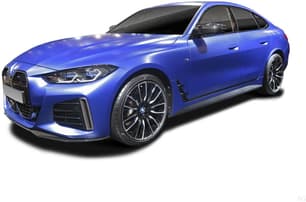
The BMW i4 eDrive35 electric liftback, which is based on the locally defunct 4 Series Gran Coupe, is one of these cars.
It recently received a mid-life update that brought more range and features, while remaining under the LCT threshold for fuel-efficient vehicles.
However, the plot thickens. BMW is soon set to launch its new i3 electric sedan which is based on the company’s Neue Klasse dedicated electric architecture.
BMW hasn’t given the i4 an official production end date, however overseas reports indicate it’ll end as soon as next year to make way for the new i3.
Should you hold out for this new-generation car, or does the i4 still hold up? Read on to find out.
I spoke to a friend who bought a Model S before one had even hit the ground here in Australia. He chuckled when I told him how much this car cost but then said something I'd already suspected. "My mates who own a P100D would never drop that kind of money on a normal car. Buying a Tesla is like buying shares in the company, you're buying into the future."
And that's kind of the point. A $300,000 Audi RS7 (fully-loaded, obviously) is a bit slower in a straight line, looks just as good, is extremely well-built and emits noises that make people like me go as weak at the knees (just as the Model S' acceleration does). And would probably win a 10 lap race with the Tesla around Mount Panorama.
The Tesla is the future of cars. It may still be decades before the internal combustion engine is gone, but Tesla buyers are getting the jump, and today the Model S is the best car in which to make that leap.
The BMW i4 balances a solid, old-school feel with the beauty and stunning looks of high-end technology. It feels like the end of an era for the German brand before it leaps into the screen-heavy age of software-defined vehicles.
While BMW hasn’t publicly announced an end-date for i4 production just yet, the new i3 is bound to overshadow it once it arrives. It offers more than double the claimed range and will likely address a number of this car’s flaws.
In the meantime however, the i4 is definitely worth considering if you value driving dynamics and a quality feel in a car that you can drive daily.