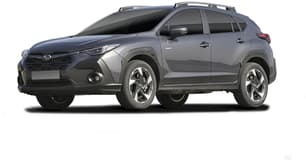
What's the difference?
Things are going well for Subaru. In the first half of 2023, all of its models in Australia are outselling their figures for the same time last year by hundreds, some even by thousands.
Except for one model, the XV. In fact, sales have plummeted! So what happened to it? It was one of the brand’s top sellers, right?
Well, it’s still here, but now it’s called Crosstrek in Australia as it already is in the rest of the world. And maybe we lied a little - it’s selling very well. In June 2023 it outsold the Forester and Outback, both well established models in Subaru’s local history.
But the name isn’t all that’s new, because this Impreza-spinoff SUV now comes as a hybrid - available here as the Crosstrek Hybrid S.
Traditionally, Subaru has been pretty… traditional. So, will a step towards the future - electrification, that is - help or hinder the Crosstrek’s rise to mass popularity?
The 2022 Mitsubishi Eclipse Cross has a new high-tech powertrain that allows it to run as an electric car, or run using the petrol engine, or even use both at the same time.
But the new hybrid SUV is not like a Toyota hybrid - because this one can be plugged in at home to recharge the batteries, and you should be able to get at least 50 kilometres of EV driving out of just a few dollars worth of electricity.
We’re talking about the new 2022 Mitsubishi Eclipse Cross Plug-in Hybrid EV, or PHEV as we’ve called it in the past. The brand has renamed it to include both ‘Hybrid’ and ‘EV’ in the name because, well, it reckons those terms have a bit more cut-through today than when the company first launched its Outlander PHEV back in 2014.
But with the new Eclipse Cross PHEV variants attracting a huge premium over the regular petrol-turbo models, does the extra money buy you a better car? Let’s find out.
It’s not perfect, in fact, the Crosstrek has a few factors that would probably turn off groups of buyers at a time, but Subaru knows its audience isn’t ‘everyone’.
Subaru customers aren’t trying to get their fuel efficiency below 4.5L/100km, nor find the car with the most luxurious interior. They’re looking for a practical Jack or Jill of all trades, which the Crosstrek does rather well for its segment.
Few small SUVs are as agreeable on rough and unsealed roads without sacrificing suburban comfort, while its features list is practical and provides plenty for the money.
Unfortunately, the hybrid system is a little underwhelming, and if it’s the main draw of the Crosstrek for you, it could be worth considering the less expensive ($38,590) Hybrid L or even a hybrid rival like the Toyota Corolla Cross or Mitsubishi Eclipse Cross.
If the all-round ability of the Crosstrek is the draw, however, the non-hybrid L is still an excellent offering and doesn’t use a lot more fuel than the Hybrid - plus it’s several grand cheaper at $41,490.
The Crosstrek is great for active people who need a bit of flexibility in one car but for the vast majority, the hybrid probably isn’t the sweet spot in the range. However, that won’t hinder the Crosstrek as an overall model, its popularity is already proven, and the option of a Hybrid puts Subaru a little closer to the eventual necessity of electrification.
The Mitsubishi Eclipse Cross Plug-in Hybrid EV is an interesting inclusion for the brand, especially as it is typically considered a ‘value player’ in the market.
But with negligible real-world fuel consumption benefits if you drive beyond the limited EV range and a high price premium over the non-PHEV models, it’s important you see if the sums add up for your particular needs.
Primarily going to use the car for running around town? Cool. Think the 50-ish-kay EV range will work for you and make you happy? Amazing. Sold on the look of the car? Hat tipped.
But let me say this - if you are considering the Eclipse Cross PHEV, there are some alternatives you should also have on your list, including the MG HS PHEV, the Hyundai Ioniq PHEV, Kia Niro PHEV, and - the one I’d buy - a Toyota RAV4 Hybrid. For me, plug-in hybrid tech is a bit of a halfway house, in most instances offering too high a price premium for the range you’re getting to drive electric. Heck, a Kona Electric isn’t much more than the top-spec Exceed PHEV, and I’d have that if I wanted a real day-to-day EV experience.
Perhaps unsurprisingly, the new Crosstrek looks an awful lot like its a development of the Subaru XV.
Which, given the latter’s popularity, is a very good thing.
While there are a lot of similarities, especially when it comes to some of the more rugged elements, the Crosstrek still manages to look quite new.
It’s rugged without having too many ‘busy’ design elements and it even looks at home in inner-city suburbs.
Of course, its raised body and cladding are mostly for practical reasons, but it gives the small SUV an adventurous aesthetic that separates it from city-focused rivals.
As essentially a high-riding development of the Impreza hatch, its size and proportions also make it look more like a ‘big car’ than a small SUV.
You’re going to be able to tell the PHEV model from its more conventional counterparts by those oversized ‘Plug-in Hybrid EV’ badges on the front doors, and if you want to tell those behind you what you’re driving, there’s also a ‘PHEV’ badge there, too. Wait, wasn’t the plan to do away with the term ‘PHEV’, Mitsubishi?
But aside from that, the outside features just the different 18-inch alloy wheels (which are the same on all PHEV models, no matter the cost - I think that’s a bit lame, because if I’m spending $7500 on the Exceed I’d like a different wheel design!). Oh, and the Aspire and Exceed get that different lower front splitter, too.
Plus the PHEV has two fuel filler doors - one on each side of the car over the rear wheels. The driver’s side one is the EV charging ports (x2 - detailed below), and the passenger’s side one is for the petrol. Note: while the EV port is push-openable, the petrol cap still requires you to lift a lever in the driver’s footwell.
It may be categorised a small SUV but at 4545mm long, riding on a 2670mm wheelbase, 1805mm wide and 1685mm tall, it’s big for its boots. The popular Mazda CX-5 is only 5mm longer, and it plays in the midsize SUV segment!
Inside there are some design differences, with a specific gear joystick-style selector, and a different instrument panel.
It is impressive how the brand has managed to shoehorn a petrol engine, two electric motors, a battery pack and more into the car, but there are some practicality implications. Read about them in the next section.
Practicality is pretty much a staple of Subaru as a brand, so it should be a huge surprise that it feels that way from the driver’s seat.
The interior doesn’t look futuristic, but it does look functional.
For example, even though the centre of the dash is all screen - and we love buttons for climate controls around here - the controls for air conditioning and temperature are at least always present on the screen, no sub-menus needed.
The phone charger is large enough for even very tall phones (looking at you, Samsung Galaxy S20 Ultra, pictured), and it’s out of the way to minimise extra digital distraction.
The steering wheel’s buttons, while many, are all clear and simple, as is the iPad-like icon layout on the multimedia screen.
Storage in the front is miles ahead of the rear seats, a large central bin with two cupholders, a big glove box, and decent space for water bottles in the door cards. In the rear, two central cupholders in the armrest and a small space in the door.
But there is a decent amount of space for an adult to sit in the rear, even if the sides of the roof are a little close to the head. It’s a little like the front, where the seats are supportive and easy to adjust to a comfortable position.
Further back, the boot space is a relatively small 315 litres, though its slightly larger than the 291L the petrol versions come with - that extra space likely swallowed by a spare tyre in the petrol versions, as opposed to the smaller batteries taking up some space in the hybrids.
Up front, the cabin is a pretty smart place, with nice enough materials and finishes, and a few good storage options. There’s a cubby in front of the shifter, but oddly enough it doesn’t have a wireless charger (there are 2x USB 2.0 ports above) and isn’t quite big enough for a smartphone (even the smaller ones don’t fit there all that easily), and there are cup holders between the seats, a decent covered centre console bin, and door pockets large enough for bottles.
The PHEV models get a different instrument cluster dial for EV driving readout info, but all have the old-school 4.2-inch TFT colour display that lacks the size and usability of some rivals with larger info screens - the MG HS PHEV, for instance, has a 12.3-inch digital display, which shows you a lot more info than this tiny little screen does. Heck, there’s not even a digital speedometer in there - and you only get one if you buy the Exceed model, which has a head-up display (HUD).
That’s part of the problem with the way this car’s interface operates. If you want the most detailed information you need to use the touchscreen media system, but that negates the usability of the media functions. On multiple occasions I found myself switching between Apple CarPlay phone calls and searching for that particular driving info screen I found most useful (there are about 15 screens to choose from, and plenty of them are hard to decipher).
It’s a huge disappointment for a customer who might want to see all that detailed information but also listen to a podcast, answer a call, follow their phone’s mapping or just have anything other than the hybrid info come up on the infotainment screen. The screen itself - an 8.0-inch unit, with sat nav integrated into the top spec only - is fine, but small compared to today’s rivals.
In the back seat, there’s a compromise for cabin space. The leg room is good, but the seat has been bumped up to accommodate some of the electrical hardware and the petrol tank, meaning someone my size (182cm/6’0”) will find they’ve got enough room for their legs but not their head, and those even larger will really need to take care getting in and out. While pre-facelift examples of this car had a clever sliding second row seat, that’s gone. It was never a feature in any PHEV version, and undoubtedly the layout of the battery pack has something to do with that.
The double pane sunroof no doubt eats into the space in the rear to a degree as well, and in the Exceed it likely feels a bit more cramped because of the black headliner.
While three adults could potentially fit across the back row for very short trips, there are dual ISOFIX and three top-tether points for child seats. The Exceed is the one you want if you’re aiming to treat your rear-seat passengers right: it has heated rear outboard seats, rear directional air vents and two USB ports for charging - the ES and Aspire miss out on all that stuff.
Boot space is 359L (VDA) for PHEV models, which is a step down from the 405 litres (VDA) for the non-hybrid models. There is extra hardware under the floor, and you don’t get a spare wheel in the PHEV models either - instead there’s a tyre repair kit. For context, we only just managed to fit all three CarsGuide hard suitcases (124L, 95L and 36L) in the boot of the PHEV version, while it was far less of an issue in the non-PHEV.
Oddly, no model comes with a power tailgate.
When you’re wearing a hybrid badge and you’re up against veterans in the field like Toyota with the Corolla Cross, you want to make sure you’re offering up something substantial.
At $45,090, before on-road costs, the Hybrid S tops the range and comes with a features list that screams it from the rooftops. Or the mountaintops. Or at least as far as the gravel tracks will take you towards the mountaintop.
From the outside, 18-inch wheels are the first indicator for the ‘S’ grade - note that hybrids don’t come with spare wheels, just repair kits - as well as body coloured door handles and black plastic trim and cladding, aside from the gloss mirror caps.
The door mirrors are heated and fold away when parked, while up top there’s a sunroof flanked by roof rails, with a styled spoiler at the rear.
Interestingly, there’s no power tailgate.
LED DRLs and headlights are automatic and are aided by steering responsive active cornering lamps, while the wipers are auto rain-sensing.
Inside, dual-zone climate control and heated front seats (the driver’s is eight-way power adjustable) for the cold - all seats are leather accented - while the steering wheel and shifter are also leather-wrapped.
Tech is covered off by the usual 11.6-inch portrait touchscreen centrepiece, with sat-nav, AM/FM and digital radio, wireless Android Auto and Apple CarPlay, USB-A and USB-C plugs (in the rear, too), a wireless phone charger, and a 10-speaker Harman Kardon sound system over the usual six-speaker set-up. There’s even an auxiliary audio input.
The driver display is a small 4.2-inch unit flanked by physical dials.
The 2022 Eclipse Cross PHEV line-up is expensive compared to the petrol-turbo models.
The ES AWD has a list price (all prices MSRP, before on-road costs) of $46,490, while the mid-spec Aspire costs $49,990 and the top-end Exceed lists at $53,990.
I know they’re not like-for-like in every instance - the ES and Aspire petrol-turbo models are 2WD, not AWD, for example, and there are some specification differences, too - but the price jump from each respective non-PHEV version is $15,500 (ES), $14,250 (Aspire) and $12,500 (Exceed).
Yikes.
You’d really, really have to want the EV driving experience to justify that additional expenditure, right?
Here’s a rundown of the specifications across the three PHEV grades.
Standard for the $46,490 ES grade are 18-inch alloy wheels, LED daytime running lights, halogen headlights, keyless entry and push-button start, cloth interior trim, manual front seat adjustment, an 8.0-inch touchscreen media system with Apple CarPlay and Android auto, a reversing camera, a four speaker stereo, digital radio and a rear cargo blind.
Step up to the $49,990 Aspire and you score LED headlights and fog lights, a lower body kit, heated front seats, faux-leather and microsuede trim, auto wipers, adaptive cruise control, an eight-speaker stereo, surround view camera, front and rear parking sensors, and an array of safety equipment that we’ll cover off in the safety section.
Choosing the range-topping $53,990 Exceed model nets you leather seat trim, a heated steering wheel, a head-up display - making it the only grade with a digital speedo! - as well as sat nav, a dual pane sunroof, and a black headliner in the cabin.
This is perhaps the part of the review you’re most interested in - as well as the following sections on efficiency and maybe driving - if the ‘Hybrid’ part of the Crosstrek Hybrid S’ name brought you here.
Like its design and interior, the engine will be familiar to anyone who has owned or driven a relatively recent Subaru - a 2.0-litre flat-four petrol engine good for 110kW/196Nm - which means it makes a little less than the standard petrol variant’s 115kW.
However, the electric motor is capable of its own 12kW/66Nm outputs, though Subaru doesn’t supply a claimed total maximum for the whole powertrain.
Drive is transferred to all four wheels - it is a Subaru after all - via a seven-step continuously variable transmission (CVT).
The plug-in hybrid version runs a non-turbocharged 2.4-litre Atkinson cycle petrol engine producing just 94kW and 199Nm.
Meagre outputs, but the petrol unit is backed by two electric motors - the front motor has outputs of 60kW/137Nm, while the rear motor produces 70kW/195Nm. It’s all controlled by a single-speed transmission.
There is no ‘combined power output’ figure, but there is a 13.8kWh lithium-ion battery pack as part of the equation as well.
The engine can power the battery pack in series hybrid driving mode, so if you want to top up the batteries before you get to a city, you can. And there is regenerative braking, of course. More on recharging in the next section.
Subaru claims the Crosstrek Hybrid will sip 6.5L/100km on the combined cycle, which isn’t enough to blow anyone away, even when you take into account the extra fuel needed for permanent all-wheel drive. The AWD Corolla Cross Hybrid comes with a claimed 4.4L/100km.
Compare this to the 8.5L/100km reading the Crosstrek returned after our time with the car, mostly with a (somewhat unkind) mix of inner-city and semi-rural backroad driving, and it’s clear the Crosstrek isn’t one of the most frugal cars in its class.
More highway driving would certainly have lowered the figure - we’ve achieved 8.0-litres on previous testing with a non-hybrid Crosstrek - but perhaps being top of the charts for efficiency isn’t necessarily what Subaru buyers are looking for.
Of course, the Crosstrek Hybrid S employs a couple of features to avoid using fuel where it can be avoided, such as auto stop-start and its (relatively mild) electric system taking over when mostly coasting or the engine isn’t required.
The Eclipse Cross PHEV has an official combined cycle fuel consumption figure of 1.9L/100km. That’s astounding, really, but you need to realise that the test calculation is only for the first 100 kays - there’s a really good chance your real-world consumption will be a lot higher, as you can only deplete the battery charge once before calling on the engine (and your petrol tank) to juice it back up.
Electric driving range is stated at 55km based on NEDC cycle testing, while the WLTP rating is a more realistic 45km. In our testing we fell between the two during our “fully charged” 100km run, in which the electric charge initially ran for 50km. But, over the 100km run, the dashboard info screen said the car used “82 per cent” electric driving, while somehow also showing 3.9L/100km for petrol consumption.
I did the numbers at the fuel filler, and the actual return was 4.5L/100km. That’s okay, but not nearly as spectacular as you might hope, and I’ve seen very close in a RAV4 hybrid - which in most instances is cheaper than the Eclipse Cross despite being bigger and, frankly, a lot better.
I also ran the car for a further 100 kays without plugging in, just to see what the ‘worst case scenario’ might be - and it wasn’t too bad, with the fuel consumption jumping to a real-world return of 5.5L/100km. But again, that’s worse than you’ll likely get with a RAV4…
When it comes to charging/recharging, there is available AC charging using a Type 2 plug that can fully recharge the battery in as little as 3.5 hours, according to the brand. DC fast charging with a CHAdeMO plug should fill from zero to 80 per cent in 25 minutes. Maximum charge input is 3.6kW.
Like me, you’ll want to do the maths to see what is going to be the most economical way to run your car - aside from just plugging it in at the office and hoping nobody notices.
A standard 10-amp household plug - which should take about seven hours to replenish the batteries - could cost as little as $1.88 to get back your circa-50km EV range - that’s based on overnight charging, off-peak, on an average 13.6c/kWh electricity price. Of course, if you’re considering a PHEV, you might have a solar array and the electricity could well be free. Good for you.
But remember, there’s more to it than just the electricity costs - you need to also consider the additional purchase budget required just to get into the PHEV model over a regular Eclipse Cross.
Two things stand out after a short stint behind the wheel of the Crosstrek Hybrid, and both become more cemented over time.
The first is that the ‘Hybrid’ part of the ‘Crosstrek Hybrid S’ isn’t quite as prominent in its real-world impact as it is in its name.
The 110kW engine doesn’t feel like it’s being massively helped along by any electric assistance, and the electric motor is very rarely doing the work by itself, as you’d find in any hybrid from Toyota or Honda.
That’s a shame, because the Crosstrek could do with a little extra oomph, if not for getting up to speed then for avoiding thrashy engine sounds under acceleration.
The CVT, while not necessarily detrimental to its performance, doesn’t help with that.
But balancing that out is a chassis and platform that’s engaging and predictable - and that’s predictable as a good thing - making the Crosstrek pleasant to pilot.
Its controls like steering and braking are nicely weighted for low speeds, commuting, and for more spirited driving, while the suspension and chassis handles surfaces from smooth suburban roads, to city tram tracks, to unsealed roads with ease, soaking up bumps and shakes nicely.
If you’re noticing a theme in this review, it’s that Subaru doesn’t seem to be chasing any ‘best at’ metrics in favour of giving the Crosstrek the ability to do a range of different driving and being at least satisfactory in any given area.
If you’re after that electric car thrill of near-silent, almost mind-blowing acceleration, the Eclipse Cross mightn’t be the right car for you
But if swift progress and the buzz you get from taking off from the traffic lights without any hesitation at all is more your thing, it could be great for you. And if you’re not quite ready to go “full EV”, then it’s probably something you’re considering.
The EV driving mode is the best driving mode in this car. You can run it just on the petrol engine to ensure you save your battery range, and you might choose to do that when you’re driving on the freeway and know you’re approaching an urban area where the EV goodness will be better used. Or you could have it so it's using battery and petrol power, and that’s where you’ll get maximum combined performance.
But running the car in the default, EV-prioritised mode means you will make the best of this powertrain's strengths, because - for the fifty odd kays you’ll get out of the battery - it’s pretty good.
It’s also impressive the way this powertrain dips between petrol engine, battery pack or both at higher speeds. When the battery range had depleted on my test drive, the engine kicked in almost imperceptibly, working to power the car and also generate more electricity for the battery pack. It then dipped out of petrol, back to battery, and so on and so forth, multiple times during my drive.
The best thing about the way it did so was that it was smooth. There is barely any vibration from the petrol engine, the transmission doesn’t have any gears to fumble with, and overall the refinement is really good.
There are drive modes - Eco, Normal, Snow, Gravel and Tarmac - and in my test I kept to Normal. I did fiddle with the regenerative braking reactiveness, though, using the paddleshifters to dial up or down the aggressiveness of the energy recoup system. It doesn’t feel as aggressive as some pure electric cars, but thankfully it has a decent pedal feel and progression when you apply the brakes yourself.
The steering is light and lacks feel, and doesn’t offer that much engagement or involvement. That might matter to you if you’re like me. I wish it was more fun. But at least it’s easy to park.
While the suspension is fine and comfortable on the highway, it can feel wooden and the ride is quite lumpy at low speeds. It never really feels all that well resolved for urban driving, which is a bit of a downer considering that’s likely where a car like this will spend most of its time
The tune of the suspension - being a bit firm at lower pace - surprisingly doesn’t have any payoff when it comes to cornering, as it lacks a bit of body control, shifting its weight side to side.
All in all it is a decent plug-in hybrid offering – and will be perfectly suitable to someone who wants some EV driving as a part of their lifestyle. It’s just a matter of doing the maths as to whether it will work for you.
As the range-topper, the Subaru Hybrid S comes with the lot in terms of safety.
And even though it hasn’t been tested by ANCAP yet, it’d be a shock if its score was anything less than the maximum five stars.
It’s what the XV scored in 2017, and the brand hasn’t missed out on full marks since the Impreza and Foresters of the early 2000s.
Nine airbags include dual front, dual front side, dual curtain, driver's knee, far side, and front passenger seat cushion airbags, plus Subaru’s 'EyeSight' safety suite does the work in crash prevention.
On top of the standard safety features you’d expect from any new car like electronic stability control and ABS, there’s a ‘Pedestrian alert system’, emergency lane keep assist with departure warning and prevention, a ‘Driver Monitoring System’ that includes drowsiness and distraction warnings, sensors and monitors for blind spots and rear cross-traffic, and of course parking sensors.
Some less common features of EyeSight include ‘Lead Vehicle Start Alert’, ‘Pre-Collision Braking System’, ‘Pre-Collision Throttle Management’, ‘Intelligent Speed Limiter’ as well as ‘Speed Sign Recognition’ and ‘Brake Light Recognition’.
Specific to the S, is a surround-view parking camera, high beam assist, plus front- and side-view monitors to help avoid kerbing wheels or bumping towbars.
It’s all fairly well implemented in the Crosstrek, though some of its chimes can be a bit much - the driver distraction alert can mistake a quick climate control change at the lights for a proper lapse of focus, while an alert for approaching speed and red light cameras comes without any indication of what the noise is for.
All Mitsubishi Eclipse Cross models have been awarded a five-star ANCAP crash test safety rating based on 2017 testing for the pre-facelift model.
The range has increasing levels of safety technology the more you spend, but all variants have forward autonomous emergency braking (AEB) with forward collision warning (operates between 5km/h and 80km/h) and the AEB includes pedestrian detection (between 15km/h and 140km/h).
Standard on all grades is a reversing camera, rear parking sensors, seven airbags (dual front, driver’s knee, front side, side curtain for both rows), active Yaw control, stability control, and anti-lock brakes (ABS) with brake force distribution. Lane departure warning is standard too.
Spend up on the Aspire for adaptive cruise control, blind-spot monitoring, rear cross-traffic alert, and front parking sensors. From Aspire up to Exceed, there’s the addition of the brand’s Ultrasonic Misacceleration Mitigation System, which can dull throttle response to prevent potential low speed collisions.
No speed sign recognition is available, and therefore no smart cruise control either. Plus there is no lane centring system fitted either, and nor is there a driver attention monitoring system, so it’s falling behind on the tech front.
The Mitsubishi Eclipse Cross is built in Japan.
The Crosstrek is covered by Subaru’s five-year/unlimited kilometre warranty, with servicing intervals coming up every 12 months or 15,000km under Subaru’s five-year capped-price servicing.
Subaru also adds 12 months of free roadside assistance.
This is all fairly standard in the industry, though some brands like Kia and MG offer seven-year warranties, or there’s Mitsubishi with a 10-year warranty (even if it requires certain conditions to be met during the decade).
There’s a huge 10 year/200,000 kilometre warranty on offer - but it’s valid if you maintain your car with Mitsubishi’s dedicated dealer service network over the 10 years/200,000km timeline, or else you get a five-year/100,000km plan.
But while the rest of the car will be covered by that decade-long warranty if you service it with Mitsubishi, the battery is only covered for eight years/160,000km, no matter where you have the car serviced.
Maintenance is due every 12 months/15,000km. But just a note - the more complex powertrain means higher service costs than the regular turbo-petrol versions. The annual fees are: $299, $399, $299, $399, $299, $799, $299, $799, $399, $799; so an average cost of $339 for the first five years, or $558.90 per visit over 10 years/150,000kn.
Included for customers who service their car with the brand is four years of roadside assist.
Do you have questions over reliability, issues, concerns, recalls, automatic transmission problems, or anything else of that ilk? Check out our Mitsubishi Eclipse Cross problems page.