What's the difference?
The SsangYong Tivoli XLV is about as unknown to Australian customers as cheeseburgers are to the tribespeople of the Amazon.
That is to say, if I asked your opinion of the SsangYong Tivoli XLV, you’d probably have no idea what I was on about. You may be unsure of its origins, unclear of its intentions, and generally baffled by the concept of it. The Amazonians may well feel the same way about burgers.
However, if Korean SUV specialist SsangYong has its way, the Tivoli XLV will become as hip and desirable, as Instagrammable and indulgent as the most clickable cheeseburgers out there. Geez, I’m hungry.
The Tivoli XLV is essentially a longer, taller version of the shorter, lower Tivoli, which is also coming to Australia. It keeps the Tivoli part of the name because it’s largely very similar, but the XLV has some points of difference: it’s all-wheel drive only, it’s diesel only, and it’s clearly one of the most practical small SUVs in the class.
What does XLV stand for? According to SsangYong, the acronym represents “eXciting smart Lifestyle Vehicle”.
Scratch that. Think of it as the 'eXtra Large Version' of the brand’s smallest vehicle, and you’ll be most of the way to understanding just what this big small SUV is all about.
Audi’s latest Q5 Sportback brings mild-hybrid power, updated underpinnings, more technology and a genuinely impressive interior glow-up.
It’s clearly aimed at buyers drawn to a more athletic take on the mid-size SUV, where style plays a bigger role than outright practicality. We're testing the base petrol spec to see how it sits alongside the BMW X4 xDrive20i, Genesis GV70 2.5T and Mercedes-Benz GLC300 Coupe.
Depending on the pricing and specifications, the SsangYong Tivoli XLV might well offer an interesting alternative to the mainstream small SUV crowd. The safety score is a bit of a deterrent, but that may not rule it out for all buyers.
It’s almost like this is a provisional review, because we simply don’t know much about the brand’s strategy ahead of the local range rollout in November.
One thing’s for sure: just like a cheeseburger or any good laboured pun, we can’t wait to get our hands on some of the finer details from SsangYong Australia.
The updated Audi Q5 Sportback TFSI is a strong example of a luxury base-grade SUV, ticking most of the boxes in styling, comfort and features. It may not always outperform its rivals on paper, but it delivers where it counts, offering a refined, practical and engaging package that will satisfy.
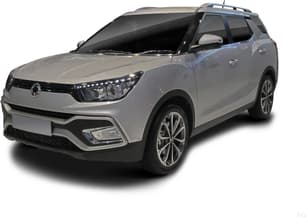
One look and you might think 'honey I shrunk the Stavic', and that’s not too bad of a summary. There are some ungainly touches to the design of the Tivoli XLV - as you might expect from a small SUV that has been stretched.
But from some angles, it doesn’t look too bad. The front end is quite fetching, I think, with those projector halogen headlights with LED daytime running lights cutting a different shape to many of its rival models sold in our market. However, the overtly lipped quarter panels aren’t to all tastes, and the curved, clear-lensed tail-lights aren’t going to win any beauty contests.
I don’t think it’s ugly in the same way the original Stavic was… but SsangYong let us in on a secret at the launch event in Korea: there’s an updated, facelifted version of the Tivoli XLV and the regular Tivoli due in June 2019. It may be worth waiting for, because not only will it bring a new, more modern look, it will probably add equipment and safety features.
What do you think? Does it look more or less attractive than, say, a Honda HR-V, Mitsubishi ASX or Nissan Qashqai? Tell us in the comments section below.
Now, size: the XLV is essentially a stretched, more family-friendly version of the Tivoli. Both are built on the same line, and everything is pretty much the same from the C-pillar forward. It measures 4440mm long (which is 198mm longer than the standard Tivoli, both on a 2600mm wheelbase), 1798mm wide and 1635mm tall (Tivoli is 1590mm). The XLV is longer than any other small SUV it competes against.
Australian customers are expected to be able to choose between an array of eight body colours and a contrasting roof finish. One really smart combination is the red body and black roof, and high-spec models are expected to get flashy 18-inch wheels (with 16s on low spec models).
The benefits of the Tivoli XLV’s stretched body are clearest in the boot area, which beats some mid-sized SUVs.
The Q5 Sportback is the more attractive sibling when compared to the standard SUV, with a shape that feels more dynamic and sport-oriented. The updated design dials back the sharper creases of the previous model in favour of softer curves, paired with slim matrix LED headlights. The revised 'Singleframe' grille has strong presence and the full-width rear light treatment adds to the Sportback’s visual appeal. Overall, it’s a very handsome vehicle.
Inside, the interior glow-up is immediately noticeable. The large new display takes centre stage in a redesigned dashboard that looks clean and appropriately sophisticated.
There’s a good mix of materials throughout the cabin, including the beige leather upholstery, although the presence of hard plastics reminds you that this is still a base grade. Even so, the cabin largely hits the right notes for a luxury entry point.
There are a few details that don’t quite land for me. The door-mounted control panel on the driver's side feels busy and a little fiddly to use, and creates an oddly sized and positioned pull handle that just doesn’t feel nice to use. And this is very much a nitpick, but the black stitching on the beige seatbelts catches my eye all the time. None of these are deal-breakers, but they stand out in an otherwise well resolved interior.
If you’re buying the Tivoli XLV, it’s arguably because it’s a compact SUV with the interior space of a bigger SUV inside. With a claimed cargo capacity of 720 litres (VDA), that makes sense. The XLV adds 297L more space (VDA) over the Tivoli, with a bigger boot than some very big SUVs.
In person the boot looks pretty big, but not as enormous as the numbers suggest. The fact there’s a false floor set-up is handy, though, and the packaged from SsangYong to be able to engineer so much boot space and still offer a four-wheel-drive system and multilink rear suspension is almost genius. Many brands can’t do it as well as SsangYong has. And going by SsangYong’s promise to fit a full-size spare wheel to all of its AWD models, the packaging is even more impressive.
It was handy for us to drive the XLV alongside the Musso and Rexton, both of which are newer-generation models that feel more modern inside. That isn’t to say the XLV feels old - it’s just not as special as its bigger siblings. Again, the face-lifted model due in 2019 could go a ways to fixing that.
If I had to compare the quality and design of the XLV to any car, it would be the old Hyundai ix35. You remember that small-to-mid-size SUV that came before the Tucson, which was on sale here from 2010 to 2015? Well, its cabin design and materials were fine, but nothing special. A bit like the Mitsubishi ASX, which launched around the same time as the ix35, yet is still sold today (and in big numbers!).
The front seats are pretty comfortable and the driver’s seat has good adjustment to it, but taller front seat passengers may lament the lack of height adjustment to the seat - especially in models fitted with a sunroof.
In the back there’s easily enough for a 182-centimetre-tall adult to sit behind their own driving position, with more knee room than most small SUVs, and reasonable shoulder and head room, too. The XLV is a five-seater, and three across the back is possible, but not enjoyable. There are dual ISOFIX child-seat anchors for outboard seats, and top-tethers across the width.
Up front, the cabin feels spacious and comfortable, with plush (heated) electric seats, while the driver also benefits from a two-position memory function, which is a plus if the car is shared. My main gripe is the short seat bases, which become noticeable on longer drives.
In the rear, comfort largely holds up, though space is better suited to two adults due to the high transmission tunnel. The 40/20/40 split-folding rear seat is a practical inclusion and helps when juggling passengers and longer items.
Storage is mostly well considered. There’s a generously sized glove box and a couple of useful storage bins in each door, although the centre console is on the smaller side. The dedicated phone tray is a highlight, housing the wireless charging pad, two USB-C ports and a 12-volt socket. Both rows get cupholders and bottle storage, while rear passengers also benefit from USB-C ports, climate control, directional air vents and map pockets. Overall, there’s just enough space and amenity for adults or teens to remain comfortable.
Technology is handled by the updated media display, which features a responsive touchscreen and a menu system that’s easy enough to navigate. Wireless Apple CarPlay and Android Auto are quick to set up, and the built-in satellite navigation is clearly laid out. That said, the near-total absence of physical buttons may frustrate some, with functions like climate control buried within the touchscreen. The number of pop-up disclaimers on start-up also feels excessive.
Boot space is where the Sportback’s sloping roofline has the biggest impact. Load height is limited, and capacity tops out at 515L with all seats in place, making it the smallest in its segment, albeit only by around 10L. I like the deep underfloor storage, along with the cargo cover, net and hands-free powered tailgate. However, the lack of a spare tyre, replaced by a repair kit, is a deal-breaker for me as a country driver, though it may matter less to those with easier access to repair services.
We don’t know what price SsangYong is aiming to list the XLV model range at, because the company hasn’t yet confirmed pricing and specifications. So we can’t tell you what it will cost.
But we do know there will be manual and automatic variants available in four-wheel drive only (4WD/AWD) at launch, and it will be diesel only. The smaller Tivoli will be offered with petrol and diesel, and a more affordable front-wheel drive model.
There’s an expectation that the XLV will come well specified as standard, but that two trim levels will be offered.
The base model will likely have cloth seat trim, dual-zone climate control and a leather-lined steering wheel, while the top-spec will come with leather seat trim. All models will likely come with a touchscreen media system with Apple CarPlay and Android Auto, plus USB and auxiliary inputs and Bluetooth phone and audio streaming.
Seat heating, auto headlights, auto wipers, a sunroof, 18-inch wheels (as opposed to 16s on the base spec), push-button start and keyless entry could be offered standard in the high grade version - but we’ll have to wait and see.
Expect more safety equipment in the top version, too, but a reversing camera and parking sensors should be offered range-wide.
As a potential budget-conscious offering pitched against relative high-spec small SUVs, the Tivoli XLV prove intriguing. Think of a Honda HR-V VTi-L, which lists at $33,390, and has a 1.8-litre petrol engine and is front-wheel drive… a similarly specified diesel AWD automatic model could be tempting.
The Audi Q5 Sportback is offered with a choice of petrol or diesel engines, across two grades before stepping up to the more powerful SQ5 variants. For this review, we’re testing the base petrol TFSI grade, which is also the only front-wheel drive option in the line-up.
It carries a before on-road costs price of $84,500 and comes well stocked with features that often sit on the options list with key rivals. Aside from the Genesis GV70 2.5T, which remains hard to beat for standard inclusions, the Q5 Sportback TFSI stands out as one of the better value propositions at this price point.
New for this update is a large panoramic display that combines an 11.9-inch digital instrument cluster with a 14.5-inch central media screen. The system includes built-in satellite navigation, wireless Apple CarPlay and Android Auto and access to the 'Audi Connect' app. The app allows access to remote services like locking/unlocking to car, checking fuel/charge levels, sending navigation routes, car finder and monitoring vehicle status (warnings, last parked location).
Our test car is fitted with optional 'Pearl Beige' leather upholstery, which is a no-cost option. New design elements include a full suite of LED exterior lights, including matrix LED headlights and side puddle lamps.
Comfort is clearly a priority in this grade, with electric and heated front seats featuring lumbar support and a two-position memory function for the driver. Three-zone climate control, a wireless charging pad, multiple USB-C ports and 12-volt sockets, along with a 360-degree camera system round out the major tech highlights.
Practical touches haven’t been overlooked either, with a hands-free powered tailgate, cargo cover and net plus a 40/20/40 split-fold rear seat set-up.
The XLV will come with only one engine option - a 1.6-litre turbocharged four-cylinder diesel engine. Hardly a horsepower hero, it produces 115kW of power (from 3400-4000rpm) and 300Nm of torque (1500-2500rpm).
It is available with a six-speed manual or six-speed automatic, with a standard-fit 4WD system known as 'Torque On Demand 4x4', which can sense the surface under the tyres and apportion torque to the rear axle to ensure better traction. SsangYong says it may offer a front-wheel drive XLV if demand necessitates.
A diesel engine isn’t unique, but it is rare in the small SUV class. But the fact of the matter is about 90 per cent of small SUVs sold are petrol-auto, so diesel could miss the mark for a lot of buyers.
The XLV offers a bonus element - towing capacity: the XLV can cope with a 500-kilogram unbraked trailer, and a 1500kg braked trailer - pretty strong for a compact SUV. Consider it competing against the Mazda CX-3 diesel AWD (640kg un-braked, 800kg braked) and Mitsubishi ASX (750kg/1400kg).
The Q5 Sportback TFSI is front-wheel drive and powered by a 2.0L four-cylinder turbo-petrol engine paired with a mild-hybrid system. Combined outputs sit at 150kW and 340Nm, which places it toward the lower end of the segment when stacked against rivals such as the Genesis GV70 2.5T and Mercedes GLC300 Coupe offering 224kW/422Nm and 190kW/400Nm, respectively.
On the road, however, there’s still plenty on offer for everyday driving, with power delivery feeling smooth and accessible. The seven-speed transmission shifts effortlessly, helping the Q5 Sportback feel refined and easy to live with, even if outright performance isn’t its headline feature.
The fuel consumption claim for the Tivoli XLV 4x4 auto is 6.3 litres per 100 kilometres. That’s not bad, and some small SUVs are better…
The Mazda CX-3 diesel AWD auto, which has a very low claimed consumption of 5.1L/100km (admittedly, it has a 1.5-litre engine with just 77kW/270Nm). But even the 2.2-litre turbo-diesel Mitsubishi ASX AWD auto uses less, at 6.0L/100km, and it’s almost a decade old. That engine has 110kW/360Nm.
The Tivoli XLV is a fair bit bigger than those two models, but even so, the fuel use should be a bit lower. It just goes to show the engine is working hard to deal with the weight of the Tivoli XLV, which in its heaviest guise, weighs 1535kg. Beefy.
The Q5 Sportback TFSI has a claimed combined (urban/extra-urban) cycle fuel consumption figure of 5.7L/100km and paired with its 65L fuel tank offers a theoretical driving range of up to 1140km. An impressive result on paper.
After a mix of long highway driving and my usual urban runaround, real-world consumption settled at 5.8L/100km, which is almost spot on.
It also highlights the Q5 Sportback TFSI’s performance/efficiency trade-off. While its outputs are modest relative to some rivals it rewards you with excellent economy in real-world use.
It’s difficult to learn what a car is all about over 29km, but that was the task I was handed in Korea, where I drove the Tivoli XLV from the hotel in Gangnam, Seoul, to a rest stop some 24km north of town. Then I jumped in some other models, before eventually getting a further - very illustrative - 5km stint behind the wheel at an off-road coarse later in the day.
There was some traffic, slow moving highway driving, and even a bit of higher-speed cruising. And it was fine.
The diesel engine was impressively refined and quiet, so much so that I initially thought it was a petrol. But after a couple of instances of traffic halts, it became clear there was a little more rattle from under the bonnet, and a more heft over the nose than you’d expect of a petrol.
That said, the performance was muted. With a torque output of 300Nm, you might think it would be potent - but it’s really not, and there’s some hesitancy from standstill, not to mention some sluggishness during roll-on acceleration.
The six-speed auto transmission did a good job, as far as I could tell, but a more arduous test loop will sort the facts from the feels.
As for the dynamic element, it’s hard to say anything other than the XLV felt smaller, more nimble and more fun to drive than either the Rexton or Musso models I also drive. The steering was adequate in its response, if a little lifeless, and the ride was a touch harder than I was expecting, but not sharp or punishing.
If you’re interested in off road specs, the Tivoli XLV is said to offer a 20 degree approach angle, a 20.8deg departure angle, and 17.0deg ramp-over. More of a problem, though, was the lack of ground clearance. The figure is just 168mm, which isn’t much more than some regular run-of-the-mill hatchbacks. Consider this: a Subaru XV has 220mm. Yep.
The suspension travel isn’t huge, either, with stiff-legged feel to the model we drove. Part of that could have come down to the stylish 18-inch alloy wheels and low-profile tyres, but it simply isn’t a soft and wobbly off-road SUV. It’s a monocoque chassis small crossover, so if you want a more serious SsangYong off-roader, the ladder-frame Rexton could offer a lot more appeal.
There’s enough power in the base grade to keep things engaging on the open road, whether overtaking or maintaining pace, with a reassuring sense of reserves and smooth, punctual delivery.
Despite the firmer suspension, ride comfort remains high thanks to the newly tuned damping system, which absorbs bumps without sacrificing road feedback. The cabin is quiet at speed and at low speeds the car can switch to its hybrid system for extra refinement.
I’m not a huge fan of the adaptive steering assist, particularly on winding roads, as it can overcorrect at times. Overall, though, the Q5 Sportback delivers enjoyable, sporty dynamics.
Visibility is good from the front and sides, while the rear window is a little on the small side. It’s easy to get accustomed to the car’s dimensions and a clear 360-degree camera view comes standard across all grades, providing a clear view that automatically activates during low-speed manoeuvres. Parking this car is straightforward and stress-free.
The Tivoli XLV doesn’t have an ANCAP crash test rating, but it was tested by Euro NCAP in 2016, where it scored a less-than-excellent four- out of five-star score. That’s in spite of the fact it was available with auto emergency braking (AEB), too.
According to SsangYong, the “top of the range Tivoli will feature AEB, lane departure warning, lane keep assist and high-beam assist”. We’ve heard that will be mirrored in Tivoli XLV flagship spec, too.
The Tivoli XLV has seven airbags (dual front, driver’s knee, front side and full-length curtain), as well as a reversing camera and rear parking sensors. ISOFIX child seat anchors are standard.
The Audi Q5 Sportback carries a fresh maximum five-star ANCAP safety rating from 2025 testing. It comes with nine airbags, including side-chest airbags for both rows which is a standout feature, as these are often limited to the front seats.
The safety equipment suite is strong, featuring lane departure warning, lane keeping assist, side exit warning, blind-spot monitoring, traffic sign recognition, dusk-sensing LED headlights and emergency call capability. There’s also front collision warning, rear cross-traffic alert with assist and rear turn-assist. Adaptive cruise control is generally well-calibrated, though it can occasionally slow for vehicles outside your lane.
Autonomous emergency braking covers cars, pedestrians, cyclists, motorcyclists, and backover assist which is operational between 5.0 and 250km/h. Child safety is supported with two ISOFIX mounts and three top-tether anchor points, although only two seats fit comfortably.
Nothing has been confirmed yet, but we suspect SsangYong could be working to match one of the best warranty offers in the Australian market in mimicking Kia’s seven-year/unlimited kilometre plan. In the UK SsangYong models have seven-year/150,000 mile (241,000km) cover, but an unlimited mileage offer is expected here.
If that’s the case, and models like the Tivoli XLV can be competitively priced for servicing, and with reasonable (read: not too frequent!) service intervals, then the score for this element of our test could increase in later reviews.
The Q5 Sportback comes with Audi’s five-year/unlimited km warranty, which also includes complimentary roadside assistance - all fairly standard at this end of the market. A five-year pre-paid servicing plan is available for $3520, which is cheaper than the pay-as-you-go option, though it’s not the most competitive compared with some rivals. For instance, BMW offers the same coverage for $2475, while the Genesis comes with complimentary servicing.
You can also extend the service period by two years with the 'Audi Advantage Package' for an additional cost. Services are spaced at sensible intervals, every 12 months or 15,000km, whichever comes first, making maintenance straightforward and predictable.