What's the difference?
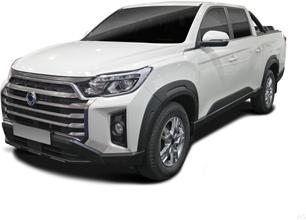
The SsangYong Musso XLV Ultimate is one of, if not the, most affordable part-time 4x4 ute on the market at the moment a recent facelift sees some improvements to its design, features and ride comfort.
I'm in the top-grade model with my family of three to see how those tweaks translate to real-world family life and how it competes against rivals like the GWM Ute Cannon and the LDV T60.
I couldn’t say I’m familiar with Australia’s inland deserts. I thought there were two or three - the Simpson, Gibson, maybe the Great Sandy.
But did you know there are 10? And Volkswagen knows each intimately thanks to a recent Guinness world record verified crossing of them all… in one go.
It took a tweaked-up Amarok six days and 17 hours if you must know, and to celebrate VW has created a limited build (300 unit) version of the dual cab ute called, you guessed it… the 10 Deserts Edition.
And we were invited to steer it on-road and over a variety of challenging (public) off-road trails around Mt Macedon and Cobaw, about an hour’s drive north-west of Melbourne.
Not quite the Strzelecki Track, but tough enough to see if this special VeeDub has what it takes to drive your off-highway ambitions. So, stay with us!
The SsangYong Musso XLV Ultimate is an affordable workhorse that has good comfort, features and drives well. It suited my little family and our gear just fine this week with its space. If you need the practicality of a ute and are on a budget, you get a lot for your money here.
It’s been developed with adventurous four-wheel-drive enthusiasts in mind, but we don’t know exactly what it will cost. However, given the current ballpark estimate, the value equation will likely stack up well and things like safety and the ownership package are solid. And we know it’s tough and capable in rough going, which is the main point, after all. This package works brilliantly well.
Note: CarsGuide attended this event as a guest of the manufacturer, with travel, accommodation and meals provided.
The Musso looks the part of a 4x4 dual cab ute. It’s big even without the XLV pack at 5095mm in length. And with it, that jumps up to 5395mm. Enough to well and truly fill out a car space.
To put it in perspective, it's longer than the Kia Carnival, so I'd check to see if it will fit in your garage!
The finish isn’t the best, with wide spaces between door jams and the tray (I can fit my hand in that one) and a painted foam-like joinery in the tailgate which is already showing a lot of wear and tear for a brand-new workhorse. Stuff like this could make it look worn quickly.
Once you move into the cabin, it becomes obvious where a lot of the facelift has been focused.
The black leather upholstery, headliner and accents all make it feel premium in the cabin.
The dashboard has been redesigned to be more horizontally-themed and to sit lower than the previous dash. It showcases the new upgraded tech screens, large integrated air vents and digital climate control panel.
The cabin looks way more expensive than the price tag might suggest and it's most welcome.
The Amarok is already a sleek-looking dual cab and the ‘Clear White’-only 10 Deserts Edition picks up unique black badging, a standard black tonneau cover and 17-inch satin ‘Asphalt Black’ alloy wheels shod with all-terrain rubber. More hardcore off-road tyres are a no-cost option, which is a nice touch, and there are black side steps and a ‘Asphalt Black’ mesh grille with ‘Bolder Grey’ inserts.
An ARB lift kit raises ground clearance by 40mm, from an already decent 235mm to 275mm, and ‘Genuine VW’ underbody protection is added.
The interior is cool, calm and collected in typical VW fashion with a predominantly dark grey colour palette highlighted by silver and brushed metal accents.
The 8.0-inch digital instrument display and 10.1-inch multimedia screen look contemporary without being garish, and there’s a workable mix of digital and physical controls, with climate being the former and audio the latter.
The cabin of the XLV Ultimate is big on space and all occupants enjoy fantastic head- and legroom.
Individual storage is good for a ute with the front enjoying two cupholders, a good-sized middle console and glove box plus a drink bottle holder in each door.
Rear occupants get map pockets, a fold-down armrest with two cupholders and storage bins in each door.
Amenities on the whole are good with the heated and ventilated front seats that feature lumbar support. But the upgrade to electric control for the fronts and heat function for the rear outboard positions clinch the luxury factor Both rows are well-cushioned and comfortable for long journeys.
Charging options are limited to the front with two USB-C ports, which is an upgrade from the old USB-A ports, and two 12-volt sockets.
But one of them is an old-school cigarette lighter which I haven’t seen in years! Now that was a teachable moment when I was a kid.
It's a shame there are no charging options in the rear as it could be inconvenient if you travel a lot and your kidlets have devices.
Fitting a child seat in the rear row is a little awkward due to the backrest folding down in one piece and it misses out on any clever hacks like some other utes have, like the zippered accessed points to the top-tether anchor points found on the HiLux and D-Max or the 60/40 split-fold on the Cannon.
Because of this, you'll want to fit your child seats at the same time and probably want it to be a 'set and forget' scenario.
On to the upgraded technology – the touchscreen of the multimedia system is responsive but the info is limited to the radio and a small settings menu.
Think of it as more of a mirror-screening device for the wired Apple CarPlay and Android Auto. It’s easy to connect to the CarPlay and the graphics are nice and bright.
The instrument cluster is semi-customisable but it’s here you can access/customise more information like the safety features, which I appreciate.
Our test vehicle has that XLV Pack fitted which adds 300mm to the tray length and boosts the overall capacity by 251L.
The max payload is 880kg, which should be sufficient for a lot of weekend pursuits.
You get a full-sized spare wheel and with our optioned tonneau accessory, you don’t have to worry about your gear getting wet, either.
The tailgate is large and feels very light to operate, thanks to the assist function but this ute lacks any sort of step to access the tray, which won’t be an issue for you giants out there but for me it was a bit of comedy to climb in to the back to retrieve stuff.
At just over 5.3m long, a little more than 1.9m wide and close to 1.9m tall (with a 3270mm wheelbase) the Amarok lives within the same dimensional footprint as key competitors like the Ford Ranger, Toyota HiLux and Isuzu D-Max.
Up front, it's easy to get in and out thanks to big door apertures and this limited edition’s slightly higher ride height. There’s plenty of breathing space and good separation from your co-pilot.
In terms of storage there are door bins with room for decent size bottles, a couple of cup/bottle holders in the centre console, a lidded storage box between the seats (which doubles as a centre armrest), a wireless charging pad ahead of that, two glove boxes, a shallow well in the centre of the dashtop and a drop down sunglasses holder.
In the back, sitting behind the driver’s seat set to my 183cm position, there’s plenty of head, leg and toe room.
Three full-size adults across the second row will be okay for short to medium trips and a trio of up to late teenage kids will be fine. There are bins in the doors with room for medium-size bottles, a fold-down centre armrest with a pair of cupholders and map pockets in the front seat backs.
On the not so good side, there’s no individual ventilation control for back-seaters and the only power option is a 12-volt socket with USB-A and -C ports confined to the front only. Shout out for the USB input in the mirror housing for a dash cam, though.
The roughly 1.5m long by 1.2m wide illuminated tray will accommodate a Euro pallet between the wheel arches. There are multiple tie-down rings and tailgate closing is assisted.
Maximum towing capacity for a braked trailer is 3500kg (750kg unbraked), a full-size spare is on-board and there are two towing hooks at the front.
The facelift sees the Musso gain a mid-spec variant in the form of the Adventure which creates a line-up of three grades overall.
Our test vehicle is the flagship Ultimate, which is priced from $45,000, drive-away, making it one of the most affordable 4x4 dual-cab utes on the market at the moment.
In comparison, the GWM Ute Cannon Vanta is the closest competitor at $46,490, before on-road costs, with the LDV T60 Max Luxe coming in at $47,884, before on-roads.
The Ultimate grade gets some great premium features, like heated and ventilated front seats, a heated leather steering wheel, as well as, updated technology with the 12.3-inch touchscreen multimedia screen (up from the previous 8.0-inch system), and the new 12.3-inch instrument cluster, up from the previous 10.25-inch unit. The climate controls have been integrated into a new touchscreen panel, which is easy to use.
Other standard features include an assisted tailgate function, full-size spare wheel,18-inch alloy wheels, LED DRLs and fog lights, HID headlights, a 360-degree camera system and wired Apple CarPlay and Android Auto.
Off-roading enthusiasts will be pleased with the part-time 4x4 drivetrain that includes low- and high- range and the auto-locking rear differential feature.
For its price point, the Ultimate is well-specified but our test vehicle has a couple of option packs and a few accessories that boost the overall costs.
The test vehicle features the 'Luxury Pack' for $3000, which adds dual-zone air-conditioning, a sunroof, leather upholstery, electric front seats and heated rear outboard seats.
It’s also fitted with the 'XLV Pack' for $1500 which adds 300mm to the tray length and an extra 20Nm of torque.
But we’re not done. With the red metallic paintwork and accessories like a tow bar, rubber mat set, tonneau cover and electronic brake controller our test vehicle actually slides in at $53,598.
Which is still great given the market but not as jaw-dropping as the first price might suggest because most of those added extras would be needs rather than wants for some buyers. Especially the extra torque and tow bar if you plan on using the 3.5-tonne braked towing capacity.
Although it’s being cagey on exact pricing at this stage, Volkswagen says the Amarok 10 Deserts Edition will be positioned between $65 and $70K (likely closer to former than the latter).
The Amarok Life TDI500 this car is based on boasts a healthy standard equipment list including LED headlights, daytime running lights and fog lights, adaptive cruise control (with stop/go), alloy rims, a towbar, wireless charging and tailgate lift assist plus wireless Android Auto and Apple CarPlay.
There’s also six-speaker audio (with digital radio), single-zone air-con, electrically folding and heated exterior mirrors (with courtesy lamps), auto headlight and high-beam control, a leather-trimmed steering wheel and gearshift, and auto rain-sensing wipers.
Not a bad fit-out, even before adding the extra 10 Deserts kit (see Design) and that prospective price puts it between the existing Amarok TDI500 Life ($59,490) and Style $69,740), both before on-road costs, and a step up from Ford’s close to $57K limited-run (1500 unit) Ranger Black Edition.
The upgrade hasn’t seen any changes to the Musso's powertrain and it is still powered by a 2.2-litre, four-cylinder turbo-diesel engine with a maximum power output of 133kW and 420Nm of torque (400Nm without the XLV Pack).
It’s got plenty of grunt and despite having only a six-speed auto transmission, the gear changes are mostly smooth.
Adventure enthusiasts should be happy because the Musso is a proper part-time 4x4 with low- and high-range, which is easy as pie to change over to when the need arises.
The record-breaking Amarok was a V6 Style, but this limited edition is based on the Amarok TDI500 Life, so a 2.0-litre turbo-diesel four-cylinder engine sits under the bonnet, sending 154kW/500Nm to the rear, or all four wheels, via a 10-speed automatic transmission.
This twin-turbo, dual-overhead cam unit is shared with the Amarok’s twin under the skin, the Ford Ranger (where it’s referred to as the ‘Bi-Turbo’), and the selectable all-wheel-drive system features three driving modes - 2H, 4H & 4L - and there’s a mechanical rear diff lock.
Despite its size, the Musso's official combined cycle fuel economy figure is only 9.0L/100km.
My real-world average came in at 10.2L/100km after a good mix of open-road and urban driving. Not too surprising, but that's without any loads. Expect it to be thirstier if you plan on towing.
Based on the combined fuel figure and 75L fuel tank, you should be able to get a driving range in excess of 800km.
The TDI500’s official fuel consumption figure on the combined (urban/extra-urban) cycle is 7.2L/100km. With an 80-litre fuel tank on board, theoretical range is around 1100km.
Stop-start is standard, but we’ll have to wait for an as-tested figure, as this launch drive leant heavily into arduous off-road work.
For reference, in previous testing we’ve recorded real-world consumption closer to 10.0L/100km for this Amarok powertrain, which would deliver a driving range of around 800km.
The Musso has won me over with how it drives. The update has seen the suspension retuned and it’s well-cushioned without feeling spongy.
The ride comfort is very good but you occasionally get some shudders through the frame when gear changes happen on a steep hill. The cabin sounds refined with how quiet it is, even at higher speeds and you’ll enjoy that on longer trips.
Hitting the open-road isn’t an issue with power being delivered smoothly when you accelerate. Despite being a tall car, the Musso handles cornering much better than I thought it would without heaps of roll.
You don’t feel any of the weight of the car when you steer, though, and that’s a bit too light for my liking. But it gives the Musso more of a car-like feel rather than a ute/truck feel which some people might enjoy.
Massive windows mean the Musso has crazy-good visibility for a ute and I feel confident about checking the blind-spot because of it. That's great for such a big vehicle.
Despite being almost 5.5m long, the Musso isn't too difficult to park because of the 360-degree view camera system, and front and rear parking sensors, a must have on large cars like this. The camera system is a smidge low quality for the image, though.
The Amarok TDI500 is easy and effortless to drive on the open road. Peak power of 154kW (at 3750rpm) is adequate, but it’s the 500Nm of pulling power, delivered exactly where you want it at just 1750rpm, that sets the tone.
With 10 ratios to cycle through, the auto transmission also helps keep things in the sweet spot and while you’re aware of a certain amount of diesel thrum under acceleration, in this type of ute that’s more reassuring than annoying.
Suspension is by double wishbones and coil springs at the front with leaf springs supporting a live axle at the rear. And as is typical for a ute with this set-up (particularly unladen) bumps on a typical B-road make their presence felt, but not to an alarming degree.
We drove it on loose dirt roads and some challenging trails (which we’ll get to shortly), but overall it feels capable and pretty well planted on the road.
The steering is electrically assisted and there’s a good connection between your hands on the wheel and the tyres on the road.
Standard 17-inch alloys are shod with 225x70 Continental CrossContact ATR (all-terrain) tyres and they’re civilised on the highway. Also worth noting more aggressive off-road-focused rubber is a no-cost option, which is a nice touch.
The brakes are discs front and rear, which is notable because the entry-level Amarok Core is fitted with drums at the back.
On the open-road and in slow-going off-highway, where you’re constantly feathering the brakes during steep declines, braking remains strong with a progressive pedal feel.
The off-road section of the launch drive was more about the nature of the terrain than ultra-steep inclines or declines.
Big boulders, cavernous ruts, bulging tree roots as well as loose gravel and sand surfaces were the flavours of the day and the Amarok did a great job.
Standard approach, departure and ramp-over angles for the Life TDI500 are pretty solid, but an extra 40mm of ground clearance makes a big difference.
Worth noting the 10 Deserts Edition held its own with the more heavily modified V6 Style that set the Guinness record, which we also had a chance to steer.
With around 80kg less weight on the front axle, the four-cylinder feels agile and eager in the rough stuff and we saw some impressive axle articulation as the suspension and drive systems helped the Amarok pick its way through the most difficult sections.
We stepped our way through two-wheel high, four-wheel high and 4WD low modes, pulling in the diff lock only when things got hairy.
In terms of miscellaneous observations, it’s worth noting the turning circle is 12.8m. The Amarok is a sizeable vehicle and you’d expect the turning circle to be up there, but just be prepared for a reasonably wide arc when you’re parking or making three-point turns.
And the front seats are a stand-out. They’re pretty much sports editions - grippy and comfortable even after a full day behind the wheel on- and off-road. And their lateral support keeps you nicely located in the corners.
On the top-grade model, you get most of the important safety features you expect to see on new cars but only at this level. The lower grades miss out on some big-ticket items and it annoys me when you have to pay extra for safety.
Standard features include biggies like rear cross-traffic alert, blind-spot monitoring, as well as AEB with forward collision warning and lane-change collision warning.
Other features include lane departure alert, safe exit assist, driver attention warning, tyre pressure monitoring, hill descent control, hill start assist, a 360-degree camera system, plus front and rear parking sensors.
It features six airbags, which is good for this class, but is currently unrated with ANCAP while its rivals all sport a maximum five-star rating.
There are ISOFIX child seat mounts on the outboard rear seats and three top-tethers but you can’t legally fit a child-seat in the middle seat as it only features a lap belt. Not having the sash does lower the safety aspect for any middle rowers and I’d think of the middle seat as an emergency spot for an adult only.
The Amarok was given a maximum five-star ANCAP assessment in 2022 and active (crash-avoidance) tech includes AEB (with pedestrian and cyclist monitoring), lane keeping assist and lane departure warning, adaptive cruise control (with stop and go function), rear cross-traffic alert, blind-spot monitoring, hill-descent control, tyre-pressure monitoring, driver fatigue alert, roll-over mitigation and trailer sway control.
There’s also ‘Swerve Steer Assist’, road and speed sign recognition, front and rear parking distance controls, and a reversing camera. That’s an impressive suite for the category.
If a crash is unavoidable, there are nine airbags onboard - dual front and front side, dual front knee, full-length side curtain and a front-centre bag to help reduce the chance of head clash injuries in a side-on crash. Again, above average.
The Amarok scores well with ANCAP for vulnerable road user protection, multi-collision braking minimises the chances of secondary collisions following an initial impact and there’s an auto emergency call-out function able to sense if the driver is incapacitated following an airbag deployment.
Important to note there are top tethers and ISOFIX anchors for baby capsules and/or child seats on the outer rear seat positions only.
The on-going costs are great on the Musso, with it coming with a seven-year/unlimited km warranty, which is above average for this class.
It also comes with a seven year/105,000km servicing program where services average $375, which is competitive for the class.
Servicing intervals are average at every 12 months or 15,000km, whichever occurs first.
Volkswagen covers the Amarok with a five-year/unlimited-km warranty, which is expected in the mainstream market.
Service is recommended every 12 months/15,000km, which is pretty handy, and the price averages $360 for the first five years, which is competitive for the class and price point.
Fixed price three- or five-year plans are also offered, which brings a modest discount and locks in the pricing. Twelve months of roadside assistance is complementary, renewed for another year each time you service the car at an authorised VW dealer.