What's the difference?
Australia’s mid-size (2.5-3.5 tonne GVM) commercial van market currently features nine brands competing for sales against Toyota’s staggeringly popular HiAce, which now represents almost 60 per cent of vehicles sold in this segment.
One of those competitors is the Renault Trafic which in 2026 brings a suite of technical upgrades designed to deliver enhanced economy, lower emissions, greater towing capacity and improved driver comfort and convenience.
With June approaching, traditionally the biggest month of the year for commercial vehicle sales, we recently spent a week in Renault’s latest offering to find out if it represents a compelling alternative to the HiAce for tradies and other commercial van users.
Farizon, the commercial vehicle division of Chinese automotive maker Geely, is a new competitor in Australia’s van market having recently launched its full-electric V7E.
Designed to attract buyers in the popular mid-size (2.5-3.5-tonne GVM) commercial van segment, Farizon claims its V7E has the payload capacity, cargo volume and pricing needed to compete with traditional diesel rivals.
We recently spent a working week aboard this new Chinese contender to see how it measures up as a potential tool of trade for tradies, couriers, SMEs, fleets and other commercial van buyers.
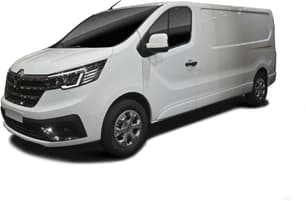
The Renault Trafic Premium LWB makes light work of heavy payloads and offers smart solutions for long internal load carrying and ‘mobile office’ requirements, combined with lengthy service intervals, good fuel economy and long driving range. It’s certainly worthy of cross-shopping with the HiAce and other rivals if you’re in the market for a refined and efficient mid-size commercial van.
These are early days for Farizon in Australia and the V7E is indicative of that. Although it offers attractive sub-$54K drive-away pricing, peppy performance and substantial payload/cargo volume ratings, it lacks refinement in ride and handling, elements of cabin design and active safety calibration which detract from the driving experience. Whether this newcomer’s negatives outweigh its positives, though, only a potential buyer can decide.
The Trafic is one of the most distinctive mid-size vans in Australia, with its sculptured flanks and ornate upswept headlights adding rare styling flair to a light-commercial vehicle segment traditionally compared with whitegoods. Even so, this overt styling does not detract from its work-focused practicality.
The spacious cabin has a neat and practical appearance with numerous shades of grey enhanced by satin chrome highlights and contrasting white stitching on the fabric-covered seats.
We also like the functional dash layout, particularly Renault’s adherence to a trio of large physical dials to control cabin climate settings in preference to distracting touchscreen prompts.
The Premium LWB has a sizeable 3498mm wheelbase which, combined with its front wheel-drive configuration, results in a large 13.8-metre turning circle. However, its 1967mm height ensures comfortable access to multi-storey carparks and low clearance loading zones.
The V7E rides on a 3200mm wheelbase and features minimalist yet purposeful squared-off styling that’s a key factor in its big load volume.
Its light and airy cabin has a slimline dash design that’s free of protrusions to allow ‘walk through’ access from either door, which is handy for delivery work. It also features physical ‘piano key’ buttons for the climate controls, which are preferable to more fiddly touchscreen prompts.
The cabin also presents a tasteful blend of colours and surface finishes including the seats, although anecdotal evidence suggests the light grey tone of their fabric trim would be prone to showing grime and stains over time in a hard-working van.
At first glance the passenger seat appears to be a two-passenger bench but only one seatbelt is provided. Therefore, what would normally be the backrest for a centre passenger is purely vertical storage for the fold-down centre armrest (see Practicality).
Our test vehicle’s relatively light 1844kg kerb weight and 3070kg GVM results in a substantial 1226kg payload capacity. Its upgraded 2500kg braked tow rating is, like the payload rating, higher than the Toyota HiAce LWB but lower than the Ford Transit Custom LWB.
However, Renault does not publish a GCM figure (how much it can legally carry and tow at the same time) so we don’t know if it can haul its maximum payload while towing its maximum trailer weight.
Access to the cargo bay, which offers a competitive 6.7 cubic metres of load volume, is through solid sliding doors on each side and glazed rear barn doors with forklift friendly 180-degree opening. The standard right-side sliding door can be deleted when ordering and a glazed single tailgate option is also available.
The load floor is 2937mm long and 1662mm wide, with 1268mm between the rear wheel housings, so it can carry up to two standard 1165mm-square Aussie pallets or up to three 800 x 1200 Euro pallets. There’s eight load-anchorage points at floor level and another eight at various heights for carrying taller loads.
Hinged flaps at the base of the front bulkhead and under the front of the passenger seat can also be opened to extend the load floor to an expansive 4150mm, allowing similar lengths of timber, conduit or PVC pipe to be carried.
The two-passenger bench seat has ample legroom for the outer occupant and even someone my height (186cm) can find reasonable comfort in the middle of a crew of three, albeit with knees competing for space with the prominent dash protrusion that houses the gearshift.
Generous cabin storage includes large bins in each door plus cup-holders on each side of the dash, a clamshell-lid compartment ahead of the driver, large open tray in the centre, small bin in the lower dash and a single glovebox.
The centre-seat backrest also folds forward to reveal a clever three-tier workstation, with a clipboard on top that can be detached to use outside the vehicle or mounted vertically in the workstation to face the driver or passenger (see image).
Beneath the clipboard is a hinged work desk, which when opened reveals a shallow felt-lined compartment underneath that’s ideal for hidden storage of phones, tablets, laptops etc.
Folding the bench seat’s front-hinged base cushions forward also reveals a cavernous hidden storage compartment below, which allows long cargo items to pass through when its front and rear metal flaps are open.
Its 1942kg kerb weight is relatively light for a full-electric commercial which combined with its 3150kg GVM results in a substantial 1208kg payload rating.
However, it’s only rated to tow up to 1000kg of braked trailer and given Farizon does not quote a GCM figure (how much it can legally carry and tow at the same time), we can’t confirm if it can carry its maximum payload while towing its maximum trailer weight.
Internally,the cargo bay is more than 2.8 metres (2865mm) long, 1690mm wide and 1435mm high, which combined with 1251mm between the rear wheel housings allows it to carry up to two standard Aussie pallets or up to three Euro pallets.
And its impressive 6.95 cubic metres of load volume is larger than mainstream mid-size rivals including the Ford Transit Custom SWB (5.8), Hyundai Staria Load (4.9) and segment-leading Toyota HiAce LWB (6.2).
The cargo bay is accessed via sliding doors on each side with generous 1100mm openings, or through twin-swing rear doors which open to a full 270 degrees with ‘ball and socket’ magnetic stays to hold them there.
The floor has a relatively low 510mm loading height and is protected by a thick composite floor liner with a shiny metal-like appearance complete with non-slip ‘chequer plate’ finish. There’s also a full-length roof lining, bright LED internal lighting, fully lined walls and doors and a handy V2L 240V three-pin plug socket.
Cabin storage includes a large bottle holder and bin in each door, open shelving across the full width of the dash, a single glove box and the previously mentioned fold-down centre armrest containing two cupholders.
There’s also twin USB ports and a 12V socket in the lower dash fascia and enough space beneath the passenger seat to store the portable AC charger cable.
The MY26 Renault Trafic range offers a choice of short wheelbase (SWB) or long wheelbase (LWB) and three trim levels across five models, comprising the entry-level SWB Pro with a list price of $52,990, SWB Premium ($56,990), LWB Pro ($54,990), LWB Premium ($57,990) and LWB Crew Lifestyle ($64,990).
Our Glacier White test vehicle is the LWB Premium (Premium has more standard features than Pro) equipped with the same 2.0-litre diesel automatic drivetrain shared by all Trafic variants. Its $57,990 list price is in the same $50-60K ballpark as the Toyota HiAce LWB ($56,880) and other established players including the Hyundai Staria Load Premium ($52,740) and Ford Transit Custom Trend LWB ($57,890).
Technical upgrades for the MY26 Trafic range include a new nine-speed torque converter automatic transmission, which offers notably smoother shifting than the six-speed twin-clutch auto it replaces.
The 2.0-litre four-cylinder turbo diesel has also been upgraded to tougher Euro 6 emission standards (previously Euro 5) and fuel consumption has been trimmed from the previous 6.5 to 6.2L/100km without reductions in power or torque output.
Its braked tow rating has been raised to 2500kg, which is a substantial increase over the 1630kg (LWB) and 1680kg (SWB) limits of previous automatic variants.
The Premium's standard equipment includes 16-inch steel wheels with 205/65 R16 tyres and full-size spare, LED headlights/DRLs/fog lights, front/rear parking sensors, adaptive cruise control, 7.0-inch driver info display and 8.0-inch multimedia touchscreen with wireless Apple CarPlay and Android Auto connectivity, wireless phone charging, three USB ports, two 12v sockets, steel cabin bulkhead with window, body colour tail-light columns, seating for three, reconfigurable centre seat workstation, large hidden storage compartment/cargo length extender beneath the passenger seat (see Practicality) and more.
Renault also offers numerous options including six exterior colours, different cargo bay door/window configurations and 17-inch alloy wheels, plus the choice of numerous individual options or tailored equipment packages like the Trade Pack and Business Pack. Options on our test vehicle include cabin floor mats, cargo bay side panels and a timber-lined load floor.
The V7E is available in two specifications defined by the size of their propulsion batteries (and therefore their driving ranges/charging times/kerb weights/payload ratings) with the entry-level Standard Range equipped with a 50kWh lithium-ion battery for $49,990, drive-away.
Our example is the premium Extended Range, which with a larger 66kWh battery is priced at $53,990, drive-away. Its Phantom Blue metallic finish is one of two premium paint options which (at the time of testing) are available at no extra cost.
Our test vehicle’s sub-$54K drive-away price is competitive with Chinese full-electric mid-size vans like the LDV e-Deliver 5 SWB ($52,621 driveaway) and lower than legacy brand offerings like Ford’s E-Transit Custom Trend ($77,890, plus on-road costs) or Kia’s PV5 Cargo ($55,990 + ORCs). Its standard equipment menu includes:
The 2.0-litre four-cylinder turbo diesel, now with Euro 6 emissions compliance using AdBlue, produces 125kW at 3500rpm and peak torque of 380Nm at 1500rpm.
The new nine-speed torque converter automatic offers a choice of drive modes and sequential manual-shifting using the steering wheel-mounted paddles.
MacPherson strut front suspension is paired with torsion bar rear springing, the latter including a pair of secondary coil springs for hauling heavy loads. It also has rack and pinion steering and four-wheel disc brakes.
The V7E is powered by a single electric motor with up to 110kW of power and up to 230Nm of torque, with a choice of Normal or Eco drive modes and light or heavy regenerative braking.
This motor, which drives the front wheels through a single-speed automatic transmission, has an electronically limited top speed of 120km/h.
The V7E rides on double-wishbone front and rigid beam/leaf spring rear suspension with four-wheel disc brakes and electric power-assisted steering.
Renault claims average combined consumption of only 6.2L/100km (lower than HiAce, Staria Load and Transit Custom) and the dash display was showing 6.9 at the completion of our test, during which we travelled 501km across our usual mix of suburban, city and highway driving of which about 100km was hauling a near maximum payload.
So, based on these figures our test vehicle has a vast theoretical driving range of around 1100km from its big 80-litre tank, but even allowing for the usual 2-3L/100km discrepancy between official and real-world consumption, it should do 800-900km between refills.
Our Extended Range test vehicle has an official (WLTP) driving range of up to 329km from its 66kWh LFP (Lithium Ferro Phosphate) battery. Farizon claims AC charging from 15-100 per cent takes around five hours while DC fast charging from 20-80 per cent trims that to 33 minutes.
It was displaying 100 per cent charge and 332km of estimated driving range when we collected the vehicle, after which we drove 187km in typical metro traffic with average energy consumption of 20.2kWh/100km, leaving 47 per cent charge and 195km estimated range.
We used DC fast charging to go from 47-100 per cent charge in 42 minutes resulting in an optimistic 422km range estimate.
On this second charge we drove another 163km, of which more than 100km was hauling its near-maximum payload, resulting in higher consumption of 22.4kWh/100km. We completed our test with 40 per cent charge and 165km range remaining.
So, based on our consumption figures, you could expect a real-world driving range of more than 300km which aligns with its official WLTP-based figure, but is short of full-electric rivals like Kia’s smaller PV5 Cargo with more than 400km achievable in similar conditions.
It has a comfortable driving position with ample steering wheel and seat positioning, the latter including adjustable lumbar. The seat’s firm bolstering provides good thigh and torso support, the latter enhanced by a fold-down inboard armrest.
The only thing missing is a raised left footrest like the one residing in the outer passenger footwell, which is of course the driver’s footwell in LHD models. The centre passenger seat’s headrest also blocks most of the central mirror’s view through the bulkhead window (we removed and stowed it when not required).
It has good unladen ride quality with surefooted handling, nicely weighted steering and strong braking making it responsive and enjoyable to drive.
The engine is at its most energetic when peak torque is tapped at 1500rpm and it continues to pull strongly all the way to maximum power at 3500rpm. The new nine-speed torque converter auto provides near seamless shifting and good all-round response.
Its long-legged gearing is also well suited to highway work, requiring less than 2000rpm to maintain 110km/h. When combined with the bulkhead, which insulates occupants from most cargo bay noise, the Trafic is a comfortable highway hauler even though tyre noise is more intrusive at these speeds.
To test its GVM rating we forklifted 975kg into the cargo bay, which combined with our crew of two equalled a total payload of 1150kg that was less than 100kg under its legal limit. The rear suspension compressed about 50mm but still had enough travel to ensure there was no bottoming-out on our test route.
It handled this big payload easily, with the increase in sprung weight providing an even smoother ride with minimal effect on handling and braking response.
The efficient drivetrain also made light work of our 13 per cent gradient, 2.0km set climb at 60km/h, with the new auto promptly downshifting to fourth gear to easily haul this load to the top.
Engine braking on the way down, in a manually selected second gear, was not as robust as you’d expect for a 2.0-litre engine but the four-wheel disc brakes were more than capable of keeping speeds under control during the descent.
Our only other gripe is the tachometer display, with its 1000rpm increments represented by a horizontal line of small dots with no corresponding numbers displayed. It’s not easy to interpret at a glance and would benefit from a more user-friendly design.
The driving position is more bus-like than car-like in terms of its steering wheel positioning and the seat has no adjustable lumbar support. There’s also no left footrest to brace against, so it can feel like you’re sliding towards the front of the seat at times which would benefit from some rake adjustment in the base cushion.
We also noticed the steering column shaft (complete with universal joint) passes through the driver’s floor to the left of the brake pedal, which restricts where you can rest your left foot. The driver’s door mirror also doesn’t pivot outwards far enough, so about one third of the mirror’s view is filled with the side of the van.
It’s quiet at speeds up to 80km/h thanks to the near silence of its drivetrain but noise from the Chinese-made Wanli tyres increases and becomes intrusive at highway speeds, where wind buffeting around its large door mirrors was also detected.
Thanks to its relatively light kerb weight, the V7E offers energetic acceleration around town when unladen with acceptable ride quality on smooth bitumen. However, it starts to lose its composure on bumpy roads with excessive bouncing of the suspension, which could benefit from refinement of spring and damper settings.
To test its GVM rating we forklifted 975kg into the cargo bay, which with driver resulted in a total one-tonne-plus payload of 1065kg that was about 140kg less than its legal limit.
The stout rear leaf springs only compressed about 25mm but such a big increase in sprung weight failed to iron out the suspension’s excessive bouncing, resulting in harsh and at times unwieldy ride and handling on uneven road surfaces.
Some of the active safety systems were also overly intrusive, particularly the lane keeping function with its unnerving fluctuations in turning weight and forceful steering inputs.
Combined with relentless warning chimes, often with no obvious visual confirmation of what they were warning about, we decided that the most annoying of these offenders were best left switched off.
The MY26 Trafic has a Gold rating (one grade lower than the highest Platinum rating) in ANCAP’s Commercial Van Safety Comparison.
Passive safety includes multiple airbags for driver and passengers plus auto emergency braking (AEB) with pedestrian and cyclist detection, lane keeping, blind spot monitoring, rear cross-traffic alert, traffic sign recognition, tyre pressure monitoring, adaptive cruise control, front/rear parking sensors, reversing camera and more.
The Farizon V7E, which is yet to be assessed by ANCAP’s Commercial Van Safety Comparison, comes standard with passive and active safety features including:
The Renault Trafic comes with a five-year/unlimited kilometre warranty, which is an improvement on the previous 200,000km limit, plus five years of roadside assistance.
Scheduled servicing is every 12 months/30,000km whichever occurs first. Capped pricing applies to the first five scheduled services up to five years/150,000km, which totals $3555 or an average of $711 per service.
That's slightly more than the HiAce but more convenient given the Trafic's once-a-year servicing requirement. Renault Australia has a national network of more than 50 dealers across most capital cities and many regional areas.
The Farizon V7E comes standard with a five year/200,000km vehicle warranty and the lithium-ion propulsion battery is covered by a separate eight year/200,000km warranty.
There’s also five years of complimentary roadside assist.
Scheduled servicing is every 12 months/30,000km whichever occurs first. Capped pricing for the first five years/150,000km totals $2385 or an average of $477 annually.
Farizon has a national network of seven dealerships (sales/service) represented in all states except Tasmania and is expanding its national vehicle servicing network through an approved third-party provider.