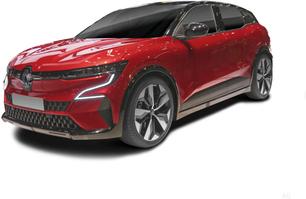
What's the difference?
The hotly anticipated Renault Megane E-Tech has arrived on our shores but we're only getting the mid-spec variant for now.
Renault's newest EV is related to the well-known Megane in name only because it has been built from the ground up as an EV. It’s not a hatchback, like its namesake, either, rather a crossover, which means it’s a bit lower than some of its small SUV rivals.
It faces firm competition in the likes of the Hyundai Kona Electric, Volvo C40 and newcomer bZ4X from Toyota. In this review we'll see how Renault's cutest EV handles life with my family of three.
It was, perhaps, a matter of time before BYD joined the seven-seat SUV brigade. In fact, the real surprise is that it has taken the Chinese brand as long as it has to begin mining the rich vein of Aussie car buyers looking for a full-sized SUV with the ability to seat a bigger family across three rows. But here it is, finally, anyway, the Sealion 8.
Interestingly, BYD hasn’t started its quest for seven-seat dominance by offering a traditional hybrid driveline. Instead, it’s gone straight for the throat with a pair of plug-in hybrid drivelines, both offering their own distinct take on the concept.
The first is a front-drive variant of the Sealion 8. With a single electric motor and a useful range, it stands as the sensible choice. But for those who want more performance, there’s the almost comically-fast all-wheel drive version with a pair of electric motors and monstrous acceleration. Interestingly, there doesn’t seem to be much in the middle, but the brand’s typically sharp pricing means there’s not a huge price-gap to negotiate in any case.
Of course, this is a pretty crowded marketplace right now, and standing out is the key to success. Whether that’s through value-for-money, performance, practicality or just shock value is open to debate, but it remains that BYD is launching the Sealion 8 into seriously competitive seas.
The design for the Renault Megane E-Tech is top-notch and the eco-conscious footprint is even better. It’s an easy and comfortable car to be in but the price is a smidge too high in my opinion when you consider there’s currently only one choice for us Aussies and it’s a mid-spec variant at that. It also misses out on some items its rivals have but is a solid EV to consider for urban dwellers.
There’s quite a bit to like here. There’s plenty of equipment, and lots of choice in price, trim level and mechanical complexity.
The driving dynamics are fine if you’re not looking for anything sporty although the performance offered by the dual-motor variants must be considered excessive, even if it’s pretty exciting the first time.
Perhaps what’s missing from the Sealion 8 experience is anything that stamps the car as something special within its hotly-contested market segment. Which is another way of saying it offers up the same limitations, most notably in the third row accommodation and access.
You only need to drive a one-box people mover and utilise the rearmost seat, to understand that the two-box SUV, while a pretty marketable thing, is compromised once the passenger count exceeds five. Nothing new there, but nothing new in the BYD, either, to change that narrative.
At which point, the front-wheel drive variant emerges as the most pragmatic choice and probably the one that meets all the important family tasks headed its way for the smallest outlay.
Note: CarsGuide attended this event as a guest of the manufacturer, with meals provided.
The E-Tech’s plump body panelling gives me some cute marshmallow vibes from certain angles but there are enough features to keep it looking slick, like the fun LED headlights, massive 20-inch alloys and optional two-tone paintwork.
I’m also a fan of the door handles on the E-Tech as they add some nice focal points, because the front has auto-flush handles that pop out on approach and the back door handles are positioned on the C-pillar.
If you're eco-conscious the E-Tech ticks the box because Renault has designed it to be 90 per cent recyclable.
The body is made of aluminium and can be reformed and shaped into new products at the end of its life. The interior materials are made from recycled fabrics and trims; even the lithium-ion battery is free from any rare earth minerals.
Head inside the cabin and the grey knit trims and upholstery on the seats, doors and dashboard creates a cabin space that feels warm and inviting. It's a similar feel to the Polestar 2 - simple but refined.
Although, with my kid around I have higher anxiety about dirtying them!
BYD has done its best to give the Sealion 8 its own character and vibe. In fact, it’s a pretty smart looking thing - although still very much a two-box wagon concept - and that’s no given when you consider how much some big SUVs can start to look like large blobs of nothing when you look closely.
There’s the usual Darth Vader stuff at the front, but in profile, the diagonal vent across the front door makes a bit of a statement. The 'plaited' motif of the tail-lights might be stretching things a bit, though.
Inside, the modern board-room feel is invoked by the angular lines and high-tech look and feel of the large info-screens. The panoramic sunroof of the Premium grade also helps brighten up an otherwise pretty dark space.
The E-Tech’s cabin is fairly roomy up front with plenty of head- and legroom. The front seats are super comfortable with powered lumbar support and I wouldn’t mind them not being powered if the price point was a bit lower.
The rear seat is comfortable enough once you get seated but the top of the door apertures are low, and I have to duck my head to get in and out.
Your head also brushes against the roof lining in the back which isn't terribly comfortable, especially considering there is no fold-down armrest to lean on.
The front row benefits the most with individual storage and you get a lot of options to choose from but the centre console is one of the most practical I’ve seen for the class. Lots of pockets and nooks that feature adjustable 'walls'.
You get a single permanent cupholder but with the removable walls, accommodation for a second cup or bottle, can be catered for.
Underneath the multimedia screen you get a dedicated phone shelf, which I love using.
In the rear, you get two map pockets and shallow bin storage in each door.
The charging options are good with two USB-C ports in each row as well as a 12-volt outlet and a wireless charging pad up front but you miss out on V2L (Vehicle to Load) functionality in this model.
The 9.0-inch touchscreen multimedia system looks great headlining the dash and is easy to access and use. The system rebooted once on me while driving but other than that everything is responsive.
You get wireless Apple CarPlay and Android Auto and the CarPlay is easy to get started.
The steering wheel has numerous stalks, controls, regen paddle shifters and even the gearshifter on the column, too. It takes a beat to get used to it but I like how driver orientated it is.
The boot offers great storage at 440L but it’s a deep well, which might be annoying if you’re unloading heavier gear. There is underfloor storage for the cables, too, and like I said, you miss out on a powered tailgate.
BYD has made sure all three rows of the Sealion 8 are fit for purpose while attempting to make the rearmost row (traditionally the trickiest to get right) less of a downmarket place to be. With that in mind, both rear rows get air vents and climate-control adjustment for that part of the car. There's also a pair of USB-C charge ports in the second row and a single USB-C and USB-A port in the third row. The third row also has cupholders bult into the wheel arch on each side.
With the third row in place, there’s a decent amount of luggage space (270 litres) largely thanks to the Sealion’s five-metre overall length. There’s no spare tyre, but a puncture repair kit lives under the floor (as does the removable cargo blind) and the rearmost luggage space also incorporates a 12-volt socket and luggage hooks.
A pair of pull-tabs drop the headrests and then the entire split third row in a single movement, at which point you suddenly have a five-seater with a huge, 960 litres of luggage space. And if you need to cart gear over people, the second row also folds flat to open up 1960 litres of space.
Up front, the feeling of spaciousness is amplified due to the low scuttle height and what the aviation industry calls the glass cockpit (no analogue dials or gauges at all). The 15.6-inch central info-screen runs the usual apps and control displays but, thankfully, the climate control touch-controls are tethered to the bottom of the screen, so they’re always visible regardless of what else is going on.
The 10.2-inch driver’s display adds a head-up function in Premium trim and displays the usual array of information required to operate the vehicle. But even better is the steering wheel which features a thick, well-padded rim that looks and feels pretty luxe. It also houses the usual buttons for stereo, phone and cruise-control functions.
A really nice touch is the addition of an extra set of tilt controls on the inside of the passenger’s front seat, allowing the driver to control that seat to allow people in or out without leaving their own seat. Nice one.
It is, of course, the centre row of seats that will make or break a car like this for many families. Even though many clans will not use the rearmost seat much of the time, the central row will get a huge workout. So it’s nice to see that leg, foot and headroom are all sufficient for even growing teenagers. Again, the car’s overall length appears to be the key, but it’s also worth noting the centre row seat is comfy and supportive. The outboard positions in the second row also feature heating and ventilation functions.
The third row, however, follows SUV tradition by being strictly for smaller kids. Access past those huge wheel arches is tight, and once you’re in, there’s a combination of dark trim and tiny windows to limit joy.
While it won’t matter to many buyers, the front-drive Sealion 8 is rated to tow 1800kg with a braked trailer, and up to two tonnes in the all-wheel drive version. But there’s no spare tyre fitted, and roadside flats need to be addressed by the included tyre repair kit.
For the moment, the Megane E-Tech is being offered in only one grade for the Australian market and that’s the Techno EV60, which is the mid-level version of Renault’s brand new EV.
The EV60 is priced from $64,990, before on-road costs, and that positions it right in the middle of its rivals. The nearest competitor is the Hyundai Kona Extended Range at $60,500 MSRP, newcomer Toyota bZ4X 2WD slides in at $66,000 MSRP and the Volvo C40 Plus sits at $78,990 MSRP.
The E-Tech comes with a decent array of features for a mid-spec variant and premium items include heated front seats, a heated steering wheel, a digital rear view mirror and wireless functionality for Apple CarPlay and Android Auto but you do miss out on items like a powered tailgate and electric front seats which most of its rivals sport.
Technology looks good with a 9.0-inch touchscreen multimedia system, 12.3-inch digital instrument cluster, dual-zone climate control, faster USB-C ports (four total) and a wireless charging pad.
Sound is covered by the Arkamys Auditorium sound system with six speakers and the mood can be set with the 48-way configurable ambient lighting system.
Despite missing out on a powered tailgate, the EV60 has some features that still offer convenience like keyless entry, heated and auto-folding side mirrors and auto-folding flush door handles that pop out on approach (front only).
BYD will offer the Sealion 8 in three trim levels, starting with the front-drive Dynamic at $56,990, before on-road costs, then moving to a pair of all-wheel-drive variants, the first with the same Dynamic trim level at $63,990 and the range-topping Premium AWD at $70,990.
The Dynamic trim level on both the front-wheel drive and the all-wheel drive variant gets you three-zone climate-control, air vents in both rear rows, full connectivity including wireless Apple CarPlay and Android Auto. There’s also wireless phone charging. The Dynamic specification also takes on 20-inch alloy wheels and there’s full LED lighting as standard.
Pony up for the Premium trim and you make the switch to 21-inch alloys, a 21-speaker sound system and even a massage function for the first two rows of seats. The Premium also includes a head-up display for the driver.
Not as easy to quantify is the level of plush inside the cabin. There are lots of soft-touch surfaces and the whole interior design looks pretty fresh and modern and well put together. But more than that, there’s a bit of design flair that makes the BYD feel perhaps a bit more expensive than it really is. That’s not an easy thing to pull off. But it seems to work here, even in the entry-level Dynamic trim.
Against the competition, the Sealion 8 can't match the similarly specified Chery Tiggo 8 on price, even though on performance and EV range, the Tiggo 8 and the entry-level Sealion 8 are quite similar. The more expensive Sealion 8 Premium, meanwhile, lines up pretty neatly on price with the Kia Sorento S PHEV. But that vehicle can't get close to the epic straight-line performance of the BYD.
The Techno EV60 has a single electric motor. It produces a power output of 160kW and 300Nm of torque, and Renault says it will sprint from 0-100km/h in 7.4-seconds.
That's perfectly adequate for keeping up with traffic or getting around town. You only notice a sluggishness with power when you have a full load of gear. Flipping it to 'Sport' mode make it feel peppier, if you ever need it.
BYD has managed to keep a lid on the price of the entry-level version of the Sealion 8, by specifying it with front-wheel drive rather than the all-wheel drive of the other two variants. It still gets the same driveline beyond the lack of a driven rear axle, although battery capacity is the other difference.
As such, you’re looking at a 1.5-litre petrol engine (kind of the default powerplant for Chinese SUVs right now) with a turbocharger. With the 19kWh battery chiming in to power the electric motor, the driveline can achieve outputs of 205kW and 315Nm.
In the case of the AWD variants, the larger 35.6kWh battery and extra electric motor ups the potential outputs to 359kW and 675Nm which is a huge jump any way you look at it and gives the Sealion 8 a huge bandwidth when it comes to matching buyer performance aspirations.
All the variants have the potential for a claimed electric-only range of greater than 100km if owners use the plug-in facility to charge either at home or at work. For the AWD variants, the larger battery stretches the EV range to a claimed 152km. On longer journeys or whenever the battery has reached about 25 per cent capacity, the Sealion 8 acts just as any other hybrid with regenerative braking and electric assistance to aid performance.
In suspension terms, the BYD is pretty conventional but if you do pay the extra for the Premium variant, you’ll gain adaptive dampers.
The official energy consumption figure is 15.6kWh/100km and I averaged 13.9kWh after a fair mix between urban and open-road driving.
That’s outstanding consumption but the official driving range for this E-Tech’s 60kWh lithium-ion battery is up to 454km, which is similar to the Hyundai Kona Electric but I still had an eye on the range during longer trips.
The E-Tech has a Type 2 CCS charging port which means you can benefit from faster DC charging speeds, however, it can only accept a top speed of 7.4kW on AC power.
On a 7.4kW AC charger, you can go from 0-100 per cent in a little over nine hours but on a standard 2.3kW house plug, that jumps up to over 30-hours.
On a 130kW DC charger expect to go from 15-80 per cent in as little as 30 minutes, which is pretty convenient if you have access to one.
Sadly, the E-Tech doesn’t have vehicle-to-load capability, so you can’t power or charge bigger items.
BYD claims a range of more than 1000km for both variants of the Sealion 8, provided you start with a fully charged battery and a full 60-litre fuel tank.
The BYD can also make use of commercial fast-chargers and, when using the maximum 40kW on the FWD version and the 74kW possible for the AWD variant, the charging times from 30 to 80 per cent are both under 20 minutes. The Sealion 8 can also charge at 11kW on an AC socket and the vehicle also offers V2L (Vehicle to Load) capability, meaning it can power on-site work tools, camping gear or even your house at night.
Provided the EV battery is kept at 25 per cent capacity or above, BYD claims a 1.0-litre per 100km fuel consumption figure for the car based on the laboratory test. In the real world, the results will vary enormously depending on where you drive and how the car is used. Deplete the battery and continue to drive at highway speeds, and your actual fuel consumption might easily increase to many times that 1.0-litre claimed figure.
I have mostly loved driving the E-Tech. It's easy to cruise around in and the power is adequate for open-road driving but it prefers an urban environment.
The power can feel a bit lacklustre when you are carrying lots of people or gear but you mostly feel that when you're on a steep incline and trying to keep up your speed.
The steering is crisp and that makes the E-Tech very responsive to drive. The power is delivered smoothly and it feels well-balanced when you put your foot down.
There is more roll in corners than I was expecting but the car still feels firmly planted.
The ride comfort is great. The suspension is more firm than soft which means you feel the road but it's not a major bother. There is a bit of wind noise at higher speeds, as if the door isn’t properly sealed by a millimetre but it doesn't annoy me.
The regenerative braking is controlled by paddles on the steering wheel and you have three levels plus a one-pedal function to choose from.
The single pedal set-up is pretty smooth, even in stop/start traffic, but it’s great to be able to quickly change modes on the go.
The smaller size of the E-Tech makes it an easy car to manoeuvre in a small car park. You get front, rear and side parking sensors which is great because the reversing camera isn’t as clear as it should be for this price level.
The first thing you’re going to do in a Sealion 8 is wonder where the gearshift is. It’s a column-shift, but it's not only located where a traditional indicator stalk would be, it looks very much like one, too.
This promises two things. One, you’ll spend a few seconds finding it and two, you’ll try to turn the indicators on with it at least once every drive. (The real indicators are on the other side of the steering column.)
Another note to those test driving a Sealion 8. Sample the front-drive version first. (I’ll get to why in a minute.) When you do, you’ll soon figure out this is a driveline that prioritises electric running. That is, the petrol motor barely ever actually drives the wheels (only at full throttle and higher speeds). Any other time, if the petrol engine is running, it’s to charge the battery that keeps the electric motor purring away. This is how efficiency is defined by BYD.
You’ll also find that the Sealion’s acceleration is purposeful in that electric-motor way, but hardly startling. And when you do smash the throttle and force the petrol engine to drive the axle, you’ll notice that this takes a fair time to play out, and that when everything is grunting as hard as possible, the petrol engine is quite noisy and even a little harsh sounding. Use the driveline sensibly, though, and it’s all smooth and quiet, even if that then means you can hear a little suspension noise creeping into the cabin.
That done, you’re now free to drive the AWD variant. Why wait? Because this thing is seriously off the leash. Bear in mind that 359kW of power is getting on for the thick end of 500 horsepower in the old money, so even though the Sealion 8 is a hefty critter at about 2.5 tonnes, all that power and torque will get it from rest in under five seconds, or thereabouts. The relevance of this to family-car technology is hugely debatable, but it’s one heck of a party trick the first time you try it.
The huge torque also magnifies the Sealion 8’s natural tendency to lift its inside front wheel when accelerating out of a turn. A small tyre squeak can sometimes be heard before the traction control gathers it all together, but even the single-motor variant displays the same trait.
In steering and suspension terms, it’s probably fair to say the Sealion 8 doesn’t unlock any new depths of talent. The ride is pretty comfy but at the expense of body control and the steering points the wheels but doesn’t convey much else to the driver.
That said, the fact everything seems to be tuned to the same frequency means it all works okay. You don’t have too-fast steering fighting the tyres or too firm suspension upsetting the interior calm. Use it as a family would, and it’s 100 per cent fit for purpose.
The E-Tech has a maximum five-star ANCAP safety rating from testing in 2022 and has seven airbags, including a front centre airbag.
The EV60 comes with lots of passive safety features including dusk sensing auto LED headlights, LED DRLs, a rear fog light, child safety locks, tyre pressure monitoring, traffic sign recognition tech, an intelligent seatbelt warning, a reversing camera plus front, rear and side parking sensors.
Active safety equipment includes items like blind-spot monitoring, driver attention alert, rear collision warning, forward collision warning, rear cross-traffic alert, lane departure alert, lane keeping aid, and adaptive cruise control (with stop and go).
You also get a digital rear view mirror which is essential as the back window is narrow and the camera feed provides a clearer view than you’d have without it.
The rear row also features ISOFIX child seat mounts on the outboard seats and three top tethers but two seats will fit best. The front passenger seat also has ISOFIX child seat mounts and a top tether.
AEB with car, pedestrian, cyclist and junction turning assist function is operational from 8.0-80km/h (160km/h for cars) but it is common to see that starting figure sit closer to 5.0km/h.
Any family car needs to be safe, so BYD has thrown the kitchen sink at the Sealion 8 in terms of its active and passive safety gear. That starts with nine air-bags including full-length curtain side bags and a centre-front airbag to help prevent head clashes.
There’s also a 360-degree camera on all grades, front and rear parking sensors, and the full line-up of current driver-assistance functions including autonomous emergency braking, lane-keeping assistant, rear-cross-traffic alert and assistance, blind-spot monitoring, driver attention monitoring and a tyre-pressure monitoring system.
To that lot, you can add adaptive cruise-control, traffic-sign recognition, adaptive headlights, front and rear collision warning, anti roll-over systems and hill-hold functions. It’s also worth mentioning that the overhead camera system is very, very good with a clear, crisp display and no processing delay.
The driver-attention monitoring seems to behave itself better than some of the over-active systems other makers specify, but the lane-keeping assistance function is still far form perfect. To be fair, it is less aggressive than some such systems and the intervention is more subtle, but the recued aggression seems to be packaged with lower sensitivity. As in, the cameras seem to sometimes miss a critical white line, particularly if its faded or less than freshly painted.
There are also ISOFIX child restraint tether points in both the second and third rows, as well as seat-belt warnings for every position and an electronic child-safety switch for the doors.
The Sealion 8 is yet to be crash tested locally, so no ANCAP star rating is available.
The E-Tech comes with a five-year/100,000km warranty, but it’s usual to see an unlimited km term for the class. The battery is covered by an eight-year or up to 160,000km warranty term.
Service intervals are reasonable at every 12 months or 30,000km and you also get five-years roadside assistance included.
Pricing over the first five years ranges from a low of $230.04 to a high of $519.62, averaging out at pretty competitive $317.72 per service. No capped-price deal is available.
Servicing any hybrid can be a bit more expensive thanks to the presence of two propulsion forms.
In any case, the Sealion 8 requires routine servicing every 12 months or 20,000km.
Warranty is BYD’s normal six-year/150,000km cover, although there’s also eight years and 160,000km of cover for the EV battery.
BYD also claims its 'Blade' battery technology is among the safest in the business, and says the design resists damage (and, therefore, the risk of fire) better than the competition.