What's the difference?
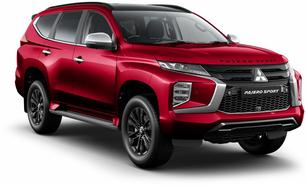
The Mitsubishi Pajero Sport GSR is the top-spec wagon in an updated line-up.
The next-gen performance-enhanced Pajero Sport is expected here in 2025 but, in the meantime, Mitsubishi looks determined to squeeze the last bit of sales juice out of the current line-up as the entire range has now undergone a notable refresh including the introduction of 18-inch alloys, design tweaks to the front and rear, as well as new styling inside and new exterior paint choices.
Is this upgraded Pajero Sport a noteworthy rival for the likes of the Ford Everest and Isuzu MU-X and, more importantly, does it represent a solid buy?
Read on.
Not many people even know what a Cupra Ateca V is… and this is the second best thing about this small SUV. The first best thing is that Cupra is owned by Volkswagen.
So, this means you can have your mysterious SUV not many other people drive while knowing it’s underpinned by one of the largest car manufacturers in the world which makes cars millions of people drive and one which also has a reputation for high quality vehicles.
The big news here is the Ateca model range has a new and lower entry fee with the arrival of this V grade. See, until now the only Ateca Australians could buy is the high-performance VZx which while really sporty also came with a pretty big price tag.
So, how much is the Ateca V and what do you get for the money? We found this out at the Australian launch along with how practical and safe it is and what it’s like to drive.
The Pajero Sport is reasonable on-road, more than satisfactory as a daily driver and it’s still a very effective 4WD.
This is a proven touring vehicle and while this update treatment doesn’t add a whole lot to the Pajero Sport package – and nothing in terms of power, torque or performance in general – it’s easily enough to tempt those who aren’t patient enough to wait for the next-generation version to arrive here.
The Cupra Ateca V is a much needed more affordable way into this small SUV while still offering a high-end feeling with plenty of standard features. Yes, the V isn't as high-powered as the VZx but it's still great to drive in the city and on the open road. Big on the inside and small on the outside the Cupra Ateca can perform urban and (small) family duties well.
Note: CarsGuide attended this event as a guest of the manufacturer, with accommodation and meals provided.
Most of the Pajero Sport’s latest round of upgrades is focused on styling refreshes, inside and out.
The upgraded interior in the GSR includes quilted two-tone burgundy and black synthetic leather upholstery.
This adds a welcome touch of understated class to an interior which is otherwise looking and feeling old.
The Pajero Sport now also has a three-spoke leather steering wheel and revised digital instrument display graphics, which may be difficult to discern for those unfamiliar with the previous renderings.
Outside, the GSR retains the distinctive Pajero Sport shape, albeit now with updated upper and lower grilles, front and rear bumper enhancements and black headlamp extensions (those are range-wide inclusions), as well as black door mirrors, door handles and tailgate handle.
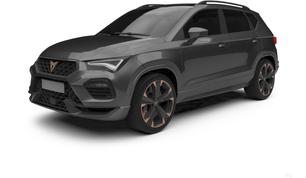
Once you know the Cupra Ateca V is closely related to the Volkswagen Tiguan and Skoda Karoq you can definitely see a resemblance. Still, all three have their own look with the Cupra clearly given the role of being the fierce, sporty one.
While the Ateca V doesn’t have the same menacing styling as the VZx, it’s definitely a seriously sporty looking SUV with its 19-inch alloys, aggressive front bumper, triangular LED running lights and blacked out wing mirrors, roof rails and CUPRA lettering across the tailgate.
The bronze Cupra logo really signals the sporty intent of this brand and I’ve been told on more than one occasion that it looks like a biohazard symbol by people confused by what it is I’m driving. According to Cupra the blade-like design represents “the sense of belonging to a clan”.
Measuring 4381mm long, 1841mm wide and 1625mm tall with 2630mm wheelbase the Ateca V is about 15cm shorter in length than a Tiguan, but as you’ll see in the practicality section the interior dimensions might be larger than you think.
The Ateca V’s cabin is full of dark-coloured materials with black leather upholstered sports seats and steering wheel. In the same way it feels like Batman designed the exterior the interior it has a ‘Made in Gotham City’ feel with a brooding style incorporating high quality textures and surfaces.
The Pajero Sport cabin is practical, but now, as a result of the upgrade, it has more of a premium look and feel. Sure, it’s still on the wrong side of aged and it’s cramped, but at least it has a layer of gloss to it.
From front to back, it’s a well set-up space. The driver and front passenger seats (both power-adjustable) are very supportive, with a nice wrap-around feel to them. The other seats are also fine.
The reach- and height-adjustable steering wheel has paddle shifters for energetic shifting if you get the urge.
The dash and touchscreen media unit are nicely integrated, but that 8.0-inch screen is too small – and thankfully the likely introduction of a 9.0-inch screen in the 2025 Pajero Sport will sort out that issue.
The cabin’s familiar feel includes the fact that all buttons and dials are easy to locate and operate, even when you're bouncing around off-road.
The second row is comfortable and roomy enough, though the entire cabin tends towards the squeezy end of the spacious spectrum. Having said that, I slotted in behind my driving position and I had plenty of head, knee and foot room.
There are three top tether points, two ISOFIX anchors and a fold-down armrest with cupholders in the second row. There are USB charge points and a power socket in the back of the centre console bin.
Third-row seating is a bit of a straight-up-and-down affair with a flat seat base, but passengers back there – god bless ’em – have access to cupholders and air vents.
In terms of packability, the Pajero Sport’s cabin, as mentioned, is quite narrow compared to most of its rivals and there are plenty of other SUVs and 4WD wagons around that offer more room inside for people, gear and dogs.
With the third-row seats in use, boot space is listed as 131L. There are power sockets and tie-down points in that rear cargo area.
With the third row stowed away, there’s a claimed 502L of cargo space, which is pretty handy. With the second and third rows stowed, there’s a claimed 1488L.
The Ateca V is only about 4.4m long which is a lot shorter than a Kia Sportage, Nissan X-Trail or Subaru Forester, which are truly mid-size SUVs. So, the Ateca is a small SUV but on the larger side compared to say a Volkswagen T-Roc.
Despite its fairly diminutive exterior proportions the Ateca V has excellent storage and is remarkably spacious. If you have a young, small family and want a five-seater SUV big enough for them but small enough to make urban driving easy the Ateca V ticks both boxes.
Up front there are the gigantic door pockets, two cupholders, a decent-sized covered centre console bin and under-dash storage with wireless phone charging and two USB ports.
The second row is incredibly spacious for a small SUV with so much room for me at 189cm tall to sit behind my driving position. Headroom is excellent, too.
There are also cupholders in the fold-down armrest, two USB ports and big door pockets.
The back door apertures are tall and wide which makes getting little kids in and out of their car seats easier for parents.
A 485L cargo capacity is large for the class and under the boot floor is a space-saver spare wheel.
As mentioned, the test vehicle is a GSR spec Pajero Sport, a seven-seat 4WD wagon with a price-tag of $64,840, before on-road costs.
But this test example has a bunch of accessories onboard – including a towbar kit ($1546), snorkel ($1103), electric brake controller ($710), roof rack/cross bars ($604), carpet mats ($249) and a towball ($42), pushing its price-tag up to the $69,094 mark, excluding on-road costs.
Standard features include an 8.0-inch touchscreen multimedia system (with Apple CarPlay and Android Auto), digital radio, as well as three-zone climate-control, front and rear parking sensors and a power-operated tailgate.
The Pajero Sport packs a whole lot more, of course, and it compares evenly with most other similarly priced seven-seat 4WDs on the market.
Exterior paint choices include 'White Diamond', 'Terra Rossa', 'Graphite Grey' and 'Black Mica', but you can also choose from White Diamond with black roof, Terra Rossa with black roof, and the new Graphite Grey with black roof.
The Ateca model now has a lower priced grade called the V and it lists for $51,990. That’s more than $10K less than the top-of-the-range VZx which has been out for a couple of years and lists for $63,490.
The Ateca V might be less expensive but the features list is still impressive. Coming standard are 19-inch alloy wheels, sports bumpers, LED headlights, running lights and puddle lights. There’s a proximity key and power tailgate with gesture control, too.
Inside black leather upholstery is standard, so are heated front seats and steering wheel, there’s dual-zone climate control, a power driver’s seat, a 9.2-inch media display with wireless Apple CarPlay and Android Auto and wireless phone charging.
As for options, you can have a panoramic sunroof for $1850 and premium metallic paint for $490.
There’s also the optional 'Tech Package' for $2950 bringing a Beats stereo system and a 360-degree camera. But the best thing about the pack is it also adds dynamic chassis control which adds adaptive suspension, so when you select 'Comfort' mode the suspension becomes softer, and in 'Sport' mode the suspension firms for better handling.
Rivals to the Ateca V include the Lexus UX and Volvo XC40 but also its Volkswagen Group cousins such as the Skoda Karoq and VW Tiguan R-Line.
The Pajero Sport has a 2.4-litre, four-cylinder, turbo-diesel engine producing 133kW at 3500rpm and 430Nm at 2500rpm – and that’s matched to a eight-speed automatic transmission.
This is a solid but lacklustre combination – it’s agricultural, truck-like and it takes a heavy right foot to punch it off the mark. But overall, I don’t mind the driving experience.
This is a respectable and well-proven combination, more than a bit sluggish and far from dynamic, but it does the job.
The GSR has Mitsubishi’s 'Super Select II' 4WD (a full-time 4WD system), selectable off-road modes and a rear diff lock.
The Super Select dial is positioned at the rear of the shifter and enables the driver to switch from '2H' (two-wheel drive), '4H' (4WD high-range), '4HLc' (4WD High Range with locked centre diff) and '4LLc' (4WD Low Range with locked centre diff).
The driver is able to safely switch between 2WD (2H) and 4WD (4H, 4HLc) at speeds of up to 100km/h.
The GSR has a button-operated off-road mode system – with 'Gravel', 'Mud/Snow', 'Sand' or 'Rock' settings, each of which tweaks engine output, transmission settings and traction control to best suit the terrain. It also features hill descent control.
The 2025 Pajero Sport will have the new Triton’s twin-turbo four-cylinder diesel engine (producing 150kW and 470Nm) and it’ll be paired with an eight-speed auto.
The Ateca V has a 2.0-litre turbo-petrol four-cylinder engine making 140kW and 320Nm. That’s a step down in output compared to the VZx’s 221kW and 440Nm, but the V doesn't feel underpowered.
A seven-speed dual clutch automatic transmission shifts gears lighting fast with the drive going to all four wheels. Yes, it’s all-wheel drive.
The Pajero Sport has an official fuel consumption figure of 8.0L/100km on a combined (urban/extra-urban) cycle.
I recorded 9.8L/100km on this test. I did a lot of high- and low-range 4WDing and the Pajero Sport was never working hard.
The Pajero Sport has a 68L fuel tank, so, going by my on-test fuel-consumption figure, you could reasonably expect a driving range of about 694km from a full tank.
Cupra says that after a combination of open and urban roads the Ateca V should use 7.1L/100km. That’s not hugely fuel efficient and urban consumption of 8.6L/100km will mean higher fuel bills than a hybrid SUV of this size.
On the launch we saw a fuel consumption average of 7.7L/100km and that’s after city roads, motorways and country roads.
Once we have the Ateca V in our CarsGuide garage we’ll be able to perform a real-world test of its fuel consumption.
The Ateca V has a 55-litre fuel tank and requires 95 RON premium unleaded petrol. Theoretical driving range is around 775km.
There have been no power, torque or driver-assist tech changes to this upgraded Pajero Sport – you’ll have to wait for the next-gen version for those – so no surprises lay in wait when driving.
But that’s okay, because the Pajero Sport in its current guise is a solid daily driver – not spectacular, but far from atrocious.
The Pajero Sport is 4840mm long (with a 2800mm wheelbase), 1815mm wide, 1835mm high and has a kerb weight of 2130kg.
Compared to other similarly-sized 4WD wagons, the Pajero Sport is narrower and has a higher centre of gravity, so it’s nimble – the turning circle is a respectable 11.2m – but it also feels a bit floaty on roads and tracks, but not despicably so.
The Pajero Sport is reasonable on sealed surfaces, although it is sluggish, noisy and there’s quite a lot of body-roll through sharp turns, especially compared to some of its more refined rivals, such as the Ford Everest.
But it is a very capable off-roader, mostly because the driver has access to a raft of technical advantages engineered into the Pajero Sport aimed at making 4WDing a safer challenge.
One of the major points of difference it has with its rivals is Super Select II 4WD. You can switch, via a dial to the rear of the auto shifter, from 2H into 4H (four-wheel drive, high-range), if you're not already driving with 4H engaged, and that gives you the best traction possible in low-grip conditions, which you may face on rough back-roads and dirt tracks peppered with loose rocks and potholes.
There's no risk of transmission wind-up because the centre diff is open when 4H is engaged in the Pajero Sport, so Super Select II 4WD adds an extra element of safety and sure-footedness to your driving experience.
Then turn the dial to 4HLc (four-wheel drive, high-range, locked centre diff) and you're ready to take on more difficult terrain but at lower speeds, because the centre diff is no longer open.
If you want to tackle even harder stuff than high-range territory, turn the dial to 4LLc (four-wheel drive, low-range, locked centre diff) and the Pajero Sport has an opportunity to excel in low-speed, low-range four-wheel driving.
Turn the dial to 4HLc and you're ready to take on more difficult terrain but at lower speeds.
So, along with decent high- and low-range gearing and a centre diff-lock – activated when 4HLc (4WD high-range, locked centre diff) or 4LLc (4WD low-range, locked centre diff) is selected – the Pajero Sport has a rear diff lock, which is engaged/disengaged via a button in front of the shifter and this further help you to easily maintain safe forward momentum.
Hill descent control sustains a controlled low speed of 3.0-4.0km/h all the way down steeper, longer hills.
The GSR also has selectable off-road modes, including Gravel, Sand, Mud/Snow (when in high-range 4WD) and Rock (when in low-range 4WD).
Each of these modes adjusts engine output, transmission settings and braking, the aim being the acquisition of superior traction to suit specific conditions and terrains.
The Pajero Sport is riding on Toyo Open Country A32 all-terrains (265/60R18 110H), which are decent tyres, but it would perform even better with more aggressive rubber.
Wheel travel is adequate, ground clearance (218mm) is reasonable, although you still have to mind your driving line through rough terrain and be mindful of this 4WD’s approach (30 degrees), departure (24.2) and ramp-over (23.1) angles. Wading depth is listed as 700mm.
While it’s never been regarded as a tow rig in the same vein as something like the Toyota LandCruiser or the Nissan Patrol, the Pajero Sport offers sensible claimed towing capacities of 750kg (unbraked) and 3100kg (braked).
Payload is listed as 645kg (so about standard for this size 4WD wagon), gross vehicle mass (GVM) is 2775kg and gross combined mass (GCM) is 5565kg.
The launch of the Ateca V saw us drive the V and the VZx back-to-back, which highlighted how good the V is for the money when it comes to its on-road performance.
The 2.0-litre engine is superbly responsive with loads of torque for such a small petrol SUV, while the dynamics were equally impressive on winding country roads. Even when those roads occasionally and suddenly turned from bitumen to dirt at 100km/h excellent all-wheel drive traction kept everything under control.
The Ateca V we tested has the optional Tech Package fitted which adds dynamic chassis control and adjusts the suspension in the Comfort drive mode setting to a softer level compared to the firmer level in Sport. The ride in any mode, however, is comfortable with great handling.
As standard the Ateca V is given sports suspension and after a quick sample of the Ateca V with this set-up I also found the ride to be comfortable and composed.
There's good visibility even through the rear window, along with nicely weighted accurate steering and a good pedal feel under my feet make the Ateca V effortless and enjoyable to drive.
The Pajero Sport range did have the maximum five-star ANCAP safety rating, but that expired in January 2023.
As standard it has dual front airbags, driver knee, front-side and curtain airbags, as well as two ISOFIX points and three top tether points for child seats/baby capsules in the second row.
Driver-assist tech includes AEB, blind spot warning, rear cross-traffic alert, lane-departure warning/intervention, hill descent control, trailer stability assist and more.
The Cupa Ateca V hasn’t been tested by ANCAP and the Euro Ncap result of five stars (which is the maximum) has now expired because it was so long ago (2016).
Still, while much of the safety tech isn’t as cutting edge as some new SUVs , there’s AEB, adaptive cruise control, lane keeping assistance, rear traffic alert plus front and rear parking sensors.
The airbag count runs to seven, including a front centre bag to minimise head clash injuries in a side-impact.
For child seats there are three anchor points and two ISOFIX mounts in the back.
The Pajero Sport has a 10-year/200,000km manufacturer’s warranty as long as you get it serviced as per the schedule at an authorised Mitsubishi dealer.
Mitsubishi’s 10-year capped price servicing applies – with prices ranging from $399 to $999 – and servicing is scheduled for every 12 months or 15,000km whichever occurs first. Check with your dealership for up-to-date servicing costs.
All Pajero Sports come with 12-months roadside assistance, but that can be extended to four years if the vehicle is serviced at an authorised Mitsubishi dealer in line with the official service schedule.
The Ateca V is covered by Cupra’s five-year, unlimited-kilometre warranty, with servicing needed every 15,000km or annually.
You can buy a five-year service plan for $1990 - which isn’t overly pricey.