What's the difference?
Mini and electricity were always destined to be together. Of course a sporty, prestigious and quirky little car favoured by urban dwellers was going to be the perfect match for an electric powertrain.
And while the Aceman SUV isn't the first fully electric vehicle for the brand it is a welcome addition that's quintessentially Mini, even if it is made in China.
The Aceman fills the gap between the Mini Cooper hatch and Countryman SUV and rivals a range of small electric premium SUVs such as the Alfa Romeo Junior and even the Volvo EX30.
The variant of this four-door, five-seater Aceman we are testing is the SE.
The Mini Countryman is the not-so-mini cousin to the iconic and smaller Mini Cooper.
The new generation offers a larger body-size, fun new interiors and a whole suite of updated technology.
We're in the flagship John Cooper Works grade in Favoured trim to find out if this small SUV is still urban-friendly and fun after all of these changes.
The Aceman could be the perfect Mini - bigger than a Cooper, smaller than a Countryman. It’s also surprisingly spacious and practical. The price is about right compared to rivals, and so is the battery size and range.
What the Mini has that others don’t is its unique and playful design and ‘attitude’. True to the Mini ethos it's not a restrained car, it’s whimsical in its design but serious in its ability. It's a great car to drive both dynamically and in terms of comfort.
The new Mini Countryman John Cooper Works in Favoured trim offers everything you’d expect it to - the iconic Mini styling, a powerful driving performance and a well-equipped cabin. It’s a wonderfully quick urban dweller that you can park anywhere but is just as happy on the open-road. For me, this is pure fun and offers more personality than a lot of its rivals.
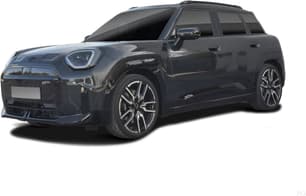
New Minis are all about design, sometimes, in my opinion, to a fault. The Aceman is very 'Mini' with its big googly eyes, little rectangular ‘grille’, blob-like tail-lights and a side profile that resembles a house brick.
That’s how all new Minis look with each model having its own distinguishing characteristics. In the Aceman's case it has more triangular headlights than the Cooper and Countryman but more rounded tail-lights and black plastic cladding around the lower grille, wheel arches and side skirts.
Our test car is painted 'Blazing Blue', with a black roof.
Inside the upholstery is 'Vescin Dark Petrol', a kind of grey blue. The stitched dash is made of recycled polyester and is knitted in 'Dark Petrol' and orange fabric.
I like Mini interiors and I love the multitude of buttons for everything. It's a refreshing change in a world where physical dials and controls are disappearing from car cabins.
The circular OLED screen is pretty and a hat-tip to early Minis with their centre speedo.
Is the Aceman an SUV or hatch? I honestly don’t know and I’ve lived with it for a week. It’s officially classified as an SUV, but it looks like a four-door hatchback with a slightly raised ride height.
If anything the Aceman looks like a cross between the Cooper and the Countryman, not quite a hatch, not quite an SUV, but probably just right for most people.
The Aceman’s dimensions make this car seem small at 4070mm long, 1754mm wide and 1514mm tall, but considering the fairly diminutive exterior the inside is impressively spacious.
It's a case of the 'not-so-mini' when it comes to the new Countryman because it now stands at 4447mm in length, 1843mm in width and 1645mm in height. That's 170mm longer and 21mm wider than the previous generation!
But the Countryman still has all of the fun styling you’d expect in a Mini and it’s that iconic styling that sets this car apart from its rivals. It knows its fun and isn't afraid to show it.
Our Mini Countryman gets JCW badging across the body of the car, including its wheels but it's the chequered flag motif across the grille that reminds you what’s under the bonnet.
Unfortunately, our test model is finished in the rather boring 'Midnight Black II' but the range of colours and customisations available on the Countryman will help make it feel like your own.
Head inside and there's a hefty mix of materials in the cabin space. You’ve got a thick and rough-textured weave/knit across the dash, doors and tops of the sports seats but that’s then mixed with a black synthetic upholstery and plastics everywhere else.
The red stitching and accents won’t land with everyone but it certainly creates a fun atmosphere.
There are some lovely design highlights with rose gold metal accents in the door handles and air vents. A panoramic sunroof adds some much needed airiness and I adore the way you still get a ‘turn-key’ experience despite having keyless start with the starter knob.
The round media screen isn't as well-integrated as before but it looks gorgeous and the different drive modes give you a range of colours to further customise the cabin.
OK, the moment I typed the word 'spacious’ in that previous section on Design I had a concern. You might think the Aceman is somehow huge on the inside, but it’s not. What it is, however, is cleverly designed so as to maximise the available space and at 188cm tall I’m a good test for this.
Space up front for me in the driver’s seat is excellent, and that goes for head, elbow and legroom. The second row is cramped for me and I can’t sit behind my driving position, but my children were happy back there - one almost a teenager and the other in a child seat.
Storage is good with door pockets, a tray for rear passengers with USB ports, cupholders up front and a wireless charging nook, plus a small box with a lid between the front seats.
The boot has a 300-litre cargo capacity which isn't bad given the car’s size.
Where is the Mini Aceman made? Yes, as I said in the intro the Aceman is made in China as a joint venture between GWM and BMW.
You knew BMW owns Mini right? Of course you did.
But as for being made in China, don’t let that put you off. Some of the best electric cars I've driven all come from China and the worst… not from China.
The cabin of the Mini Countryman doesn't feel like it belongs in a small SUV. The legroom is still best up front but the second row offers more than enough space for taller adults. It will be most comfortable for four rather than five adults, though.
The electric front seats have large side bolstering and decent padding but they are on the firmer side. You get a little bit of fatigue on a longer trip but around town they’re great and the massage function on the driver's seat is strong.
The rear seat is even firmer than the front and set like a stadium seat, so it won't be as comfy for adults on a longer trip. The fold-down armrest adds some bolstering.
While the storage looks a little odd at first, all of the cubbies are quite functional. There's a lot of them, too, and the dual shelves underneath the starter-knob are particularly handy for your larger 'small' items, like phones and sunnies case. This is where the wireless charging pad is, too.
The glove box can fit a manual and the little centre console is kind of adorable but still fit all of my keys and wallet.
The sliding armrest is a nice touch and there's a couple of USB-C ports underneath it. There are two large cupholders, two drink holders and small storage bins in the doors.
In the rear you get a drink bottle holder in each door, two map pockets, two USB-C ports and two cupholders.
The circular multimedia screen looks great and once you get used to how the menus are accessed and the little shortcuts, it’s a fairly simple system to use while on the go.
The touchscreen is fairly responsive but you'll need to do wide swipes across to switch the menu screens.
I’m not a massive fan of having to access a screen for most of your functions but do like the way climate control remains on the screen at all times and it's just the fan function that needs a couple of extra toggles.
The multimedia system is run by Android Automotive and has wired and wireless phone mirroring. The Apple CarPlay maintained a steady connection this week with my iPhone 15 Pro Max and the built-in sat nav is easy to use.
Rounding out the interior is the large 505L boot and if you want more storage options, the back row has a 40/20/40 split-fold.
The loading space has a small lip, and a handy storage compartment underneath the floor which holds the tyre repair kit and other items you don’t want rolling around. JCWs get a hands-free powered tailgate, which is always handy after a big shopping trip.
Shortly after the Aceman launched around a year ago Mini dropped the base E grade, leaving the SE and spicy JCW as the only grades left.
The Aceman SE lists for $60,990 before on-road costs. Another five grand will get you into the high-performance Aceman JCW.
Frankly, the SE feels plenty powerful and sporty and the features list is also plentiful.
Standard gear includes 19-inch alloy wheels, proximity unlocking, panoramic glass roof, black roof rails, JCW bucket-style sport seats, a Harman Kardon sound system, 240mm circular OLED central media display, digital radio, head-up display, wireless Apple CarPlay and Android Auto, wireless phone charging, sat nav, ambient lighting, LED headlights and tail-lights.
The interior fabrics and colour styling show in the images are all standard, too.
The value is good considering the Mini Aceman is a prestige car, and you’ll pay a similar amount for entry-grade rivals such as Alfa Romeo's Junior, Volvo’s EX30 and the Zeekr X.
There are five versions of the new Mini Countryman, which includes a line-up of petrol and fully-electric powertrains.
For the petrol John Cooper Works (JCW), there are two trim levels available and our test model is the flagship Favoured variant. It's priced from $73,990, before on road costs, making it an affordable high-performance small SUV compared to its Euro rivals.
The third-gen Mini Countryman JCW is built alongside the BMW X1 and because they share the same platform and engine, it directly competes against the X1 M35i xDrive which is priced from $92,300 MSRP.
So, if its the impressive engine outputs you’re after our JCW Favoured is the better pick. The Audi RS Q3 2.5 TFSI quattro is even more expensive at $101,215 but it does have better engine outputs.
Surprisingly, the John Cooper Works Favoured doesn’t add all that much to the ‘base’ Classic trim but the additions include 20-inch alloy wheels with performance brakes (including red calipers) and six extra paintwork options. You also get electric front seats, with memory and massage functions for the driver.
JCW models come with keyless entry and start, heated front seats, a panoramic sunroof, adaptive cornering LED headlights, dual climate control, powered tailgate with kick-function, heated steering wheel and velour floor mats.
The technology includes a round 9.4-inch OLED multimedia screen, dash cam recorder, a premium Harman Kardon sound system, digital radio, a head-up display, 'Spike' Mini Assistant, an interior camera (you can take selfies!), augmented satellite navigation, wireless Apple CarPlay/Android Auto, a wireless charging pad, four USB-C ports and two 12-volt sockets.
While it's impressively more affordable than its peers, the JCW in Favoured trim misses out on a few top-grade features you'd expect at this level. Features like front seat ventilation and heated rear outboard seats or even a massage function on the front passenger seat.
The Mini Aceman is fully electric and while there is talk of a combustion version coming in the future, whether that happens or not is yet to be confirmed. Besides, an electric powertrain is perfect for the Aceman.
In the SE grade the single electric motor drives the front wheels and makes 160kW and 330Nm which is enough to fling the little rectangular beastie from 0-100km/h in 7.1 seconds.
Just as a comparison the five-door Mini Cooper S has a combustion engine that makes 150kW and 300Nm and 0-100km/h comes in 6.8 seconds.
The JCW Countryman is an all-wheel-drive with a seven-speed dual-clutch auto transmission. It has a 2.0-litre, four-cylinder, turbo-petrol engine that produces up to 233kW of power and 400Nm of torque. This model has a 0-100km/h sprint time of just 5.4-seconds!
There are eight drive 'experience' modes you can choose from, comprising 'Core', 'Green', 'Go Kart' (very fun), 'Personal', 'Timeless', 'Vivid', 'Balance' and 'Trail'.
The Aceman has a 49.2kWh battery which sounds small and it is compared with larger cars, but is the same size as similar vehicles such as the Volvo EX30 (49kWh) and Alfa Romeo Junior Elettrica (51kWh).
The DC charge rate of 95kW is disappointingly slow. The EX30 has up to 153kW. The AC charging speed is a standard 11kW.
Charging from 10-80 per cent using a DC charger takes 31 minutes.
Energy consumption is 14.4kWh/100km over combined driving conditions which is neither excessive nor super efficient. My own driving saw 15.4kWh, according to the trip computer.
Range is up to 406km, which also is close to rivals but could be better.
For a performance SUV, the JCW Favoured has a lowish official combined (urban/extra-urban) fuel cycle figure of just 7.7L/100km and a large 54L fuel tank, giving you a theoretical driving range of up to 701km, which isn’t bad for such a little go-getter.
After doing a few bigger road trips this week, plus a long weekend in the city, my real-world usage has popped out at 7.9L/100km, which is excellent but expect it to be higher if you only do city driving.
There’s not a Mini model I haven’t driven in the past 15 years and the Aceman lives up to the sporty and engaging feel that makes these little cars fun to pilot, even if it’s just down the road to get milk.
Good, instant acceleration, quick steering that’s a little on the heavy side and a comfortable suspension tune that can handle quick corners while keeping the car flat makes the Aceman a liveable and enjoyable car.
A range of noises - Mini calls it a 'Sonic Universe' - provides a soundtrack to your driving and while they’re all a bit embarrassing, only one can be heard outside the vehicle and it’s not too cringeworthy.
The Mini Aceman drives like a small, sporty prestige car, meaning there’s a solid, planted feel with good handling and comfort to go with it.
And its tiny proportions makes it super easy to pilot through tight laneways and park in impossibly small places.
Even if you don’t love the design, the power and performance of the turbo-petrol engine will win you over. It’s just pure unadulterated fun on the open road and in the city. You get a total hot-hatch experience, despite the Countryman being an SUV.
The adaptive suspension feels a little stiff when you’re going over uneven road surfaces at higher speeds and road noise also creeps in, but around town this is a comfortable ride.
Visibility is great, even in heavy rain with a child's car seat installed in the rear (we had a mix of weather on test). Thanks in no small part to the all-wheel drive system it felt sure-footed in the wet and I felt confident this car would do everything I asked of it.
The firm steering makes for a nimble on-road experience no matter the situation and you have gear-shifting paddles on the steering wheel.
There’s also a 'Boost' mode that wrangles the top performance out of the suspension, steering and engine for when you want more control.
You can park the Countryman just about anywhere and the 360-degree camera view system is excellent quality. It’s easy to park, even in small, tight car parks.
The Mini Aceman was awarded the maximum five-star ANCAP rating in 2025. The safety equipment list is vast and includes tech from auto emergency braking (AEB), lane keeping assistance and blind spot warning to rear cross-traffic alert with braking, exit warning and auto parking.
The Aceman has a puncture repair kit in the place of a spare tyre.
For child seats there are two ISOFIX points and three top tether anchor points.
The new Mini Countryman hasn’t been assessed by ANCAP but features a healthy list of crash-avoidance safety features and has nine airbags, including a front centre bag.
Standard safety equipment includes driver monitoring, rear cross-traffic alert, AEB, 'Cornering Brake Control', blind-spot monitoring, emergency e-call, lane keeping aid, lane departure warning, side exit assist, a dash cam recorder, tyre pressure monitoring, 360-degree view camera system plus front and rear parking sensors.
The adaptive cruise control is also well-tuned and one of the better systems I’ve sampled recently.
The rear seat has two ISOFIX child seat mounts and three top tether anchor points but two seats will fit best.
Mini covers the Aceman with a five-year/unlimited kilometre warranty and while that's the standard for prestige makers such as BMW and Mercedes-Benz, it falls short of mainstream coverage with some brands now offering seven years or more of coverage.
The Aceman’s battery is covered by an eight-year/100,000km warranty, which is the norm right across the industry.
Mini has conditions-based servicing so rather than a specific schedule, the car's computer will tell you when it is due for a service.
Mini offers owners pre-paid service packages priced from $1575 for four years and $2360 for six years.
The Countryman is offered with a five-year/unlimited km warranty which is pretty standard fare for a Euro model. You can pre-purchase a five year or up to 80,000km servicing plan for $2250, which is very competitive for the class.
Servicing intervals are condition based, so your Mini will tell you when it needs to visit the workshop.