What's the difference?
Remember when MG’s first convertible sports car came out? I don’t, I’m 30. But I remember when the most recent one came out.
It’s got a weird name and it’s very hard to avoid drawing attention to yourself when you get out of it at the shops… but should you buy one?
I’ve been getting about in the new MG Cyberster to answer exactly that question.
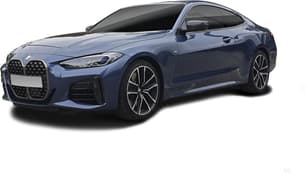
BMW's new 4 Series blasted onto the world stage with a chonky schnozz on it that only a mother could love. If BMW didn't want anyone to look at the rest of the car, it did a cracking job of it, because everyone had something to say about the big gnashers now grafted to the 4's front end.
I was nervous about it, too, because the 4 Series has always been so elegant and the current 3 Series - on which it is based - is quite nice to look at. It also threatened to overshadow just how good a car the BMW 4 should be, based as it is on the excellent 3 Series.
And, of course, one also had to wonder if a sports coupe like this would be any good around town. Limited vision? Hard to get in and out of? A true four-seater, or just a squishy 2+2? So many questions.
The Cyberster is certainly an impressive thing in a lot of ways, but if you were expecting a perfect sports car from MG, you'll be a bit disappointed.
It's quite expensive if you're looking for a nice EV, but on the flip side it's quite cheap if being fast is your main concern.
If anything, the Cyberster is an exciting look at what the brand is capable of, even if it's a bit rough around the edges.
The BMW 420i is a terrific car if you're after a bit of style and sophistication. Not everyone will warm to your car's nose, but if you get it de-chromed, like this white one, it really does look pretty good. It's a car that uses very little fuel, moves along smartly and is brimming with a decent amount of tech, even if it could do with a bit more safety gear at this price.
I reckon this car is settling well into the automotive landscape and ignoring it because of a few loudmouths think the grille is too big would be a terrible waste.
MG reckons the Cyberster draws on the proportions of classic roadsters like its MG A and B from the ‘50s and ‘60s.
And I reckon that’s about where the comparison ends, really.
But don’t get me wrong, I think it’s got some pretty angles and nice elements.
It’s got the long bonnet, but its cabin isn't set so far back and its aerodynamic lines and curves probably weren't a priority back then either.
This is the standard colour, English White, which is more like off-white or cream or beige.
You can have a red roof on the lighter colours, white, silver, and grey, but red and yellow Cybersters have black ones.
The tail-lights at the back were inspired by the union jack, but they’re probably one of the elements on this car I'd put in the ‘tacky’ column.
The internet exploded when it became clear the big kidney grille was for real. To be fair, BMW did itself absolutely no favours by ensuring the photos of the 4 Series made the twin grille look Easter Island statue sized.
And it persisted in doing them naked, without number plates to break up the look. In the flesh, it all works, the nose is striking but not completely overblown.
BMW coupe elegance reigns supreme in profile, however, with excellent proportions, and even in base form the wheels are the right size. The slim tail-lights and sculpted tail complete the look. It's a car I think most people love looking at. Hardly anyone mentioned the grille.
The cabin is excellent, as are all of the newer BMW interiors. It's not really a base model, given the price, but the mix of Alcantara and synthetic leather is very pleasing.
The big screens for the media and instruments headline the cabin with high-tech style and while it's not avant-garde, it's sharp and feels premium, which is just as well.
A three-screen dash sounds a little daunting at first, but it’s not that far from the giant screens in some new cars now.
The central 10.25-inch screen is info only, while the flanking 7.0-inch screens are touchscreens, as is the climate control screen in the console.
As much as I’m a fan of physical buttons where possible, this car shows that multiple screens means you don’t need many sub-menus.
Basically, this feels like a lot, but you get used to it relatively quickly.
And while it also seems like MG’s software has become more intuitive and less laggy, the placements of the screens is a little annoying - the side screens on the dash are blocked by the steering wheel, and the central touchscreen is a bit fiddly.
Like I mentioned, no wireless phone mirroring is a let-down and there’s not really an obvious place to put a phone, but the ability to level out the cup holders is kind of interesting and the central storage where the USB-A and C ports are is big enough.
There’s a narrow bit of storage behind the seats, but the boot is actually 249 litres and seems much more usable than you might expect.
It's also worth noting the Cyberster comes with an AC slow charging cable as standard, but not a DC fast-charging cable for plugging in at some charging stations.
As a sports coupe, it's hardly a practical all-rounder but it's not a squishy 2+2 either. The rear seats are sculpted for maximum headroom and have the added bonus of holding onto rear passengers.
Six footers won't be super-comfortable but it's bearable for short trips. There are two ISOFIX points back there, too.
The front seats electrically fold out of the way for ingress and egress, but it's not an elegant process.
Front-seat passengers score two cupholders and bottle holders in the doors and a black hole for your phone and its wireless charging pad.
The boot takes an impressive 440 litres and the rear seats split and fold like good little soldiers.
The MG Cyberster finds itself here as the only electric convertible sports car on offer, which means it’s hard to compare its $115,000 price tag to any direct rivals.
The Kia EV6 GT and Hyundai Ioniq 5 N are the wrong shape, the Porsche Cayman has the wrong running gear and most other things with doors like this are a lot more expensive.
So what does $115,000, before on-road costs, get you?
It’s only available in one variant, with pretty much the only cost-option being paint colours.
Aside from the scissor doors, there’s the electric folding roof, triple-screen cockpit with another centre panel, an eight-speaker Bose sound system, heated electric seats and steering wheel, and ambient lighting.
The exterior lights are all automatic intelligent LEDs, and you can open the doors with the key fob.
It is, however, missing a couple of things.
No phone charger might be down to space, but no wireless phone mirroring is a bit annoying, and the manual steering wheel adjustment feels a little cheap in a six-figure EV.
The 420i starts at $71,900. That's a fair bit of money, I think you'll agree.
You get 19-inch wheels, a 10-speaker stereo, LED headlights with auto high beam, head-up display, power front seats, lighting package, auto-parking with reverse assistant, synthetic leather and Alcantara interior, 'Live Cockpit Professional' (fully digital dash), wireless phone charging and digital radio.
The massive 10.25-inch touchscreen may be smaller than the 12.3-inch digital dashboard, but it still looks huge. BMW's Operating System 7.0. is a cracking set-up, and you can control it via either touch or the 'iDrive' rotary dial on the console. It also has Apple CarPlay and Android Auto. Both of them, wireless. You don't read that every day.
You also get 'BMW ConnectedDrive', with some remote services that last for three years. The subscription includes things like the endearingly weird 'Caring Car' and the far less weird real-time traffic information.
The 4 Series is available in eight colours. 'Alpine White' is the only freebie while 'Black Sapphire', 'Arctic Race Blue', 'Portimao Blue', 'San Remo Green' and 'Mineral White' are $1538 each (or part of the 'Visibility Package'). 'Tanzanite Blue' and 'Dravit Grey' are a hefty $2962.
My car for the week had the $6300 Visibility Package (metallic paintwork, sunroof, BMW Laserlight, Ambient Light, which is worth it for the amazing Laserlights alone), the $2860 'Comfort Package' (lumbar support, electric boot, heated front seats, 'Comfort Access' with 'BMW Digital Key') and an $800 black pack. All this took the price to $81,860.
Okay, here’s where the Cyberster gets impressive.
Its dual-motor set-up combines a 150kW front motor and a 250kW rear motor for a total of 375kW.
Peak torque is a hefty 725Nm.
All that is enough to get you and two tonnes of MG from zero to 100km/h in 3.2 seconds.
Sure it tops out at 208km/h, but the rush of hitting highway speeds is already enough to put your licence at risk.
The 420i’s 2.0-litre turbocharged four-cylinder, codenamed B48, spins up 135kW/300Nm. Driving the rear wheels through an eight-speed ZF automatic transmission, you'll go from zip to the 100km/h mark in 7.5 seconds, which is brisk, if not staggering.
The MG Cyberster has a 77kWh battery and a claimed efficiency of 19.1kWh/100km.
While that means its claimed driving range of 443km relies on a bit of energy to be recuperated from braking, something you don’t really get on the highway, it actually works in the car’s favour during dynamic driving.
After 264km of driving on a test loop that included some urban but mostly highway and rural driving, the Cyberster’s trip computer displayed a 19.4kWh/100km average consumption.
The battery sat at 27 per cent, with 108km estimated range remaining.
While 443km of total range seems optimistic for a car that’s likely to be driven relatively quickly a lot of the time, the efficiency of the Cyberster held up better than you might have expected.
BMW's official combined-cycle figures seem to be slowly moving towards reality. The 420i's sticker figure of 6.4L/100km was met with an indicated 6.8L/100km, which was excellent going for almost exclusively suburban and urban running.
It's a solid result, but being a BMW, it's premium unleaded only for its 59-litre tank.
With my generally unsympathetic (but not psychopathic) right foot, that means a real-world range of over 800km between fills.
There’s good news and bad news about the Cyberster from behind the wheel.
The good news is it’s quite easy to drive this thing very fast.
The bad news is it feels like it would be quite easy to get sick of as a day-to-day car, depending on your situation.
The first thing I noticed is the seat feels a bit high, even at its lowest setting. That's likely due to the placement of the battery pack under the floor of of the car.
Following that, if you’re taller than me (I'm five foot 11), it feels like the wrong road surface will have you nudging your head into the roof liner.
That mechanical roof should take about 15 seconds to lower or raise, and that can be done at speeds up to 50km/h.
It could be a symptom of trying to keep 1985kg tied down, but some of Melbourne's highways and arterial roads between 70 and 100km/h had the Cyberster bobbing quite a bit.
But the suspension doesn't let individual bumps intrude too much into the cabin, so it’s not all bad.
Similarly, there’s good and bad when it comes to the steering and braking.
The first being that the steering seems pretty accurate, even though the feedback is a bit numb.
The braking on the other hand is handled by some pretty capable Brembos up front that pull the heavy roadster up quickly, but don’t always clamp as hard as you might expect when approaching a traffic light at 60km/h.
But stopping’s one thing, and going’s another.
There are three main drive modes, Comfort, Sport, and Super Sport, which mainly alter the acceleration intensity. And they feel well calibrated.
Comfort keeps things calm and cruisy, Sport is plenty for the road, and Super Sport has the potential to draw the attention of the authorities.
There’s good adjustability when it comes to regen braking, and even a decent single-pedal driving mode.
Aside from a couple of particularly heinous roads, the Cyberster held mostly flat when cornering at high speeds, but the potential for its suspension to let its wheels lose their footing might - or should - stop you from pushing the MG too hard.
At high speeds, there’s a bit of wind noise that you really can’t complain about if you’ve just purchased a drop-top, but the noise, vibration and harshness is decent, all things considered.
My only gripe with the interior fit out is that the passenger seat wobbles a little, and rattles on the surface behind it before moving it forward.
It’s impressive what this car can do in terms of performance, it’s just a shame it’s not more playful.
One of the main things that sets a BMW sedan or sedan-based coupe apart is that they're good everywhere, except perhaps in quicksand.
As the platform has matured and BMW's persistence with run-flat tyres has yielded improvements in tyre construction, the 3/4 Series platform (and many others - the internal name for the platform is CLAR) has once again become the benchmark for ride and handling.
For some people reading this, that's a lot of blah blah blah but the main point is, it's a terrific thing to drive whether you're dawdling along in traffic, dealing with traffic calming or bombing down your favourite deserted road.
The Bridgestone tyres on the 420i aren't as ultimately grippy and sticky as the alternative rubber on the 430i but they work well in town and are quiet on the 80km/h roads so prevalent in Sydney.
The steering is absolutely lovely, providing just the right weight at any given speed and throwing in the road feel to inspire confidence.
Ride around town is compliant but with the whiff of fun if you decide to push things outside of the city.
Its capabilities are still more than worthwhile day-to-day, however, because the way it handles the need to duck in and out of spaces in traffic is extremely handy.
The 2.0-litre four-cylinder is as smooth as rival Audi's. It doesn't sound like much (with a few vestigial pops in Sport mode) but it's certainly got the power to get you out of sticky situations and a transmission that's willing to play ball, whether in Sport or Normal.
Without the adaptive suspension of its 430i and M 440i brethren, this is a very smooth, easygoing sports coupe, with just enough sportiness to keep you interested, if you're that way inclined.
The Cyberster hasn’t been tested by ANCAP but as a niche sports car, it may never get tested.
The good news is it rides on the same platform as the MG4, which has five stars.
It’s got frontal and side airbags, plus all the usual new-car tech like adaptive cruise, lane-keep assist, blind spot warnings, collision warnings and avoidance, and speed limit warnings.
The Cyberster’s active safety is actually mercifully restrained, giving a couple of relatively quiet dings when exceeding the limit before you turn it off, letting you do the steering even when lane-keep is on, and in my case, only giving me a driver attention alert when I yawned while at a red light.
The 4 Series comes with six airbags, ABS, stability and traction controls, forward AEB, forward collision warning, lane-departure warning, reverse cross-traffic alert and reversing camera.
The 4 Series hasn't been tested by ANCAP or Euro NCAP and the 3's five-star rating can only be a guide because of the very different structure of the 4.
Sports cars rarely fare well in the sometimes complex rules so carmakers tend to keep them away from the clutches of crash testers.
MG has a 10-year/250,000km warranty that’s pretty impressive by industry standards, and the warranty also covers its EVs.
It’s important to note that the convertible roof is one of a few items (including 12-volt batteries and light bulbs) that MG covers for less than 10 years. In the case of the roof it’s only five.
It’s worth closely reading the fine print before you crack into buying a car, regardless.
There are also ten capped-price services which occur every 12 months or 25,000km, ranging from $246 to $785. The average price per service is $503.40.
MG also offers free roadside assist for the period of the warranty.
BMW offers a ho-hum length of three years and 100,000km of warranty coverage. Mercedes has gone to five years so one wonders why BMW (and Audi) hasn't joined its German rival.
Servicing is entirely reasonable at $1650 for a five-year/80,000km package that covers the 12 month/16,000km servicing regime.
At $330 per service, it includes things many carmakers don't, such as brake fluid and spark plugs.
You can go full noise with the 'Plus Package', which costs $4500 and chucks in brake pads, rotors and even windscreen-wiper replacement. That doesn't seem like terribly good value to me unless you drive like a lunatic.