What's the difference?
The Mercedes-Benz Sprinter range of vans and cab-chassis models competes for buyers in the Light Duty (3501-8000kg GVM) segment of Australia’s highly competitive Heavy Commercial vehicle market.
In 2024 the German manufacturer expanded its diverse turbo-diesel van range by launching a full-electric variant called the eSprinter, which for the first time offered local buyers the opportunity to drive with zero tailpipe emissions.
We recently spent a working week with this unique offering to assess how competently it could fulfil the diverse job requirements of private tradie buyers and fleet operators.
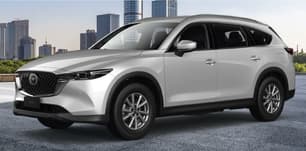
Mazda has a tendency to have a lot of similar looking horses in the stable; blink and you'll miss the (very) subtle differences between the CX-8 and the CX-9 but if you're not super keen on the bulk of the CX-9 and you've outgrown the space of the CX-5... this one's for you.
Especially, if you've been considering its competition - the Hyundai Santa Fe Elite CRDi AWD and Toyota Kluger GXL AWD. Both of which have become known for their features and space.
So, how does it compare? The CX-8 GT SP diesel all-wheel drive seats seven, has a decent boot space (albeit, when the third row isn't in use) and handles like a dream.
Perfect combination? Maybe. I've been driving it for the last week with my family to find out for you.
With the convenience of back-to-base charging the eSprinter would be well suited to last-mile logistics or other urban delivery roles, as its driving range is ample for many of these urban tasks with the added benefit of zero tailpipe emissions. However, at more than $100K it is a big spend (like its full-electric rivals) so only a thorough cost-benefit analysis can decide if it’s the right choice for your business.
So, what did my family think about the Mazda CX-8 GT SP diesel all-wheel drive? I love how it performs on the road - it's super easy to drive and you don't notice how large it is in a car park.
There are some great family-friendly features scattered throughout and I like how practical this is too with the extra seats and top-tether points. The multimedia system isn’t my favourite and I would have preferred to have seen a few extra airbags and a 360-degree view camera, but overall, it’s a good family car and gets an 8.0/10 from me.
My son loved the sun blinds and the cool colour of the seats. He also gives it an 8.0/10.
This is a substantial vehicle riding on a 3665mm wheelbase and spanning almost 6.0 metres in length (5932mm) and more than 2.0 metres in width (2020mm without mirrors), yet it has a tight kerb-to-kerb turning circle of only 12.4 metres.
And with the optional High Roof as fitted to our example it stands almost 3.0 metres tall (2867mm), so drivers need to be conscious of this extra dimension when accessing underground loading zones, driving under height-restricted bridges etc.
Its rear-wheel drive unitary chassis features simple and rugged McPherson strut front suspension paired with a De Dion-style rigid beam/leaf spring rear axle, along with four-wheel disc brakes and electrically assisted power steering.
There’s prominent use of unpainted dark grey plastic in external areas where bumps, scrapes and wear are usually inflicted, including the grille, front bumper, hubcaps, doorhandles, door mirror shells, side bump-strips and rear bumper.
The cabin design is spacious, neat and functional, with unique instrumentation which replaces the traditional tachometer with a gauge that monitors driving efficiency. There’s also a digital info screen that displays average energy consumption, battery charge, estimated driving range, gear selection and more.
To be honest, I can't really tell the CX-8 and CX-9 apart on the road. They're both large SUVs that sport the classic Mazda bonnet - sharp and long. Up close, the CX-9 has a bulkier shape but otherwise they are remarkably similar.
The CX-8's darkened grille generates some interest with its lattice-work and there are enough shiny chrome accents scattered about the car that it looks pretty.
Yet, the sporty sharpness that Mazda is known for is still hinted at with its shaping and the 19-inch black alloy wheels.
Our model is finished in 'Platinum Quartz Metallic' and it is the highlight for the exterior styling for me. I think because it's such an interesting colour to look at - it varies a lot depending on lighting conditions. Sometimes, it almost has a sheen of pink to it and at others, it looks like pearly sand.
The interior looks polished and refined with its burgundy leather trim and soft-touchpoints. Again, there is a lot of chrome inside to make otherwise dull features, like air vents, pop out.
With its hefty 2727kg kerb weight (largely due to the battery) and 4250kg GVM, the eSprinter has a sizeable 1523kg payload rating. It’s also rated to tow up to 2000kg of braked trailer but with its 5000kg GCM (or how much it can carry and tow at the same time) that big payload must shrink to only 273kg to legally tow its maximum trailer weight.
That’s only enough payload capacity to cater for the weight of a two-man crew and little more so it’s important to be aware of these numbers if you’re planning to tow this heavy (although we suspect few if any owners would do so).
The cargo bay with the High Roof option is enormous, with 2009mm from floor to roof allowing even tall people to stand without stooping. Its load volume is a cavernous 10.5 cubic metres.
The load floor, which is protected by a hard non-slip surface, is 3375mm long and 1732mm wide with 1350mm between the rear-wheel housings. This allow up to two Aussie pallets or up to four Euro pallets to be carried, secured using a choice of 10 load anchorage points which fold flush with the floor when not in use.
Cargo bay access is through a sliding kerbside door with a big 1260mm-wide opening and a pair of rear barn doors which can open to a full 270 degrees on each side to optimise access to forklifts and loading docks.
The walls and sliding door are neatly lined to roof height and large handles inside both door openings assist access. There’s also bright LED lighting plus handy storage pockets in each rear door.
Its spacious cabin provides a comfortable and efficient workspace. The fabric-trimmed bucket seats offer generous head and legroom for driver and passenger and the ample open floor space between them features a sturdy cradle in which to carry the charging cable (see image).
There’s also ample storage including a large bottle-holder and multiple bins in each door plus a full-width overhead shelf with a key-lockable security box and a central glasses holder.
The top of the dash has two cupholders on each side (so, four in total) plus a large compartment with clamshell lid in the centre equipped with a 12V socket and three USB-C ports. There’s another shelf in the lower dash on the passenger side, a quartet of cupholders in the centre console and yet another compartment hidden beneath the passenger seat.
The CX-8 is a very practical family hauler because there's ample room in all three rows. Yes, even adults will be able to squeeze into that third row without too many complaints!
All rows enjoy well-cushioned seats and up front they are electrically adjustable, but unfortunately, only the driver's side has lumbar support.
The middle row can slide forward manually or by using the electric button found on the side of the seats... but doing it yourself is way faster.
They do slide far enough forward that you won't embarrass yourself too much when you have to clamber into the third row. Where the seats have a 50/50 split-fold and manual adjustments (accessed via the boot).
In the first two rows there are lots of individual storage options but the front enjoys the most. The middle console is deep enough to be useful and I like the dual opening lid. Each row gets a couple of cupholders and drink bottle holders, too.
The charging options are great, with each row getting two USB-C ports and the front getting a wireless charging pad and 12-volt socket.
All of the controls and dials feel within easy reach and the 10.25-inch touchscreen multimedia system graphics are clear.
You can use it as a touchscreen or opt for the rotary dial but switching between the two was awkward for me. Especially, since the touchscreen function is disabled when you are using the wireless Apple CarPlay. This also has wired Android Auto, for those users.
The amenities are practical throughout with a dark headliner, three-zone climate control and heated outboard seats and retractable sun-blinds in the middle row.
Good news for families because there are five top-tether points across the back rows and ISOFIX child seat mounts on the outboard seats in middle row, in case you need them.
You can fit a 0-4 rearward facing child seat and it shouldn’t impact on front passenger comfort.
My six-year old found it super easy to get in and out of this car because of the 205mm ground clearance and wide door apertures. He enjoyed the high seating position, too, but was disappointed he couldn’t see out of the sunroof!
The boot space is a bit cramped with all three rows are in use at 209L but folding the third row opens up a more respectable 775L - perfect for the average family and its stuff!
The loading space is level, with the temporary spare tyre and clever storage compartments housed underneath. There is a retractable cargo blind and net, luggage anchor points and a 12-volt port, too.
And, as always, I love a powered tailgate, which this has!
The local eSprinter range, which does not include a cab-chassis variant, offers a choice of van-based models comprising the MWB (Medium Wheelbase) with 81kWh motor for a list price of $104,313 and LWB (Long Wheelbase) with 113kWh motor for $121,041. This six-figure pricing is in the same ballpark as full-electric large van equivalents from Ford (E-Transit) and LDV (eDeliver 9).
Our test vehicle, finished in standard 'Arctic White', is the smaller MWB/81kWh model equipped with the optional High Roof (option code DO3) which adds almost half a metre (489mm) to its external height and $2392 (ex GST) to its price.
Its work-focused standard equipment includes 16-inch steel wheels with 225/75 R16 tyres and a full-size spare, DRLs and side marker lights, sealed cabin bulkhead with central window, electric-adjustable truck-style exterior mirrors, heated driver’s seat and exterior mirror, prestige leather-rimmed steering wheel with multiple remote control functions, colour 5.5-inch driver’s information display, reversing camera, front/rear parking sensors and tyre pressure monitoring to name a few.
The cabin also has an electronic parking brake, electric air-conditioning and heating plus multiple USB ports and 12V sockets. The latest 'MBUX' multimedia system features a large 10.25-inch touchscreen as central command offering voice activation, digital radio, wireless Apple/Android connectivity and more.
The GT SP diesel AWD is one of the premium models, sitting third from the top and will cost you $65,560, before on road costs.
However, its price tag positions it as the most expensive compared to its rivals. With the closest rival being the Kluger at $65,310 and the most affordable being the Santa Fe at $60,000.
You do get a stylish-looking package with lots of features for your cash, like heated front seats, heated rear outboard seats, a tilt and slide sunroof, and premium leather interior trim.
There's some great tech scattered throughout, too, like the 10.25-inch touchscreen multimedia system, wireless charging pad, USB-A ports in the third row, Bose Premium sound system with 10 speakers, wireless Apple CarPlay and wired Android Auto.