What's the difference?
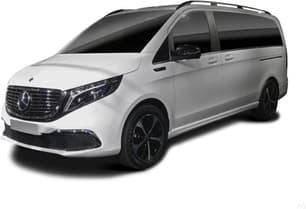
As far as vehicle niches go, this is pretty niche. The Mercedes-Benz EQV is Australia’s first premium electric seven-seat commercial vehicle-based people mover.
The EQV falls under Benz’s electric ‘EQ’ banner and is based on the Vito van platform, but adapted to house an all-electric powertrain.
However, unlike the popular EQA small SUV or recently launched EQB, don’t expect to see too many EQVs on the roads.
It is likely to appeal to airport transfer operators, hotels and other corporate customers that need to ferry multiple people around in comfort.
But given the kilometres those airport limo drivers can clock up in a day, is an EV capable of doing the job? And will these buyers be happy to fork out more than $150,000 for the privilege?
If you’re someone still convinced the newcomer Chinese brands don't have what it takes to shake up the Australian new car market, this might just prove you wrong.
It’s the 2025 XPeng G6 Long Range, and it’s a lot like the Tesla Model Y, only cheaper – and, in some ways, much better.
Don't believe me? Read on and I'll prove it.
The EQV is indeed a curious offering. The driving range is decent, but not outstanding, and depending on what you’re using it for, it could be a savvy investment. Especially if you charge using solar power. You’ll also save on servicing costs. But if you’re a limo operator, it really will depend how many kilometres you’re going to do each day. A V-Class might suffice.
Either way it’s great that Benz is giving buyers electric options in a variety of body styles and segments - an SUV simply won’t suit everyone.
If you can live with that ride quality and have the deep pockets for an EQV, there’s more than enough to like. But I suspect there won’t be many of you.
You never know quite what to expect when you jump into the first model from a brand-new brand, but the XPeng G6 was a pleasant surprise. And at this price, with these features, it should really give Tesla Model Y shoppers something to think about.
If you’ve seen a Mercedes van or people mover, you’ll have an idea of the EQV.
The difference between it and its V-Class twin is the ‘EQ’ touches, including the front end that has a definite connection to other EQ models like the EQA.
The chrome-rimmed grille is blacked out and has fins, and that’s the key difference between the two MPVs. Otherwise it’s a very large white box on wheels. Nicely designed 18-inch five-spoke alloy wheels, at that.
Inside, the EQV is showing the age of this vehicle's shared underpinnings. Next year will mark 10 years since the current Vito went on sale in Europe, and while it and its derivatives are still somewhat handsome, the interior is getting on.
It’s hard to fault the materials used inside, and elements like the perforated leather steering wheel, and dash stitching are welcome, but it could feel even more premium. It’s no more high-end than a Kia Carnival Platinum that is more than half the price of the EQV.
But the look of the dash is very reminiscent of Benz models from a few years back - certainly nothing like the twin-screen set-up of the current crop. And given the size of the cabin, the 10.25-inch central screen looks small in this vehicle.
There’s more than a little Tesla Model Y in the XPeng’s exterior design, with the two sharing the same kind of soft-edged, swept-back SUV styling.
It helps make the XPeng look familiar and inoffensive, and while I wouldn’t go so far as to call it ground-breaking, I think it has enough exterior flourishes to break up the body work, and I don’t mind the way it looks, and the way it sits on those big alloys.
Inside, it’s a spacious and pretty stylish space. This giant screen is super responsive, and is easy enough to navigate, with the key functions (like climate) glued to the bottom of the screen so you don't have to paw through menus to access them. The idea begins to fail when you have Apple CarPlay or Android Auto active, though, as you have to revert back to the car's home screen to access anything.
The XPeng uses its steering wheel controls to access air-con fan and temp controls as a kind of shortcut, but confusingly they change to distance adjustment when you’ve got the cruise control on. An easier, and much better solution would be to bring back buttons.
I also don't love the stalk-style gear selector, which doubles as a cruise control activator, and, with a double pull, as your autonomous helper. It just feels super old-school in a vehicle this modern.
What is a massive win though is the driver screen. Tesla fans can scream minimalist aesthetics all they want, but the drive experience is simply better when you can see your speed and other key info right in front of you.
If space is what you want, space is what you’ll find in the EQV. People movers like the Kia Carnival are incredibly spacious, but they can’t compete with something that’s spawned from a commercial vehicle platform, like this Benz.
Thanks to the flat floor and 2+2+3 three-row seating layout, you can literally stand up (depending on your height) and walk from the driver’s seat to the third row.
Back up front, the old underpinnings mean no fully digital instrument cluster here, just analogue dials, which is not a bad thing.
That also means the air con controls are separate from the central screen and therefore easy to use.
The MBUX system isn’t as advanced as the version fitted to the latest Benz models, and as a result there are fewer functions and it’s less complicated to use. There’s a touchpad as well as the touchscreen but I only ever used the screen.
Another slightly old school element to the EQV is the fact that it requires a key to start. Which is unusual for an EV. Also, the ignition is on the left side of the steering wheel which is great news for left-handed people but it’s somewhat annoying if you’re right-handed.
Storage wise up front, there is a decent space with a cover under the centre stack, housing cupholders, two USB-C ports and a 12-volt charger, but no wireless charger. There’s ample space for very large bottles in the front doors and it has a medium-sized glove box.
The front leather seats with fold-down armrests on each side are well bolstered and are very comfortable, too. No complaints there.
Given this car is designed to ferry people around, you’d hope for a functional rear cabin and on that Benz has delivered - for the most part.
Unsurprisingly given the EQV’s massive dimensions, there is a huge amount of headroom, legroom, and hip and shoulder room in all rows.
Both sliding side doors are power operated and one (the passenger side) can be opened via the key fob. The very large tailgate is also power operated.
Those two second-row captains chairs are comfy and supportive. There are map pockets on the rear of the front and second-row seats. There are floor and roof-mounted air vents, but just roof vents in the third row.
There’s not a whole lot of storage options in the second row, while the third row has stand-up phone holders, but that’s about it. No USB ports back there.
If you’re folding the second row seats, they’re quite heavy and cumbersome. But tumbling them forward via the lever is much easier. That ensures ample space to get into the third row.
The third row can be folded flat as well but you have to remove the very large and heavy parcel shelf from the cargo area. Like the seats the shelf structure is also on rails and it lifts out if required. That third row can also slide but not as far as the second row.
The shelf can double as a stand-up desk for a computer in the rear if required. It’s actually quite handy.
And it helps hide items in the boot. It comes with plastic folding shopping crates.
Benz says the boot can swallow 1030 litres with all seats in place, but minus the parcel shelf. It also has a 17-inch spare steel wheel under the rear of the vehicle.
At 4753mm in length, 1920mm in width and 1650mm in height, the XPeng fits into the fast-growing mid-size electric SUV space.
And it ticks a lot of practicality boxes, like with its 571-litre boot, swelling to 1374 litres with the seats folded. But its real party trick is in the back seat, where the space is properly massive.
I have another mid-size SUV, powered by a petrol engine, at the moment and our baby seat presses against the back of the passenger seat. In this it feels like I could fly a kite in the space between them.
It’s the same for passengers, too. Honestly, the real estate on offer is massive, and that includes for the middle-seat rear passenger, where the lack of a bulky tunnel eating into legroom means adults can sit there comfortably.
There's a pull-down divider separating the back seat that's also home to two cupholders, and there are twin USB connections, as well as air vents (though no temp controls).
There's no spare tyre, though, which means fiddling with the repair kit should you get puncture, or waiting for roadside assist.
It’s fair to say the EQV isn’t cheap. At $155,338 before on-road costs, it’s now the priciest people mover money can buy in Australia.
But, it’s not without expensive electric competitors. Chinese commercial vehicle specialist, LDV, has just launched a new MPV dubbed the Mifa 9, another people-moving EV. The price for that model ranges from $106,000 to $131,000, before on-road costs.
Soon enough Volkswagen will have its funky ID. Buzz people hauler here as well, while Ford’s Transit Custom-based Tourneo MPV now has an electric version in Europe.
Point is, Benz and LDV aren’t going to be on their own for long.
The EQV sits alongside the mechanically related internal combustion V-Class in its line-up and that model ranges from $91,668 and $106,344. So it's quite a leap to electric from there.
The EQV is offered in one grade in Australia and Mercedes has ensured it has a decent amount of standard gear. The EQV comes with a 10.25-inch central screen housing the 'MBUX' multimedia system and operated via touchscreen or touchpad, digital radio, Apple CarPlay and Android Auto, sat-nav, and USB-C ports.
It also gets power side doors, leather trim, a Burmester surround sound system, multifunction leather steering wheel, heated power adjustable front seats, ambient lighting, automatic dual-zone climate control with pre-entry climate, a seat rail system and rear removable parcel shelf.
Lining the specs up next to the LDV reveals that the Mifa 9 Luxe has more gear. It’s not super surprising given that model is very new and LDV has a strong value proposition. Also the underpinnings of the EQV are older.
But at more than $150K and a Benz badge, you think there would be a few more goodies, like heated rear seats or a massage function. Some extra luxuries would be nice, but it’s certainly not without the good stuff.
Okay, first things first – what the hell is XPeng? It's been around for about 10 years in China, but only made its way to Australia last year. It was founded by some former car company execs and tech tycoons — one of whom is telecommunications billionaire He Xiaopeng, which is where that name comes from.
Anyway, this one is the XPeng G6, which launched in Australia with two trims – the Standard Range, which is $54,800, before on-road costs, and the one we’ve tested, the Long Range, which is $59,800. The difference is in the battery size, of course, but we’ll get to that in a minute.
As of now, the new Model Y can be ordered for $63,400 for the Standard Range or $73,400 for the Long Range, which makes the XPeng a whole heap cheaper.
Outside, you get LED lighting all around (including the DRLs), a massive glass roof, auto door handles, an auto-opening boot, a V2L connection, which allows you to use your XPeng’s battery to power whatever you plug in and big 20-inch wheels wrapped in Michelin rubber.
You also get some cool high-tech features, accessed through the XPeng app, like the ability to drive your car out of tight parking spots remotely.
Inside, there are synthetic-leather seats that are heated, a heated steering wheel, dual-zone climate, a massive 18-speaker sound system (with speakers in the headrest), wireless charging and two very handy screens — a responsive 15-inch central screen with Android Auto and Apple CarPlay, and a 10.2-inch digital dashboard.
There’s also more safety stuff than you can shake a crash test at, but we’ll come back to that in a second.
The EQV is a battery electric vehicle that uses a single motor that sends up to 150kW of power and 365Nm of torque to the front wheels. It is paired with a 90kWh lithium-ion battery pack housed beneath the floor. The kerb weight is a hefty 2846kg.
With a DC charging capacity of up to 110kW, topping the battery up from 10 to 80 per cent can be done using a rapid charging station in about 45 minutes.
If you use an 11kW AC charger, like a Mercedes-Benz Wallbox, it will take approximately 10 hours to recharge from empty to 100 per cent.
This G6 is a rear-wheel drive affair, with a single electric motor housed at the rear axle. It produces 190kW and 440Nm in Standard Range form or 210kW/440Nm in Long Range guise, which don’t sound like massive numbers — especially given the 2.0-tonne-plus weight of this XPeng – but it gets up and moving just fine.
The 100km/h sprint is a claimed 6.2 seconds, while the top speed is 200km/h.
According to Mercedes-Benz, the EQV has a driving range of 418km on the NEDC cycle, which is about 355km on the WLTP cycle, which is seen as more real world.
I covered 233km in the EQV and by the end of the week the vehicle’s trip computer was sayong I had used 239km of range, which is pretty close.
As an example of how this vehicle would be used, let’s say an airport transfer driver did six trips to and from the Melbourne CBD to the airport in a day (about 46km), that’s about 276km - which is well within the EQV’s range.
However, when you consider the diesel V-CLass has a range of more than 900km, you can see why some buyers might not want to take the risk.
It consumes 26.3kWh of energy, which was the same figure I achieved.
The EQV has a CCS charging port.
The Long Range version of the G6 nabs a 87.5kWh battery (compared to 66kWh in the Standard Range), unlocking a claimed driving range of 570km.
The official power use figure is 17.5kWh/100km, but I did a fair bit of driving on all sorts of roads and my number was more like 14kWh.
When it does come time to charge, the G6 is set up for 280kW DC fast charging which means, should you find the right fast charger, a 10-80 per cent charge should arrive in just 20 minutes. Home charging will take a lot longer, of course – we’re talking overnight plugged into a regular wallbox.
Driving the EQV feels a bit like driving a bus. That’s because you’re essentially driving a bus.
There’s no getting around the EQV’s size and heft, especially in an urban driving setting. It’s massive and challenging to park, especially in inner city areas with small spaces. It also has a pretty sizable 12.9-metre turning circle.
It does also have excellent visibility thanks to a significant amount of glass around you.
After so many years of complaining about Mercedes’ steering wheel-mounted gear shifter, I think I have finally come around to it. Would I prefer it in the centre console? Yes, but I now think the stalk is actually a logical place for it.
A stalk is a less logical place to house cruise control buttons. They are much better on the steering wheel than a stalk hidden behind the wheel.
From take-off, the EQV doesn’t quite flaw you with its acceleration like some EVs can. It’s more leisurely, but far from slow.
The 0-100km/h dash is done in approximately 12 seconds but around town it is responsive enough. In fact, on a particularly hectic day rushing to and from appointments all over town, I was surprised how lively the EQV felt, despite feeling heavy on the road.
As expected, it’s quiet on the road, for the most part - a nice change from diesel engines found in its siblings. But I did notice some creaking noises when driving on less than perfect tarmac.
The steering is weighted on the heavier side and slow to respond but that’s fine for a vehicle like this. You don’t need point and shoot steering for a 3.0-tonne bus. The brakes are not super responsive and require a bit of weight in the foot.
The biggest issue is with the EQV’s ride. The firmly sprung suspension combined with the vehicle’s mass means that you feel, and hear, every single bump.
I understand it is a commercial vehicle platform but given its positioning, Benz could have done more to soften the ride and make it less crashy, especially over speed bumps, potholes and sections of roadwork.
The EQV bumps along the road after you’ve gone over a speed bump and takes a while to balance itself out. It’s this floaty, bouncy ride characteristic that makes all but the smoothest roads a bit of a chore.
How much you love your time behind the wheel of the XPeng G6 comes down to what you're looking for from your mid-size electric SUV.
Speed and sportiness? There's not much of either. But it does serve up tons of space and technology, surprising refinement and a calm and cosseting ride.
And I think you can mount a pretty solid argument that all of that is pretty important in a mid-size SUV, more so than the ability to carve corners.
I did some solid driving in the G6, including a round trip from Sydney to the start of the NSW South Coast, taking in every road type and surface imaginable, and XPeng proved super comfy, pretty quiet and very, very easy the entire time.
Sure, it's not one of those EVs that makes the scenery blur when you put your foot down. Its outputs and acceleration are a bit more user-friendly than that. But it also doesn't ever feel underpowered, with the plenty of poke away from the lights and even some in reserve for freeway overtakes at 110km/h.
The steering, even in its 'Dynamic' mode, is fairly soft, and you can never magic away the weight of the XPeng in corners, where that compliant suspension does allow for some roll, but it also doesn't feel entirely disconnected from the road below in that disconcerting way some vehicles can.
So, if comfort is mission critical in your SUV space, the XPeng delivers.
Oh, and I know that big screens aren't that uncommon these days, but the multimedia unit in the XPeng is a treat. It's super fast, even when scrolling across maps, and it's relatively user friendly, too.
At this point, ANCAP has not rated the EQV.
Benz has fitted the EQV with standard safety gear including A-to-D-pillar window airbags, auto emergency braking, driver and front passenger airbags (front, thorax and window), hill-start assist, lane keep assist, blind spot monitor, crosswind assist, reversing camera and sensors, driver attention warning, and a tyre pressure monitor.
It also has Benz’s ‘Active Distance Assist DISTRONIC’ which uses the adaptive cruise control to reduce and increase speed according to the movement of the vehicle it is following.
The Benz’s lane keeping aid is not intrusive. Rather than steering you back into the lane it has a haptic steering wheel vibration and audible alert. The adaptive cruise control is responsive, too.
The XPeng G6 wears a maximum five-star ANCAP safety rating from assessment in 2024, owing mostly to a flood of active safety features that arrive as standard, including AEB (with pedestrian, backover, cyclist, motorcycle and crossing detection), lane departure warning, lane keep assist, speed sign recognition, driver monitoring and more.
But it could also lay claim to a unique record – the first Chinese EV in which the safety systems don't make you want to make you pull your hair out with their incessant chiming and bonging.
Only on the freeway, where an intermittent chiming incorrectly warned me I was leaving my lane, were the safety systems at all overzealous. Otherwise, they were entirely liveable.
If a crash is unavoidable, the airbag count runs to seven (dual front, front side, side curtain and front centre) and multi-collision brake is standard, to minimise the chances of a secondary crash following an initial impact.
The EQV is covered by a five-year, unlimited-kilometre warranty for private buyers (that drops to five years/250,000km for commercial buyers), and an eight-year or 160,000km battery warranty.
The servicing schedule is once a year or every 40,000km.
Benz offers the EQV with a choice of three servicing plans, covering three services ($1252), four ($1959), or five services ($2149).
It also comes with a one-year complimentary Chargefox subscription.
The warranty terms are a little better than the LDV Mifa 9 (five years/160,000km), but you get more kilometres (200,000km) for the battery warranty on the LDV.
I'm scoring the regular warranty offering here, which is five years or 120,000km, with the battery covered for eight years or 160,000km. Keep an eye out for deals, though. At the time of writing XPeng was offering a 10-year warranty on both, for example.
Service intervals are 12 months or 20,000km. The cheapest individual service is $238, but over five years the total cost is $2064, averaging out to more like $410 per year.