What's the difference?
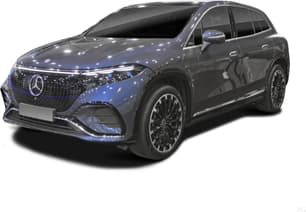
The EV revolution is bringing plenty of firsts, and this big electric behemoth is yet another one. Meet the EQS450, which Mercedes describes as its first "electric luxury full-size SUV with seven seats".
That is a bit of a mouthful though, right? So let’s shortcut that a bit, shall we?
What you really need to know is that this is one of the few proper seven-seat electric SUVs on sale in Australia, so it will — a little surprisingly — end up being compared with the increasingly premium Kia and its EV9 when it launches in November.
So what does this electric answer to a high-riding S-Class bring to the table? Well, lots of luxury, of course.
I'm going to reveal something of myself here - I used to be a RenaultSport Clio owner. This is what the purists call what we now know as Clio RS, and I find myself constantly corrected yet unrepentant. It was a 172 - a nuggety three-door with wheels that looked too small, a weird seating position and a 2.0-litre naturally aspirated engine that was big on torque as long as you belted it.
It was a classic and you could still see the links back to the epoch-making Renault Clio Williams, that blue and gold Mk 1 Clio we never saw in Australia that redefined the genre. The current Clio has been around for four years now and I even drove this current RS Clio at its launch in 2013, memorable for the sudden bucketing rain that drenched the circuit and made things very interesting indeed.
This Clio was a big change from the cars that went before - slimmer-hipped, less aggressive-looking and with a 1.6-litre turbo engine, five-door-only body and (gasp!) no manual, just Renault's twin-clutch EDC transmission. It was a hit, at least with enthusiasts. Back then it was the dawn of a golden age in small hot hatches. But that was then, this is now. With a small power bump and a couple of features thrown in, is the ageing RS still at the pointy end?
Does electrification enhance the seven-seat SUV experience? In the case of the EQS450, the answer is yes. Smoother, quieter and with plenty of easy-flowing power, the brand's family-focused luxury electric SUV behaves exactly as you might expect.
Note: CarsGuide attended this event as a guest of the manufacturer, with meals provided.
The Clio RS is still a ton of fun and in Cup spec, probably the best compromise between price and livability. Despite its advancing years (it turns five this year, so ready to start kindy) and big brother Megane hogging the limelight with a fancy new model on the way, the Clio is a stayer. It's missing some frustratingly obvious things like CarPlay, AEB, rear airbags and rear cross-traffic alert, but it's hardly alone in the segment.
With the departure of the Fiesta ST, though, the Clio returns to the top of the list of best small hot hatches on sale today.
It’s a handsome SUV, and one that’s not immediately recognisable as electric — especially given there are little exhaust-pipe-mirroring design flourishes at the rear which make you look twice.
Aussie-spec cars get the AMG exterior treatment, which includes AMG alloys, aluminium-look side steps and the power-domed bonnet, but there's still nothing overly 'shouty' about the design, with the sleek, smooth body panels (accentuated by the hidden handles) making the EQS450 look smaller than it actually is.
Inside, it’s a super-comfy space to spend time, and the little fluffy pillows attached to the headrests should be standard in every car. The tech on offer is ample, too.
But it does all feel a little gigantic, with great swathes of wood panelling and massive screens, all of which make you feel bit like you’ve been shrunken down and are now living amongst the giants.
The Clio is a handsome small car but nothing out of the ordinary until you apply the very cool Liquid Yellow paint. That hue really is quite something and works even better with the black alloys of the Cup chassis.
The car has some lovely surfacing and in a recent-ish refresh, the slightly odd headlights were reworked, as were the front and rear bumpers which now link to the RenaultSport Megane. Sorry, Megane RS. The RS flag signature lighting is a nice touch, acting as DRLs at the bottom corners of the front bumper.
The lovely organic shapes of the Clio's sides still look good and the rather tough rear end with the chunky diffuser leaves you in no doubt that it's the proper RS not the halfway-house, 1.2-litre GT-Line.
Inside is starting to look its age, but graceful, a bit like Jamie-Lee Curtis' or George Clooney's embrace of grey hair. There are still some of the sharp edges I didn't like. It's certainly a Renault to look at and ergonomically works pretty well. One thing that has been fixed at some point is the switch on the gear selector - it won't bite you if you curl your finger underneath when you press it. You might think that's a small thing, but when you did it, damn it hurt.
The EQS450 stretches 5136mm in length, 1965mm in width and 1718mm in height. That's about the size of a Nissan Patrol and long enough to make it a proper seven-seater.
The middle row can be adjusted forwards or backwards, and with the front seat set to my 175cm driving position, I found I had ample head and knee room to get comfortable.
USB-A charge points abound, and there's wireless device charging, and because of the sheer size of the cabin, the storage options are plentiful. The central bin between the front seats, for example, seems styled on the Grand Canyon.
In the third row, though, things get a little tighter, but it’s perfectly good for kids. My knees were touching the seat in front, however, and it still requires some acrobatics to climb into.
At the rear, with all three seats in place, you'll find 245L of room (measured to the ceiling), growing to a maximum 1030L with the third row flat. Stow the second row, and you'll find a maximum 2020L of storage space – which, and take my word for it – is plenty.
One small quirk, though. While the second row is electric, stowing away at the touch of a button, the third row isn't. That means, when it's flat, you have to climb into the boot to pull it back up, or attack it from the rear door. Either way, it's more awkward than it needs to be.
The Clio's interior is certainly snug. Rear seat passengers do okay for legroom but headroom is a mite marginal with the falling roofline for six footers. There are no cupholders out back, that curious French habit of supplying just a couple of cup receptacles of different and weird sizes persists. The front doors have space for bottles, the rears do not.
The boot is class-competitive at 300 litres (worth knowing the Trophy loses 70 litres to the Cup) and with the seats down stretches to a claimed 1146L.
Arguably the biggest hurdle the EQS450 has to clear is its asking price, which is a considerable $194,900, before on-road costs.
Inside, you'll find leather seats and trim, a big 12.8-inch central display (and a head-up display), a 12.3-inch digital instrument display, a Burmester sound system with 15 speakers, a panoramic sunroof and cooling and heating in the front seats.
Outside, there are 21-inch alloys, flush-fitting door handles, illuminated running boards and LED lighting, which Benz calls 'Digital Lighting', and offers 1.3m pixels of light per headlight.
The iconic 'Liquid Yellow' ($750 option) Clio I had for the week was the Cup spec chassis. The Clio RS 200, as it is officially known, comes in two specs - Sport and Cup - and there's a Trophy 220 at the top of the range. I had the Cup, which retails at $32,490 (plus on-road costs). The RS220 Trophy, with a bit more poke and stuff, weighs in at $38,990 if you're interested.
The Cup spec is heavily based on the more affordable ($30,990) Sport, which means you get 18-inch alloy wheels (painted black, so watch those kerbs), climate control, four speaker stereo, keyless entry and start (the "key" is still that unwieldy keycard style thing), reversing camera, cruise control, front and rear parking sensors, fog lamps, LED daytime running lights, sat nav, auto LED headlights, auto wipers, launch control, leather bits and pieces and a tyre inflation kit instead of any kind of spare.
The 7.0-inch 'R-Link' touch screen software runs the four speaker stereo with DAB digital radio, Bluetooth and USB. If you get the optional RS Monitor, there is a full-on telemetry system from which you can save your, er, "track day" data and overlay in Google Maps to compare with your mates' or past efforts. You can also change the piped-in engine sound to various different sound effects which are delightfully silly.
Android Auto is part of the breathtaking $1500 'Entertainment Pack' option that includes RS Monitor (which used to be standard) and no, there's no Apple CarPlay. Leather is a further $1500.
Bottom line is that you do get a decent spec bump from the $30,990 Sport along with the more capable (and less comfortable) Cup chassis.
There are two electric motors delivering the driving power, one at the front axle and one at the rear, which will deliver a combined 265kW and 800Nm, fed through a single-speed transmission and with all four wheels being powered.
That's enough for a sprint to 100km/h of 6.0 seconds.
The 200-equipped RSes pony up 147kW/260Nm, which is pretty much bang-on the obvious competition (Peugeot 208 GTI and the outgoing Fiesta ST), driving the front wheels through Renault's six-speed EDC twin-clutch. Unlike those two, there is no overboost function.
Dieppe's finest sprints from 0-100km/h in a claimed 6.7 seconds, pulling along a kerb weight of 1204kg.
There's a huge 107.8kWh on board here, but the EQS450's driving range is a less impressive 483km. Maybe something to do with the 2918kg weight of this big SUV.
Don't get me wrong, 483km is plenty to cover almost anyone's weekly commute (and then some), but early promises had pointed to a range of more like 600km.
When it comes time to plug in, you'll find the EQS450 is set up for 200kW DC fast charging, which should see you go from 10 to 80 percent charged in just 31 minutes.
Home charging is, of course, a slower proposition. A three-phase 11kW supply should take 10 hours, while a 7.0kW wallbox will be slower again, and more like 15 hours.
Renault claims 5.9L/100km on the combined cycle but, yeah, nah. My week was admittedly filled with plenty of horseplay and spirited driving, yielding 11.4L/100km. If you were careful you may fare better - but not that much better.
The fuel tank is a fairly standard 45 litres. It requires 98RON premium unleaded.
The drive experience is, well, unremarkable. But I don’t want that to sound negative, because that's not how it's intended.
The EQS450 SUV does exactly what you expect a circa-three-tonne, premium electric SUV to do, and it does it all well.
It's powerful enough without being exhilarating, comfortable enough, and laden with enough tech to satisfy almost anyone.
It's just that it also doesn't exactly ignite the senses. But the question must be asked, what seven-seat family-focused SUV does? Few, if any.
So, surely the real test is if electrification has improved the formula here, and I'd argue that it definitely has.
For one, the EQS450 is properly whisper-quiet in the cabin, with Benz employing multiple sound-deadening techniques at once to lock out road noise. And with no pesky engine to interfere, the cabin is about as serene as they come.
The power delivery is predictably smooth and easy, too. There is no headline-stealing acceleration figure here, but the power is potent and plentiful, and more than enough for any real-world situation you might encounter.
The ride, too, is commendable. Aided by Mercedes' air suspension, it glides over all but the most broken road surfaces. And it is fitted with rear-axle steering, which really does cut down a turning circle that would otherwise surely resemble that of a cruise ship.
It feels heavy at times, though, and even the most high-tech suspension can't eliminate body roll entirely through tighter corners (physics and all that).
But unless you're really pushing – and why would you be – the cabin is calm, comfortable and cosseting.
So, exciting? Not really. But comfortable and calming, which are probably the traits its owners will value much higher.
The RS has always had a belter of a chassis. The Cup chassis became a thing just over a decade ago and is lauded by the fans as The One To Have. I've not always been convinced of this as my earlier drives of the Cup-equipped machines have usually been in close proximity to the Sport chassis.
The Cup is slightly lower than the Sport, with 15 per cent stiffer springs and dampers and perhaps more importantly it scores 18-inch wheels with Dunlop Sport Maxx RT2 tyres, which you can reasonably expect to be a bit firmer than the 17s with Goodyear F1s on the Sport. And they are.
However, in most situations, the Cup chassis is perfectly benign. You certainly feel the bumps and lumps, but you haven't bought a Cup chassis for Lexus-like isolation. It's certainly sharper than the Sport chassis and when you're really giving it a go around the bends, the comfort deficit is more than made up for by the extra grip and poise.
The RS has always had a belter of a chassis.
The chassis is aided and abetted by a torquey 1.6-turbo that cheerfully...no, gleefully spins to the redline which could do with another thousand revs, but that's forced induction for you. The aluminium shift paddles need a good positive pull to get a gear, but that gear is delivered quickly and effortlessly. The Clio is a great deal of fun in Sport and Race modes, with throttle mappings and gearshifts becoming more aggressive as you switch through the modes.
The brakes are tremendously effective and the electronic limited slip diff (*cough* brake-based torque vectoring) ensures you'll hit your apexes and the tyres spend more time gripping than spinning.
But it's not all hairpins and off-camber left-right-lefts, is it? Plenty of owners have to live with the car in traffic day to day. Driving the Cup in isolation, I've changed my mind about it. I reckon it's the best of the two chassis settings. The city ride is better than decent, with the hard edges potholes chamfered off by the dampers and decent compliance. It's not too noisy, either.
The EQS450 SUV is yet to be ANCAP crash tested, but you can expect an extensive suite of active safety equipment, including AEB with pedestrian and cyclist detection and junction assist, adaptive cruise control, active lane keep assist, lane change assist and steering assist, traffic sign recognition and eight airbags.
On board the Clio is four airbags (no curtain coverage for those in the rear), ABS, stability and traction controls, a reversing camera and two ISOFIX points along with three top-tether anchors.
The Clio was awarded a five-star ANCAP rating in November 2013.
The Mercedes EQS450 is covered by Mercedes-Benz's five-year, unlimited-kilometre warranty, with servicing required every 12 months or 25,000km.
You can prepay your service costs, coming in at $2350 for three years, $3695 for four years or $4280 for five years.
The battery its covered for eight years or 160,000km.
Renault says it was the first European maker to offer a five-year/unlimited kilometre warranty in Australia, and who are we to argue? The package also includes up to four years of roadside assist and three years of capped-price servicing.
Renault expects to see you just once a year or every 20,000km, which gives you a bit more headroom than some similar service plans, at least on the mileage. The first three services will cost no more than $369 unless you need a new air filter ($38) or pollen filter ($46). At 60,000km or four years you'll cop $262 for a set of spark plugs. The company's website also suggests if the Clio doesn't like the state of its oil, it will beep at you until you have that attended to.