What's the difference?
Mercedes has long been the leader in niche filling, and we’d argue that no other model encapsulates that more than the CLA four-door coupe.
Now in its second-generation form, the CLA is based on Mercedes’ MFA2 small car platform that also underpins the A-Class small car range, B-Class tallboy hatchback and GLA crossover, but is actually dimensionally longer than the one-size up C-Class.
However, while the C-Class might offer more conventional styling, Mercedes says the CLA is targeted towards a younger demographic that puts more weight on design and aesthetics.
The previous generation CLA was topped by a hardcore 45 version, which makes a return here, but new this time around is the less-potent, but still AMG-badged, 35 variant to plug the gap between mainstream grades and the range-topper.
After living with the car for a week, here are our thoughts on the new baby AMG CLA.
There has never been a better time to be shopping for an electric SUV in Australia, with the avalanche of Chinese brands constantly smashing through the price floor as they bid for the title of Australia’s cheapest.
MG led the charge with its S5, which is $40,490, drive-away. Then Leapmotor upped (or downed?) the ante with its B10 with a $38,990, drive-away, price tag. And now BYD has knocked them both out with its Atto 2, officially Australia’s cheapest electric SUV (at least for now), with a MSRP of $31,990, which, in NSW, translates to a drive-away cost of less than $35K.
Cheap is one thing. But cheerful? Let’s find out, shall we?
Is the Mercedes-AMG CLA 35 the perfect choice in the sleek sedan’s line-up?
Well, if you are after outright performance, then the answer still clearly lies with the CLA 45. But for those that just want a little more pep compared to the standard CLA range, the 35 is undoubtedly the one to get.
It’s not without its flaws, though, commanding a $15,000 price premium over the CLA 250 and a tougher-than-we’d-like ride, but if you value a more engaging drive and a brisk 0-100km/h time, the CLA 35 should definitely be on your shopping list.
The BYD Atto 2 isn't just the cheapest electric SUV in Australia, it's also one that doesn't feel all that cheap, which is a hell of a magic trick. If it's easy, comfortable city motoring you're after, the Atto 2 delivers in spades. But if your blood type is high octane, there are better driving EVs out there.
Note: CarsGuide attended this event as a guest of the manufacturer, with meals provided.
Note: The author, Andrew Chesterton, is a co-owner of Smart As Media, a content agency and media distribution service with a number automotive brands among its clients. When producing content for CarsGuide, he does so in accordance with the CarsGuide Editorial Guidelines and Code of Ethics, and the views and opinions expressed in this article are solely those of the author.
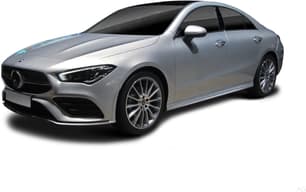
From the front, the CLA 35 exterior oozes style and luxury.
Up front, the sleek and slender headlights emphasise the width of the fascia, while the large Mercedes logo sits proudly front and centre of the CLA’s nose.
There are subtle hints to the CLA 35’s sportiness too, with a slightly bulging bonnet and chiselled lower chin.
The grille is also unique on the 35, with a dual-horizontal slat design instead of the non-AMG CLA’s diamond pattern or the CLA 45’s Panamericana grille.
To my eye, the front of the CLA 35 is actually a bit too tame in styling for an AMG model. I prefer the in-your-face aggression of the CLA 45’s widened track and front grille, while the CLA 35 opts for more subtle styling cues. To each their own, though.
The silver paintwork of our test car probably doesn’t help, and if it was my choice I'd pick 'Sun Yellow' or 'Denim Blue' to stand out a bit more from the sea of black, grey and white German cars out there.
Move to the rear of the car though, and a large rear diffuser, big dual-exhaust outlets and a bootlid spoiler are much more befitting an AMG model.
Step inside the CLA and you will see it adopts the same dashboard design as all new-generation Mercedes vehicles built on the MFA2 platform, with the 'MBUX' dual-screen layout, large air-vents and central touchpad.
Our car was specced out with red-leather interior, which is a bit too loud for my tastes, but a two-tone black leather/titanium grey combo can also be had at no extra cost.
Sitting inside the CLA 35, you can tell it’s a modern car thanks to the clean layout of all the controls, while the screen-heavy dashboard definitely makes it feel tech-focused.
I think it’s a sharp-looking thing, this Atto 2. Kudos to BYD for not making the design look like it’s trying too hard, or like the Atto 2 is something it isn’t. It’s just smooth, sensible small SUV with styling that looks like it will age gracefully.
I like the chunky black moulding which makes it look a bit tougher than it is, plus the LED DRLs and swept back (and spoiler-equipped) roofline add a bit of visual drama.
Inside, BYD has made two pretty good choices. The first is that the cabin feels toned down from the one in the Atto 3 (which is all chunky wheel-style controls and vents).
This one feels far more sedate and conventional in its design, which I think is a win.
The other good decision is to equip the Atto 2 with soft plastics, rather than hard scratchy ones, in places like the door panels. In some cheaper cars, you feel your elbows constantly rubbing against cheap-feeling plastics, but that’s not the case here.
Too much stuff is still controlled through that central screen, and BYD has an awkward way of shortcutting functions. They call it a three-finger swipe, meaning that if you run three fingers across the screen horizontally you can adjust the climate-control’s fan speed, while swiping horizontally adjusts temp, but it feels like a weird movement.
Measuring 4695mm long, 1834mm wide, 1399mm tall and with a 2729mm wheelbase, the CLA 35 is definitely a sizeable sedan in the metal.
This actually makes the CLA 35 slightly longer and wider than a non-AMG C-Class sedan that measures 4686 and 1810mm respectively, but don’t expect the same level of practical interior space.
With a heavily sloped roofline, rear-seat comfort takes a hit. My 183cm (6.0ft) frame could not sit upright behind my driving position without tilting my head, while legroom was also slightly lacking.
With such large C-pillars and a small rear window, the second-row can actually feel a little claustrophobic for full-sized adults, but will seat children quite comfortably.
Second-row amenities include air-vents, two USB-C ports, back-of-seat storage nets, bottle holders in the doors, and two cupholders in the fold-down arm rest.
Just like at a music concert though, the best seats in the CLA 35 are up front, with plenty of room for heads, shoulders and legs.
The cabin is also much more light-filled up front, making for a more pleasant experience.
The front seats are electronically adjustable, as is the steering column, but the headrests are fixed.
Storage options include sizeable door bins, a centre console cubby, glove box, two cupholders and a wireless smartphone charger.
Boot space is 460 litres, but can expand with the rear split-fold 40/20/40 rear seats stowed.
Though the boot looks small and shallow on the outside, the aperture is actually quite large, and can easily accommodate a large suitcase with plenty of room to spare.
The Atto 2 measures 4310mm in length, 1830mm in width and 1675mm in height and it rides on a 2620mm wheelbase. It also sits on BYD’s fully-flat EV platform, which helps to maximise space in the back seat.
I’m 175cm tall and could get comfortable behind my own driving position, with enough knee and headroom to ensure I didn’t feel cramped.
There are two ISOFIX attachment points, one in each window seat in the back as well as USB-A and -C connection points.
Boot space is a not cavernous, but also not tiny, 380L with the rear seats in place, growing to 1320L with the rear pews folded flat. Both models also offer a V2L (Vehicle to Load) connection, too, so you can power up household devices.
Priced at $85,500 before on-road costs, the CLA 35 sits $15,300 upstream of the CLA 250 but is $25,700 cheaper than the $111,200 CLA 45.
Standard equipment includes leather interior, dual-zone climate control, electronically adjustable front seats with heating and memory function, keyless entry and push-button start, 64-colour ambient lighting, and a wireless smartphone charger.
AMG specific appointments include 19-inch wheels, a flat-bottomed steering wheel, sports exhaust, high-performance brakes with silver-painted calipers, blacked-out exterior highlights, sports suspension, a racy bodykit and speed-sensitive steering.
Instrumentation is displayed on a 10.25-inch screen, which can be customised and features AMG readouts.
The multimedia system, which includes satellite navigation, digital radio and Apple CarPlay/Android Auto connectivity, is also outputted to a 10.25-inch screen, with inputs including touch, voice commands, centre touch pad or steering wheel controls.
Our test car also came with a ‘Mojave Silver Metallic’ paint finish and 'Vision Package', adding $1190 and $990 to the bottom line each.
The Vision Package adds LED headlights with adaptive high beams, a panoramic glass sunroof and surround-view monitor.
Straddling the lines between a small- and mid-size sedan, the CLA 35 doesn’t really have any direct competitors, which is reflected in its pricing that slots it between the Audi S3 and S4 sedans.
Though the CLA 35 features a long list of equipment, it is still a sizeable chunk of coin, costing more than the C300 sedan and Volvo S60 T8 PHEV, the latter boasting higher engine outputs.
This thing really is cheap. The BYD Atto 2 arrives with a two-model range kicking off with the Dynamic, at $31,990, before on-road costs, before stepping up to the Premium at $35,990 BOC. They both get the same motor and battery, by the way, so the extra money comes down to extra kit.
The Dynamic rides on 16-inch alloys wrapped in cheaper Westlake rubber, scores LED headlights and DRLs and gets rain-sensing wipers and heated wing mirrors. Inside, there’s a 10.1-inch central touchscreen, an 8.8-inch driver display, synthetic leather seats with manual adjustment up front and wireless Apple CarPlay and Android Auto linked to a four-speaker stereo.
The Premium rides on 17-inch alloys wearing better Hankook rubber, and there’s a panoramic glass roof with a shade and roof racks. Inside, the central screen grows to 12.8 inches, and there’s an eight-speaker stereo and a wireless charge pad. Your seats are now electronically adjusted and heated and cooled. Plus there’s some extra safety stuff, but we’ll cover that off in a second.
Powered by a 2.0-litre, turbo-petrol four-cylinder engine, the CLA 35 punches out 225kW/400Nm.
Drive is sent through a seven-speed dual-clutch automatic transmissions to the road via Mercedes’ '4Matic' all-wheel-drive system, enabling a 0-100km/h sprint in the 1603kg sedan in just 4.7 seconds. Top speed is electronically limited to 250km/h.
Though I didn’t get a chance to test the latter, the former certainly feels accurate when taking off from a freeway on ramp, however, there is some hesitation from the turbo in getting on boost.
Peak power comes in at 5800rpm, while maximum torque is available from 3000-4000rpm.
Both Atto 2 models share the same powertrain - a front-mounted electric motor producing 130kW/290Nm which is sent to the front tyres. It feels fairly sedate, even under flat-footed acceleration, though BYD reckons you can knock off the sprint to 100km/h in 7.9 seconds.
Officially, the CLA 35 sips 7.5 litres per 100km on the combined cycle, but we managed a 9.9L/100km figure in our week with the car.
The majority of our driving was done in inner-city environments, with the two trips down the freeway to seek out twisty country rounds.
Minimum fuel grade in the CLA 35 is 98 RON.
Both models also share the same battery, a 51.1kWh LFP unit, which should unlock a WLTP driving range of 345km. AC charging is pegged at 7.0kW, so a good match for a standard home wallbox, while DC fast charging is 82kW. Using the latter, BYD says you should go from 10 to 80 per cent charged in 38 minutes.
The CLA 35 might not offer the outright thrills or breadth of capability of the CLA 45, but don’t think the cut-price AMG offers up a cut-rate driving experience.
From the driver’s seat, one of the cool things about the CLA 35 is that it doesn’t actually look any different from its more expensive sibling.
The drive-mode selector that is now embedded on the steering wheel is fantastic, a feature first seen on the Mercedes-AMG GT 4-door, and makes changing the driving dynamics on the fly an absolute breeze.
In fact, we think all cars where you can select drive modes should have a selector on the steering wheel like this, which lets you quickly and easily dial it up or down while keeping your hands on the wheel.
'Comfort', 'Sport', 'Sport+' and 'Individual' modes are available, while the transmission can also be put into manual mode independently for those that prefer to use the flappy paddles.
Suspension settings can also be tweaked regardless of which drive mode you are in, and it’s this level of customisability that we appreciate.
You want loud exhaust pops and the engine in full attack with manual shifting and the softest suspension? Sure, that’s doable here in the CLA 35. And toning it down to its most comfortable settings is just a flick of the wrist away.
The steering feels a little numb on centre and at slower speeds, though feedback picks right up with speed and is communicative enough when the road starts to get twisty.
Fitted with wide and sticky Michelin rubber, as well as the aforementioned all-wheel drive system, the CLA 35 is certainly not lacking in grip.
The suspension does an okay job of absorbing bumps, but uneven surfaces, like Melbourne’s tram tracks, can send uncomfortable jolts into the cabin if travelling quickly.
In fact, we think the ride comfort of the CLA 35 is probably its weakest aspect, offering not enough variability in its Comfort and Sport settings, and instead settling somewhere in between, regardless of drive mode.
The CLA 35 is ultimately still a fun and engaging sports sedan, though there are some sacrifices made to get it there.
Your drive experience in the Atto 2 very much depends on what you ask of it.
Or to put it another way, the first half of my drive route was a breezy run through the city and suburbs, then onto the freeway, before arriving at our destination.
It was probably 60 kays or so, and across it all the Atto 2 felt quiet and comfortable, with enough power at its disposal to easily get up to speed and stay there.
In the second half, though, I hunted down some twisting roads and cracks started to appear. The ride is pretty solid and there isn't huge amounts of body roll during more enthusiastic cornering.
But the steering is vague and there's plenty of slack – you can turn the wheel a fair bit without eliciting much response from the tyres.
Interestingly, turning the wheel with a bit of aggression also produced a weird sound up front, like you could hear the mechanicals shifting the tyres.
The tyres make a difference, too, with the Premium's more expensive Hankook rubber far happier to hang on without squealing than the Dynamic's Westlake tyres.
But context is key here. The Atto 2 is an accessible, affordable city-focused EV, and it performs those duties admirably. But if you're sold on a car-driver connection, there isn't much of that on offer here.
The CLA 35 has not been tested by ANCAP or Euro NCAP, but the standard CLA range was awarded a five-star rating in September 2019.
Standard safety equipment in the CLA 35 includes autonomous emergency braking, automatic high beams, nine airbags, drive attention alert, blind-spot monitoring with exit warning, lane-keep assist, traffic sign recognition and tyre pressure monitoring.
The standard CLA also comes with these features, and was awarded 96 and 92 per cent respectively in ANCAP adult occupant and child occupant protection tests.
For the vulnerable road user and safety assist examinations, the standard CLA scored 91 and 76 per cent respectively.
ANCAP says the AEB system works from seven-200km/h.
Of note, adaptive cruise control is not standard in the CLA 35 like it is in the CLA 45. Instead, buyers will have to tick the 'Driving Assistance Package' box for the feature, which also comes bundled with cross-traffic alert and lane change assist.
The Atto 2 is yet to be assessed by ANCAP but there’s no shortage of stuff. The entry-level car gets six airbags, rear parking sensors and all the usual traction tech. Then there’s active cruise, lane departure warning, blind spot monitoring, cross-traffic alert in both directions - the list goes on. In fact, the only things the Premium adds on top are a 360-degree camera and front parking sensors.
As with all new Mercedes-Benz models, the CLA 35 comes with a five-year/unlimited kilometre warranty, which is one of the best assurance periods offered by a premium carmaker.
It also comes with five years of roadside assist.
Scheduled service intervals are every 25,000km or 12 months, whichever comes first.
A three-year service plan is available for $2150 for new CLA 35 buyers, saving $500 when priced individually.
Four- and five-year plans are also available, and are priced at $4200 and $4950 respectively.
BYD’s warranty is an okay six years but just 150,000km, which is underwhelming compared to the best in the business. The battery is covered for eight years or 160,000km.
BYD vehicles typically have 12 month, 20,000km service intervals with capped price servicing, but the details are yet to be confirmed for the Atto 2.