What's the difference?
Mazda has updated one of its most popular, but rather old models.
Yes, the Mazda CX-3 is still around after more than a decade since its reveal, and it remains almost at the tippy-top of Mazda’s local sales charts.
With the brand having shifted 8221 CX-3s in the first half of 2025, it seems the light updates and modest price rise haven’t scared away any potential customers.
We’ve grabbed a CX-3 Evolve, the second-up of four available variants, to see if the popular light SUV still stacks up, or if you’re better off taking your money elsewhere.
Aussie buyers could be excused for being wary of SsangYong, given the marque’s chequered history involving numerous ownership changes, crippling debts and in 2021 its rescue from the jaws of receivership by Korean industrial conglomerate KG Group.
However, the KG Group’s corporate rehabilitation of the troubled carmaker was completed in 2022, allowing the renewed SsangYong Motor (renamed KG Mobility in Korea) to hopefully focus on its core business of producing 4x4 SUVs and pick-ups, with increasing use of electrification planned for future model development.
As part of this renewal, in late 2023 SsangYong Australia announced MY24 updates to refresh its local 4x4 Musso ute and Rexton seven-seater SUV ranges, which, combined with a Merv Hughes-hosted marketing campaign, is aimed at building brand appeal and sales through its 70-plus national dealer network.
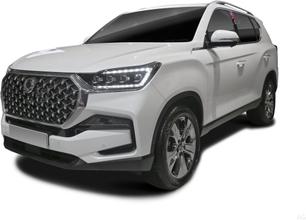
We were recently handed the keys to the latest Rexton, which competes for buyers in Australia’s fiercely competitive ‘Large SUVs under $80K’ segment that hosts more than 20 rivals.
‘You get what you pay for’ comes to mind with the CX-3, which is interesting given it’s neither the newest nor most feature-packed SUV in its class.
The ageing light SUV does however offer one of the best-put-together experiences in a car of this size and its engine is powerful for the class. Build quality feels well above par and there aren’t any annoying inclusions that are becoming more common in new cars.
There aren’t many downsides unless you were hoping for a big screen and the ability to play around with software functions, but at this end of the new car spectrum, a car that drives this well and remains stylish a decade on should be applauded.
Put aside its relative (but forgivable) lack of efficiency and somewhat smaller boot than rivals, and the CX-3 nails everything it needs to.
If KG Group can provide the long-term stability and new model investment that has eluded SsangYong for so long, the brand could have a promising future in Australia judging by the MY24 Rexton Adventure. It’s a solid package and what it lacks in benchmark ANCAP safety and third-row comfort is offset by a compelling driveaway price, generous warranty and national dealer network. So, if you’re looking for a feature-packed 4x4 seven-seater SUV for less than $55K, you might be pleasantly surprised by this competent Korean.
For one, there’s the way it looks inside and out.
The Mazda CX-3 hasn’t remained the most popular car in its segment on price, so the fact its styling continues to age gracefully in the design-focused light SUV segment (aimed at young or first-new car buyers) must have something to do with it.
While it’s been lightly updated a couple of times since 2014, the CX-3 is still in its first generation and has stood the test of time.
Looking like a jacked-up Mazda2, the CX-3 brings some traditional aesthetic to a category peppered with more divisive and daring (but admittedly admirable) designs like the Hyundai Venue, Suzuki Ignis (RIP) or the cute but prohibitively expensive Jeep Avenger.
Some elements of the CX-3, like the chrome trim around the grille or the black plastic cladding along the bottom of the body and around the wheel arches, seemed in the past like they had the potential to age poorly, but Mazda’s design language has only slowly changed since 2015, and the CX-3 still looks at-home in the brand’s line-up.
It’s not the most adventurous - even inside its layout is quite basic - but it does give off a premium vibe and the fact it plays things a little bit safe means the CX-3’s broad appeal is undeniable.
With its 4850mm overall length and 1960mm width, the Rexton rides on a 2865mm wheelbase with a compact 11-metre turning circle.
Its smooth ride comes from four-coil suspension with double-wishbones up front and an independent multi-link arrangement in the rear. For those venturing into the rough stuff, it has 20.5 degrees approach and departure angles, 20 degrees ramp break-over angle and 203mm of ground clearance.
Looks are subjective, of course, but we reckon it has attractive and cohesive styling, with its prominent and ornate diamond-style grille complimented by distinctive side-body contours that can’t be mistaken for other SUVs.
The interior has a premium look and feel, with lots of exposed stitching along soft-touch seams and a tasteful blend of contrasting surfaces including chrome, satin chrome, piano black and textured patterns.
There’s good attention to detail and build quality is excellent, but there are some annoying design quirks like the need for the front passenger to access a touchscreen menu just to adjust the audio volume.
The second-row of seating has a/c vents in the centre console and is spacious even for tall people like me (186cm). When sitting behind the driver’s seat in my position, there’s about 60mm of clearance between my knees and the driver’s seat backrest, which combined with ample head and shoulder room makes for a comfortable ride.
By contrast, the third-row seating is strictly for young kids, as there are no adjustments for the second-row’s backrest angle or fore/aft base cushion positioning to accommodate taller frames like mine. The side windows in the thick rear roof pillar are also conspicuously small, which adds to a claustrophobic feel.
Fortunately, access to the third-row is made easier by the 60/40-split second-row, which can be folded and tumbled forward.
However, given I’ve found tolerable third-row comfort in some rival seven-seaters, the Rexton’s third-row is my only gripe for those with longer limbs.
The Mazda CX-3 isn’t the most spacious light SUV on the inside, but from either of the front seats it’s clear a lot of thought has gone into the best way to make the cabin work.
For example, precious space hasn’t been wasted by two dedicated cupholders, instead there’s a cupholder in the central storage compartment that’s relatively easy to reach into.
Like its design and some of its features, the CX-3’s layout can’t hide its age - there are still big physical controls for the climate settings, the speedometer is a physical dial and the gear selector is a very traditional style.
Mazda’s soon-to-be-gone media control wheel persists in the CX-3, which is by no means a bad thing. It falls nicely to hand, as with many of the controls in the CX-3. Its seating position isn’t too high and the positions you’re able to get the seat and steering wheel into should accommodate most humans.
Behind the front seats it’s a little more spartan. Space is at a premium, with my 178cm frame fitting in the back seat just enough that I had a fair bit of headroom, but my knees were able to brush the seat in front, set to my own driving position.
There are no ports for charging or vents in the second row, but the fold-down armrest has a clever fold-away cupholder. The window shoulder is a little high for young kids to properly see out, but there’s enough light that it doesn’t feel cramped.
The boot is similarly diminutive, a 264-litre space becoming 1174L with the second row folded down. Compare it with the Hyundai Venue and its 355-litre boot, or the Toyota Yaris Cross and its 390 litres, and the CX-3’s simple, well-constructed interior starts to lose points.
With its 2130kg kerb weight and 2960kg GVM, our test vehicle has a sizeable load capacity of up to 830kg, which should be ample for five occupants and their luggage.
It’s also rated to tow up to the class-benchmark 3500kg of braked trailer and its 350kg maximum tow-ball download is compatible with that requirement.
Plus, its generous 6460kg GCM (or how much it can legally carry and tow at the same time) means it can legally tow its maximum trailer weight while carrying its maximum car-load, which is a practical set of numbers for just about any recreational requirement.
Front-row cabin storage includes cup/bottle-holders and a small bin in each front door, plus a single glove box. The stylish centre console has a bin up front with sliding-lid, two cupholders in the middle with another sliding-lid, plus a box at the rear with hinged padded-lid that doubles as a driver’s elbow rest.
Those seated in the second-row get a cup/bottle holder and bin in each door, plus pockets on each front seat backrest. The fold-down centre armrest has two more cupholders and a handy hidden compartment that’s ideal for small items. Third-row occupants get storage bins on each side but no cup/bottle holders.
Accessing the cargo area through the power tailgate reveals 236 litres (VDA) of load volume with the third-row seats upright. This expands to 641 litres with the third-row folded flat and 1806 litres (or more than 1.8 cubic metres) with the second and third-rows folded.
The cargo area’s rear floor has a two-tiered design, with the top floor lying flush with the third-row seats when folded but it can be removed to reveal a lower floor that provides a second level of storage. There’s also a usefully large bin in the right-hand-side wall cavity. The only things missing are sturdy load-anchorage points at floor level to secure cargo nets or straps.
Upon updating the Mazda CX-3, the Evolve variant is now a $32,100 ask before on-road costs, which is $900 more than before. It’s a little step up from the $30,370 entry price of the Pure, but falls well short of the top-spec Akari’s $38,890 sticker price.
The CX-3 range now comes with updated autonomous emergency braking and adaptive cruise control, with the Evolve specifically scoring new fog lights and keyless entry.
The Evolve also comes with black machined 18-inch alloy wheels, synthetic leather interior trim and front parking sensors.
This is all on top of the CX-3’s standard kit which includes a leather-wrapped gear shift knob, handbrake handle and steering wheel, keyless start, an 8.0-inch multimedia display, wireless Apple CarPlay and wired Android Auto plus LED headlights, daytime running lights and tail-lights.
For its segment, the CX-3 isn’t cheap. The Evolve grade is more expensive than pretty much the entire line-ups of rivals like the Kia Stonic or Hyundai Venue, and its price somewhat lines up with the newer, hybrid-powered Toyota Yaris Cross.
But there’s more to the CX-3 than just a list of features.
Our test vehicle is the new ‘Adventure’ model, which serves as the middle-grade offering between the entry-level ELX and top-shelf Ultimate.
It’s equipped with the same 2.2-litre four-cylinder turbo-diesel, eight-speed automatic and part-time 4WD as other Rextons, for a drive-away price of only $54,000 (our 'Space Black' metallic paint is a $595 option).
That pricing looks razor-sharp compared with mid-grade 4x4 seven-seaters offered by segment leaders like the Isuzu MU-X LS-U ($61,400), Ford Everest Trend ($66,790) and Toyota Prado GXL ($69,530).
And they are 'list' prices (not including on-road costs) whereas the Rexton is 'drive-away-no-more-to-pay'.
The MY24 upgrades include a new dash layout and high-mounted 12.3-inch multimedia touchscreen with Apple/Android wired connectivity. There’s also a restyled dual-zone climate control hub with touchscreen, plus new lower body mounts for improved ride quality.
The Adventure brings numerous luxuries like a walk-up welcome system (mirrors unfold and puddle lamps illuminate), touch-sensing front door locks with walk-away auto door-locking, power tailgate and soft-touch synthetic leather seats with the fronts offering power adjustment, heating and cooling.
The second-row outer rear seats and steering wheel are also heated, plus there’s speed-sensitive power steering and tyre pressure monitoring.
These appointments are in addition to the base ELX’s generous standard equipment list including 18-inch 'diamond-cut' alloy wheels with 255/60 tyres and a full-size alloy spare, LED dusk-sensing headlights/DRLs/front fog lights/tail-lights, heated door mirrors, a four-way-adjustable leather steering wheel and 12.3-inch driver's digital instrument display.
There are also four USB-C ports (two front and two in second row centre console), three 12-volt outlets (front console box, second row centre console and cargo area), electric parking brake, reversing camera, front and rear parking sensors and more. It's fair to say the Rexton Adventure is feature-packed.
The Mazda CX-3 is still powered by a 2.0-litre, naturally aspirated, four-cylinder petrol engine, as has been the case for years. Its outputs remain at 110kW/195Nm.
It drives the front wheels only, via a six-speed automatic transmission.
The quiet and refined 2.2-litre, four-cylinder, turbo-diesel, which meets Euro 6 emissions standards, produces 149kW at 3800rpm and 441Nm across a 1000rpm-wide torque band between 1600-2600rpm. It provides energetic response in city and suburban use.
This engine is paired with an equally refined eight-speed torque converter automatic, with overdrive on its sixth, seventh and eighth ratios ensuring low-rpm operation and optimum fuel economy at highway speeds.
Sequential manual-shifting is available using the steering wheel-mounted paddles and there's a choice of three drive modes ('Power'/'Winter'/'Eco') which can be selected using a console button.
The part-time, dual-range 4WD system is controlled by a console dial, offering the choice of 2H (2WD high-range), 4H (4WD high-range) and 4L (4WD low-range). It also has an auto-locking rear diff to optimise traction as required.
Mazda claims the CX-3 sips 6.3 litres of fuel per 100km, minimum 91 RON petrol, though on test the small SUV returned an 8.1L/100km figure under a mix of urban, highway and some dynamic driving.
With its 48-litre fuel tank, that means you’re realistically likely to get about 550km to a tank, though theoretically given Mazda’s efficiency claim a 760km trip on a single tank would be possible - if you could recreate the test lab conditions.
SsangYong claims an official combined cycle average of 8.7L/100km. At the completion of our 307km test, which comprised mostly city and suburban driving with a bit of highway travel, mostly in Eco mode with up to five occupants on some trips, our figure calculated from fuel bowser and trip meter readings came in at 11.0L/100km.
Although higher than SsangYong’s claim, it was within the usual 2.0-3.0L/100km discrepancy between official and ‘real-world’ figures. So, based on our numbers, you could expect a driving range of more than 600km from its 70-litre tank, which is not bad. Based on the official figure, driving range extends to around 800km.
The light SUV category is an interesting one, as it feels somewhat like a gateway to bigger SUVs for those who get a taste of the higher seating position. But in city and urban areas, a light SUV should be as much car as someone needs - unless they have two kids or a bunch of equipment to get around with.
This comes down to the fact cars like the CX-3 are more efficient and easier to manoeuvre than their larger counterparts. And as light SUVs go, the CX-3 feels solid, confidence inspiring and more capable when outside its inner-city comfort zone.
Its naturally aspirated engine is big for the class. Even if it doesn’t feel the punchiest off the line it offers plenty of flexibility at higher speeds and makes overtaking on the highway feel less daunting than it would otherwise be in a car this small.
Its steering is light, which is an advantage in everyday driving, but has enough feedback that more dynamic driving is still engaging. It’s not sportscar-sharp, but you wouldn’t want it to be.
While its age would suggest the CX-3 should feel unrefined compared to newer small cars and light SUVs because of what lies underneath, Mazda’s work on the little SUV over the years has resulted in a car that feels mature and capable.
The suspension isn’t perfect, but it manages low-to medium speeds elegantly and does a decent job of maintaining stability at high speeds. It feels better than you’d expect from a car this size on the highway.
The 1294kg kerb weight and small-enough 18-inch wheels mean there’s not too much weight to manage, and there’s enough cushion in the tyres that harsh bumps don’t come crashing into the cabin.
While the CX-3 feels refined for its class, don’t expect a dead-quiet ride, as some road and wind noise make their way in above 80km/h. Then there’s the fact its engine and transmission will sometimes need to get a bit raucous when accelerating quickly. Aside from this, the CX-3 around town and in suburban areas feels nice and calm.
The Rexton’s overall refinement and build quality are evident when you get behind the wheel. It offers good adjustability for driver comfort and the fundamentals of the vehicle are sound, as there were no red flags during our test.
The engine is smooth and quiet with good all-around performance, the automatic transmission shifts quickly and smoothly, the steering is nicely weighted and communicative, the brakes provide reassuring response and the ride quality is supple over bumps yet disciplined enough to provide good handling response.
It’s also pleasantly quiet at highway speeds, with low tyre and wind noise. Engine noise is also minimal, given that it requires only 1600rpm to maintain 110km/h, ensuring low-stress cruising.
Most of our driving time was spent in Eco mode, as we found performance in this setting more than adequate for our purposes. We did briefly use the Power mode but didn’t notice any significant change in response.
The Mazda CX-3 is technically unrated by ANCAP, though only because its original maximum five-star rating expired after seven years. While this means it easily passes many of ANCAP’s main criteria for safety (and strict Australian Design Rules - ADRs - to be able to be sold here), the CX-3 is missing some recent, more complex safety features.
Not everything is standard across the line-up, either. The Evolve misses out on adaptive headlights, a surround-view parking camera and traffic sign recognition. The base Pure variant also misses out on a front parking sensor.
Fortunately, there are plenty of other key features like seven airbags, dual-front and front-side plus curtain airbags spanning the sides. The CX-3 also has ABS and emergency braking with forward pedestrian detection and rear cross-traffic alert.
There’s lane departure warning, forward obstruction warning, blind-spot monitoring and a driver attention alert for those times you might miss something or - hopefully not often - are distracted.
All these systems are programmed well to minimise interference while driving, making the CX-3 refreshingly trusting of the driver to actually do the job of driving.
No ANCAP rating (as yet). Even so, it comes with numerous passive and active safety features highlighted by dual front, side and curtain airbags plus a driver’s knee protection bag (but no centre airbag between driver/front passenger).
There’s also AEB, lane assistance, blind-spot warning and rear cross-traffic alert, trailer sway control, hill descent control, front/rear parking sensors, reversing camera and more, but a notable absentee is speed-sign recognition and the cruise control is non-adaptive. There are also ISOFIX child seat anchorages on the two outer second-row seating positions plus top tethers for all three.
Mazda offers a five-year, unlimited kilometre warranty, which is behind the curve for a mainstream brand these days. Rival brands like Kia and Hyundai offer seven years, for example, with some offering up to 10.
Servicing is undertaken every 12 months or 15,000km, whichever comes first, with servicing costing between $353 and $633 per visit. Total cost over the first seven years currently sits at $3233, averaging $462 a service, which is pricey considering the relatively simple mechanicals under the CX-3.
Mazda says there are more than 150 certified service dealerships across the country, with a tool to find the most convenient one for you. Given the CX-3’s advanced age, chances are there won’t be too many mechanical issues that haven’t been worked out in the last decade.
Warranty cover is seven years/unlimited km warranty plus seven years roadside assist.
Scheduled servicing is every 12 months/15,000km whichever occurs first.
The first seven scheduled services run to $375 each, up to seven years/105,000km, for a total of $2625.