What's the difference?
Has it really been 20 years since the humble Mazda6 station wagon hit our roads? You betcha, but I was more shocked that I remembered when it did!
I have a sudden flashback of questionable fashion choices, glittery butterfly hair clips and how Skipper was making a play at being the coolest 'Barbie' (she wasn't).
I've always had a soft spot for wagons, they are the forgotten heroes for family hauling. It's hard not to glide over them when the market is dominated by SUVs but if you happen to remember they still exist (albeit, barely) you might remember why they were popular back in the day.
Being a 20th Anniversary Edition means there are some nods to the past in this model but unlike the low-slung jeans of my youth, they're stylishly done. With some luxuriously-appointed rivals to contend with, like the Skoda Octavia and Volkswagen Passat, does it offer enough to be considered by a modern family?
My little family of three has been in it all week to find out for you!
This is the most affordable plug-in hybrid available in Australia – as this review is published – but it’s got a lot more going for it than just that.
The 2026 BYD Sealion 5 is a mid-size SUV wearing a BYD badge that has been thrust into the public’s awareness by the popular BYD Shark 6 – as well as by widespread criticism of brand's less popular aftersales shortcomings through much of 2025.
It’s also a plug-in hybrid that is showing up as the nation faces a fuel crisis, despite many remaining sceptical of going ‘full EV’.
The Sealion 5 has a long list of features, of course, plus a claimed four-figure driving range. Is this BYD too good to be true?
We grabbed the entry-level Essential to find out.
So, what did my family think about the Mazda6 20th Anniversary wagon? Firstly, I like that it drives well and how many luxe features are up front. The trims and body paint look divine but there's a disconnect with family practicality in the back seat. Besides the multimedia system, which 100 per cent needs to be improved, I don't mind the retro-feeling elements in the cockpit but my husband's first comment was that it looked old.
It may be better suited to a smaller and older family that isn't carting around a stack of gear but you get a lot of features for your cash in this model. So, this gets a 7.0/10 from me.
My son didn't spend heaps of time in this one but he liked the colour of it and the seats. He gives it a 7.0/10.
While the BYD Sealion 5 lacks the polish of some more established plug-in hybrids, it has a seriously compelling price advantage over some competitors. It makes a base-model Mitsubishi Eclipse Cross PHEV feel positively outdated and it’s $13,800 cheaper.
BYD's lack of ANCAP rating for the Sealion 5 and the uncertainty around it still being a new brand are downsides, even if BYD is quickly moving past the latter. But being the most affordable PHEV available while having this much showroom appeal is bound to work in the Sealion 5’s favour, just don’t expect a dynamic masterpiece once you’re out on the road.
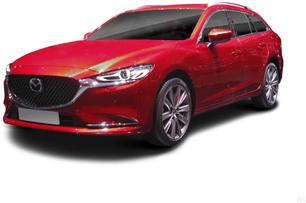
At first glance there's not a lot that separates this from its siblings, it's not until you get up close that you notice more shiny chrome accents on the grille, those special anniversary badges on the side and its limited colour options – I hope you like red or white, as those are your only choices!
The wagon manages to look sporty with its 19-inch alloy wheels, full LED exterior lights and the classic protruding nose that Mazda seems known for now.
It's far more obvious in the interior though with the beautiful tan Nappa leather seats, synthetic suede trims and special embossing on the front headrests.
Surprisingly, the dashboard is still headlined by the older 8.0-inch touchscreen multimedia system. There's also the traditional gear-shifter and buttons/dials to deal with. All of which manage to nod to its long history while starting to feel like relics for such a special edition.
Overall, its pleasant and handsome but don't expect to be wowed, Mazda hasn't broken new ground with this one.
The BYD Sealion 5, from the outside, is inoffensive but also uninspiring. That’s likely not such a bad thing for a mid-size SUV – it’s rare you’re hearing someone talk about how beautiful the Mazda CX-5 or Toyota RAV4 is.
Its quartet of colour palette options comes in on the safe side, too. Aurora White is standard, Atlantis Grey, Harbour Grey and Cosmos Black are cost-options.
Our test car is Atlantis Grey, which is interestingly quite blue.
The relatively upright shape is a slight departure from the more ‘aquatic’ silhouettes of BYD’s line-up, but the front grille and light layout are decidedly in step with the brand’s oceanic design language. There’s a bit going on, you could say.
The slimline tail-lights are the rear, especially from a three-quarter angle to the side, look attractive and help break up the rear without looking messy.
The Sealion 5’s design is overall net-good, but it’s inside where the mid-sizer feels like you’re getting plenty for your dollar.
The seats, despite the leather fakery, feel like decent material, and the layout uses buttons and physical controls cleverly without feeling outdated.
The interior is comfortable and well-proportioned but front passengers will enjoy the most room. You'll still feel like you'll be jostling for premium armrest position, though!
Up front, the individual storage is adequate and the open utility tray is large but my phone slid around in it, making it hard to use the wireless charging pad.
There are enough charging options throughout the car to satisfy four people, with two USB-A ports in each row. Curiously, you can only utilise the backseat USBs when the armrest is down, which makes this feel more suited to a smaller family.
The 8.0-inch touchscreen is small and the graphics aren't super clear. You can use it as a touchscreen or opt for the rotary dial but I found switching between the two awkward. Especially, since the touchscreen is disabled while using the (wireless) Apple CarPlay or (wired) Android Auto.
The back seat is quite lean when it comes to amenities and storage. Although, the heated outboard seats are a nice touch, but again, you can only access the controls when the armrest is down.
You can fit up to three (skinny) child seats but with the low roofline, you might not want to be bending over to buckle them in. The door apertures are not too wide either but my six-year-old had no trouble climbing in and out.
For this class, the boot is an okay size at 506L. There is a temporary spare wheel under the level loading space and it's great how the cargo-blind lifts up and away from the space because it's attached to the boot lid.
Unfortunately, this doesn't come with a powered tailgate and I did miss having that feature this week.
To actually interact with the interior is, at times, another story. BYD’s tech interface is generally easy to manage, but could be simpler when it comes to navigating menus for the sake of driver distraction.
While larger text and buttons would be welcome, the multimedia system is easy to use when parked, and the functionality is impressive for the price point.
Winning more points for the Sealion 5, though, are the physical controls – buttons and the traditional gear selector – which make the cockpit much more intuitive while on the move.
Ergonomically, though, the adjustment between the steering wheel and driver’s seat could do with some work, as I found it difficult to find a truly comfortable driving position. This is coming from someone 178cm tall, a very normal height in Australia.
Better adjustability on the steering column would be helpful, as it’s something I’m not sure I’d ever get totally used to.
Visibility and physical space inside the Sealion 5 is impressive, though. The car is 4738mm long, 1869mm wide and 1710mm tall, and the roof and window lines don’t swoop too aggressively towards the rear.
There are low window shoulders even into the rear, so light isn’t at a premium, though under-leg support could be better on the pew.
It’s otherwise un-cramped. The 2712mm wheelbase means decent legroom for second-row folk, plus behind the 60/40 split-fold seats there’s 463 litres of space for luggage. That becomes 1410L with the seats folded.
There’s unfortunately no spare tyre, just a tyre repair kit.
As the name suggests, this is a special edition and it bumps the Atenza from its usual 'top spot' in the model line-up. Yet, for a top-model it is spectacularly well-priced at $54,935, before on-road costs.
That places it below the Volkswagen Passat 162TSI Elegance ($57,190) and above the Skoda Octavia RS 180TSI ($53,090) wagons.
You get all of the features of the Atenza, like the luxurious heated and ventilated front seats, heated rear outboard seats, heated steering wheel and a sunroof.
Then, you'll also be enjoying the 20th Anniversary badging on the exterior, tan Nappa leather seats with that same badging embossed on the headrests and a delightful synthetic suede trim on the dashboard.
Other features include some nice tech, like wireless Apple CarPlay and wired Android Auto, dual-zone climate control and a premium Bose sound system with 11 speakers, but more on tech below.
The BYD Sealion 5 Essential kicks off from $33,990 before on-road costs, four big ones less than the Premium ($37,990). We’re focusing on the Essential today, but don’t think that means a shallow list of features.
As you’d expect from BYD if you’ve been paying attention to the Chinese brand in its emergent years, the Sealion 5 comes with more than $34K would normally get you – a 10.1-inch central multimedia touchscreen, an 8.8-inch driver display, synthetic leather upholstery, dual-zone climate, a six-speaker sound system, wireless Android Auto and Apple CarPlay, USB-A and -C ports front and rear, digital radio and keyless entry.
On the outside, LED headlights and tail-lights are the same for both variants.
Both also have 18-inch wheels, not unwelcome for the benefits of on-road comfort.
Consider that the most popular SUV in the country, the Toyota RAV4, costs at least $45,990 without the benefit of a plug-in drivetrain (yet) and comes with, on paper, a more sparse list of features.
The closest PHEV competitors are still more pricey, including the Geely Starray ($37,490) and Chery Tiggo 7 ($39,990), and arguably lack the brand power BYD has come to enjoy.
This shares the same engine with the Atenza and that's a 2.5-litre, four-cylinder turbo-petrol one. It has a max power output of 173kW and 420Nm of torque. Plenty of oomph to get you (and your gear) to where you need to go.
The 20th Anniversary edition is a front-wheel-drive and has a six-speed auto transmission. It's not the smoothest combination at lower speeds but let it stretch its legs and you'll be happy with the results.
The Sealion 5’s front wheels are driven by a combined maximum of 156kW thanks to a 1.5-litre four-cylinder petrol engine (145kW/300Nm) and a permanent magnet synchronous motor (72kW/122Nm).
BYD claims a 0-100km/h sprint of 7.7 seconds for the Sealion 5 Essential, four tenths faster than the Premium despite only a 61kg difference in kerb weight.
Let's talk about efficiency. It has a combined cycle fuel figure of 7.6L/100km but I only managed to achieve 10.9L. I reckon that's pretty thirsty considering how much open-road driving I did this week but it's not outrageous for a turbo. Expect a higher figure in an urban setting.
Based on the combined figure, you should be able to get a driving range of around 816km, which is perfectly respectable for those wanting to do a road trip.
With a charged 12.9kWh lithium iron phosphate (LFP) battery and a full 52-litre (95 RON minimum) fuel tank, BYD reckons the Sealion 5 Essential can cover 1001km under NEDC testing, which is optimistic. It claims 71km can be done on EV power alone.
Not only due to the lenient nature of NEDC testing (WLTP is more common and usually results in lower ranges), but the reality is that once the battery is flat, the engine is doing a lot more work.
Charging is slow, limited to 3.3kW (AC only), which should take between 4 and 5 hours to charge from the lower end of the gauge for the battery size. Given most PHEV owners will do this overnight at home, that’s certainly not the end of the world.
Claimed consumption figures are 1.2L/100km with more than 25 per cent battery charge, or 4.5L/100km when it dips below that.
Realistically you could do sub-50km trips and use no fuel, or never plug your Sealion 5 in and see fuel consumption soar. In any case, anything close to 1001km in a single run is extremely unlikely.
This is a car that knows what it is and stays in its lane. It's not trying to be the best but it certainly comes close with how it handles itself.
The lower centre of gravity and responsive steering make it hug corners and the car feels firmly situated on the road.
There's enough power that this is a comfy open-roader and you're confident overtaking or getting up to speed but you do feel like you're starting to dig when you hit steeper slopes.
The suspension is a little firm but your backseat passengers will feel that more than you will. Still, it absorbs enough of the bumps that you feel cushioned, even on rough country roads!
The cabin space is fairly quiet but you will get wind noise at higher speeds. Otherwise, all passengers should be able to chat without raising their voices.
I didn't find this to be a bother to park but the 360-degree view camera is terrible. It's very blurry and on the 8.0-inch screen, the image looks small, too.
That said, I love the 11m turning circle and the front and rear parking sensors. Overall, you won't have much trouble parking this one.
You might expect a car at this price, regardless of its drivetrain, to be underwhelming from behind the wheel.
That, then, makes it even more pleasantly surprising that the BYD Sealion 5 is actually rather competent. Not massively exciting or dynamic, but certainly not a disappointment.
The Sealion 5 is, save for a couple of arguably minor annoyances, quite easy to get used to and drive.
Firstly, when making proper use of its electric power, the drivetrain provides enough shove for its intended use. It’s not overly powerful, but you won’t have trouble overtaking. It’s the same with most of the inputs, the steering is light but not completely numb – again about right for how the Sealion 5 will be driven.
Perhaps its biggest departure from expectations based on other cars from China is its suspension is on the stiffer side of things, but again it’s not unruly or too rugged. In fact, it does provide a better sense of control than many of its compatriots.
Again, the biggest issue with the Sealion 5 day-to-day is its driving position, the steering column adjustment isn’t up to scratch and there’s not really a perfectly comfortable seating position (I’m a very standard 178cm).
On long trips, you might also find the engine gets quite noisy once the battery power is gone as it works hard to pull the mid-size SUV along under acceleration.
Its driver-assist systems are, you might be pleased to hear, on the calmer side of things – BYD is getting better at calibrating its safety features and I didn’t find myself rushing to switch it all off as quickly as usual.
It can still be a bit too persistent in its lane-keeping, but it’s a big improvement on the way things were.
Safety is important on any car, but more so on a family one. I'm happy this has the usual specs, like daytime running lights, lane keeping aid, lane departure alert, blind-spot monitoring, rear cross-traffic alert, 360-degree view camera, front and rear parking sensors and intelligent seatbelt reminders.
I like the fact the adaptive cruise control now has a stop and go function and that traffic sign recognition and a head-up display are included.
The autonomous emergency braking (and forward collision warning) with car, pedestrian and cyclist detection, is operational from 10–80km/h (a little slower than the average 5.0km/h).
It has a maximum five-star ANCAP safety rating but it was done a while ago in 2018. It only has six airbags which is a bit low for a family vehicle now but that does include curtain airbags covering both rows.
There are ISOFIX child seat mounts on the outboard rear seats and three top-tether anchor points across the back. You may get lucky with three skinny child seats but two will fit best.
A 0-4 rearward facing child seat can be installed but will encroach on front passenger comfort, especially if they're tall.
There’s no ANCAP rating for the Sealion 5, but the list of safety kit isn’t lacking on paper.
BYD lists seven airbags ,including full-length side-curtain bags and an important centre airbag, plus there’s a whole suite of tech that’s, as noted, better behaved than past driver-assist systems from BYD.
The Essential only misses out on a surround-view parking camera and front parking sensors, both arguably important safety features for parents, but the rest of the list is the same as the Premium including adaptive cruise control, lane-keep and lane departure assist, traffic sign recognition, blind-spot monitoring, rear cross-traffic alert with rear AEB (as well as front AEB, of course) and tyre pressure monitoring.
The ongoing costs match the purchase price for their affordability. This has a five-year/unlimited km warranty, which is pretty normal for this class.
However, on the five-year servicing plan, services average $501 per service - which is very competitive for this class! Servicing intervals are also reasonable at every 12 months or 15,000km, whichever occurs first.
You're not even getting hit with the fuel pricing you can see on other mid-range models because this accepts a minimum of 91 RON petrol and is even E10 suitable.
BYD has a six-year/150,000km warranty, which is probably more than you’d need in terms of distance but is behind many competitor brands’ timelines – seven to 10 years is becoming the norm, even if it’s conditional.
An eight-year/160,000km warranty covers the battery, which is about par for the industry.
Servicing for the first five proper services ranges from between $285 and $930, plus there's a free check-up six months into ownership and a total cost over the span of $2355 – an average of $471 per service.
BYD has just over 100 dealerships in Australia, so finding one for servicing shouldn’t be too challenging.