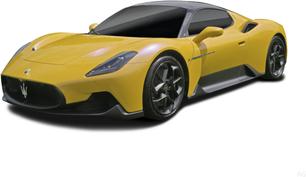
What's the difference?
With Ferrari leaving the Fiat-Chrysler family and becoming an independent entity in 2016, Maserati was left without a technology partner.
Suddenly, the Trident brand had to go it alone and come up with its own engines for the first time in more than 20 years. The MC20 sports-car is the result of that rebirth.
While there’s no doubt the Maserati brand has the currency to pull this off, the MC20 is also a big step outside the company’s usual grand-tourer box.
The new coupe is aimed at McLaren, Porsche and even Ferrari buyers, so can the first true Maserati sports car since the MC12 of 2004 walk the walk? And let’s not forget that the MC12 was Ferrari Enzo-based…
No-compromise cars are often the ones that impose the most compromises, and in that sense, the MC20’s shattering on-paper performance means its greatest attributes can’t be enjoyed on a public road.
That’s why this review was conducted entirely on Philip Island’s 4.4km Grand Prix layout. As a result, we can’t tell you much about parking ease or highway fuel consumption. But as for the things that give a super-sports car its identity, read on.
Zeekr is making waves in Australia at the moment but it's not because of the car you see before you.
Nope, it’s the 7X mid-size SUV that’s captured a heap of attention and a whole lot of sales. In fact, of the 1832 sales the brand has managed over the first three months of 2026, just 54 were for the X.
But that was the old X and this is the new one. With more power, more performance, faster charging and a whole heap of pretty special equipment, especially for the small SUV segment.
So, is that enough to finally put the X on the map?
With a 320km/h-plus top speed and the ability to get from rest to 100km/h in under three seconds, there’s no doubting the MC20 meets or exceeds its performance brief. But when you’re paying these prices, there must be more than just the measurable stuff going on.
And there is. The MC20 brings a big dollop of purity to the ranks of current supercars, doing away with all-wheel drive and hybrid tech and relying instead on and old-school approach in terms of handling and overall feel.
Anybody who wants to argue that call has plenty of alternatives to the MC20 from other manufacturers, and for some of us, that less-is-more thing will ring true.
Note: CarsGuide attended this event as a guest of the manufacturer, with meals provided.
It's a good thing in a small package, this Zeekr X, and there are a lot of things I like about it. In fact, the only sticking point for me is the price. But that's all about perspective. If you see this as a newcomer Chinese brand, then yes, there are a lot of more affordable options out there. But if you see it as a premium player, it's really a more affordable version of a Volvo.
Note: The author, Andrew Chesterton, is a co-owner of Smart As Media, a content agency and media distribution service with a number of automotive brands among its clients. When producing content for CarsGuide, he does so in accordance with the CarsGuide Editorial Guidelines and Code of Ethics, and the views and opinions expressed in this article are solely those of the author.
Perhaps the most striking thing about the MC20’s design is that it’s so restrained. You won’t find wings, vents, fins and diffusers all over the car, but rather an overall shape that creates downforce, rather than that job falling to tacked on additions.
And, like any modern supercar worth its salt, the MC20 is based around a carbon-fibre tub for rigidity and low weight. From that tub structure are hung aluminium front and rear subframes which, in turn, mount the suspension and other mechanical bits.
The wind tunnel still got a huge workout in the car’s development, of course, but the aim was to integrate the downforce-inducing elements rather than having them demanding your optical attention.
As a result, the whole car is an upside-down wing, if you want to simplify it. But a very pretty upside-down wing.
This gives the MC20 a smooth, sleek look that stands it apart from the rent-a-racer crowd and supports the theory that sometimes, less is, indeed, more.
Some of the detailing is lovely, too. The vents cut into the Perspex rear windscreen form Maserati’s trademark trident shape, there’s lots of visible carbon-fibre inside the door jambs, there’s lashings of Alcantara inside and the two-tone body kit breaks up the shape perfectly.
Elements we’re not so sure about include the 'Park' button mounted way down low under the dashboard, and the swing-up, scissor-type doors, which, if your more than about 180cm tall, still require you to duck under them.
On the upside, the carbon-and-leather steering wheel with its integrated controls is gorgeous to hold and gaze at.
The visual changes aren’t massive. This AWD version welcomes a couple of new exterior colours, including the 'Matt Khaki Green' of our test car. It also gets the two-tone black roof and there are new 20-inch alloy designs.
Elsewhere, it's the futuristic-style of design we’re used to which differentiates the X from its Volvo EX30 twin under the skin.
Inside, this is a seriously well-equipped and polished-feeling small SUV, and — unlike some of the newcomer brands to Australia — it all feels very high quality and well put together. And that includes the material choices.
I don’t even hate the fact that most of the functions are controlled via this screen, thanks to the little shortcuts glued to the home screen. I do, however, hate the fact that there’s no easy way to change the wing mirrors or shortcuts for toning down some of the safety stuff.
That aside, though, it’s a nice and high-quality feeling space.
Although the MC20 has a front and rear luggage compartment, they’re both small enough to be pretty much useless. This is a shame, because as a long-weekend getaway car, the Maserati otherwise makes a strong case for itself.
The other area that suffers for the car’s art is the interior practicality. While the driving position is great and the pedals and wheel relationship is spot on, when it comes to storing anything, you’re on your own. Best the MC20 can offer is a single cupholder at the rear of the central tunnel.
The mid-engined layout also means there’s precious little vision through the back window. To counter that, Maserati has fitted the MC20 with an interior rear-view mirror that can act as a conventional mirror (you can still see only the engine) or as a screen for the rear-mounted camera.
The catch is the image projected to the 'mirror' lacks depth of field and forces the driver to refocus on the image rather than simply glance at it.
You know you're in a small vehicle when you can't fit two large (not those crazy American-style jumbo cups, just normal coffee-shop takeaway) coffees in the cupholders, but so it is with the Zeekr X.
The small SUV's 4432mm length, 1836mm in width and 1566mm height doesn't leave much room to spread out up front. There's ample room for driver and passenger, of course, but we are talking about a small vehicle here.
Clever storage helps to mitigate that, though, especially the super-deep storage space in the centre console and the very clever fridge that separates the driver and passenger seats.
Weirdly, though, the space doesn’t feel overly tight in the back seat. We had a massive baby seat in there, and that fit without issue. And full size humans can genuinely get pretty comfortable. I'm 175cm, and I had enough knee and headroom.
In the boot, there’s 404 litres of volume with the rear seats upright and 1247 litres with them folded flat. And it’s worth pointing out this isn’t intended to be a family car, but there’s certainly enough space for the shopping... and a pram.
Maserati has followed the lead of many a high-end carmaker by using the options list to ramp up the profitability of the MC20. Of course, that’s after the MSRP of $438,000 has been dealt with by your accountant.
The point is that you kind of need to suspend disbelief when it comes to supercars and their value-for-money credentials. By any sane, conventional measure, they’re seriously over-priced, but within its peer group, the Maserati is neither the cheapest nor the most expensive way to go this fast.
But back to those options: Again, it’s all a case of throwing away what you think you know, because there are several options for the Maserati that cost more than a good, brand-new hatchback.
The carbon-fibre engine cover alone will cost you a staggering $13,164, and according to Maserati management, it’s a popular option.
Then, there are the carbon-fibre brakes which not only cost $28,961, but if you want the yellow-painted calipers, that’ll be another $2962.
The hydraulic front-lifter which allows you to deal with driveways and speed humps is a monstrous $8721, but at least there’s some engineering in that. Unlike the black-roof option which is, er, a black roof at $10,202. And the external carbon-fibre kit? A cool $92,806!
This is a small SUV with a LOT of stuff. There are two trims in the Zeekr X range – the entry-level rear-drive model is $48,900, drive-away, while the all-wheel drive version we've tested is $57,900 on the road.
The obvious comparison is to the Volvo EX30, which shares its platform with the Zeekr X through both brands' Chinese parent company Geely.
As of right now, the cheapest single-motor Volvo is $56,051, drive-away in NSW, or $49,990 plus on-roads, making the Zeekr version much, much cheaper.
Anyway, outside there are 19- or 20-inch alloys, though our test car is fitted with the optional 20-inch black alloys, paired with a black-with-red-highlights interior treatment, which adds $2000 to the price.
Ours is also fitted with the electric front doors which open or close at the push of a button, and back doors that unlatch, but don’t fully open, the same way, which adds another $2000.
Both trims also get heated and cooled front seats, and heating in the rear window seats, but this AWD version also adds a massage function for front seat riders.
There’s also wireless charging, a 13-speaker Yamaha sound system and — very cool, literally — is the little drinks fridge between the front seats in the AWD variant.
Tech is handled by a 14.6-inch touchscreen with Apple CarPlay and Android Auto and there’s a head-up display for the driver.
Previous generations of Maseratis borrowed Ferrari (both brands were once part of the extended Fiat Chrysler family) technology for their drivelines in a deal that allowed both brands to share the cost of development.
And since having a Ferrari-built engine in your car was never seen as a sale hindrance, it was a sweet deal for Maserati. But when Ferrari was spun off and became a publicly-owned company in 2016, Maserati’s supply of engines dried up.
The solution was to take engine design in-house and the twin-turbocharged 3.0-litre V6 in the MC20 is one of the first fruits of that.
While it’s undoubtedly a high-tech powerplant, in other respects it’s fairly conventional. Maserati, for instance, has a long history with the V6 layout, and there’s no hybrid element to the driveline. Nor is there a hybrid option.
Maserati claims the V6 is the world’s most powerful six-cylinder production-car engine and, with no less than 463kW at 7500rpm and 730Nm between 3000 and 5500rpm, that’s a credible statement.
Technical details that you won’t see on most road cars include a dry-sump lubrication system (where the engine oil lives in a remote tank rather than the hot sump of the engine itself) and a sophisticated fuel injection system with two injectors per cylinder.
The real trick, however, is an ignition system with two spark plugs per cylinder. There are also effectively two combustion chambers, the first ensuring multiple flame fronts to achieve a more complete burn of the fuel in the main combustion chamber.
The rest of the driveline is similarly aimed at the purists out there; the transmission is an eight-speed dual-clutch, driving not all four wheels, but only the rears through a mechanical limited-slip differential.
Selectable drive modes from GT (the default setting) through to 'Wet', 'Sport', 'Corsa' (Track) and 'ESC Off' tailor the shift points, throttle sensitivity and suspension behaviour, but still allow for full engine power.
The big news here is a more powerful rear motor – meaning you get more grunt whether you opt for the rear-wheel drive or this all-wheel drive.
In rear-drive form, that boosts your outputs from 200kW to 250kW, dropping the sprint to 100km/h to 5.6 seconds. In AWD guise, your new outputs are 365kW (up from 315kW) and 573Nm, and your sprint to 100km/h falls to 3.7 seconds.
Fuel economy is probably not going to be top of mind for most MC20 buyers, but the official combined figure of 11.6 litres per 100km is still pretty greedy by 2022 standards.
Balanced against the available performance, however, and an engine making more than 600 old-fashioned horsepower with that combined fuel-economy number is still cause to reflect on modern technology and efficiency.
The MC20 has a 60-litre fuel tank, making it a handy cross-country car for weekends away.
This is where it starts to get weird. The rear-drive Zeekr X is fitted with a 61kWh LFP battery, which can accept up to 230kW DC fast charging, taking you from 10 to 80 per cent charged in just 18 minutes. Total claimed range is 405km.
The flagship AWD, though, charges at a slower rate. It gets a 66kWh NMN battery and can only be charged at 150kW, meaning the same charge takes 30 minutes. Zeekr is promising a 415km driving range between charges.
Here’s where your half-a-million bucks has gone.
The MC20’s acceleration is absolutely shattering and is all the more amazing for the fact the car uses neither all-wheel drive grip nor hybrid torque to achieve its sprinting abilities.
While the V6 is not the most sonorous of powerplants, it does manage to sound high-end and pretty sophisticated and it’s never as shouty as some of its opposition which seem to confuse decibels with kiloWatts.
While the sheer thrust confirms the existence of two turbochargers, the lack of lag (or throttle delay) and the ability to charge into the rev limiter in the lower gears does not.
Even though power peaks at 6500rpm (as with many a modern turbo motor) the MC20 will happily smash on to the redline at 8000rpm; sometimes too happily if you don’t have your finger over the upshift paddle. As with other good modern turbocharged units, this one doesn’t actually feel overtly turbocharged.
The transmission shifts relatively smoothly in GT mode, but as you crank up the mode selector to Sport, the shifts become very fast with an accompanying jolt through the backrest as each gear clicks home. The shifting process is fairly foolproof, although you do get full over-ride, so you need to pay attention.
Both the cars we were able to sample at Philip Island were sporting the optional carbon-ceramic braking package, and one was also fitted with the optional 'birdcage' alloy wheels which are lighter.
Each of them needed a firm shove on the pedal to slow things down, but it’s true the lighter wheels seem to be worth their almost-$3000 ask as that car required less leg-pressure for the same result.
The lack of a hybrid element to the driveline, as well as the rear-drive layout, suggests a degree of purity of purpose in the car’s design. And that’s backed up by its behaviour in the first corner.
Fundamentally, instead of just hurling it at an apex and allowing the electronics to sort it all out for you, the Maserati requires a more 'classical' technique if it’s to really shine.
It doesn’t, for instance, reward trail-braking (where you continue to brake once you’ve turned into a corner) and would much prefer you get your braking over and done with before applying any meaningful steering lock.
Ignore this, and the rear weight bias of the mid-engined layout can see the car try to yaw, with the rear end becoming light and the vehicle over-rotating (which is a spin, to you and I).
Similarly, getting on the power before you’ve actually got the MC20 turned, can unload the front end and send the front wheels ploughing (ploughing is an exaggeration, but at the speeds we’re dealing with here, even a small degree is a big deal) towards the outside of the turn.
Ultimately, then, the technique becomes a text-book case of brake, turn and then power out, at which point the MC20 reveals itself to be huge fun and incredibly fast. The only thing to deal with then is the knowledge that whatever happens next is going to happen extremely quickly.
Short answer? Pretty good, with some caveats.
I'm partial to a firmer ride. I find some Chinese car companies can feel like they get their suspension bits from Captain Snooze, such is the soft, pillowy ride served up. And to be honest, it makes me a little seasick at times.
The Zeekr is not like that. It has firmness dialled into the ride equation and can feel harsh at times, but also improves the drive experience, delivering connection and engagement at the cost of some sharpness on the wrong road.
It's also faster than the model it replaces, but it's also one of those cars in which the real-life feeling doesn't quite match the on-paper promise.
This thing serves up supercar speed, but it doesn't feel like it from behind the wheel. Instead, the acceleration - especially from a rolling start - feels potent, but not biblical.
From a standing start it pauses for a moment, almost like an internal-combustion vehicle might, before delivering a quick (but not stratospheric) flow of power. None of that is a bad thing, by the way. Who wants their small SUV to accelerate like a supercar?
It's otherwise an entirely pleasant drive. The cabin is serene and quiet and it's a small car that doesn't feel like one. There's nothing light or tinny about the drive experience, instead there's a heft and quality.
Neither ANCAP nor Euro NCAP have tested the MC20 for crash safety, so we can’t give it a star rating.
But the lack of standard safety gear such as rear-cross traffic alert and blind-spot monitoring (it’s optional at $2797) can’t go unmentioned. That’s especially concerning when you consider the mid-engined layout makes for very poor rear visibility.
The Zeekr X wears a maximum five-star ANCAP safety rating, earned in 2024, which means the long list of required active safety stuff is present and accounted for, all wrapped up in what Zeekr calls its 'Intelligent Driving Assist System'.
There are five cameras, five radars and 12 sensors, which is a crazy number for a car this small.
And this is also not a car in which I was desperately trying to figure out how to deactivate any of the active safety systems – save the overzealous over-speed warning – which is a win these days, too.
There are also seven airbags, including a centre front airbag.
The Zeekr X is fitted with ISOFIX anchors on the rear outboard seats and top tether anchorages for all rear seating positions.
High-end cars often disappoint on the details, and the Maserati is no different here, offering just a three-year factory warranty (albeit with unlimited kilometres).
That trails even the most humble commuter cars these days, and suggests there’s still a degree of indifference from some carmakers. And, possibly, their customers.
There is, however, the option of fixed-price servicing for the MC20 with the first three years’ worth of servicing costing $4000.
Scheduled services are every 15,000km or 12 months, whichever comes first.
Zeekr's coverage is an underwhelming five-year, unlimited-kilometres, while the drive battery is covered for eight-years or 160,000km. There’s five years' of roadside assistance thrown in, too.
Service intervals are 20,000km or 12 months, with five years' of ownership setting you back a hefty $3072; an average of $614 per workshop visit.
There are currently 16 Zeekr dealers in Australia - two of which are 'pop-up' sites rather than full retail centres.
Multiple locations in Melbourne, Sydney and Brisbane with the ACT, Adelaide and Perth also covered. Others include Geelong and the Sunshine Coast but so far you're out of luck in Tassie or the NT.