What's the difference?
The march away from diesel power and towards a petrol-hybrid future in off-roaders continues. Okay, so it’s a full-sized Lexus we’re talking about, but the off-road credentials of the Toyota LandCruiser 300 Series-based Lexus LX have never been in question, have they?
The full-sized, super-lux Lexus LX might never see the Simpson Desert or the Old Telegraph Track, but that doesn’t mean it couldn’t tackle either with a fair degree of ease. So there’s no way Lexus would allow a new hybrid driveline to compromise any of that. Besides, this is the same driveline that will take the LandCruiser on its next step, so you better believe it’s the real deal.
Of course, the Lexus badge and somewhat frightening price tag also infer a high degree of plush and tech, and, let’s be honest, those elements are more likely to get a leading role in the LX’s day-to-day strut, as opposed to the walk-on part played by the off-road stuff.
So does all this make the LX one huge, high-tech mash up of conflicting priorities, then? That probably depends on how pragmatically you view motor vehicles generally, but one thing’s for sure, if the hybrid LX is paving the way for the next generation of LandCruiser powerplants and drivelines, then we’re all ears.
Part of the undeniable charm of Toyota’s 70 Series LandCruisers is the fact they don’t change much, if at all. Sure, the much-loved V8 has been dropped from new 70s in recent years, and it now has LED headlights and a new multimedia system, but otherwise not a lot has been altered. And that’s good.
Because, in a world where everything is so slick, and everyone is so worried about offending someone, the 70 stands out as unapologetically being simply what it is: a boxy truck-like live-axle 4WD.
It's not pretty, it's not comfortable and it offers few, if any, real concessions to occupant safety. But it's very capable off-road and has a ton of potential as a handy touring vehicle.
Toyota has a bad habit of doing the bare minimum with its new-release vehicles, yet the loyalists keep coming back for more and new Toyota fans keep turning up, as well.
It seems this kind of ‘do nothing’ approach works wonders in terms of maintaining the appeal of something like the HiLux or 70 Series line-up.
But does it really? We tested the 2026 Toyota LandCruiser 76 Series in GXL trim to find out.
Read on.
Huge specification in terms of convenience and safety gear are matched by an equally huge range of abilities in this vehicle. As well as rock hopping with the best of them, this is also a phenomenal touring rig and a more-than-capable off-roader. Of course, whether you can see yourself clambering up the side of a muddy creek crossing in $202,000 worth of vehicle is a personal matter, but rest assured, the Lexus will do it if you ask it to.
In the case of the hybrid LX, however, the vehicle now has an extra dimension to cover off, and from what we can see, it does take the efficiency and running costs of the big wagon to a new, better place. Mind you, that may only be the case if diesel continues to cost a dollar-a-litre more than petrol at the bowser.
The shift to petrol power also brings with it a level of mechanical background noise that we’re not entirely sure fits the Lexus legend, while additions such as the camera-based rear-view mirror system seems to be a conversation starter rather than an actual improvement.
It looks like a house brick, it drives like a busted truck, it has less safety gear than a go-kart and fewer standard features than a shopping cart, yet there’s still so much to like about the 2026 Toyota LandCruiser 76 Series.
It’s fun to drive (if you know what to expect), it’s highly functional (for the job-site or camp-site) and one of the best 4WDs straight out of the showroom. And in GXL guise it makes a lot of sense as a work wagon or a touring vehicle.
Sure, Toyota pushes the boundaries of brand loyalty – consistently doing the bare minimum to keep buyers coming back for more – but in the case of the 76, I don’t mind that because this is one of the old-school 4WDs that should always be available.
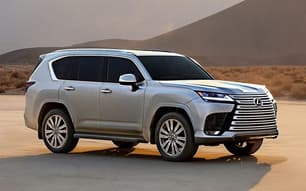
In a styling sense, that big, bold, deep grille at the front won’t be to everybody’s liking, but we reckon it’s pretty well matched with the otherwise taut skin of the LX’s body.
Inside, the plush look and feel is the dominant factor, but if you look really closely, there’s a fair bit of generic Lexus stuff on show. Is that a criticism? Hardly. The leather looks and feels luxe and only some hard plastics (such as on the door cappings) belie the car’s LandCruiser origins.
The 76 Series is boxy and blocky at 4910mm long (with a 2730mm wheelbase), 1870mm wide and 1940mm high. It has a listed kerb weight of 2300kg.
This is a straight-up-and-down 4WD wagon whose hard edges have been somewhat softened through the most recent significant upgrade.
The cabin retains its spacious but spartan look and feel. Function wins out over form here.
The five seats sport a hard-wearing grey cloth trim which fits in nicely with the 76 Series’ spirit of utility.
Like many hybrids, cargo capacity takes a bit of a blow. In this case, placement of the battery under the cargo floor means a reduction in luggage capacity from 1109 litres to 899 litres. In the seven-seat variant, capacity is 883 litres with the rearmost row folded flat. The rear seat folds 60:40 and there are good, solid tie-down points in the rear. There’s no under-floor storage, however, apart from a small compartment just behind the rear seat which locates the tools and safety triangle.
The tailgate is powered (if a bit slow in its action) and there are cup-holders atop each suspension tower, clearly a hang-over from the seven-seat variant which is not available in F Sport trim. The cargo blind is a good addition, as is the 1500-Watt power socket in the cargo bay.
In the cabin, there are plenty of grab handles and the side steps give shorter folk a leg up when entering or leaving. Once you’re in, the front seats are terrifically comfortable as well as featuring a massage function on top of the heating and cooling functions. The steering wheel is also heated.
Paddle shifts might seem odd in a vehicle like this, but they are brilliant in off-road situations, although you need to first select manual mode on the shifter to have the paddles hold each gear for more than a few seconds in most of the on-road driving modes.
Speaking of the shifter, Lexus has seen fit to once again reinvent this simple control. You now need to pull the handle towards you and up for Reverse, across and down for Drive while Park remains a separate button even though it looks like just another icon on the lever.
A pair of cup holders live over to the passenger’s side of the centre console, and there are a pair of USB charge ports as well as an HDMI port in the dashboard. But the switches for the power windows are located almost directly under the driver’s interior door pull, forcing some unorthodox wrist geometry.
At least the buttons for the climate control and off-road functions such as diff locks and ride height are, indeed, buttons and not menu items. The simple knob to control the stereo on-off and volume is a great touch, too. So is the cooled centre console under a cover that opens from either side.
The rear seat is big and wide but the high floor dictated by the body-on-frame construction means those with long legs will have their knees bent while ever they’re in the back seat. The seat cushion itself is pretty flat, too, but the backrest does recline through a wide range of angles.
Reading lights, lots of air vents and a full set of climate controls ease the pain of riding in the back, but if you want cup holders, you need to keep the centre rear seat free so the armrest that houses the holders can be lowered and snapped open. Adding to the impression that plenty of thought has gone into the rear seat environment are the pull-up sun blinds on each window. Why don’t all cars have these?
The 76 cabin is practicality maximus, albeit with a basic interior that feels like it was delivered here from the 1970s by a disco-ball-equipped time machine.
It is unashamedly purpose-built for work and in GXL guise this five-seat wagon is well-suited to job-site duties and/or touring life.
The cabin layout has a nice familiarity about it and it’s an easy space in which to quickly become comfortable.
All controls are easy to locate and operate – dials or buttons as per most Toyota cabins – and the 76 Series has a new multimedia screen. But it’s nothing to get excited about. It’s too small, too dark and it’s difficult to operate. So, that’s a fail.
The cabin is roomy, however, even if storage spaces are few and far between and some of them are small or awkwardly shaped or both.
There are two outboard cupholders, a narrow centre console bin, a cupholder and narrow smartphone spot to the left of the gear stick and door pockets. There is also a shallow shelf for something below the front passenger's outboard air vent.
It's a spartan interior, but as plain as it all is, it fits in with the 70 Series ethos of being functional.
Cloth seat and door trim retain that rough-and-ready feel the model is renowned for and there are expanses of hard plastic surfaces everywhere to endure whatever work and life can throw at them.
The carpet floor in our test vehicle was topped with rubber mats.
Storage spaces up front include a glove box, centre console with lid, dual cupholders between the driver and front passenger, pop-out outboard cupholders and door pockets big enough for a water bottle.
Rear-seat passengers each get a seatback map pocket… and that’s about it.
Front seats are as comfortable as you’d expect in a 76 Series, offering adequate rather than exceptional levels of support and comfort, and the rear seats are squeezy for adults, so better left to children.
Payload is listed as 1210kg and the expansive squared-off rear cargo area could probably cop most of that weighty burden. That space can be expanded to fit even more work or camping equipment if you tumble-fold the 60/40 split second-row forward.
Access to the rear is via the 60/40-split barn-type tailgate.
As a reference, the Ineos Grenadier Trialmaster offers very comfortable Recaro seats at the front, as well as slightly more space and comfort in its second row and more amenities throughout its cabin (as well as quirky touches, such as aircraft-style switchgear and the like).
While the LX line-up incorporates off-road oriented versions dubbed Overtrail, that specification is not available in the hybrid variety LX700h. Instead, the LX hybridised line-up kicks off with the Sport Luxury grades in either five or seven-seat layouts and a list price of $196,000 and $199,800 respectively. The F Sport is the new LX flagship model with its $202,000 price-tag (all prices are plus on-road costs) and is only available in five-seat configuration.
As you might imagine for a flagship badge for a maker like Lexus, there’s really nothing missing from the specification. In the case of the hybrid variants, that includes 22-inch alloy wheels, power sunroof, full leather trim and a hands-free tailgate. Those feature are part of the Enhancement Pack on lesser versions, but have been added to all hybrid LXs.
You also get four-zone climate-control, heated, cooled and massaging front seats, keyless entry and start, steering wheel-mounted controls, paddle shifters, automatic headlights and wipers, heated mirrors, soft-close doors, 12.3-inch touchscreen, digital radio, embedded sat-nav, wireless Apple CarPlay and Android Auto, head-up display, premium audio system and pretty much everything else you’ve ever seen fitted to a car.
The F Sport variant we’ve tested here is the big daddy and adds four-way adjustable head rests in the front, a heated steering wheel, specific aluminium trim, aluminium pedals, F Sport-specific gear knob, ventilated and heated rear seats, and a digital rear-view mirror.
The 2026 Toyota LandCruiser 76 Series in GXL trim, with a 2.8-litre, four-cylinder, turbo-diesel engine, five-speed manual gearbox and diff locks as standard costs $77,800 (RRP).
As tested, this five-seat vehicle costs $79,293.10 (RRP) because it has an EBC brake kit (module) ($242.50, RRP, estimated fitted), wiring kit, brake controller (harness, $394.95 RRP, estimated fitted) and a towbar ($855.65 RRP, estimated fitted)
Standard features include a 6.7-inch multimedia touchscreen system (with Bluetooth as well as wired Apple CarPlay and Android Auto), AEB, cruise control (not adaptive), a reversing camera, lane departure alert, speed sign recognition, hill-start assist, power-operated wing mirrors and 16-inch alloy wheels.
Exterior paint choices include 'French Vanilla', 'Graphite', 'Merlot Red', 'Silver Pearl', 'Eclipse Black', 'Midnight Blue', and 'Sandy Taupe', which is on our test vehicle.
For reference, the 76’s closest rival, the Ineos Grenadier Trailmaster (with a 3.0-litre six-cylinder turbo-diesel engine), offers much more in terms of standard features onboard but has a starting price around the $120,000 mark, before on-road costs. A Ford Everest Tremor 4WD 3.0 V6 diesel auto costs around $76,590, BOC, and easily tops the 76 in terms of features and refinement and a Nissan Patrol Warrior (with a 5.6-litre petrol V8 engine) has a price-tag of $110,660, BOC, and also easily tops the 76 for features, refinement and all-round driveability.
The hybrid driveline of the vehicle we’re looking at here marks a further expansion of buyer choice when it comes to how their Lexus LX is powered. The twin-turbocharged petrol and diesel variants will continue alongside the newcomer, although you can bet Lexus (and Toyota) will be watching the sales charts closely to see where consumer tastes fall.
The hybrid set-up here starts with the twin-turbocharged 3.4-litre petrol V6 (a lot of people - Toyota included - are calling it a 3.5, but at 3445cc, it’s not) from the Lexus LX600.
But instead of bolting directly to the 10-speed transmission, in this case, there’s a single electric motor and clutch unit sandwiched between the engine and transmission. That means the Lexus retains mechanical four-wheel drive, while the electric motor can provide extra urge for acceleration or towing as well as offering EV-only operation when it’s required (mainly in stop-start traffic).
Crucially, it also means the vehicle retains those traditional off-road qualities of low-range gearing and permanent four-wheel drive. The electric motor also contributes torque to the equation when the driver selects either Rock, Dirt or Deep Snow modes to maintain a steady flow of Newton metres.
The petrol V6 contributes a healthy 305kW and 650Nm to the picture, while the electric motor adds a further 36kW and 250Nm. When all that’s harnessed up, there’s a total of 341kW of power and 790Nm of torque on tap, allowing for a braked towing capacity of 3500kg. It also makes this variant the torquiest Lexus LX ever.
Interestingly, Lexus says the conventional 12-volt starting system and alternator for the petrol engine, means that unit could continue to operate if any part of the EV system failed.
One of the big questions over hybrid drivelines in off-road conditions is what happens if the vehicle suddenly finds itself partly under water. In this case, says Lexus, there are additional waterproofing measures which should prevent any problems mid-creek.
The F Sport grade gets a Torsen (torque-sensing) rear differential and firmer dampers for an overall sportier feel.
At 2780kg, the LX hybrid is heavy, and is at least 100kg more than the LX600 due to the batteries and other hybrid gear.
This 76 Series GXL has a 2.8-litre, four-cylinder, turbo-diesel engine producing 150kW from 3200–3400rpm and 450Nm from 2400–3000rpm and a five-speed manual gearbox.
It has part-time four-wheel drive and auto-locking hubs, and this GXL variant has locking front and rear diffs as standard.
Here’s where the hybrid driveline really comes into its own. On paper, at least.
Despite the added kiloWatts and Newton metres, the 700h manages an official fuel consumption figure of 10 litres per 100km. That compares with 11.9/100km for the 305kW LX600, although it’s still more than the 8.9L of the 227kW diesel-powered LX500d.
But the hybrid’s big advantage will come in city and suburban traffic where the stop-start nature of things will enable the driveline to harvest braking energy and turn that back into electricity for the battery.
Our testing showed an average of 11.2 litres per 100km in mixed conditions which blew out to 13.0 litres with more urban running. That’s pretty handy in the context of a vehicle like this and won’t be far from the real-world numbers of the diesel LX.
The Lexus carries 98 litres of petrol, split between one 68-litre tank and a 30-litre sub tank. That should give it a theoretical range of almost 800km, but again, that will depend largely on where and how it’s used.
Official combined cycle (urban/extra-urban) fuel consumption is listed as 9.6L/100km.
Fuel consumption on my test was 11.4L/100km and that was recorded after a variety of driving (suburbs, highway, back roads and bush tracks) with a full day of 4WDing thrown into the mix.
The 76 Series uses diesel and has a 130-litre fuel tank. Driving range is 1354km (based on the official fuel-use figure) and 1140km (based on my fuel-use figure on test).
At low speeds, threading your way through traffic or parking, the LX feels like it needs a lot of real estate. Which makes sense given the 5.1-metre overall length that puts it on par with a lot of dual-cab utes. The width of almost two metres plays into things, too, and reversing down the average driveway will often have the sensors chirping at you constantly.
What’s interesting, though, is the way the Lexus seems to shrink once you’re up and running in a more open setting. Even a winding road reveals a car that is easy to place in corners and seems to feed back lots of the right sort of information in terms of what the wheels are doing and where they’re placed. The result is that you can actually hustle the LX along quite smartly if you need to.
The ride remains composed yet there’s a level of control that helps keep the big, high LX relatively flat through corners and responding sharply to the helm. Even those huge wheels and tyres and their corresponding unsprung mass don’t intrude. It’s a great trick.
Less easy to appreciate, however, is the driveline, specifically the twin-turbo petrol V6. Frankly, it’s just not as refined as we were expecting. I wouldn’t mind betting Lexus has tuned the exhaust system to make the LX sound like there’s a petrol V8 under that heavily sculpted bonnet. And at low revs, it kind of works with a rhythmic, muted, yet guttural sort of bass coming through.
But rev it harder and the engine soon reveals itself to be a V6 with all the secondary vibration and resonance that implies. Simply, this vehicle is neither as smooth nor as quiet as the Lexus brand would suggest and the harder you rev it, the more it descends into NVH (noise, vibration and harshness) territory. The issue is made worse by the fact that the rest of the package is so darn quiet.
Even the stop-start - a technology that is now well understood - doesn’t seem quite as slick as it should be. Taking off from a green light with the petrol engine stopped, the Lexus often produces a small `sonic bump’ from the driveline as the V6 fires into life. It’s felt more than heard. But it’s still puzzling in the context of this make and model.
The transmission, meantime, is as silky as you’d imagine with upshifts and even downshifts that are barely perceptible. It would be nice, though, if the transmission obeyed the paddles a bit more faithfully. As it is, the chosen gear is only held for a few seconds unless you also pull the shift lever into manual mode.
I’ll also take issue with the rear-view mirror that includes a camera view as well as a conventional mirror option. I can see the point of having a camera-view mirror (when the cargo area is piled high, for instance) but I’ve never yet met one that works properly. The problem is that the camera view that pops up on the mirror’s screen is never as faithful as it should be. Also, if you wear glasses to read, you’ll also need them to focus on the image properly. While a conventional mirror has the same depth of field as looking through the windscreen, the camera-generated view does not. Also, when used through a wet rear window in low light, the camera view is borderline useless. This tech clearly has a ways to go.
It’s a lot of fun, but be prepared to drop any expectations of comfort and safety and simply enjoy the all-in experience of driving a vehicle that steers around like an old school mini-bus and exhibits the ride and handling characteristics of a sugar-cane harvester.
From the massive throw of the big gear stick and old-armchair-like cloth seats to the low-key rumble of the turbo-diesel engine and commanding driving position, spending any drive time in the LC76 is a shedload of fun.
This is not an insubstantial wagon and it’s unwieldy on suburban back streets and parked-in city lanes, especially if you're used to driving zippy urban-friendly SUVs.
When you drive it, the 76 feels tall and narrow, but it still somehow feels well planted on the road, unless you're driving over-energetically, and you soon get used to its lumbering attitude.
Visibility is impressive all-around and that turbo-diesel offers ample responsiveness when you need it to, Unfortunately, it doesn’t have the deep rumble of the ol’ V8 but it’s pleasing, nonetheless.
Steering is truck-vague, there is body-roll when you pitch it into sharper corners and the brake-pedal action is spongy, rather than direct.
The five-speed manual gearbox is well matched to this four-cylinder engine and with the taller fifth gear sorted out a few years back the LC76 overtakes with ease and is an easy drive on open roads. Though Toyota has fine-tuned the gearbox to better suit this engine, I wouldn't mind another gear in this thing.
The 76 is noisy because it's a tall, boxy wagon that monsters its way through the air as opposed to slipping smoothly through it like a 4WD ninja. And there's wind-rush around this 76's big wing mirrors and its chunky snorkel (mounted on the driver-side A-pillar in our test vehicle).
It always feels like a window's open or a door's not shut properly in the 76 because this wagon is as draughty as an old house. But those quirks are part of this wagon’s charm and I don’t mind them, at all.
Anyway, to the off-road bit.
This is a purpose-built 4WD wagon and it remains as brutally effective off-road as it's ever been.
As standard, the 76 has part-time four-wheel drive and auto-locking hubs. And in GXL guise it has locking front and rear diffs as standard.
Off-road angles are 33 degrees approach and 23 degrees departure, as well as 290mm of listed ground clearance and a 700mm wading depth, which all check out.
Its suspension set-up – coil springs at the front, leaf springs at the rear – yields a comfortable ride over poorly maintained back roads and corrugated gravel tracks.
Low-range gearing is great and there's plenty of torque available at low revs and the 76’s 4WD set-up offers impressive flexibility when you're in low-range 4WD.
The 76 also has front and rear diff locks (dial-operated from the driver seat and standard on the GXL), as well as driver-assist tech, such as hill-start assist, to call upon.
The 76 has live axles front and rear and wheel travel is decent, so you're generally able to stretch a tyre to the dirt for more traction.
It’s worth noting the 76's wheel tracks are still set at different widths from front to rear – 1555mm wide at the front (because of the line-up's now discontinued V8 engine and large radiator) and 1460mm wide at the rear – but that’s of little consequence in general daily driving or even 4WDing.
This 4WD rides on bush-friendly 16-inch alloys, shod with light-truck construction Dunlop Grandtrek AT1 (265/70R16 115R). Good size rubber and there’s a full-size spare as back-up.
Unbraked towing capacity is listed as 750kg while braked trailer capacity is 3500kg. The 76 Series has a gross vehicle mass (GVM) of 3510kg and a gross combined mass (GCM) of 7010kg.
For reference, the Ineos Grenadier offers a GVM of 3550kg and a GCM of 7000kg, so it’s a close weight race with the 76.
It will come as no surprise to learn that the expensive LX range is well equipped safety wise, nor that the flagship version of that range features every driver aid ever dreamed up by engineers.
That includes autonomous emergency braking that incorporates pedestrian and cyclist recognition, intersection turn assist, lane-keeping assistance, lane-departure warning, blind-spot monitoring, road-sign recognition, hill-start assist, front and rear parking sensors, a reversing camera with 360-degree views, rear cross-traffic alert and braking and tyre-pressure monitoring.
On top of that, the LX gains the safety additions revealed at the 2025 facelift of the LX line-up, including emergency driving stop, safe-exit monitoring and a forward-facing camera.
There are no less than 10 airbags in the LX, including rear-seat cushion airbags and side-curtain airbags for every outboard seating position.
What’s perhaps even more impressive is that the driver aids are beautifully calibrated to the point where other carmakers should pay close attention when calibrating their own. Where some cars physically fight the driver for control of the wheel in the name of lane-keeping assistance, the Lexus instead offers a polite suggestion of a better course than the one the driver is currently on.
The Lexus LX series hasn’t been crash tested by ANCAP, but the 300-Series LandCruiser on which it’s based scored the full five safety stars when it was tested in 2022.
In terms of ANCAP safety ratings, the 2026 Toyota LandCruiser 76 Series 2.8L is unrated.
Standard safety gear onboard includes two airbags (one each for the driver and front-seat passenger), as well as driver-assist tech such as autonomous emergency braking (AEB, including pedestrian detection and daytime cyclist protection), cruise control (it’s not adaptive though), traffic sign recognition, lane-departure warning (overly sensitive and beeping annoying but minus intervention), automatic high-beam headlights (now LED), hill descent control and a reversing camera.
But it’s missing blind-spot alert, rear cross-traffic alert and driver attention warning.
In contrast, even though the Grenadier is not overloaded with safety gear and driver-assist tech it does have six airbags, reversing camera, rear parking sensors, a tyre pressure monitoring system and front parking sensors. But, again, the Grenadier costs more than the 76.
Lexus offers a five-year, unlimited-kilometre warranty on its vehicles and throws in three years’ worth of subscription to the Lexus Encore owner privileges and benefits program. Those extras include Lexus on Demand, valet parking, roadside assistance and even complimentary access to Qantas airport lounges.
There’s also five years of capped-price servicing available.
As well as the overall five-year/unlimited kilometre warranty, there’s eight years and 160,000km of cover for the hybrid battery. That can be extended to up to 10 years provided the battery is checked for degradation every year after the fifth year.
Servicing for the LX is every six months or 10,000km which is much more frequent than much of the competition, but reflects the heavy-duty nature of the vehicle.
Lexus has about 30 dealerships in Australia, primarily in urban locations, but for many servicing and repair jobs, a Toyota dealership or service centre should be able to handle things on the LandCruiser 300-Series-based LX.
The 2026 76 Series is covered by a five-year/unlimited km warranty.
Service intervals are scheduled for every six months/10,000km (whichever occurs soonest) and it has to be said that those intervals are short compared to other vehicles.
Cost per service for the LC70 is $545 for five years or 100,000km (up to the first 10 services) for a total cost of $5450.
For reference, Ineos offers a five-year/unlimited km warranty for the Grenadier, with servicing scheduled at 12-month/15,000km intervals at a total approximate cost of $4626.