What's the difference?
Peter Anderson road tests and reviews the new Lexus IS200t F Sport with specs, fuel consumption and verdict.
Long ago, the Lexus IS overtook the LS as the most recognisable Lexus on the road. With strong, angular styling, sharp pricing and spec against the Germans, and a 2.0-litre straight six engine, it seems like Lexus sold a million of them and only one of them has broken down irretrievably and is now being used to prop up the Harbour Bridge, such was its solid build quality.
Hell, Lexus was even able to hide for a while that it was a rebadged Japanese Toyota Altezza, partly because Toyota didn't do funky rear-wheel drive sedans outside of Japan. The IS took the brand into many more homes than the ES or GS could ever hope to because it looked like it was a Lexus.
We're now three generations and one facelift into the IS and the big selling IS250 is no more, replaced some time ago by a 2.0-litre turbo four and renamed IS200t. You can now get an F Sport version, too, just like you can buy an Audi with S Line or a BMW with M Sport.
That turbo engine hopefully addresses one of the problems with the entry-level IS sedan - it was always a little on the slow side...
Does Australia need yet another new car brand?
It’s the question I keep asking myself seemingly every other week as a new brand announces its intention to join the other 70 odd marques already competing for a slice of the Australia new-car market.
Chery made a successful re-entry into the Australian market in 2023, quickly establishing itself as a value-led brand. Earlier this year it launched Jaecoo, its more premium, adventure-focused offering and announced it would be spun-off into separate showrooms alongside the new Omoda brand.
The first Omoda-badged vehicle has now arrived, the Omoda 9 Virtue SHS (Super Hybrid System), which will join the almost-as-new Jaecoo J7 and J8 in the growing number of dealers around Australia.
So, does Australia need Omoda? Does the Omoda 9 Virtue SHS make a compelling case, in the same way the sharply-priced Chery models have?
Read on for our verdict.
The Lexus range comes with a four year/100,000km warranty with roadside assist for the duration. Servicing is every 15,000km or twelve months, whichever comes first.
Sadly, there's no fixed or capped-price servicing regime, not even a pre-pay option like the stingy Germans. Lexus will only commit to indicative pricing, although the first service at 15,000km is priced keenly - it's free.
When you buy a Lexus, they don't like to let go of you. My father-in-law's original IS 200 is still fetched by the dealership - should he so desire - for its annual service. If he chooses to darken the dealership door himself, he'll drive out in a loan car. Nobody has ever stalked him at the dealership demanding he consider a new one.
The IS200t seems the pick of the IS bunch, despite pricing on par with a couple of the IS350s. It's a worthy alternative to the usual suspects, with its own look, feel and approach to luxury motoring. In fact, it's far more a luxury car than sports sedan, but manages to do both well. In the end, a BMW will edge it for handling and overall chassis grace, the Merc has that badge and the Audi is all-wheel drive and bang-up-to-date.
But none of them can touch the Lexus for after-sales service nor are any of them quite as well put together as the Japanese-built IS. It may not be as fast or as fun, but it's very, very good.
The arrival of Omoda and Jaecoo so soon after Chery’s Australian return just feels like a huge task to take on for the company. And given the amount of other new brands hitting local roads there is a real danger that customers will either feel overwhelmed or simply ignore many of these new models.
Trying to position Omoda as a genuine alternative to luxury brands, and even the likes of Mazda and Volkswagen, is a tough ask for the brand and its dealers. Certainly the price and styling will help attract potential buyers but to cement itself in the local market it will need to make sure it makes an impact early.
Judging the Omoda 9 on its merits, it’s a nice enough SUV and does many things well but doesn’t have any elements that really ensure it stands out from the numerous competitors it faces.
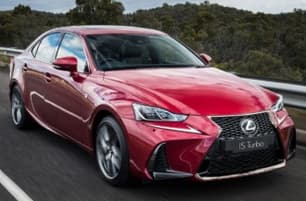
The current IS is by far the most distinctive of the three generations. With a couple of exceptions, it is a terrific looking car. It looks long and low slung, like the best sporting sedans, with an almost Maserati-like approach to its proportions. The loud and proud Lexus spindle grille - the object of such derision when it first arrived - looks utterly fantastic and draws attention away from the odd, squished headlights.
it is one of most comfortable cars you can buy, for both front and (short) rear seat passengers.
Inside is less impressive, with a weird stacked dash and integrated screen. The materials are top notch, however and while the designers have tried to do something interesting with the dash design, there are better ideas out there they might want to consider next time around.
From a design perspective, the Omoda 9 certainly stands out as different from the Chery and Jaecoo range. It has a distinctive look that speaks to its ‘premium’ and ‘technology’ aspirations, both on the exterior and interior.
However, to this reviewer’s eyes, there are also quite clearly some visual similarities to the Cadillac Lyriq, both in the overall silhouette but also the details and cabin design. This isn’t unusual in the car industry, especially from Chinese brands. Jaecoo’s designers clearly took inspiration from Range Rover, so it makes sense that the Omoda would find an equivalent luxury brand to be inspired by. Or perhaps it’s just a coincidence…
The important thing is that it’s notably different to what Chery is offering with its Tiggo models, which form the core of its Australian line-up. Omoda needs to be distinct and more upmarket if it is to justify its price premium. On that front, the wider group has done a nice job of making each brand stand out visually.
Judging the interior of the Omoda 9 on its own, it's actually a very pleasant place to be. The level of design, fit and finish also feels like a big step up on what Chery offers, even if it does feel familiar. The materials don't feel truly premium, but given the price that's understandable and acceptable.
The IS's cabin is probably the weakest point of the car, with limited storage for your bits and bobs. Front and rear seat passengers do get cupholders for a total of four, but the rear doors don't have bottle holders, limiting you to the two upfront.
On hot days like Sydney's 2017 summer, those cooled seats are heaven-sent.
The centre console bin is small and is the only place for your phone apart from the cupholders, which isn't an ideal spot, let's face it. The boot is a German-matching 480 litres and you can split fold the seats for more room.
Having said that, it is one of most comfortable cars you can buy, for both front and (short) rear seat passengers. The front seats are especially good and on hot days like Sydney's 2017 summer, those cooled seats are heaven-sent.
One of the standout features of the Omoda 9 is its size, measuring 4775mm long with a 2800mm wheelbase. That makes it longer in both measures than the likes of the Toyota RAV4 and Mazda CX-5, pushing it to the upper end of the ‘medium-sized’ SUV segment.
That liberates more space inside, with good room up front and a generous back seat, at least in terms of knee and foot room. The rear seats are compromised slightly by the large sunroof and sloping roofline, with headroom tight for anyone over 180cm.
Unfortunately, the space isn’t utilised as best as it can be, thanks to the lack of seat height adjustment for the driver. It’s not unique to Omoda and is becoming a common issue among Chinese-built cars for reasons I can’t explain. What it means is I couldn’t get the seat to a point I was 100 per cent happy with, which is a problem for what should be a very comfortable vehicle.
Omoda compensates for this with some clever technology, beyond just the pair of 12.3-inch screens (housed in a single setting, which again looks very similar to the Cadillac Lyriq), and the option of wired or wireless Apple CarPlay and Android Auto.
The 14-speaker Sony sound system includes two speakers inside the driver’s headrest. This is a clever addition that allows you to take phone calls via these speakers only, so you don’t annoy the rest of the occupants in the car.
The other notable luxury element is the fragrance system, which can diffuse three different scents into the car. While the names are a bit hard to interpret (Natural, Cure and Sport), the fact you can choose from three different scents and have them gently fill the cabin is a nice luxury touch.
In terms of storage, there's plenty of small item spaces around the cabin and the boot measures a roomy 660 litres and offers a nice flat floor with a square load area. However, that comes at the expense of any sort of spare tyre, with a tyre repair kit located under the floor.
The IS range kicks off with the 200t Luxury at $59,340, closely followed by the hybrid 300h, the V6-powered 350 ($65,390) and then the $73,540 200t F Sport. Pricing then heads up into the mid-$80,000s for the IS350 Sports Luxury.
The 200t F Sport's almost $74,000 price tag fetches you a car with 18-inch alloys, dual-zone climate control, reversing camera, front and rear parking sensors, a hefty safety package, electronic dampers, auto LED headlights, auto wipers, electric heated and cooled front seats, digital instruments, sat nav, keyless entry and start, leather (some real, some not) interior, variable ratio steering rack and power everything.
The 10-speaker stereo is Mark Levinson branded and is controlled by Lexus' own connectivity and sat nav suite. The sound is fantastic, the control system less so. Commands come from a few shortcut buttons (good) and weird mouse-type arrangement on the centre console that is largely infuriating. The less said about the on-screen graphics, the better - they're low-res and on occasions, amateurish. You can connect via USB or Bluetooth but the app integration is limited. You also get an at-first unfathomable DAB+ radio.
Once on boost, the engine is smooth with a lovely flat torque curve.
Options are limited to $1500 for premium paint, which makes up eight out of ten colours.
Out of interest, $74,000 gets you a reasonably well equipped BMW 330i M Sport or Luxury Line and a few hundred dollars more will get you into a hybrid 330e M Sport. Audi will cheerfully sell you a loaded-up A4 quattro 2.0 TFSI and Mercedes might be tempted to sell you a C350e. Infiniti will probably throw themselves at you with a V6 twin-turbo Q50 Red Sport rocketship, or at the very least a V6 Hybrid Premium.
For those who have been paying close attention the Omoda name will be familiar, as the Chery Omoda 5 was the first model the Chinese brand launched on its return to Australia. That has now evolved into the Chery C5, so the Omoda 9 becomes the first standalone model for the brand as it tries to position itself as a more premium, luxury and lifestyle brand separate from Chery.
While there are no confirmed plans for further Omoda models yet, the Omoda 9 is being positioned as the flagship of the range. It’s a medium-sized SUV but at the larger end of the segment so it will compete against the likes of the Mazda CX-60, BYD Sealion 6 and even the Mitsubishi Outlander PHEV.
In keeping with the more premium image the brand is trying to create, there will be a single, high-specification model offered, the Virtue SHS, which will be priced from $61,990 plus on-road costs.
For this price you get 20-inch alloy wheels, LED headlights and tail-lights, dual-zone climate control, a 14-speaker Sony-branded sound system, inbuilt navigation, surround view camera, automatic parking function, head-up display, wireless smartphone charger, leather seats with memory function, heated seats and steering wheel and even an in-built fragrance system.
The 200t denotes a 2.0-litre turbocharged four-cylinder under that long bonnet, delivering 180kW and 350Nm to the rear wheels via an eight-speed automatic transmission. This translates to seven seconds dead to 100km/h for the 1680kg sedan, which isn't hanging around.
The Super Hybrid System may sound fancy, but it’s effectively a plug-in hybrid powertrain, which is a technology that is becoming increasingly familiar to Australian drivers as it fills the gap between internal combustion and electric vehicles.
Omoda’s SHS system combines a 1.5-litre turbocharged petrol engine with three electric motors - two at the front, integrated into the transmission package and one at the rear - to create a potent SUV. This complex system can send power to either the front wheels or all four wheels via a three-speed ‘Dedicated Hybrid Transmission’.
Omoda claims the combined output of the Super Hybrid System is 395kW, allowing this family friendly SUV to sprint from 0-100km/h in just 4.9 seconds.
It’s backed up by a 34kWh battery, which allows for meaningful electric only range too.
Try as we might - and we did - we couldn't get at all close to the claimed combined fuel figure of 7.5L/100km. We didn't even hit the standard plus 30%, but we did get 12.2L/100km. That's a fairly solid miss.
What gives Omoda some confidence to use the Super Hybrid System name is its claim that the battery allows the 9 to drive up to 145km (WLTP) on electric power alone, which is more than both a conventional hybrid and many existing PHEV models. For example, the Mitsubishi Outlander PHEV has an EV range of 84km and the Mazda CX-60 can make 76km.
Fuel economy is officially rated at 1.4L/100km, although that relies on using the battery to its maximum and once that is depleted, you can expect to see a much higher figure. Realistically somewhere around 5.0L/100km is what you should expect if you do mostly urban driving and anything below that is a good result.
Omoda claims that the Virtue SHS can drive up to 1100km, but that is theoretical and based on achieving both the full EV-only range and then the 1.4L/100km figure, which isn’t actually achievable in the real world.
After having the good fortune to step out of the IS350 and into the 200t, it was immediately apparent that the 200 is the better car. For a start, it feels so much more nimble. Sure, it doesn't have the seamless urge of that silky V6, but the 2.0 turbo does a fine impression of a bigger engine. Once on boost, the engine is smooth with a lovely flat torque curve. If you're off boost, though, you're in a bit of trouble - the eight-speed is reluctant to downshift and needed prodding from the steering wheel mounted paddles on occasion.
As with just about every Lexus, the ride is impeccable and refinement virtually unmatched in the class.
From a driving point of view, the fundamentals are better - less weight over the front wheels meaning the steering feels better, it turns in better and it moves more fluidly, which is impressive because the 350 isn't a slouch. Even the dashboard is better. The 350 has a traditional two clock arrangement where the 200t has a single dial in the middle that is digitally remastered. Press a button and it slides to the side to provide extra info on your choice of the available data. It leaves a fair amount of black space but it's easier to read and doesn't suffer as badly from reflections.
As with just about every Lexus, the ride is impeccable and refinement virtually unmatched in the class. There's something about the way a Lexus knocks the edge of all but the biggest bumps, sails over speed bumps and handles imperfections that is hard to beat and hard to find unless you're spending really big bucks. The adaptive damping never feels like it's doing anything which is exactly the point - even when switching to Sport+, there's an ease to the ride without it feeling loose.
You'll barely know the engine is there, and the way the transmission slurs around the gears means non-stop serenity.
While a generous level of standard equipment is one key measure of a luxury/premium vehicle, driving is another. For a vehicle to be truly premium it must have effortless performance, a comfortable yet controlled ride and confidence-inspiring handling.
This sets the bar quite high for the Omoda 9 and that makes it hard to really live up to the brand’s aspirations.
From a performance perspective the SHS powertrain does a great job. Certainly 395kW means the SUV feels quick and easy to punch into gaps or call for a burst of acceleration. But the rest of the driving experience doesn’t really live up to the premium standard buyers might expect.
The ride is too busy most of the time, never feeling settled and often fussing over the bumps in the road. It lacks the smooth, relaxed ride that premium buyers are looking for.
The same is true for the handling, with the steering too light and vague off-centre and lacking feeling when you find yourself on the open road.
The Omoda 9 is by no means a bad car to drive, but it does lack the precision and elevated comfort that genuine premium cars need to have. Perhaps with some local ride and handling optimisation it could get closer to what buyers in this part of the market expect.
Standard safety kit includes eight airbags (including knee bags for front seat occupants), ABS, stability and traction controls, blind spot sensor, lane departure warning, rear cross traffic alert, brake assist and driver attention detection.
The IS scored the maximum available five ANCAP stars when it was re-tested in October 2016.
The Omoda 9 ticks all the boxes that customers and, just-as-importantly, the safety authorities expect, like autonomous emergency braking (AEB), forward collision warning, emergency lane keeping, driver monitoring system and adaptive cruise control.
Omoda even goes a step further and offers 'Traffic Jam Assist' and 'Integrated Cruise Assist', which can centre you in the lane when cruise control is active to create a low level of autonomous functionality.
However, like so many modern cars these safety systems are not integrated smoothly into the driving experience. Instead, the Omoda likes to distract you with graphics and warnings on the dashboard and then warn you that you’re distracted. To be blunt, it’s both annoying and - ironically - very distracting.
To the credit of Omoda, as well as Chery and Jaecoo, the company has invested in a local tuning program for the active safety features and there has clearly been a dramatic improvement since the first Chery model I experienced less than 12 months ago. Hopefully with a bit more time and tuning the systems will become better integrated and the car won’t tell you you’re distracted looking at warnings.
In terms of a crash test safety rating the Omoda 9 hasn’t been tested by ANCAP yet but has five-stars from Euro NCAP so there’s little reason why it would be dramatically different if crashed locally.
The Lexus range comes with a four year/100,000km warranty with roadside assist for the duration. Servicing is every 15,000km or twelve months, whichever comes first.
Sadly, there's no fixed or capped-price servicing regime, not even a pre-pay option like the stingy Germans. Lexus will only commit to indicative pricing, although the first service at 15,000km is priced keenly - it's free.
When you buy a Lexus, they don't like to let go of you. My father-in-law's original IS 200 is still fetched by the dealership - should he so desire - for its annual service. If he chooses to darken the dealership door himself, he'll drive out in a loan car. Nobody has ever stalked him at the dealership demanding he consider a new one.
In a bid to give customers confidence to try a new brand Omoda is applying the Jaecoo ownership model, which means an eight-year warranty as well as eight years of capped-price servicing and roadside assistance.
Service intervals are every 15,000km or 12 months, whichever comes first and across the eight years you’ll be spending a total of $3343, which averages out to just over $418 per year.
The decision to offer such extended coverage is a commendable move from Omoda and will no doubt help its bid to convince customers to give it a chance.