What's the difference?
Make no mistake, you are looking at the biggest challenge the all-conquering Tesla Model Y has ever faced in Australia.
It’s the Kia EV5, a mid-size, all-electric SUV the Korean brand thinks will be its best-selling EV by some margin.
Oh, and it’s cheaper than the Tesla, by more than a little bit.
So, is this the electric SUV that might finally put an end to Tesla’s winning run in Australia?
An American all-electric car brand with a unique take on the automotive industry, an up and down share price and a cheaper model in its future plans. You could be mistaken for thinking I’m talking about Tesla, but I’m not.
Recently CarsGuide got the opportunity to experience an alternative electric car brand, and one that, despite having many similarities to Tesla, is also in many respects its polar opposite.
I’m talking about Rivian, which is very much behind Tesla in terms of sales, market cap and just about every other measure. But what it does have is a compelling line-up of electric vehicles, with plans for expansion, including an eventual entry into Australia.
Back in 2023 we drove the brand’s ute, the R1T, but on a recent trip to Los Angeles we sampled the brand’s other model, the R1S SUV. It was an eye-opener to see how far the brand has come in two years and showcased just how different Rivian is from Tesla.
The size is right, the price is right and the drive is right – three things that make the Kia EV5 a pretty formidable foe, and the kind of vehicle that might finally be able to break through the wall of the temple of Tesla in Australia.
Note: CarsGuide attended this event as a guest of the manufacturer, with accommodation and meals provided.
While there are some obvious signs that the R1S is Rivian’s first mass-market vehicle, the good news for the company is that its problems are not impossible to overcome. The suspension needs retuning to improve the ride quality and the multimedia system’s software needs upgrading. But even with those issues the R1S left a positive impression.
This is a very stylish SUV with great space and excellent performance, that also happens to be electric, rather than relying on being electric as its primary selling point.
Rivian has put more effort into the design and finishes than many of its EV rivals and the result is a vehicle that can genuinely compete with the established premium players with more credibility.
The only catch is there’s no clear timeframe for when, or even if, this generation of R1S will make it to Australia. The brand has repeatedly spoken of its hopes of entering the market here without locking anything in, but given the current state of the EV sales it may pay off to wait until the conditions are right for a new, premium player to try its luck here.
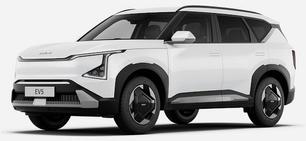
If you’re familiar with any of Kia’s EV designs, and specifically the EV9, you’ll already know the Kia EV5, which looks a lot like a shrunken version of the company’s biggest electric 4WD.
But this one looks a bit smaller, a bit more familiar looking, and maybe a bit more accessible than the hyper-modern EV9.
Honestly, it looks like a contemporary, mid-size SUV that could be powered by anything.
There are a couple of EV5 design elements I really like. The first is the combination of hard edges and subtle curves, which combine really well. I also love the lighting treatment up front, which gives the EV5 a bold and unique light signature, especially at night.
Inside, it’s another story of familiarity, with a clean, high-tech cabin and Kia’s common twin-screen set-up. Actually, it’s more a triple screen, with two 12.3-inch screens, and a 5.0-inch climate monitor between them.
The materials are all nice, and they look great, but they don’t exactly melt under the touch, and that gives the EV5’s cabin a hard edge I don’t love.
I do, however, love the inclusion of some physical buttons, so you’re not pawing through the screen to access every in-car function.
And one final design quirk. I know it looks like it has an old-school bench front seat, but you can’t use it as a third seat in front. Kia says it’s just a design flourish. But it is also somewhere safe to pop your phone or other small valuables to stop them sliding about when you're on the road.
Design is another area where Rivian has carved out a unique position for itself. Whereas other brands, including Tesla, have focused on simplicity and aerodynamic efficiency, Rivian has given the R1T a unique style that looks interesting, different and most definitely not plain.
The oval daytime running lights make every R1S and R1T stand out from a mile away, even on LA’s busy freeways. The overall design is high quality and manages to strike a good balance between aesthetics, aerodynamics and practicality - even if it doesn’t suit everyone’s personal taste.
The cabin is worth highlighting in particular, because rather than go for the ‘minimalist’ look that so many brands are going for these days, with as little switchgear and different trims as possible to keep costs down, Rivian has opted for something more complex and, frankly, more impressive.
There’s a level of craftsmanship, a great mixture of premium materials (including some striking light wood options) that make the R1S feel like a stylish and relaxed environment inside the cabin. Our particular example had a great mixture of colours, textures and patterns that really elevated the cabin experience.
The technology is also nicely integrated into the design, rather than being the focal point, like so many other modern electric vehicles. It still offers the same level of technology - a pair of screens - but doesn’t rely on them to carry the design of the interior.
At 4615mm in length, 1875mm in width, 1715mm in height, and with a wheelbase of 2750mm, the Kia EV5 is roughly the same size as a Tesla Model Y, so if you’re ever sat in the back of the Tesla, you’ll have a fair idea of what to expect here.
Sitting behind my own 175cm driving position, I found I had a heap of knee room, more than enough headroom, and I reckon you could fit three adults across the back seat pretty easily, too.
There are a couple of design flourishes I really like, too. The pull-down divider that separates the backseat is home to two cupholders, which isn’t unusual, but what is new to me is the unique positioning of the USB charge ports, which are in the middle-back of the front seats, right above the storage pocket, so you have somewhere to pop your phone and cable when you're charging.
There is also a deep storage draw between the two front seats. It’s just for extra storage in the Air and Earth, but in the GT-Line it’s heated and cooled, which means hot pies or cold drinks when you’re on the move.
The EV5 might be an all-electric vehicle, but it’s still a mid-size SUV, which means there are certain standards it has to hit to be taken seriously, and one of those is boot space.
Up front there’s 67 litres of space in the fruit, or frunk, while the boot holds 513L with the rear seats in place – that number obviously growing as you begin folding them flat.
It is also a hugely customisable space. There’s heaps of under-floor storage below the removable panels. There’s also vehicle-to-load capability, which takes the form of a standard power point in the boot that can use the vehicle’s battery to power pretty much whatever you want.
Finally, there are adjustable luggage hooks, so you can carry bigger or smaller bags as you wish.
The R1S comes standard as a seven-seat SUV, split across three rows (two in the first row, three in the second row and two in the third row). Space across the three rows is fairly typical for an SUV of this size, which is to say generous up front, good in the second row and a little bit tight in the back.
What is good though, is the length of the cabin allows for quite a spacious boot even with the third row in use, which is definitely not something all seven-seat SUVs can claim. Using a direct conversion from Rivian’s specifications that list cargo capacity in cubic feet, the R1S has a claimed 498 litres with the third row in use and up to 1331L with the third row folded down. There’s also 314L under the bonnet and another 144L underneath the boot floor (although that comes at the expense of a spare tyre).
As mentioned in design, Rivian has nicely integrated the technology into the cabin, with the 12.3-inch digital driver display and 15.6-inch central multimedia touchscreen feeling like a natural part of the car rather than a centrepiece. Rivian has also managed to incorporate eight USB-C charging ports spread around the cabin to keep everyone’s devices charged up.
However, while the technology is nice from an aesthetic design perspective, the same cannot be said about its useability. Like Tesla, Rivian has opted to go it alone with its multimedia system and has developed its own Google-based software that is not compatible with either Android Auto or Apple CarPlay. That would be acceptable, although still disappointing, if the system worked as well as Tesla’s, however the Rivian system is very slow. It repeatedly took several seconds to load between the various functions, which may not sound like long, but when you’re trying to get back to the navigation so you don’t miss your freeway exit a few seconds can make a big difference.
But, honestly, in this day-and-age, systems like this should work quickly and seamlessly, so it’s an area Rivian needs to improve.
On a positive note, Rivian does have some cool accessories for the R1S including what it calls a ‘Camp Speaker’ which is a US$400 option that it integrates into the sound system but is also removable, so you can pull it out of the centre console and listen to your music if you’re around the campfire or having a picnic.
The cheapest EV5, the Air, arrives in two guises, Standard Range or Long Range, and the former is something of a bargain.
It’s the only EV5 to get included on-road costs, and Kia is asking $56,770, on the road. That puts it well below the Tesla Model Y. As of right now, the single-motor Tesla is $60,868, on the road, in NSW.
Next is the Air Long Range, which lists at $61,170, before on-road costs. The EV5 Earth occupies the middle rung, at $64,770, before on-roads, while the yet-to-arrive flagship, the GT-Line, is a considerable $71,770, before on-road costs.
Air models get 18-inch alloys, LED lighting all around, roof racks and power mirrors, while inside there are cloth and synthetic leather seats, with a massage function for the driver, along with a synthetic leather steering wheel and LED interior lighting.
Tech is covered by twin 12.3-inch screens, with a smaller 5.0-inch climate screen sandwiched between them, and there’s in-built nav, a six-speaker stereo and Apple CarPlay and Android Auto.
The Earth then adds 19-inch alloys, gloss black exterior design flourishes and privacy glass, while inside, the seats are now entirely synthetic leather. You also get a second V2L connection, as well as a powered tailgate.
Finally, the GT-Line gets pretty much everything Kia could throw at it, including 20-inch alloys, auto-flush door handles, a panoramic sunroof, two-tone seats which are now billed as offering "premium relaxation", wireless phone charging, fingerprint recognition, a heated steering wheel and an augmented-reality head-up display.
When we drove the R1T in 2023 Rivian was still in the ramp up stage of production and was limited with what it could offer customers. Fast forward to 2025 and the brand now has both the R1T and R1S available with dual or tri motor powertrains, with a quad-motor powertrain expected by the end of the year.
The R1S Dual Standard begins the range at US$75,900 (approx. A$118,000), the R1S Dual steps it up to US$83,900 (A$130k) and the R1S Tri-motor completes the current line-up at US$105,900 (A$165k). While those prices are definitely in the premium end of the market the R1S is actually cheaper than the Tesla Model X, which is still on sale in the US market, and starts at US$86,630 (A$135k) and stretches to US$101,630 (A$158k).
For more context, the Audi Q8 e-tron starts at US$74,800, the BMW iX from US$87,250 and the Mercedes-Benz EQE from US$77,900.
Standard equipment across the range includes the 12.3-inch digital instrument display, 15.6-inch multimedia touchscreen, dual-zone climate control, heated and ventilated front seats, heated steering wheel, eight-way power adjustable driver and passenger seat and panoramic glass roof, so it certainly has premium levels of equipment.
We drove the range-topping RS1 Tri-motor which, aside from an extra motor, gets standard 22-inch alloy wheels, a dynamic glass roof, a soft-touch suede textile headliner as well as unique colour and trim options.
The entry-level EV5 Air is available in Standard Range or Long Range guises, both powered by a single front-mounted electric motor, producing 160kW and 310Nm.
The Standard Range will clip 0-100km/h in 8.5 seconds, while the extra weight of the bigger battery slows down the sprint in the Long Range, taking around 8.9 seconds.
The Earth is a twin-motor AWD offering, with a motor at each axle, lifting outputs to 230kW and 480Nm, dropping the sprint to a brisk-feeling 6.1 seconds. The incoming GT-Line gets the same powertrain.
As mentioned earlier, there are currently three versions of the R1S available, each with a different powertrain.
The Dual Standard AWD has, unsurprisingly, dual motors (one at the front and one at the rear) which make a combined 397kW/827Nm. That’s enough for it to launch 0-60mph (0-96km/h) in just 4.5 seconds. The R1S Dual AWD has the same power, torque and acceleration figures, however it gets Rivian’s Large battery, which we’ll detail below.
The Tri-Motor AWD obviously has three motors, one on the front axle and two on the rear, which naturally provide more power, 633kW/1495Nm. With so much power and torque the Tri-motor is wickedly fast, taking just 2.9 seconds to launch 0-60mph.
If, for some reason, the Tri-Motor isn’t fast enough for you, Rivian has released the details on the Quad-Motor. It will have two motors on each axle providing a staggering 764kW (that’s 1025-horsepower!) and 1624Nm, enough to rocket it from 0-60mph in just 2.6 seconds and across the quarter mile in 10.5 seconds.
The Air Standard Range gets a 64.2 kWh lithium iron phosphate battery, weighing in at a hefty 428kg, which delivers a claimed driving range of 400km. The Air Long Range, the Earth and the incoming GT-Line all share the same 88.1kWh battery, upping the range to 555km, 500km and 470km, respectively.
So, if driving range is at the very top of your must-have list, the Air Long Range is the car for you.
All cars can take 7.0kW home AC charging, while the dual-motor versions are set up for 11kW AC charging. Fast charging. When it comes to fast charging, all models can plug into a 350kW charger, taking them from 10 percent to 80 per cent in less than 40minutes.
Rivian offers three different battery types across the three variants, each with a different driving range. The R1S with the Standard battery (92.5kWh) has a claimed 434km driving range, the R1S Dual with Large battery (109.4kWh) extends that to 530km, while the Tri-Motor comes standard with the Max battery (141.5kWh) that has an impressive 597km of range.
It is worth noting, though, that those range claims are based on US EPA estimates, rather than either the WLTP or NEDC methods usually used.
Charging times vary depending on the type of charger used, in the US Tesla has given access to its network to other EV brands and the Rivian is available with a plug adaptor to use a Tesla charger. The R1S is capable of charging up to 220kW, which means it takes approximately 40 minutes to take the battery from 10 to 80 per cent.
First things first – I spend most of my time behind the wheel of the EV5 Earth, which though it shares its dual-motor powertrain with the GT-Line, is actually the fastest of the lot owing to the extra weight of Kia's flagship.
That means zero to 100km/h in just over six seconds, and trust me when I say this, that is more than fast enough. I know you read about EVs knocking off the sprint to 100km/h in supercar-besting times, but you don't need that sort of crazy acceleration in a family-focused mid-size SUV.
Actually, forget needing, you don't want it. The EV5 feels more than punchy enough, without shaving years off your life every time you plant your foot.
Fit for purpose, then, which is exactly how I'd describe the rest of the EV5's very good drive experience. Kia's Australian ride and handling wizards have once again had their way with the EV5, and the result is an EV that handles most everything Australian road surfaces can throw it at it with ease.
Surprisingly, it's maybe not quite as dynamically sharp as the bigger EV9, but it's always comfortable, without feeling floaty or disconnected, and it will happily grip its way around tighter corners without tipping from side to side, either.
There are a couple of small quirks, though. The first is the steering, which is definitely responsive and confidence inspiring, but it also has a kind of artificial weight or heaviness at times that feels a bit disconnected from what's happening beneath the tyres. And the cabin can be a little noisy through wind, too.
But these are small beans, really. The EV5 is comfortable and capable, and without the harsh ride or too-sharp steering that can be found in some of its rivals.
We drove it for hours across all sorts of road surfaces, and in all sorts of conditions, and found very, very little to complain about.
The R1S and R1T are Rivian’s first mass-produced cars, and it shows. It’s not all bad news by any stretch, but there are some major issues the brand will need to address in the future if it wants to succeed globally (or even just in the US).
The biggest issue is the ride, which just doesn’t feel as well resolved as the more established brands that have been designing, developing and building cars for decades. The R1S isn’t bad to drive by any stretch, but the ride is too firm at times and it also lacks control and feels too soft at others.
All R1S grades come standard with Air Suspension that has multiple levels of firmness and can adjust the ride height. However, in the ‘normal’ setting the ride feels too busy, with the heavy (3096kg) SUV skittering over the imperfections in the road rather than absorbing them. The problem is, if you adjust the suspension to the softer setting it lacks control and has a tendency to bounce over bigger bumps and take a few seconds to settle. This was particularly noticeable on LA’s concrete freeways, but it would be an issue on any road with undulations or joints.
But while the ride needs improvement, the R1S has strengths in other areas - namely performance. The Tri-motor AWD we sampled had immense punch from its three motors and it certainly felt like 633kW and 1495Nm was on tap. We didn’t test its acceleration claim officially, but any take-off could be made into a rapid one with just a squeeze of the accelerator pedal.
The R1S is also capable of towing up to 3500kg, so it’s a strong and capable SUV too, rather than just a speedy EV.
Another strength is the regenerative braking system. There are multiple settings but we found the lowest regen was the best option, as it still provides powerful regen but is more progressive than the more powerful modes.
Every EV5 gets a comprehensive safety offering, including 'Advanced AEB' that includes junction crossing, lane oncoming and lane changing alerts. There’s rear-cross-traffic alert, semi-autonomous highway cruising and a whole heap more.
If you want a blind-spot view monitor, surround-view monitor or remote park assist, you’ll need to spring for the GT-Line.
The EV5 hasn’t been crash-tested yet, but Kia will be shooting for the maximum five-star ANCAP rating.
The R1S comes loaded with safety equipment across the range, including eight airbags, adaptive cruise control, autonomous emergency braking, blind spot monitoring, forward collision warning, lane departure warning, lane keeping assist and rear cross-traffic alert.
It also comes with what’s called the ‘Rivian Autonomy Platform’ that includes 11 cameras and 12 ultrasonic sensors for mild-autonomous functionality in specific circumstances, such as freeway driving or on well-marked roads.
The EV5 is covered by Kia’s seven-year, unlimited-kilometre warranty, and you can prepay your servicing costs, too.
Three years will set you back $980, five years is $1535 and the full seven years will set you back $2431 ($347 per workshop visit), which is category competitive.
Rivian offers a four-year/80,000km warranty for the R1S vehicle as a whole, as well as a separate battery pack and drivetrain specifically. The Standard battery is covered for eight years/190,000km while the Large and Max batteries are covered for eight years/240,000km.
As for servicing, Rivian uses an app-based system, which allows owners to schedule a service at any time via the app and then either have a Rivian technician come to your home for a small service or drop it off at a service centre if it’s a bigger job. The app is also connected to the car, so if the car’s own diagnostic system recognises a problem, it can prompt you to book a service proactively.