What's the difference?
Sales figures show Australian buyers are moving away from pure internal combustion engine power for their family cars. Instead they’re looking for hybrid, plug-in hybrid and electric models.
While a number of brands - mostly newer manufacturers from China - are going down the plug-in hybrid route, others are focusing on regular or 'plugless' hybrids. Think models like the GWM Haval H6, Hyundai Tucson, Kia Sportage, MG HS and Toyota RAV4.
KGM (formerly SsangYong) is also headed down this path and the first hybrid model from the Korean carmaker is the Torres.
The Torres is a mid-sized five-seat SUV with unusual, rugged looks, but it hasn’t had an impact on the sales charts as yet. This hybrid version could change that. It’s affordable, spacious and offers a serious point of difference from its compatriots, as well as rivals from China and Japan.
But is it as good as those popular rivals?
Few cars have had the sheer staying power of the Suzuki Swift.
Except for a four-year hiatus as the original Ignis from 2001, the Japanese supermini has been a segment mainstay since 1983, winning over consumers worldwide as an inexpensive, economical and reliable yet fun option in the Toyota Yaris class.
In Australia, its impact has been even more profound, providing Holden with its famous “beep-beep” Barina for two early iterations from 1985, while also introducing us to the pocket rocket decades before the Volkswagen Polo GTI, with the Swift GTi of 1986.
Now there’s this – the sixth-gen model in 41 years if you exclude that Ignis – doing what the little Suzuki has always done: offering buyers a great budget alternative. But this time, in this new-electrification era, where precious few attainable choices remain.
Is it any good? Let’s dive straight in.
The KGM Torres Hybrid represents yet another choice for buyers in the family SUV segment, as if there aren’t already enough! But the Torres offers a level of value its mainstream competitors can’t match. The hybrid powertrain is a winner, however KGM needs to iron out a few issues, like tyre choice and the advanced driver assist tech. But there is a lot to like about the Torres Hybrid. And it’s definitely the pick over the pure petrol version.
So, there you have it. A brief look at the new, sixth-gen Swift.
Better where it needs to be, the supermini survivor still remains competitively priced, with loads of new efficiency and safety tech that buyers will appreciate.
But, most of all, the Suzuki still feels, drives and rewards like the old model used to. It just does so with more sophistication.
As inexpensive city cars continue to fade, the new Swift continues 41 years of providing a fun, affordable and dependable solution, in a vibrant and desirable package.
What a curious thing the KGM Torres is. It has typical medium SUV proportions but with over-the-top styling designed to give the impression of a rugged off-roader. But this is no off-roader.
It has a Jeep-like slotted grille, faux winch hook in the lower grille, squared-off wheel arches, a boxy shape and weird grab mounts on the bonnet that serve no discernible purpose.
It also has what appears to be a rear-mounted spare wheel with a side-opening tailgate. But it’s all an illusion. It’s just a chunky addition to the tailgate which opens upwards, like a regular SUV boot.
If you discount the fake 4x4 bits, the Torres is quite a handsome SUV, especially from the front. The grille surrounded by cool integrated LED headlights makes for a nice front end.
The tail-lights sit a little low at the rear, and the pointlessly massive C-pillar is a bit much. But there are some appealing elements.
Inside, there’s a bit of a nod to fellow Korean brands Hyundai and Kia with the dual 12.3-inch multimedia and driver display screens.
There are no buttons to be found on the console and centre stack so it’s a clean look. The screens and air vents are angled towards the driver, too.
Bronze is a feature throughout and it breaks up the dash nicely, as does the ambient lighting. Matching stitching is a lovely visual touch on the nicely patterned cloth seats.
It doesn’t look or feel like a base model. It definitely feels a step up from the Korando and the Musso in KGM’s stable, as well as some rivals.
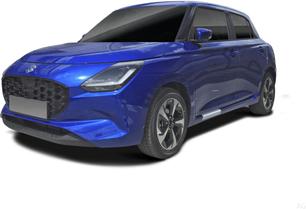
At first glance, the new one looks a lot like the old one. Short overhangs, long wheelbase, upright A-pillars, that signature 'floating' roof. This could be nothing else but a Swift.
Obviously, though, every single panel has changed, resulting in a stronger, quieter and more aerodynamic body.
Helping communicate this is a new and very definite crease line added to create a more-pronounced shoulder. The bonnet seems to be more clamshell-like and the nose is squarer, too. Indeed, everything about the overall styling seems to be more upright.
Debate is already raging in some circles. Is the new Swift too fussy? Too conservative? Has it lost the playful boldness of the proceeding version's gently-sculptured sides and hidden rear-door handles? Are the proportions slightly out now? Has the previous design integrity and oneness of vision been diluted? Does the 2017 predecessor look better?
Underneath, the platform is essentially the same, while overall dimensions are largely identical except for a 20mm stretch and 25mm roof lift. Length, width, height and wheelbase numbers 3860mm, 1735mm, 1520mm and 2450mm, respectively.
Happily, the aesthetic changes inside are likely to please rather than perplex, and even delight rather than divide opinion.
The KGM Torres Hybrid sits at the smaller end of the medium SUV set, but it still offers decent levels of space throughout, especially when it comes to headroom.
Storage is something KGM gets right with the Torres. The centre console has an armrest with large under-lid storage. There are a couple of good sized cupholders and a small slot for the phone to sit in, however it’s not super deep so it’s better for keys.
Further under the console is a large tray and two USB-C ports, plus another smaller shelf just above. There’s heaps of space in the doors for two bottles, plus additional space. And the glove box can hold the vehicle manual.
When it comes to in-car tech it’s a bit of a mixed bag. The multimedia screen takes way too long to boot up, especially when it’s hot. Which is not great because you need the screen to crank the air-con as most vehicle functions are housed in the screen. That display delay also frustrates if you want to reverse immediately after turning the car on, meaning sometimes there’s no camera display for a few seconds. It’s just not good enough by today’s standards.
The system is fine in terms of navigation and menus but not super intuitive. Swipe down for drive modes ('Comfort', 'Sport' and 'Eco'), plus some quick access options. You can always swipe down even when Apple CarPlay is active.
You can also hit the fan from left of screen to open the air con settings.
As mentioned, there’s no digital radio and no wireless Apple CarPlay. Also no wireless charger in the K30. Having to use a cord can be a pain but at least it means flawless CarPlay connection and a properly charged phone - something most charging pads fail to achieve.
The digital Instrument cluster is clear enough, but there is no head-up display.
Steering wheel controls are clearly labeled on the lovely looking thin-rimmed, four-spoke wheel.
In the back seat you’ll find ample leg, knee and toe room. There’s plenty of space behind my 183cm driving position. The rear bench is flat so there’s not as much side support as the lovely front seats.
That rear space has quite a high window line so small kids may struggle to see out.
Amenities back there include two map pockets, rear knee-level air vents, two USB-C ports, ISOFIX anchors on the two outboard seats, three top tether points and enough room in the doors for one big and one small bottle.
You get 465 litres of space (to the top of the seat back) with all seats in place. It is ample space for luggage or a big shopping haul. Drop the 60/40 split-fold rear seats and the front seats and that grows to 1526L.
You’ll find a 12-volt outlet in the boot as well as nooks on the side, a light and a cargo blind. What you won’t find, disappointingly, is a spare wheel of any kind. Just a tyre repair kit. This puts KGM behind the pace of brands like Toyota and Hyundai that at least offer a temporary spare wheel for their hybrid models.
Another quirk is adjusting to the tailgate opening upwards, not sideways as the rear 'handle' suggests.
From a packaging perspective, the latest Swift carries on from before, and that’s no bad thing. It remains exceptionally roomy as well as practical.
To that end, entry and egress are easy, there’s a sense of spaciousness thanks to deep windows, a high ceiling and lofty seating, while the latter also helps provide an agreeable driving position. Storage and ventilation are provided in abundance.
For many people, the dash redesign reflects a big change in attitude, having finally grown up and away from the previous cheap and cheerful look. Highlights include pleasing seat fabrics, interesting textures and a sense of quality craftspersonship, within a stylish and sweeping design. After 41 years, the Swift has matured gracefully.
It’s also worth pointing out the super-clear analogue instrumentation dials, supported by a digital speedo and configurable trip computer data; actual buttons for the heating and air-conditioning system and – joy of joys – a handbrake lever.
Plus, if you want to turn off the various beeps from the driver-assist systems, physical buttons are but a simple press away. No distracting sub-menu searches within fiddly touchscreens here, thanks.
Except if you want to change the volume because you’ll need to prod the screen after all. The knob is always the better option, Suzuki.
What else? The rear bench area is a little plain but surprisingly roomy for this class of light car. Probably more so than a Corolla provided back in the early 2000s, with a decent level of cushy support for two people or three at a squeeze.
Given the extra specification, even the cheapest grade is all the Swift you’ll need. A sign of a democratic car.
But keep in mind the base variant no longer comes with a driver’s seat adjuster, passenger vanity mirror and multiple USB ports found in the Plus and GLX versions, while it is alone with a clammy plastic rather than leather-sheathed steering wheel rim.
At least cargo capacity edges up, by 23 litres to 265L (VDA), and that’s just under the luggage cover, thanks to some clever repackaging of a now-lower boot floor and internal tailgate panels. Drop the rear backrests and that expands to 569L.
Note, however, that for the Swift to achieve its sensationally low kerb weight that starts from just 919kg (up around 50kg), it now uses a fiddly and frankly-inadequate tyre repair kit. Thankfully, Suzuki offers that space-saver spare, at extra cost (and mass) of course.
Still, keeping those kilos low pays high dividends when it comes to performance and economy.
The hybrid version of the Torres is available in two model grades, the K30 from $45,000 drive-away and the K40 at $48,000. We tested the K30 Hybrid.
The non-hybrid turbo-petrol Torres is available in three grades and ranges from $38,000 to $47,000. There’s also a fully-electric Torres called the EVX that costs $58,000. Keep an eye out for our review of the EV in the coming weeks.
In terms of other hybrid rivals, the Torres lines up against the GWM Haval H6 ($40,990-$47,990, drive-away) and MG HS ($42,990-$46,990, d/a). Some more established models have more hybrid grades, like the Hyundai Tucson, Kia Sportage, Nissan X-Trail and Subaru Forester but they creep up dangerously close to $60K for the priciest grade.
KGM offers solid value for money across its model range and that’s definitely the case with the Torres Hybrid. The standard features list is healthy without being jaw-droppingly generous.
In the K30 you get 18-inch alloy wheels, LED headlights and daytime running lights, dual-zone climate control, interior ambient lighting, leather steering wheel, heated, power-adjustable and power-folding door mirrors and rain-sensing wipers.
It also has dual 12.3-inch screens, one for driver instrumentation and the other for multimedia, wired Apple CarPlay and Android Auto, a retractable cargo blind, fabric seats, manual adjust front seats, six-speaker audio and USB-C ports.
It misses out on digital radio and the lack of wireless connectivity is a miss.
The K40 adds synthetic leather front seats, heated seats, a heated steering wheel, rear sunblinds, a hands-free power tailgate and auto up-down front power windows.
The Torres Hybrid also has a lengthy standard safety features list, but more on that in the Safety section below.
So. Why are there so few affordable city-sized superminis like the Swift?
Just 10 years ago, the Swift had at least 25 rivals under $25,000. Today that’s phonetically as well as literally down "t(w)o" "three" – namely, the ageing but still-surprisingly-spry Mazda2 and intriguing all-new MG 3, as well as Australia’s sole sub-$20K new car, Kia's darling Picanto.
Many of the Class of 2014 have since morphed into pint-sized crossover hatchbacks like Suzuki’s soon-to-be-discontinued Ignis, the Hyundai Venue and Kia Stonic. And if you must, there are also the cheerless MG ZS and ancient Mitsubishi ASX biggish-small SUVs – but they’re cheapo for a reason.
Unlike the latest Swift... which, from $24,490 drive-away, is more than reasonably cheap, since it introduces some electrification tech across the whole range, while still being around the same price as the old base GL.
This now makes the new Swift Australia’s cheapest 'hybrid'.
Granted, despite wearing the Hybrid badge on every grade, it’s just a mild hybrid system, but one that provides extra electrification to usefully boost performance and economy for the all-new powertrain and revised transmissions. More on all that later.
What else? The base Swift at last gains LED lights, telescopic as well as tilt steering adjustment and important driver-assist safety like Autonomous Emergency Braking (AEB), along with lane-support systems, adaptive cruise control and rear parking sensors.
Also included now are keyless entry/start, a 9.0-inch touchscreen as part of a new multimedia set-up, wireless for Apple CarPlay (but not for the Android Auto), a digital radio, heated mirrors, traffic sign recognition, auto high beams and an alarm.
And there's more. The entry-level Swift Hybrid is also class unique in offering a manual gearbox. Good on you, Suzuki.
Not for you? Don't worry, because the Hybrid auto that is expected to be the bestseller starts from $26,990, drive-away. For the record, that’s only about $1000 more than the equivalent old version but with all that extra gear to boot.
But, beware, the base-model Hybrid alone lacks a few items that may or may not have been standard in the outgoing Swift, such as a driver’s seat-height adjuster, leather-wrapped steering wheel, privacy glass, alloy wheels, front passenger vanity mirror, front-seat map pockets, multiple USB charging outlets and a spare wheel (though you can pay extra for one as the wheel-well remains).
All of the above, except the missing spare, are included in the new Hybrid Plus auto grade, from $28,490 drive-away, along with heated front seats and additional driver-assist tech like a blind-spot monitor. We’ll get into more detail in the Safety section below.
Finally, there’s the Hybrid GLX auto, with its wireless phone charger, folding exterior mirrors, steering wheel paddle shifters, climate control, glossy alloys and more from $29,490, drive-away.
Sadly, the terrific old GLX 'BoosterJet' three-cylinder turbo is no more, and there might not even be a new Swift Sport to continue the GTi hot-hatch legacy.
Still, Suzuki’s managed to keep the entire range under $30K drive-away, despite big changes inside and out. Let’s check those out.
Powering the KGM Torres Hybrid is a 110kW/220Nm 1.5-litre, four-cylinder turbo-petrol engine paired with a permanent magnet synchronous motor delivering 130kW/300Nm, for a combined power output of 150kW. KGM does not provide an overall torque figure but clearly pulling power is healthy.
It also has a 1.8kWh lithium iron phosphate battery as part of its hybrid set-up. As mentioned. this is not a plug-in.
That’s a little less than the Hyundai Tucson (172kW) and GWM Haval H6 (179kW) hybrids, but more than the Honda CR-V (135kW).
It uses a ‘dedicated hybrid transmission’ and drives the front wheels only.
If there’s one area where Suzuki shines, that’s in making sweet little engines, and the new, chain-driven, 1197cc 1.2-litre mild hybrid three-cylinder petrol unit is no exception.
Now, on paper, 61kW at 5700rpm and 112Nm at 4500rpm may seem slightly lacking. A Mazda2 manages to make nearly 35 and 30 per cent more power and torque, respectively.
But the Swift's new 'ISG' integrated starter/generator/electric motor unit delivers an additional 2.3kW and 60Nm.
Combined with the hatchback's comparative lightness, it makes for a sufficient power-to-weight ratio of between 63 and 66kW per tonne.
Or, in other words, it provides some welcome extra low-down muscle.
Drive is naturally sent to the front wheels, via either a light-yet-positive shifting five-speed manual gearbox, or new CVT auto. Both have been heavily revised in their new roles serving the mild-hybrid powertrain.
KGM says the Torres Hybrid consumes 5.6 litres per 100 kilometres on the combined (urban/extra-urban) cycle. After a week of mixed urban and freeway driving I recorded a figure of 7.0L/100km. Not bad, but it could be better.
The Torres’s Euro 6 powerplant uses 95 RON premium fuel and taking into account the 50-litre fuel tank, you could theoretically get a total driving range of about 890km.
The latest Swift’s maturity does not end with its suave cabin presentation.
Prioritising high economy and subsequently low pollution, this Euro 6d-rated three-pot hybrid powertrain promises an astonishing combined fuel-consumption average of just 3.8 litres per 100km for the manual, and slightly more for the CVT at 4.0L/100km.
The results are 78 and 80 grams per kilometre of carbon dioxide emissions, respectively, along with around 970km between refills of the meagre 37L fuel tank.
These facts somewhat ease the pain of the need for more-expensive 95 RON premium unleaded petrol instead of the regular brew. High-tech solutions do require superior fuel, after all.
With just 70km on our ultra-tight test car’s odometer, the trip computer’s 6.7L readout is likely no indicator of the frugality we’re expecting to come.
So, how are such low consumption figures attainable? Along with better aerodynamics and a low kerb weight, the latest Swift Hybrid’s ISG hybrid unit generates supplementary electricity under acceleration, to ease the engine’s reliance on petrol.
It also recharges the 12-volt lithium-ion battery that lives beneath the front passenger-seat floor off-throttle via regenerative braking.
Note that the Suzuki never drives purely on electricity.
While this might be CarsGuide’s first time behind the wheel of the KGM Torres Hybrid, we have driven the petrol version. Andrew Chesterton lived with one for three months. You can read his take on it here.
As predicted by Chesto, the hybrid powertrain does sort out some of the issues with the pure petrol version. Regular acceleration is smooth and lacks any of the jerkiness experienced in the pure-combustion model, thanks in part to the hybrid transmission.
There is, however, tyre squeal when you give it a boot full. That could be fixed with better tyres than the 225/60R18 Nexen Roadian GTX rubber on the hybrid grades. There was also axle tramp when I tested the Torres under hard acceleration.
The transition between petrol and electric power is seamless. Only when pushed hard up a hill does the petrol engine sound a little rough.
Of the three drive modes - Comfort, Eco and Sport - the latter only adds mild spice. Best stick with Comfort.
The Torres Hybrid’s brakes are strong and lack the spongeyness of some hybrids. It has regenerative braking which just feels weird in a hybrid. I kept it at a lower setting as a result.
It steers nicely, offering a good amount of feel and it’s sharp without overdoing it.
I noticed some light vibration through the steering wheel on coarse chip and uneven roads. But the cabin is well insulated and relatively quiet. A particularly windy Melbourne spring day was the only thing that unsettled the peace in the cabin.
Suspension is MacPherson strut up front and multi-link at the rear and in terms of handling, there’s subtle lean in corners but it feels pretty hunkered down for a family SUV. More so than a number of its rivals.
The Torres Hybrid’s ride quality is variable, depending on the road quality. On some average roads, it handles better than others. You’ll definitely notice sizeable ruts, but there’s little to complain about in urban settings.
In terms of visibility, the C-pillar is way too big. I get that it’s a design element but that, combined with the tiny rear third-quarter windows, make a head check all but useless.
No Swift since 2004’s new-millennium redesign has been anything less than fun to punt around. A focus on driving pleasure and superior dynamics has helped make each version a cut-above most rivals.
Losing the smooth old 1.2-litre four-cylinder engine in the name of low consumption and emissions is a noble move. But how does this translate out in the real world, especially with a Swift fan behind the wheel?
It's mostly great, actually.
Losing a cylinder results in a slightly less creamy power delivery, especially as it’s accompanied by a distinctive three-cylinder exhaust-note thrum. But that’s still in keeping with the Swift’s endearingly sporty character.
Better still, even with all the examples we tested showing barely more than delivery mileage on the odometer, there seems to be more than enough grunt to please driving enthusiasts.
While not wanting to tax engines that weren’t even run-in yet, the charming revvy eagerness and instant throttle response remains, along with a discernible extra kick when accelerating away from standstill.
Even being so new, our Swifts proved to be lively, lusty and surprisingly rapid performers. We can’t wait to test run-in examples!
The five-speed manual is deliciously well-oiled and precise, immersing the driver into the Swift experience on another level compared to the CVT auto, which still manages to impress by responding quickly and effortlessly, without feeling laggy or droney. A lot like the old version.
Suzuki is making a lot of noise over how agile yet comfortable the newcomer’s handling and ride qualities are, as a result of improved rigidity and noise-dampening measures.
The Swift’s MacPherson-style front struts and torsion beam rear suspension systems have been revised with stronger and quieter mounts for better performance, while the electric steering has been retuned for greater feel and linearity.
The result? Even our limited time behind the wheel revealed tactile and precise steering, composed handling and extraordinary isolation from the road below for a car barely weighing 950kg (at most).
Combined with the nuanced driver-assist safety tech that rarely interrupted the fun, the latest Swift is a cheerfully animated, nimble and rewarding experience... and one that stands out all the more for evolving while so many other like-minded rivals like the Ford Fiesta have sadly fallen away.
Bravo, Suzuki. Generation Number Six remains the enthusiast driver’s choice, and a hybrid bargain to boot.
The Torres has not been tested by ANCAP for a crash safety rating, but it comes with a long list of safety gear as standard.
Hybrid grades get autonomous emergency braking (AEB), adaptive cruise control, lane keep assist and lane departure warning, forward collision warning, driver attention alert, multi-collision braking, trailer stability assist and front and rear parking sensors.
Disappointingly the K30 misses out on a rear cross-traffic alert, blind spot warning and lane change-collision warning that are all standard in the K40.
It comes with eight airbags including a front centre bag to help avoid injury in a side collision.
On the road, some of the driver aids need improving.
The seatbelt warning is annoying, beeping loudly until you put your belt on. I could not find a way to change that in the settings.
The driver attention alert pops up every so often with a coffee icon and audible alert. The alert stays on for way too long and is annoying.
Adaptive cruise is pretty smooth, slowing and speeding up at just the right time and speed.
The lane keeping aid is twitchy and tugs at the wheel too much. It’s not as bad as systems from some other carmakers but it needs further calibration.
There’s no self-steering function, just the lane keep and you can’t alter the level of that system. You can turn it off and just use the lane departure warning which is what I did.
The latest, sixth-generation Swift has yet to be crash-tested by ANCAP.
Even the base Hybrid now includes driver-assist safety like AEB that includes night and day pedestrian and cyclist detection as standard, along with lane-departure warning, lane-keep assist, 'Weaving Alert' (a driver-drowsiness warning prompt), rear parking sensors, traffic-sign recognition, a reverse camera, automatic high beams and adaptive cruise control.
You’ll need to go Hybrid Plus for rear-cross traffic alert and blind-spot warning tech, though.
Note that Suzuki does not supply information about the AEB and other driver-assist tech’s operating parameters.
Also fitted are six airbags (dual front, dual front side and curtain), electronic stability control, anti-lock brakes with electronic brake-force distribution and brake-assist.
The rear seats also contain a trio of child-seat tether anchorages, as well as an outboard pair of ISOFIX attachments.
KGM covers the Torres with its seven-year, unlimited kilometre warranty and the high-voltage battery is backed by seven-year, 150,000km cover.
Servicing is recommended every 12 months or 10,000km, whichever occurs first. The category standard is every 15,000km. KGM's service pricing is available for the first seven years with prices ranging from $349 to $454. Over that seven years it should cost $2758, which is not bad.
KGM’s dealer network consists of 65 sales and service outlets across the country, with a number in regional and rural Australia.
Suzuki offers an industry-average five-year/unlimited kilometre warranty and roadside assistance.
Service intervals are every 12 months or 15,000km, while basic capped-price servicing is available, with the website showing pricing for the first five years and 100,000km averaging $391 per workshop visit.