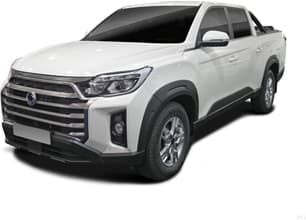
What's the difference?
What new 4x4 dual-cab ute can you buy for $50K these days? Well, if you want to stick with the major players, $50K will only get you into base-model workhorses like the Ford Ranger XL 2.0L auto ($50,880), Toyota HiLux Workmate 2.4L auto ($50,420) or Isuzu D-Max SX ($50,700). And that's list pricing before on-road costs.
However, if you’re prepared to try something different, the same money can let you drive away in the top-shelf model of KGM SsangYong’s MY25 Musso range, which is a 4x4 dual-cab ute that's bursting with luxurious standard equipment.
We recently spent a week behind the wheel to determine if its comparative bargain pricing does not come at the expense of quality or performance.
Zeekr is making waves in Australia at the moment but it's not because of the car you see before you.
Nope, it’s the 7X mid-size SUV that’s captured a heap of attention and a whole lot of sales. In fact, of the 1832 sales the brand has managed over the first three months of 2026, just 54 were for the X.
But that was the old X and this is the new one. With more power, more performance, faster charging and a whole heap of pretty special equipment, especially for the small SUV segment.
So, is that enough to finally put the X on the map?
The lack of an ANCAP rating and centre rear lap-sash seatbelt may be deal-breakers for some. However, the Musso offers a tantalising menu of luxurious standard features, in a refined, comfortable and capable package backed by a generous warranty. For $50K driveaway, it represents compelling value for money.
It's a good thing in a small package, this Zeekr X, and there are a lot of things I like about it. In fact, the only sticking point for me is the price. But that's all about perspective. If you see this as a newcomer Chinese brand, then yes, there are a lot of more affordable options out there. But if you see it as a premium player, it's really a more affordable version of a Volvo.
Note: The author, Andrew Chesterton, is a co-owner of Smart As Media, a content agency and media distribution service with a number of automotive brands among its clients. When producing content for CarsGuide, he does so in accordance with the CarsGuide Editorial Guidelines and Code of Ethics, and the views and opinions expressed in this article are solely those of the author.
The XLV option adds 110mm to the wheelbase (3210mm) and 300mm to load tub length compared to the SWB Musso, so our test vehicle's external dimensions are about the same as a Ford Ranger dual-cab ute. Even so, its 12.2-metre turning circle is tighter than the Ford and only slightly larger than its shorter Musso sibling.
It exudes a high standard of finish and build quality throughout, including the latest lower-body-to-chassis mounts with enlarged volume and a redesigned profile which, according to SsangYong results in superior bump absorption. As a result, ride comfort has been improved.
The leather-accented interior has a refined look and feel consistent with its prestige positioning, with fine exposed stitching along seams and a tasteful mix of contrasting surfaces that include different shades of grey and splashes of piano black and satin chrome.
The visual changes aren’t massive. This AWD version welcomes a couple of new exterior colours, including the 'Matt Khaki Green' of our test car. It also gets the two-tone black roof and there are new 20-inch alloy designs.
Elsewhere, it's the futuristic-style of design we’re used to which differentiates the X from its Volvo EX30 twin under the skin.
Inside, this is a seriously well-equipped and polished-feeling small SUV, and — unlike some of the newcomer brands to Australia — it all feels very high quality and well put together. And that includes the material choices.
I don’t even hate the fact that most of the functions are controlled via this screen, thanks to the little shortcuts glued to the home screen. I do, however, hate the fact that there’s no easy way to change the wing mirrors or shortcuts for toning down some of the safety stuff.
That aside, though, it’s a nice and high-quality feeling space.
With its 2100kg kerb weight and 2980kg GVM, our test vehicle has an 880kg payload rating.
It’s also rated to tow up to 3500kg of braked trailer and with its big 6480kg GCM rating (or how much it can legally carry and tow at the same time), that means it can tow its maximum trailer weight while carrying its maximum payload.
The latter is an unusual capability for a dual-cab ute of this size, which offers great versatility for heavy load-hauling requirements in both work and recreational roles.
The longer XLV load tub has square internal dimensions of 1610mm in length and width, which combined with its 570mm depth results in 1262 litres (or more than 1.2 cubic metres) of load volume. Load-anchorage points are located at floor level in each corner.
The new assisted-tailgate operation, which SsangYong claims has a soft-opening and easy-close design, also needs some beefing-up as we found the level of assistance was not sufficient.
Cabin storage includes a single glovebox, plus small and large-bottle holders and a storage bin in each front door. The centre console has a small tray up front, two small-bottle/cup-holders in the centre and a storage box at the back with a padded lid that doubles as a comfortable driver’s elbow rest.
Rear seat passengers also get a small-bottle/cup-holder and storage bin in each door, plus two cup-holders in the fold-down centre armrest and storage pouches on each front seat backrest. The rear bench seat-base cannot be swung up and stored vertically to create more internal carrying space, like some rivals, but it does provide hidden storage underneath for soft items.
The Musso's rear doors are only 50mm shorter than the front, which ensures easy entry/exit and comfortable rear seating, even for people my height (186cm).
There are large assist handles on the A and B pillars and, when I'm seated in the second row behind the driver’s seat in my position, there’s still sufficient knee clearance and plenty of headroom.
This also applies to those seated in the slightly higher centre position, where they’ll also appreciate the minimal height of the transmission hump that allows both feet to sit together behind the centre console.
However, like all dual-cab utes short of a full-size US pick-up, shoulder room for three adults across the back seat is marginal and only tolerable for short trips.
Our only gripes are the lack of a lap-sash seatbelt for the centre rear passenger (there’s only a lap-belt), which remains a glaring safety omission that should have been addressed years ago.
You know you're in a small vehicle when you can't fit two large (not those crazy American-style jumbo cups, just normal coffee-shop takeaway) coffees in the cupholders, but so it is with the Zeekr X.
The small SUV's 4432mm length, 1836mm in width and 1566mm height doesn't leave much room to spread out up front. There's ample room for driver and passenger, of course, but we are talking about a small vehicle here.
Clever storage helps to mitigate that, though, especially the super-deep storage space in the centre console and the very clever fridge that separates the driver and passenger seats.
Weirdly, though, the space doesn’t feel overly tight in the back seat. We had a massive baby seat in there, and that fit without issue. And full size humans can genuinely get pretty comfortable. I'm 175cm, and I had enough knee and headroom.
In the boot, there’s 404 litres of volume with the rear seats upright and 1247 litres with them folded flat. And it’s worth pointing out this isn’t intended to be a family car, but there’s certainly enough space for the shopping... and a pram.
Our test vehicle is the Musso XLV Ultimate Luxury Pack, which comes standard with the same 2.2-litre four-cylinder turbo-diesel and six-speed automatic transmission shared by other Musso models, for only $50,500 drive-away or $49,500 drive-away for ABN holders.
Our example also has the Indian Red metallic paint option, which adds another $595 to the price.
The list of standard Ultimate features (before you add the Luxury Pack) is impressive, starting with 18-inch black alloy wheels with 255/60R18 tyres and a full-size alloy spare. There's also HID headlights, LED daytime running lights and new vertical LED front fog lights, front and rear parking sensors, 360-degree ‘birds-eye’ and reversing cameras, heated door mirrors and assisted tailgate operation.
There's more luxury in touch-sensing front door locks and a walk-up welcome system that ensures the door mirrors unfold and puddle lamps illuminate as the driver approaches with the keys. Likewise, as the driver moves away from the vehicle, the doors and tailgate lock automatically.
The Luxury Pack adds a new dual-zone climate control hub with full touchscreen control, powered sunroof and premium leather seating, with powered front buckets that offer heating/cooling and adjustable lumbar support/base cushion rake. The outer rear seating positions are also heated.
This is in addition to a height/reach-adjustable and heated leather-rimmed steering wheel with multi-function controls, 12.3-inch digital LCD driver’s instrument cluster and 12.3-inch touchscreen for the six-speaker multimedia system with Apple CarPlay/Android Auto connectivity, two USB-C ports and two 12-volt sockets. And there’s more, so you could say it’s fully loaded even before you put something in the tub.
This is a small SUV with a LOT of stuff. There are two trims in the Zeekr X range – the entry-level rear-drive model is $48,900, drive-away, while the all-wheel drive version we've tested is $57,900 on the road.
The obvious comparison is to the Volvo EX30, which shares its platform with the Zeekr X through both brands' Chinese parent company Geely.
As of right now, the cheapest single-motor Volvo is $56,051, drive-away in NSW, or $49,990 plus on-roads, making the Zeekr version much, much cheaper.
Anyway, outside there are 19- or 20-inch alloys, though our test car is fitted with the optional 20-inch black alloys, paired with a black-with-red-highlights interior treatment, which adds $2000 to the price.
Ours is also fitted with the electric front doors which open or close at the push of a button, and back doors that unlatch, but don’t fully open, the same way, which adds another $2000.
Both trims also get heated and cooled front seats, and heating in the rear window seats, but this AWD version also adds a massage function for front seat riders.
There’s also wireless charging, a 13-speaker Yamaha sound system and — very cool, literally — is the little drinks fridge between the front seats in the AWD variant.
Tech is handled by a 14.6-inch touchscreen with Apple CarPlay and Android Auto and there’s a head-up display for the driver.
The quiet and refined 2.2-litre inline four-cylinder turbo-diesel produces 133kW at 4000rpm and (for the XLV) 420Nm of torque between 1600-2600rpm.
The smooth-shifting Aisin six-speed torque converter automatic provides the option of sequential manual shifting, plus three drive modes comprising Eco, Power and Winter. It also has overdrive on the fifth and sixth gears for fuel-efficient highway driving.
The part-time, dual-range 4x4 drivetrain has an auto-locking rear differential that automatically locks and unlocks in response to changing traction requirements.
The big news here is a more powerful rear motor – meaning you get more grunt whether you opt for the rear-wheel drive or this all-wheel drive.
In rear-drive form, that boosts your outputs from 200kW to 250kW, dropping the sprint to 100km/h to 5.6 seconds. In AWD guise, your new outputs are 365kW (up from 315kW) and 573Nm, and your sprint to 100km/h falls to 3.7 seconds.
KGM SsangYong claims a combined average consumption of 9.0 litres per 100 kilometres and the dash readout was showing 10.1 at the end of our 317km test, which comprised the usual mix of suburban, city and highway driving.
Our own figure, calculated from fuel bowser and tripmeter readings, was higher again at 11.0 which, while not the thriftiest we've tested, is still not bad for a ute weighing more than two tonnes in mostly urban driving, of which about one third of our test distance was hauling a near-maximum payload.
So, based on our figures, you could expect a ‘real world’ driving range of around 680km from its 75-litre tank.
This is where it starts to get weird. The rear-drive Zeekr X is fitted with a 61kWh LFP battery, which can accept up to 230kW DC fast charging, taking you from 10 to 80 per cent charged in just 18 minutes. Total claimed range is 405km.
The flagship AWD, though, charges at a slower rate. It gets a 66kWh NMN battery and can only be charged at 150kW, meaning the same charge takes 30 minutes. Zeekr is promising a 415km driving range between charges.
Drivers of most heights and widths can find a comfortable driving position, thanks to a combination of multiple powered seat adjustments, a height/reach adjustable steering wheel, nicely-positioned elbow rests on either side and a large left footrest ideal for big Aussie boots.
The turbo-diesel’s 1000rpm-wide peak torque band between 1600-2600rpm, combined with well-matched ratios in the six-speed auto, ensure good response in the 40-80km/h speed range often encountered during city and suburban driving. However, we could not detect a noticeable change in response when switching between the Eco and Power drive modes.
The unladen ride quality is commendable, given its supple four-coil suspension and longer XLV wheelbase. Combined with nicely-weighted speed-sensitive steering (light at parking speeds, firmer at highway speeds) and responsive braking, it’s enjoyable to drive in urban environments.
It also has impressively low engine, tyre and wind noise, particularly at highway speeds where the refined drivetrain only needs 1700rpm to maintain 110km/h. These attributes create a pleasant cabin environment and low-stressed cruising.
We forklifted 650kg into the load tub, which with our crew of two equalled an 830kg payload that was only 50kg less than its 880kg legal limit. The rear coil springs compressed 70mm, which allowed the rear axle to engage with large cone-shaped jounce rubbers mounted on the chassis rails above it.
These rubbers not only provide a second stage of support when hauling heavy payloads, but also eliminate the jarring thuds of traditional hard-nosed rubber bump-stops when the suspension uses up all its travel.
The Musso made light work of hauling this payload up our 13 per cent gradient, 2.0km set climb at 60km/h, self-shifting back to third gear and 2500rpm to easily reach the summit.
Engine braking on the way down, in a manually selected second gear, wasn’t as strong as the auto transmission over rode our manual selection when the engine reached 3700rpm on overrun (4500rpm redline) and shifted up to third gear.
These engine-protecting measures are increasingly common in utes and vans, which can spring a surprise when you’re leaning on the engine to assist with braking on a steep descent and the auto suddenly shifts up a gear and the vehicle starts running away from you.
Even so, the Musso’s quartet of disc brakes were more than capable of keeping speeds in check for the remainder of the descent.
Short answer? Pretty good, with some caveats.
I'm partial to a firmer ride. I find some Chinese car companies can feel like they get their suspension bits from Captain Snooze, such is the soft, pillowy ride served up. And to be honest, it makes me a little seasick at times.
The Zeekr is not like that. It has firmness dialled into the ride equation and can feel harsh at times, but also improves the drive experience, delivering connection and engagement at the cost of some sharpness on the wrong road.
It's also faster than the model it replaces, but it's also one of those cars in which the real-life feeling doesn't quite match the on-paper promise.
This thing serves up supercar speed, but it doesn't feel like it from behind the wheel. Instead, the acceleration - especially from a rolling start - feels potent, but not biblical.
From a standing start it pauses for a moment, almost like an internal-combustion vehicle might, before delivering a quick (but not stratospheric) flow of power. None of that is a bad thing, by the way. Who wants their small SUV to accelerate like a supercar?
It's otherwise an entirely pleasant drive. The cabin is serene and quiet and it's a small car that doesn't feel like one. There's nothing light or tinny about the drive experience, instead there's a heft and quality.
No ANCAP rating but the active safety menu includes auto emergency braking (AEB), front collision and lane-departure warnings, trailer sway control, blind-spot monitoring, rear cross-traffic alert, front/rear parking sensors plus 360-degree/reversing cameras and more. There’s also driver and front passenger front and side (thorax) airbags plus curtain airbag protection for both rows of seating, along with three top-tethers and two ISOFIX child seat-anchorage points for the rear seat.
The Zeekr X wears a maximum five-star ANCAP safety rating, earned in 2024, which means the long list of required active safety stuff is present and accounted for, all wrapped up in what Zeekr calls its 'Intelligent Driving Assist System'.
There are five cameras, five radars and 12 sensors, which is a crazy number for a car this small.
And this is also not a car in which I was desperately trying to figure out how to deactivate any of the active safety systems – save the overzealous over-speed warning – which is a win these days, too.
There are also seven airbags, including a centre front airbag.
The Zeekr X is fitted with ISOFIX anchors on the rear outboard seats and top tether anchorages for all rear seating positions.
It comes with a seven-year/unlimited kilometre warranty, which includes commercial use (which SsangYong claims is a unique offering in this segment) and seven years roadside assist.
Scheduled service intervals are 12 months/15,000km. Capped price for the first seven scheduled services up to seven years/105,000km totals $3238, or a reasonable average of $463 per year.
Zeekr's coverage is an underwhelming five-year, unlimited-kilometres, while the drive battery is covered for eight-years or 160,000km. There’s five years' of roadside assistance thrown in, too.
Service intervals are 20,000km or 12 months, with five years' of ownership setting you back a hefty $3072; an average of $614 per workshop visit.
There are currently 16 Zeekr dealers in Australia - two of which are 'pop-up' sites rather than full retail centres.
Multiple locations in Melbourne, Sydney and Brisbane with the ACT, Adelaide and Perth also covered. Others include Geelong and the Sunshine Coast but so far you're out of luck in Tassie or the NT.