What's the difference?
If a Jaguar owner fell through a wormhole from 2003, the company they bought their car from would be almost unrecognisable. Back then, it was a bewildering mess making an odd assortment of cars, yet to emerge into the light after Ford's confused and debilitating period of ownership.
Why 2003? Fifteen years is a nice round number and pre-dates the arrival of the brand-saving XF.
Today, Jaguar has three SUVs, and the gorgeous F-Type, the XE, its second-generation XF and the big XJ. It has three SUVs (the F-Pace, E-Pace and I-Pace) because without them Jaguar would be a niche manufacturer before long, because big sedans, formerly the brand's trademark, are continuing their gentle decline. Oddly enough, one of the market segments contracting even faster than sedans is wagons.
So what better time to launch into a draining pool from the three-metre board than now? Jaguar has bravely taken that risk and brought us the puzzlingly named XF Sportbrake.
Some of my favourite television shows or movies are flawed. When I talk to people about those films and about those flaws, there's a pattern - they don't know what they are and are therefore a bit confused. I don't know why that appeals to me, it just does.
Cars can be like that. There are some cars that aren't sure what they are. One of the exemplars of this is the Toyota C-HR - a small SUV aimed at young get-up-and-go types but bought almost exclusively by baby boomers, attracted to the badge. Young folks want more performance, lower cost and Apple CarPlay.
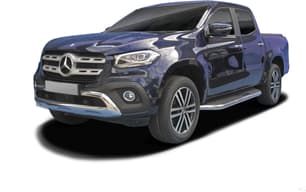
Hindsight suggests that the less-than-stellar sales performance of the much-heralded Mercedes ute, the X-Class, might be down to confusion. Mercedes thought it would be one thing and it turns out the market thinks it's another.
With that iron fist wrapped in a velvet glove wrapped in bubble wrap engine, excellent ride and gorgeous looks, the XF Sportbrake ticks all the boxes. Apart from the entry price and options prices, there are few objective reasons not to buy the car. It's just as good as any of its German competition and arguably the prettiest of the lot.
Should Jaguar have taken the dive? Given the XF Sportbrake is a luxury wagon done right, yes.
The X was an opportunistic shot at a market segment new to Benz. With even apprentices able to afford to buy a well-specced Hilux, it's become harder to separate the foreman from the kids. I, like Mercedes, thought this would be the boss's car. Mercedes saw the gap and went for it, thinking it could grab sales from top end utes from VW, Toyota and Ford, while maybe saving a few folks from buying a RAM or an F150.
The problem is, the target market knows its utes. And in a rough-and-tumble workplace, the perception is that if you've spent up big on this Merc, you've actually just paid too much for a Nissan Navara. Still, like those flawed movies I enjoy, the X-Class is a fine thing - and I don't blame Mercedes for trying. It just costs too much, and yet isn't Mercedes enough to justify that price.
The second-generation XF is a very pretty car. A few carmakers have a had a crack at that four-door coupe idea, but Jaguar's Ian Callum got it right first go. You might expect the wagon to be a bit dumpy but it's far from it. That's not to say wagons can't be good looking - many are better-looking than the car they're based on (the weirdly proportioned Golf wagon being the exception to the rule). The XF sedan just looks right.
Anyway, the Sportbrake is basically the same until behind the B-pillar, with the roof continuing on to steeply raked tailgate glass. Obviously the lights are different back there but it's a nicely integrated job, it doesn't look like a dodgy extension. Rolling on the optional 20-inch wheels it looks amazing - low, long and well-proportioned. Unfortunately, it's more than vaguely hearse-like in black (the only First Edition colour).
Inside is standard XF, with the obvious exception of the rear seats and the big open load area. With this First Edition's glass roof the cabin seems infinite. Either way it's big and comfortable, although fit and finish could be a bit tighter.
Despite being a Japanese ute in drag, the X-Class isn't immediately rumbled as resembling a Nissan, which certainly should count in its favour. Everyone who asked about it had little idea it wasn't a Daimler from the ground up, until you pointed out various details. Up here in the higher reaches, it's a really quality-looking thing, with beautiful paint and enough differentiation to make it look like a Merc. The headlights do seem a tad small next to the rest of the Mercedes range, but the whopping great three-pointed star in the grille leaves no one in doubt.
It's fairly tasteful in silver, too, and with a few carefully chosen options it looks pretty tough.
Once you're inside you see where it starts to get confused about itself. The hard, scratchy plastic dash pokes out from behind a huge slab of metallic trim. The centre console is clearly a brother from another mother, as is the overall dash layout. The cabin lacks the thoughtfulness and quality of a Mercedes design - you can't just slap on those signature air vents and expect to get away with it. Every piece that comes from Mercedes appears glued on, and it's jarring.
This might have been less of an issue if the car was significantly cheaper and not likely to be purchased by people who are familiar with the brand.
Front and rear passengers enjoy plenty of space. Storage includes a not-quite-big-enough-for-a-phone tray ahead of the rotary dial gear selector and a pair of cupholders. Those in the rear have plenty of space, except for the middle seat occupant who must straddle a stout transmission tunnel. The rear armrest holds a pair of cupholders and the doors have slim pockets.
The boot holds 565 litres with the seats in place and "up to" 1700 litres with the seats down - that latter figure does not feel like a VDA number.
I really can't imagine how anyone signed off on the most annoying features of the X. Front-seat passengers get a solitary, shallow cupholder (the second one is unusable), and big door bins that could hold a bottle if you didn't mind it getting smashed from sliding around (they're unlined), and nowhere to put your phone. Like, nowhere, except maybe the glove box. Even the centre console bin is shallow and not much good for anything, apart from as an armrest.
The front seats are reasonably comfortable but the rears are way too high (in the name of a better view) and rammed hard against the rear bulkhead. The rear doors are also pretty narrow, so entry and egress can be a bit of a challenge if you're large or toddler small. Once you're in the seats, legroom is limited and headroom marginal. At least you get air-conditioning vents, but you don't get an armrest in the rear. On a nearly $80,000 ute. Even the dark-ages Colorado has one of those.
Anyway, that's enough said about the interior flaws.
The tray is a big boy, but it's worth knowing that the roller cover does rob a bit of space, as it does on any ute. The optional tray liner looks good and with Mercedes-Benz stamped in it, reminds you again what you've got. All told, it's 1581mm long, 1560mm wide (1215mm between the wheelarches) and you can load up nearly a tonne of people and things into the X350. You can also tow a massive 3500kg braked and still be able to carry a payload of 490kg. Gross vehicle mass is 3250kg (tare is 2190kg).
Over the years the XF has edged its way upmarket and is now playing with the Germans in the big luxury segment. And as is now customary for Jaguar, the Sportbrake is available in First Edition guise. First Editions are available for a model's first year of production and are usually based on the top-spec (in the Sportbrake's case, that's the 30d S) with a few extra bits and pieces to make things interesting.
While the 30d S retails for $123,450, the FE weighs in at $137,300. For that you'll waft out of the showroom with 19-inch alloys, dual-zone climate control, a huge panoramic glass roof with gesture-activated roof blind, around-view camera, front and rear parking sensors, 11-speaker Meridian-branded stereo with DAB, sat nav, head-up display, electric gesture-activated tailgate, keyless entry and start, rear air suspension, auto LED headlights, auto wipers, leather trim and a space-saver spare.
Jaguar Land Rover's 'InControl' media system is presented on a whopping 12.3-inch screen and, as ever, is steadily improving but goes without Apple CarPlay and Android Auto. The sound is, as you might expect, pretty good.
Our car had a few options fitted. 'Active Safety Pack' (see below), carbon-fibre trim ($3470), driver and passenger memory pack ($3210, including perforated leather trim), 20-inch wheels upgrade ($2790), cold-climate pack ($2540), illuminated metal treadplates ($2110), privacy glass ($950), 'InControl Protect' ($630), configurable interior lighting ($540), nets and rails ($390 and $320 respectively), extra power socket ($240) and 'InControl Apps' ($100). Most of it is cosmetic and/or unnecessary and took us to $158,950.
And there is still a plethora of boxes to tick.
The X-Class range starts at the $45,450 X220D manual dual-cab and reaches all the way to the $87,500 X350d Edition 1. One step back from that is the $79,415 X350d Power dual-cab with all-wheel drive. That nets you 19-inch alloy wheels, an eight-speaker stereo, climate control, around view camera, reversing camera, keyless entry and start, front and rear parking sensors, electric front seats, sat nav, auto LED headlights, fake-leather interior, heated and folding rear vision mirrors, power windows and a full-size alloy spare.
An 8.0-inch screen hosts Mercedes COMAND system, complete with rotary dial and the weird scratchpad. COMAND is not as good as its German rivals and for some reason doesn't have Apple CarPlay and/or Android Auto, which is a mammoth oversight for a car of this type and cost.
Our car also had the lockable roll cover for $3295, the $1551 styling bar, a tow bar ($836) and, presumably, tow-bar wiring ($462).
The First Edition ships with Jaguar's 3.0-litre twin-turbo diesel V6. Good for 221kW and a prodigious 700Nm, power heads to the rear wheels via an eight-speed ZF automatic.
With all that power and torque, the XF Sportbrake cracks 100km/h from rest in 6.6 seconds.
The air suspension means you can tow up to 2000kg with a braked trailer.
The X350d has something very Mercedes about it - the engine and transmission package. With 3.5-litres of turbo-diesel V6, you get 190kW at 3400rpm and a thumping 550Nm between 1400 and 3200rpm. These kind of figures at least put it up there with the brawnier VW Amarok.
Feeding the power to all four wheels is Mercedes' own seven-speed automatic. A centre diff apportions power front to rear and you have a choice of three modes - automatic, high range and low-range.
Jaguar claims a combined-cycle figure of 5.9L/100km. Our time with it was mostly shuttling around the suburbs with a couple of highway runs and we managed a respectable 8.3L/100km.
The X350d did pretty well in the week I had it - the official figure of 8.8L/100km was never going to happen but with a long motorway run to the Blue Mountains and the rest bashing about town, the 10.5L/100km I did achieve without trying was not bad at all. The 80-litre tank should give you a decent range of 750km, or thereabouts.
There's no getting away from the size and heft of the Sportbrake. Where a four-cylinder sedan comes in under 1600kg - not bad for an almost five-metre-long car - up here at the top it's well over 1800kg. With big wheels and a long wheelbase it's not going to win any wards for manoeuvrability, with a big turning circle and a length that's challenging to shopping centre car parks.
The 3.0 V6 twin-turbo is a fantastic unit. It can be a bit noisy when cold but it's super smooth and with all that torque it crushes overtaking with little need for advanced planning. The Sportbrake wafts along, lazily turning over in traffic and keeping the vibe calm.
Despite those big wheels, the ride is excellent. Even when in Sport mode, it's a rare bump or surface that will cause drama. It's very comfortable and very quiet, almost to the level of the XJ limo.
If you do fancy a bit of amusement, the V6 and well-sorted chassis are ready to play. In reality, Sport mode is where both myself and my wife left the car the whole time we had it. Both of us found the steering a little too light and preferred the more lively throttle response. The XF features torque vectoring using the brakes and coupled with a well-judged stability and traction control system, it delivers a good impression of a sporty sedan.
But the XF is best when you keep it relaxed. Both in town and in the cruise, it's a lovely, quiet place to be and a relaxing, undemanding drive.
Only a couple of things were annoying - the light steering we've already covered. The heated windscreen was more reflection-prone so the head-up display could be hard to see in some lighting conditions. And sometimes it beeped for no apparent reason, which I eventually traced to the blind-spot warning.
One of the weirder things to make it into the X-Class is the world's second most irritating column stalk, which is asked to pack in indicators, headlights and wipers. Thankfully, the world's most irritating column stalk, the Mercedes automatic shifter, wasn't inflicted on the X-Class. But the obvious problem is the key, which clearly isn't a Mercedes unit - even the star is ill-fitting and will probably fall off after a while. This is not a premium experience.
Thankfully, the big turbo-diesel wipes away a lot of the complaints about this car not being Mercedes enough. Brawny and super quiet (twin balance shafts will do that), the X is a very easy car to live with. While not especially lively, it's easygoing in the city and very refined.
On the open road it cruises almost silently and the ride is way above what you might expect from an unloaded tradie-mobile. It doesn't feel as high as some utes, which makes it feel a bit more car-like, and will no doubt appeal to some who might have to swap in and out of a traditional SUV and into the X, for whatever reason.
It is by far the most civilised ute I've ever driven and was worlds away from the Colorado I drove last week, to the point where I could almost - almost - see a justification for the unbelievably hefty price tag.
Credit for the refined ride and handling goes to the coil-spring rear end, much maligned in some quarters. While that style of suspension is not the ultimate in load-lugging, it's way more comfortable for passengers and, given the likely buyer profile, probably more agreeable than a cart-sprung rear-end.
I would cheerfully drive long distances in the X and it feels like it could go anywhere.
The XF comes with six airbags, ABS, stability and traction controls, forward AEB, reversing camera, lane-departure warning, and tyre-pressure monitoring.
For child seats you've a choice of three top-tether anchors or two ISOFIX points.
Our car had the $4360 Active Safety Pack, which adds blind-spot monitoring, reverse cross traffic alert, lane-keep assist, adaptive cruise and driver-attention detection. If you were to ask me, this little lot should be standard at this level.
Despite that, the XF scored a maximum five ANCAP stars following assessment in 2015.
The Mercedes-Benz finally starts to puts its nose ahead of its competitors on the safety front.
The X350d has seven airbags, ABS, stability and traction controls, forward collision warning, low speed forward AEB, pedestrian detection, lane-keep assist and around-view cameras, trailer-sway control and hill-descent control.
It also has three top-tether and two ISOFIX points.
Its five-star ANCAP safety rating was awarded in 2017.
Jaguars are offered with a three-year/100,000km warranty with a matching roadside-assist package. You can purchase a five-year/130,000km service plan for an oddly reasonable $2200. Even more reasonable are the service intervals - 12 months or 26,000km (!).
Mercedes offers a three year/200,000km warranty for the X, which isn't too bad. It also throws in roadside assist for the duration. Also worthy are the 12 month/20,000km service intervals.
A basic capped-price service scheme will hit you for $1950 (pre-paid) or $2,555 if you pay when you front up for each of the three services covered. The servicing isn't super-cheap, as you can see, but at least you know what you're up for.