What's the difference?
Isuzu’s 3.0-litre MU-X has attracted plenty of fans over the years – and for good reason: it’s a seven-seat 4WD wagon packed with features, driver-assist tech and it has a decent 4WD set-up including a recalibrated rough terrain mode.
But the Japanese brand's 1.9-litre experiment has now officially ended – it’s a Gary-goner. So, for this test I’m driving its replacement: the 2.2L MU-X. This 4WD wagon has a, you guessed it, 2.2-litre engine – offering better claimed fuel consumption than the 3.0L, as well as an eight-speed automatic transmission and idle stop-start technology. And this MU-X has the same 3.5 tonne towing capacity as the 3.0-litre version, that’s 500kg more than the outgoing 1.9L MU-X.
So, how does this new 2.2L MU-X perform off-road? And does it make more sense as an adventure wagon than its 3.0L stablemate?
Read on.
The BMW 7 Series is Munich’s flagship, the car that fans of the blue and white roundel respect as peak plush motoring.
Now, for the seventh 7 Series, BMW has brought electric power to the table in the form of the i7 in order to stay ahead of the curve.
It’s still joined by a petrol-powered variant here in Australia, the 740i, which is a mild hybrid and shares a lot of the luxury specifications of the i7 - including a properly impressive rear seat theatre screen.
But is it forward-thinking enough to fend off the likes of the Mercedes EQS?
The MU-X has plenty of appeal as a daily driver – dependable and it’s a proven 4WD wagon.
Does the 2.2-litre engine add anything substantial to the mix?
Well, it's better than the 1.9-litre, that's for sure, and there's a lot to like about this MU-X in terms of its off-road capability, driver-assist tech, standard features and all-round driveability. And, while the LS-T lacks the top-shelf polish of the X-Terrain, it’s still an appealing potential purchase.
But the 3.0-litre option is better because while the 2.2L is very effective off-road and general day-to-day driving, it lacks grunt and has to work that much harder and is that much noisier under load than the 3.0-litre in most driving scenarios, including 4WDing.
While the new 7 Series won’t visually appeal to everyone, nor is it at the forefront of spirited driving dynamics, it’s hard to argue that it isn’t fit for purpose.
Its rear theatre screen and lounge layout might seem gimmicky at first, but it’s difficult to think of a more comfortable way to be transported on wheels short of putting a chassis under your loungeroom. Even then, you’d have to ask someone for a massage.
This is one of those cases where a car becoming larger isn’t such a bad thing, and BMW should feel like it’s achieved, seemingly, what it set out to do in building an electric limousine that doesn’t fall short in range or dynamics.
If BMW can bring this level of refinement down to its more affordable models, its electric future is looking promising.
Note: CarsGuide attended this event as a guest of the manufacturer, with meals provided.
In terms of appearance, the MU-X remains largely unchanged from the most recent iteration. And that’s a good thing. It’s blocky enough to be recognisable but sleek enough to remain inoffensive. Worth noting the door handles, window trims, front fender accents, roof rails, and side steps on the LS-T are gloss black.
Inside, nothing much has changed (other than a newly-introduced idle start/stop button) and, as such, the MU-X retains a low-key familiarity that makes it a comfortable space. Generally, design-wise, the MU-X more than holds its own against the likes of the Toyota LandCruiser Prado and Ford Everest.
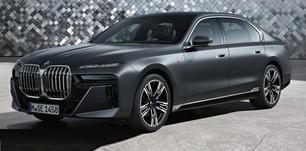
BMW freely calls the new 7 Series “monolithic” in its press material, and it’s hard to argue. The seventh-generation of its luxo limo is bigger in every dimension, and with a higher bonnet and bootlid, the car is convincingly imposing even when parked. Even more so in black.
From the front, the 7 Series clearly has a new face compared to its predecessor, with split headlights now an indicator of BMW’s luxury oriented models - the incoming XM SUV features the same.
Its LED daytime running lights feature Swarovski crystals, while the grille surround illuminates while the vehicle is parked and on. It’s currently unable to be illuminated while driving to comply with Australia’s laws.
It’s perhaps less elegant and more aggressive than previous generations, but that doesn’t mean there won’t be those who approve. It’s certainly emotive, especially when compared to the side and rear of the car.
The side profile of the 7 requires quite a few steps back from the car to really take in - it’s almost 5.4 metres long - though it's hard to hide the size of a car that allows its rear passengers to almost lay down.
From the rear, the 7 Series is probably at its most uninspiring, which is a reverse from the interior where the front feels more minimalistic than some of its rivals like the Mercedes-Benz S-Class.
BMW has used crystalline geometric shapes throughout the cabin, and the front ‘interaction bar’ is perhaps the best example.
In keeping with the minimalism, its screen sits in an almost freestanding style out from the dash, with no physical buttons seen around it.
The interior has a familiar and practical feel about it and the cabin is an easy space in which to become comfortable. Controls are easy to locate and operate and charging options are numerous – a mix of USB-A, USB-C (front and second row) and 12V.
Storage places include recesses for the bits and pieces from your pockets, a deep-ish centre console, as well as dual cupholders up front, cupholders in the rear fold-down centre armrest and bottle holders in the doors. There are also cupholders either side of the third row.
The MU-X has physical-button options to activate some functions (including to switch on the audio system, to adjust volume and access sat nav).
Seats are comfortable and supportive through all three rows – yes, even the third row is roomy enough to prevent whining from whoever is back there.
My camera guru/photographer/sergeant-at-arms, Glen Sullivan, reminded me that the third-row seats don’t have ISOFIX or top-tether points for child seats. Thanks, mate.
The cargo area is 311 litres with all three rows in use, 1119L with the third row flat and 2138L with the second and third rows stowed away.
The rear cargo area has a cargo cover, tie-down points, a 12V power outlet, a storage space under the rear cargo area floor and a space for tools inside the driver’s side rear cargo wall. The MU-X’s full-size spare (bravo!) is attached to its undercarriage.
If the word ‘practicality’ brings to mind simplicity, the 7 Series might require you to have a bit of a mental reset. If it means plenty of space and a long list of elements to keep you comfortable, you’d be closer to the money.
While it’s visually restrained in some ways, the space accessible to the driver is thought out reasonably well, as you’d expect from a car costing more than a quarter-million.
The front seats certainly aren’t the main event, but the Merino leather and cashmere wool combination seats are far from uncomfortable, with the heating, cooling, and massage functions accessible from the central multimedia screen.
The controls for those, as well as functions like the climate control, are easily accessible, though could probably be even easier with a physical climate control panel.
Controls for the individual vents, and even the glovebox are found along the BMW interaction bar, which can (frustratingly) reflect light thanks to its crystalline design, meaning it’s hard to see while driving on a sunny day.
Similarly, while the centre console where the main control dial for BMW’s 'iDrive' isn’t far removed from previous versions, it’s less tactile and requires a look sometimes to see what’s being pressed. Here, too, sunlight can reflect (this time off the dial) and make it more distracting.
Fortunately, the steering wheel controls remain physical buttons, and they’re laid out in a way that previous BMW owners or drivers will find familiar.
The 7 Series also now leans more heavily on voice activation, so if the lack of physical climate controls or the multimedia screen is a little distracting, much can be achieved by actually asking the car with a “hey, BMW… ”.
There’s a large storage unit in the centre console, as well as two cupholders and a phone charging platform in front of the multimedia controls.
The rear seats, especially the one behind the front passenger, are where the 7 Series begins to feel its worth. If you’re buying one with the intention of being the driver 100 per cent of the time, you’re missing a trick.
The ability for the front passenger seat to shift forward and maximise legroom while the rear seat reclines into a lounge position is nothing new, limousine sedans have been able to do this for years, but the 7 Series takes it to another level.
Not only is there plenty of space for even the tallest of humans to stretch out, but the positioning and angle of the huge 31.3-inch theatre screen is great, even if it impedes the driver’s rear view, and the ability to use it as a touchscreen for some functions means less need for the handy but sometimes fiddly door-mounted control screen.
If you plan on playing games, the controls (and the fact you’re likely in a moving car) can make it a little difficult, but the small control panel is overall easy to use and well-placed.
The cushioned armrest that folds down in place of a middle passenger is comfortable, features a phone charging pad and pop-out cupholders, as well as a storage space under the armrest.
Finally, the boot space in the BMW 7 Series is far from small, with the electric i7 offering 500 litres (VDA) of space, while the 740i boasts 540 litres thanks to its lack of battery.
The new MU-X with a 2.2-litre, four-cylinder, turbo-diesel engine is available with a 4×2 or 4×4 drivetrain in several variants. Don’t worry, the 3.0-litre is still in the line-up.
Our test vehicle has the 2.2L and, it is priced at $71,400 before on-road costs.
Standard features include a 9.0-inch multimedia touchscreen system with sat-nav, wireless Apple CarPlay and Android Auto, an eight-speaker sound system, eight-way power-adjustable driver’s seat (four-way power-adjustable front passenger seat), heated front seats, a 7.0-inch driver display and 20-inch alloy wheels shod won 265/60R20 Bridgestone 684II HT tyres.
It also has white ambient interior lighting, remote engine start, rear privacy glass, power-folding and heated door mirrors (with side cameras) finished in gloss black, and leather-accented upholstery with grey stitching and synthetic leather on the door trims and centre console.
Exterior paint choices on the MU-X LS-T include 'Mineral White', 'Basalt Black mica', 'Moonstone White pearl', 'Magnetic Red mica', 'Neptune Blue mica', 'Mercury Silver metallic', and 'Obsidian Grey mica'. Anything other than standard Mineral White costs an extra $695.
Given we’re in the realm of models where the price difference between two variants could pay for an entire new city car, what value means shifts a little bit.
The BMW 7 Series comes in two variants for the seventh generation, starting at $268,900 for the petrol-powered 740i, and $297,900 for the electric i7.
Previously, it was possible to get into the BMW 740i for $198,900 after BMW lowered the price of the sixth generation car.
However, the new 7 Series is larger and has more packed into it, with both variants highly specified and mostly differing in price due to their drivetrains and some more minor creature comforts.
The 740i starts with an already impressive list of standard features, with 20-inch M alloy wheels, remote start, a tyre pressure monitor, rear-wheel steering, 'crystal' headlights and an illuminated grille surround, a panoramic glass roof, heated seats and a massage seat for the driver with Merino leather, a 20-speaker Bowers & Wilkins sound system, as well the option to select the M Sport or M Sport Pro pack at no extra cost.
The more expensive i7 xDrive60 gains, on top of that, 21-inch wheels, active roll stabilisation, automatic opening and closing doors, multifunction seats with heating, cooling, and massage in the rear, plus a 39-speaker sound system and the impressive 31.3-inch theatre screen.
The i7 also comes with a BMW third-gen wallbox, home and public charging cables, and a five-year ChargeFox subscription. It also gains a six-year service package over the five included with the 740i.
If the i7’s extra features are tempting, but its drivetrain isn’t, 740i buyers can opt for a 'Connoisseur Lounge' pack for $27,900 which adds the auto doors, multifunction seats, rear theatre screen, and a 40-speaker sound system.
This MU-X has a 2.2-litre, four-cylinder, turbo-diesel engine, producing 120kW at 3600rpm and 400Nm between 1600-2400rpm and it’s matched to an eight-speed automatic transmission.
Worth noting the 3.0L MU-X has a six-speed auto and produces 140kW (at 3600rpm) and 450Nm (1600-2600rpm) while the outgoing 1.9L MU-X has a six-speed auto and produces 110kW (3600rpm) and 350Nm (1800-2600rpm).
While the 3.0-litre has always been unstressed in most driving scenarios – even low-range 4WDing – the 2.2-litre feels underpowered. More about that in the ‘Driving’ section below.
The MU-X has a part-time 4WD system which includes a dual-range transfer case (with high- and low-range 4WD) and a rear diff-lock. The driver is able to shift from 2H (two-wheel drive, high-range) to 4H (4WD high-range) while on the move up to speeds of 100km/h. The diff-lock may only be engaged when the vehicle is in 4L (4WD low-range).
The MU-X also has a switchable terrain mode system which tweaks the engine, transmission and traction control to suit the driving conditions. 'Rough Terrain' mode, like a steroids-enhanced off-road traction control, is king of these modes when you’re off the bitumin.
The BMW 740i is powered by a 3.0-litre turbocharged in-line six-cylinder petrol engine, as is the way with many of BMW’s larger cars. It’s also a mild hybrid, incorporating a 48-volt electric starter/motor combination.
The 740i makes 280kW between 5200-6250rpm, and 520Nm between 1850-5000rpm, which is transferred to the rear wheels via an eight-speed automatic transmission.
The electric i7 xDrive60 is the flagship model, with its dual-motor all-wheel drive powertrain good for 400kW and 745Nm, allowing for a claimed 0-100km/h time of 4.7 seconds - 0.7s faster than the 740i.
Official combined cycle (urban/extra-urban) fuel consumption for this MU-X is 6.7L/100km. The 1.9L MU-X offers 7.4L/100km while the 3.0L offers 7.6L/100km.
Actual fuel consumption on this test was 8.7L/100km.
The MU-X has an 80-litre fuel tank, so, going by that on-test fuel consumption figure, you should be able to get a driving range of about 920km. But remember, your fuel consumption may be completely different to mine because chances are you'll have friends, family pets, sporting equipment, camping gear, the whole kit and caboodle on board. I've only been carrying vehicle recovery gear, MaxTrax, and a first-aid kit, so I haven't had a huge amount of weight on board.
BMW Australia hasn’t yet specified local figures for fuel consumption or energy efficiency for either variant of the 7 Series at the time of our review, but the international specifications for both i7 xDrive60 and 740i give a relatively accurate guide.
BMW claims the electric i7 has a power consumption of between 19.6 and 18.4kWh/100km, which means its 101.7kWh battery allows a range of between 591 and 625km according to the brand.
It’s claimed to charge from 10 per cent to full in less than 5.5 hours with a 22kW AC wallbox, or in 34 minutes to reach 80 per cent using DC fast charging at 195kW.
The petrol powered 740i will use between 7.0 and 8.0 litres per 100km, according to BMW, which equates to between 183 and 159g/km of CO2.
Before we launch into the off-roading section of this test, it’s worth noting the MU-X has always been decent on-road; composed, reasonably refined (for a 4WD wagon, anyway) and comfortable. And thankfully, with the 2.2-litre engine, not all of those characteristics have been thrown out the window.
It is quite noisy, especially under pressure when you have to do some heavy acceleration or when you have a bit of gear on board. When it has to work that bit harder than it usually does, it can become quite noisy. Admittedly, the 3.0-litre MU-X is also quite gruff, but there's an edge to the roughness in the 2.2-litre that is very noticeable on road.
This MU-X is quite sluggish off the mark, exhibiting a disconcerting lag under heavy throttle from a standing-start. And it’s far from the most dynamic vehicle to drive. But it has a tractability about it that manages to mostly negate these flaws.
Otherwise, the new eight-speed auto deserves credit as it’s slick and smooth in application and feels right at home in this wagon.
Now to off-roading. The MU-X is still very capable. In fact, even with the 2.2-litre engine, it remains one of the better-performing 4WD wagons straight out of the dealership, in terms of pure off-road capability.
The 3.0-litre MU-X is not the torquiest in this segment, but it offers ample pulling power available across a wide rev range – count on peak torque between 1600rpm and 2400rpm – and it delivers that pulling power in an even-handed fashion. The 2.2-litre MU-X has to work harder than its stablemate, and it’s noisier and harsher.
However, those characteristics don’t take away from how effective this MU-X is because it offers impressive off-road performance. It still has a decent amount of low- and mid-range torque, which makes dirt-road cruising and low-speed 4WDing easy.
The MU-X has part-time 4WD with high- and low-range 4WD gearing, a rear diff lock and overall it retains all of that off-road capability the 3.0-litre MU-X has been renowned for – so you don't lose any efficacy there.
The line-up’s off-road traction control system, which once was a bit patchy in its effectiveness, has gone through a couple of phases and it’s been recalibrated/tweaked over the years and it is much better now.
Of course, the MU-X also has Isuzu’s much-vaunted Rough Terrain mode (a form of early-acting off-road traction control which converts lost grip into torque for the wheels with grip), and it is smooth and effective, giving the driver better overall control in challenging terrain.
Some of this MU-X’s listed off-road angles appear shallower than the 3.0-litre MU-X’s – approach: 23.9 (3.0L = 29.2), departure: 26.4 (3.0L = 26.4) and ramp-over: 19.6 (3.0L = 23.1) – but, even if that is the case, it has very similar driving characteristics in low-speed, low-range four-wheel driving to its 3.0-litre stablemate.
If you drive with control and consideration, you shouldn't have any trouble tackling light to moderate 4WDing in this MU-X. It could even, if push comes to shove, handle challenges that may be considered by some to be on the edge of hard-core 4WDing – for a showroom-standard 4WD wagon anyway.
Ground clearance is 235mm and wading depth is 800mm, so there’s an adequate amount of clearance to work.
The MU-X – with a turning circle of 11.6m and a kerb weight of 2130kg (3.0L = 2185kg) – feels quite nimble on bush tracks.
This wagon’s wheel travel – how far the axle can move up and down relative to the chassis – has more than an adequate amount of flex, stretching its tyres close, if not all the way, to the dirt.
A noticeable trade-off is its 20-inch wheel-and-tyre combination, which is best suited to sealed surfaces and so are far from ideal for dirt-track touring. There’s an easy remedy, though. Buy a set of decent all-terrain tyres on 17- or 18-inch rims to replace the showroom-standard 265/50R20 Highway-Terrain tyres. If you are using your MU-X, avoid dropping pressures too much because you’ll risk sidewall pinches and punctures on these low-profile road tyres.
In terms of packability: the 2.2L MU-X has a listed payload of 670kg, whereas the 3.0L version offers 615kg.
The 2.2L MU-X can legally tow 750kg (unbraked trailer) and 3500kg (braked), so theoretically you can tow the same load as a 3.0-litre MU-X. But, as mentioned, the 2.2-litre engine feels underpowered, even in general day-to-day driving, so with a load and/or towing that’s an added burden.
For reference, the 2.2L MU-X has a listed gross vehicle mass of 2800kg and gross combined mass of 5900kg.
BMW hopes for two things for the new 7 Series: one, that it’s the best car to be driven in, and two, that it’s the best car to drive.
While one of those things could be argued to be true, we suspect there are some engineers in BMW’s M department who would be frustrated at the thought of a more-than 2.6-tonne limo being called better to drive than a car half that size with a manual gearbox.
But, perhaps unsurprisingly, the BMW 7 Series is rather refined from the driver’s seat, especially on roads where the speed limit is high and the corners are long.
The two variants Australia has available, the i7 xDrive60 and the 740i, differ in their drivetrains as mentioned above, and the dynamics of each are slightly different.
The all-wheel drive electric i7, despite its extra heft (the 740i is almost 600kg lighter) the EV feels more nimble thanks to its immediate torque delivery and higher outputs give it more flexibility in dynamic driving.
The lower centre of gravity, even with the extra weight, helps the electric i7 hold its own against the turbo six-powered 740i.
Both variants come standard with BMW’s rear-wheel steer system, or ‘Integral Active Steering’, which is vital to providing the agility needed for keeping the 7 Series in shape on tight roads, where it tightens the turning circle below 60km/h, though its 3215mm wheelbase does a lot to keep it feeling stable.
Above 60km/h, the rear-wheel steering improves stability further by turning slightly with the front wheels as opposed to against them, allowing for smoother flowing cornering and highway lane changes.
In either case, the 7 Series is easy to drive, with the steering able to be set to Comfort regardless of the drivetrain’s intensity (Sport and Comfort are the only options), which leaves the wheel feeling lighter.
The ride, whether from the front or the back, is impressive, even when being chauffeured through rough backroads.
The 7 Series, despite not being engineered specifically for Australia’s sometimes shockingly pockmarked roads, manages to soak up impacts before they transfer from the tyre into the seats, and that goes for the sound and road noise, too.
Unfortunately, our launch test drive was hampered by some roadworks out of BMW’s control, so stay tuned for a more in-depth drive soon.
The MU-X has the maximum five-star ANCAP safety rating from testing in July 2022.
Standard safety features include eight airbags - dual front, dual front side, dual full-length curtain, front knee and centre (far-side) - and a comprehensive suite of driver-assist tech including AEB, adaptive cruise control, lane-keep assist, lane departure warning, a digital reversing camera and a tyre-pressure monitoring system.
Remember, the third-row seats do not have ISOFIX or top-tether points for child seats.
The new BMW 7 Series hasn’t been crash tested by ANCAP, nor does it seem likely it will be, given the small number that are likely to be sold here.
But the car itself isn’t short on safety features, and BMW has a good recent history of scoring the maximum five stars for its cars.
The 7 Series features front and side airbags for driver and front passenger, curtain airbags for both front and rear seats, crash sensors, and a tyre pressure indicator.
Of course, the standards like active cruise, AEB, and sensors for collision warnings are all standard, plus BMW also offers active roll stabilisation as an option, which uses 48-volt motors to steady the car and account for the road surface and body roll through corners.
The MU-X has a six-year/150,000km warranty and seven years of roadside assistance. Unlimited km in the warranty would be welcome.
Service intervals are scheduled for every 12 months or 15,000km, whichever occurs soonest.
Capped price servicing covers the first five scheduled services for MY24 and later vehicle models (up to 5 years/75,000km – whichever occurs first) – at a flat price of $469 for each service.
Isuzu Ute Australia has a nationwide network of more than 160 dealer sites.
BMW offers a five year, unlimited kilometre warranty and that extends to both variants of the 7 Series.
BMW also offers servicing packs for its new cars, though the pricing for each group of models excluded the 7 and 8 Series and its M cars.
Given the most expensive servicing pack listed is the BMW X7’s $2800 five-year, 80,000km pack, expect anything similar for the 7 Series to cost more.
In terms of when servicing is required, BMWs are condition-based, meaning the car’s own systems detect whether something like an oil change or part replacement is required, and provides that data to your BMW service centre to help calculate an estimate for work needed, ahead of time.