What's the difference?
This is the baby SUV for Hyundai’s line-up but it does tend to remind you of this a little too often for this to truly be fun.
Still, it presents an interesting road-side presence and a comfortable urban driving experience.
Coupled with the competitive price tag, is this the little SUV that could? I’ve been driving it for the last week to find that out for you.
Jaecoo has entered the medium SUV space with the J7, pairing a plug-in hybrid powertrain with a sharply positioned price tag. On paper, it’s a compelling formula; electrified efficiency without the 'premium'.
But the J7 doesn’t arrive in a vacuum. It sits above its smaller sibling, the J5, and goes head-to-head with some increasingly polished rivals - the mechanically related Chery Tiggo 7 Super Hybrid, GWM Haval H6 GT PHEV, MG HS Super Hybrid and now the BYD Sealion 5. And all of them are chasing the same buyer.
So the question isn’t just whether the J7 is good value. It’s whether it carves out a clear identity of its own in a segment that’s quickly filling up.
The Hyundai Venue Elite is a sweet-looking, compact SUV that should suit drivers who only need an A-to-B sort of car in the city. Or an empty nester who doesn’t want to feel flustered by any high-end tech and wants knobs and dials where they expect them to be.
Some elements of the safety set could be better though and that’s something to consider. However, for an urban landscape, you can practically fit it anywhere. With its engine specs, it's also happiest in the city - don't consider this a road trip car.
The Jaecoo J7 SHS Track enters the medium SUV segment with a sharp drive-away price and generous equipment list. The ongoing ownership benefits add strong value but the on-road driving experience needs some finessing and the cabin doesn't quite hit every mark for practicality. Although it's ‘on track’ to make waves in this corner of the market, it hasn't yet carved out an iron-clad niche for itself. It's worth a look but it's not class-leading.
Cute is the adjective that comes to mind when you look at the Venue’s compact styling. And it is compact with its wee 4040mm length. The benefits of its dimensions means that you should be able to tuck this away in most garages or apartment car spots!
The Venue does have a boxier shape than I ordinarily like but because it’s small, it manages to get away with it and still feel sharp.
Our model’s paintwork and roof colour has been finished in Atlas White but you can customise the Venue with a two-tone roof job (either black or white, depending on main body colour), to add some more personality.
You just lose the sunroof with that option, which I actually think adds a lot of oomph to the interior and stops it from looking too plain inside.
Speaking of, the interior is pleasing but simplistic. There are a lot of traditional design elements from the gear shifter and handbrake to the easy-to-access buttons and dials. This is a no-fuss interior that is banking on having a no-fuss sort of driver.
There is some cool cred with the white painted metal accents around the air vents and gear shifter. Plus, the contrasting piping and stitching on the cloth seats adds some fun, too.
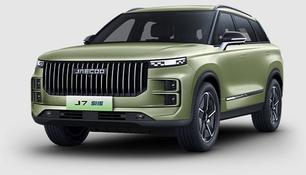
The J7 is, in essence, a scaled-up version of its smaller sibling, the J5 - a car my family affectionately dubbed the “Temu Range Rover” during our week with it. The resemblance remains.
The squared-off proportions, upright grille and slim lighting signatures lean heavily into that premium off-roader aesthetic, and there’s no doubt the look will appeal to buyers chasing presence without the associated price tag.
Compared to the J5, the J7 carries a touch more personality.
There’s a small racing-flag accent panel along the flanks, flush-fitting door handles and a set of 19-inch aerodynamic alloy wheels that add some visual flair.
Inside, the cabin is cleanly executed with its pared-back styling and the 13.2-inch central display dominates the dashboard. This makes it the visual anchor of the interior as physical buttons are minimal and most functions are accessed via the media screen. That screen-led design will divide opinion, but it does create a modern aesthetic.
The synthetic leather upholstery feels convincingly premium, and the materials do enough to lift the ambience beyond what you might expect at this price point.
It ain't a people mover. Period.
If you plan on having regular passengers and they’re tall, look elsewhere because they won’t find much comfort (especially in the back seat).
On the back seat, I barely fit with my 168cm (5’6”) height and had to accommodate my driving position by spreading the ol’ knees apart. So ladylike.
However, kudos to the clever high roofline because headroom isn’t an issue. The 170mm ground clearance also makes this a super easy car to get in and out of.
Front passengers definitely enjoy the most room and amenities but you will be jostling for the premium position on the armrest. The storage is good for this size SUV with a glovebox, middle console, two cupholders and a cute little storage shelf in front of the passenger.
There’s also a dedicated phone tray that has the wireless charging pad, a USB-A and C port plus a 12-volt port too.
The tech is simple to use and it was easy to get my iPhone connected to the Bluetooth and wired Apple CarPlay (there’s Android Auto, too for those users). The new-for-2023 4.2-inch digital instrument panel adds some pizzazz but unfortunately, isn’t customisable.
The boot is a solid size for this class at 355L. You can adjust the floor to sit a little lower and there is a space-saver spare tyre.
No Venue grade has a powered tailgate but honestly, you don’t need it.
Up front, the J7 Track delivers where it matters. The electric front seats offer heating and ventilation functions and feel supportive over longer drives. There’s enough width and shoulder room to avoid feeling hemmed in.
Access is good with wide door apertures and an easy step-in, step-out height from both rows. In the rear, the available space is generous, and the thick seat padding and supportive backrests will make longer journeys quite comfortable. The flat floor also means the middle seat isn’t automatically the punishment position for an adult.
Storage has been thoughtfully considered. Up front, the large centre console shelves make it easy to keep clutter contained, while the dual-opening middle console is deep enough to swallow a small handbag. There’s also a small side pocket beside the driver that’s ideal for keys or a garage remote.
Rear passengers will enjoy four device pockets, as well as a couple of map pockets. There are two cupholders and drink bottle holders in each row, as well as good-sized bins in each door.
With all rows in use, the boot has up to 500L of capacity, and the flat loading floor makes it easy to slide larger items in and out. Overall, it’s a usable and practical space for gear storage but you'll notice the lack of a powered tailgate as there isn't a dedicated handhold on the outside of the lid to easily open the boot.
There's also no charging ports or power outlets in the boot, which feels unusual for a plug-in hybrid. You have to make do with a tyre repair kit rather than a spare wheel but that's not unusual in this corner of the market.
The individual charging options are functional with a single USB-A and C port offered in each row and a 12-volt socket up front but you miss out on a wireless charging pad in this grade. The multimedia touchscreen is responsive and the layout is fairly intuitive to use. However, the lack of physical controls for simple adjustments like side mirror positioning or climate control can become frustrating. Some functions are just better served by buttons.
The wireless Apple CarPlay and Android Auto operate smoothly and the CarPlay has maintained a steady connection this week. The built-in sat nav is also easy enough to use.
Even though the Elite is the top model for the Venue line-up, it’s just $28,500 before on-road costs.
That puts it on par with the Mazda CX-3 in Maxx Sport guise, but about $4500 cheaper than the Toyota Yaris Cross Urban.
The Elite has an okay spec sheet but is a few items short of feeling like a top model should.
For example, this has wired Apple CarPlay and Android Auto, whereas the lower grades enjoy wireless.
This is a common trait in Hyundai and Kia products due to a quirk with the vehicle architecture. It also just makes do with halogen headlights but they stand out against the rest of the LEDs on the road.
However, the other standard equipment for the Elite still makes it a competitive player, like the tilt and slide sunroof, 17-inch alloy wheels, temporary space-saver spare tyre, steering wheel-mounted controls, tilt and telescopic steering wheel, 8.0-inch touchscreen multimedia system and wireless charging pad.
There are two plug-in hybrid grades in the J7 line-up and we’re testing the entry-level Track here, priced at $43,990 drive-away. It’s a strategic price point because aside from its close relative, the Chery Tiggo 7 Super Hybrid, which undercuts it at $39,990 drive-away, the Track is the second-most affordable option among its immediate rivals.
By comparison, the GWM Haval H6 GT PHEV lists at $51,990 drive-away, while the MG HS Super Hybrid Excite comes in at $52,696 drive-away. The BYD Sealion 5 undercuts them all as the most affordable plug-in hybrid in the country right now, starting from $33,990 before on-road costs.
It’s worth noting that the H6 GT is offered in a single, well-specified grade, and its higher price reflects that broader equipment list. Even so, the J7 starts from a strong position before you get into its features.
For a base variant, the Track gets some good stuff like electric front seats with heating and ventilation, synthetic leather upholstery, remote start with pre-entry climate control and a full suite of LED exterior lighting. That’s the sort of kit you’d expect to climb trim levels for.
Practical touches are scattered throughout. The centre console is air-cooled, the driver’s seat has a memory function, there are steering wheel-mounted controls and dual-zone climate control comes as standard. Then there’s the built-in karaoke app. Entirely unnecessary, but mildly amusing, however, you will need to supply your own microphone!
Technology feels well-considered as there’s wired and wireless Apple CarPlay and Android Auto, built-in satellite navigation, a large 13.2-inch multimedia display and a 10.25-inch digital instrument cluster. The 360-degree camera system is clear and complemented by front and rear parking sensors.
You do miss out on a powered tailgate and some charging options as there’s no internal vehicle-to-load (V2L) AC outlet and no charging ports in the boot. Still, as a base offering, the J7 Track presents as a neat package.
All Venue grades share the same engine – a 1.6-litre four-cylinder petrol drivetrain with a maximum output of 90kW and 151Nm of torque. Which sounds as gutless as it feels.
The six-speed auto transmission and under-powered engine can feel a bit rough on the open-road when you need to put your foot down.
Basically, you’re not going to do Daytona 500 in this. Think the odd bit of shopping, taking your small lap dog to get trimmed and going for a coffee with your friends.
Both plug-in hybrid grades of the J7 share the same powertrain, pairing a 1.5-litre four-cylinder turbo-petrol engine with a single electric motor. Combined outputs sit at a healthy 255kW and 525Nm which is the same as its Chery cousin and makes it more powerful than its MG rival but the GWM Haval H6 GT has bigger outputs.
However, once the EV battery is depleted and the system leans more heavily on the petrol engine, the outputs drop significantly to 105kW and 215Nm. This shifts the J7 from feeling spritely to serviceable on the open road.
Power is sent exclusively to the front wheels, and towing capacity is rated at 750kg unbraked. That’s enough for a small box trailer but it won’t be hauling any serious weekend toys.
It earns back some points with the fuel efficiency, especially considering how hard you have to drive this to wring out its power.
The official combined fuel figure is 7.2L/100km and I achieved the same according to the trip computer. Not too shabby but there are hybrid versions for the Venue’s rivals now - like the Yaris Cross - so it would be good to see one for this as well.
It has a 45L fuel tank and based off the official combined figure, you should be able to get around a 625km driving range, which means you should be able to go a couple of weeks without filling up if you’re doing shorter commutes.
The J7 Track has a Type 2 CCS charging port and accepts up to 6.6kW on AC power and up to 40kW on fast DC power. On that type of DC charger you can go from 30 - 80 per cent in as little as 20 minutes which is great for when you’re on the go. You can shop and charge without much fuss.
The 18.3kWh lithium-iron phosphate battery supports an electric-only driving range of up 90km (WLTP). That sits below its Haval and MG rivals with their respective WLTP ranges of 153km and 120km. Overall though, the J7 has a theoretical driving range over around 1200km, which is great. Of course, you will only see that type of range if you regularly charge it.
Jaecoo claims a combined fuel cycle usage (urban/extra-urban) of 1.0L/100km but my real-world usage has come out at 5.0L/100km even after regularly charging it. However, it's worth noting that I do a lot of longer, highway driving which is where plug-in hybrids are typically less efficient.
Jaecoo recommends a minimum 91 RON unleaded petrol to be used for the J7.
This is an urban dweller for sure. It’s happiest going under 70km/h but it handles that range very well. You have enough kick to cross traffic without too much fuss and the steering feels direct.
Those feelings disappear on the open road where it’s a struggle to maintain your speed and the engine complains so loudly, I was nervous it was going to conk out.
The cabin also gets loud at higher speeds with wind and road noise, which just reaffirms that this is a city car. At lower speeds, it’s fairly quiet and you can chat without interruption.
There’s some roll when you tackle corners but once you get used to how to drive it, it won’t bother you. The ride comfort is good until you hit bumps and then, you probably feel more connected to the road than you might like but it’s short lived because of the short wheelbase.
I really like the 10.2m turning circle and compact size - it made navigating around tight city streets an absolute breeze. Parking? Hurrah for a small car. I got into spaces that would ordinarily elude me. I just would have liked a clear reversing camera, it’s a bit blurry for a top-spec model.
This is where the J7 Track feels less resolved. It's not fundamentally flawed by any means but it's not as polished as it could be.
With a charged battery, acceleration is strong and immediate, and there’s enough punch for hills and confident overtaking. Even when the battery is running low, the drop in output doesn’t feel as dramatic in real-world conditions as the standalone engine figures might suggest. You won't win any drag races but it remains competent. It just loses some of the initial punch when accelerating.
Steering is light, which makes urban manoeuvring easy, and the suspension leans toward the softer side. Around town, that translates to a comfortable and compliant ride. Push it harder through bends, though, and the body control starts to feel a little loose.
Highway refinement is another area where there’s room for improvement. Road noise becomes noticeably more present at open-road speeds, although it remains quiet around town.
Visibility out the front and sides is good, and the driving position gives you a fairly commanding view of the road. I don’t feel like there are any large blind spots from my driving position.
There are three levels of regenerative braking, and running it in the strongest setting does a good job of harvesting energy. However, even on the lowest setting, the braking response feels abrupt. At low speeds when the system tends to remain in EV mode, the transition can feel lurchy.
The 360-degree camera system is clear and outside of the heavy-handed regen braking, the J7 is straightforward to park. Just be prepared for passengers, especially opinionated children, to comment on the body movement.
This little SUV has some good safety features that come as standard, like: blind-spot monitoring, auto emergency braking (AEB) with forward collision warning - car, pedestrian and cyclist detection (operational from 5.0 – 60km/h), rear cross-traffic alert, rear parking sensors, driver attention warning, check rear occupant alert, lane keeping aid, rear view camera with dynamic guidelines and tyre pressure monitoring.
However, the Venue was awarded a four-star ANCAP safety rating back in 2019. It missed out on that extra star because of the forward collision system, which had a lower ability to avoid rear-end impacts with vehicles in front. That dropped the Safety Assist and Vulnerable Road User scores down to just 62 per cent. That’s something to consider for the sort of traffic you’d get in an urban setting.
It only has six airbags but that does include curtain airbags covering the back row.
The J7 plug-in hybrid variant has a maximum five-star ANCAP safety rating from testing done in 2025 and scored well across its individual criteria with an 81 per cent for its adult protection, 85 per cent for child protection, 80 per cent for vulnerable road user and 84 per cent for its safety assist.
Passive safety items include eight airbags including a front centre airbag and drivers’ knee airbag. Families will like that there are two ISOFIX child seat mounts and three top-tether anchor points but realistically, two child seats will fit best. There are also manual child-safety locks on the doors, powered locks for the rear windows and intelligent seatbelt reminders for all five seats. Parking is easy with the front and rear parking sensors and 360-degree view camera system.
Active safety includes forward and rear collision warning, lane keeping aids, lane departure warning and prevention, blind-spot detection, side exit assist and a relatively unobtrusive driver monitoring system.
Other highlights include emergency lane keeping, which will activate when there’s no response from the driver and the rear cross-traffic alert also gets assisted braking. The lane keeping can oversteer at times and the adaptive cruise control is best without the assisted steering on. The J7 misses out on emergency call capability but otherwise, the safety equipment feels pretty robust.
There’s autonomous emergency braking with car, pedestrian and motorcyclist detection and is operational from 4.0 – 85km/h and up to 134km/h for car detection but it is more typical to see that top figure closer to 180km/h.
Ongoing costs are great as the Venue comes with Hyundai’s five-year/unlimited kilometre warranty, which is a standard term for the class.
You can pre-purchase servicing plans for up to five-years or 75,000km (whichever occurs first). The five-year plan averages $315 per service, which is very competitive!
Servicing intervals are reasonable at every 12 months or 15,000km, whichever comes first.
The Chinese lucky number '8' is heavily featured in the ownership as the J7 is offered with an eight-year/unlimited km warranty, eight years of battery cover and roadside assistance, plus eight years of capped-price servicing where services average just $422 per visit. That's an impressive suite of terms for the class.
Servicing is well-spaced at every 12 months or 15,000 kilometres and for now the service network is still fairly small, with around 50 centres nationwide.