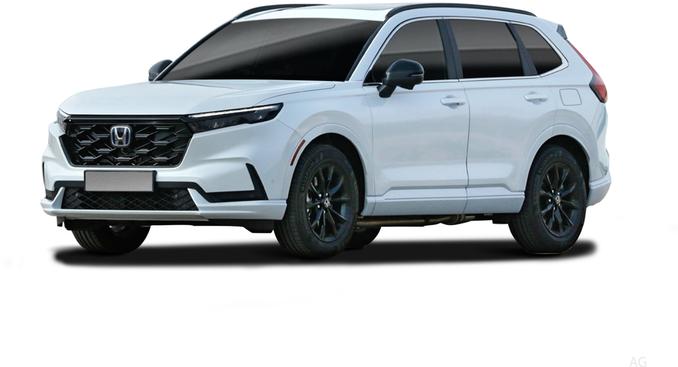
The 2024 Honda CR-V range of configurations is currently priced from $29,990.
Our most recent review of the 2024 Honda CR-V resulted in a score of 7.5 out of 10 for that particular example.
Carsguide News Editor Dom Tripolone had this to say at the time: After three months behind the wheel the CR-V e:HEV RS is clearly one of the best family hybrid SUVs on the market, but can we please put in a spare tyre in future upgrades.
You can read the full review here.
This is what Dom Tripolone liked most about this particular version of the Honda CR-V: Good looking, Great to drive, Cheap to run
The 2024 Honda CR-V carries a braked towing capacity of up to 1500 Kg, but check to ensure this applies to the configuration you're considering.
The CR-V is available as a five seat model, and two grades are offered as seven seaters (VTi X7 and L7). The second row can be rolled back and forth by 190mm to increase rear seat room. The seats fold 60/40. The seven seat grades have a lever that flips the seat base up to make it easier to get in and out.
This is a classic symptom of a car with a body computer that is dying a (sometimes not so) slow silicon death. The body computer controls just about everything on a modern car apart from the actual driveline, so things like the climate control, entertainment system, power windows and, yes, the electric tailgate operate on the body computer’s say-so.
In some cases the central locking goes haywire, other times you might come out to the driveway to find the car has switched its own lights on for no good reason. Either way, the body computer, once it has started to fail, can easily be the cause of this.
The ultimate solution (once you’ve confirmed this diagnosis and ruled out stuff like an iffy switch or sensor that controls the tailgate) is a new body computer at no small cost. But before you do that try a little trick that we’ve picked up over the years. Disconnect the car’s battery and leave it that way overnight. Reconnect it next morning and se if the problem persists. This doesn’t always work and, even when it does, it’s not always a permanent fix as the computer continues to degrade, but it’s definitely worth a shot since it’s free and might just fix things for good.
Your car was sold brand-new with a five-year/unlimited kilometre warranty. Although that’s technically now expired, it would be worth asking Honda for some financial help if you do have to replace a body computer in a car that’s just a few months out of warranty. You may not do any good, but it can’t hurt to ask, particularly if the car has been serviced by Honda its whole life.
Show more
These two readouts are closely linked in that one determines the other. Your average fuel consumption dictates the distance the car estimates it can travel based on what’s in the tank. But variation in these readings is perfectly normal. That’s because the range estimate is based on your most recent driving. So, if your fuel consumption has jumped from 7 to 8 litres per 100km, the computer will adjust the range down to compensate and prevent you from running out of petrol. That’s all very normal.
The bigger question is why your consumption has recently increased. Have you changed your driving style? Are you suddenly towing a trailer? Have you allowed another driver (with a heavier foot) to borrow the car? Are your tyre pressures correct? Have you added a roof rack? Do you now do more city and suburban driving than before? Is the car in need of a service and tune?
All these things can have a noticeable effect on fuel consumption, and any one of them could be the key to your fuel consumption increase and associated range reduction.
Show more
Is the engine in your Honda CR-V timing belt or chain? It depends on when the car was made, but it’s crucial information. That’s particularly so for owners of the first-gen CRVs we saw in Australia. That vehicle had the B Series Honda engine which used a rubber timing belt. The good news is that this has proved a very reliable set-up, and Honda recommends the belt be changed only every 150,000km which is a huge replacement interval by industry standards. A full kit to replace the timing belt on this engine, including a new water pump, will cost around $300 for the parts
After that (from 2001 onwards) Honda fitted the K Series engine to CRVs, and this engine used a timing chain which should be good for the life of the engine. The R20A four-cylinder engine used from late 2012 also uses a timing chain, as does the turbo-diesel 2.2-litre engine from the same era. The current-model CR-V with its 1.5-litre turbocharged petrol engine (the L15B7) also uses a timing chain.
The task of the timing chain or timing belt is exactly the same: They take drive from the engine’s crankshaft to the camshaft and, in the process, keep all the moving parts in harmony. Many car makers moved away from a timing chain to the rubber, toothed drive belt as a way of simplifying engine design and driving down the cost of each engine. The rubber timing belt is also quieter in its operation and is also less prone to stretching (as a timing chain can) so the camshaft (commonly referred to as the cam) stays in perfect synch with the rest of the engine’s rotating parts. The rubber timing belt is a simpler design because it doesn’t need to be tensioned via oil pressure from the engine as many timing chain systems are.
The timing chain, meanwhile, is preferred by some manufacturers because it should last the lifetime of the engine and never need replacement. This isn’t always the case, however, and some engines designs from a variety of manufacturers suffer problems in this regard. But, in a properly maintained engine of sound design, the timing chain should never need attention, while the rubber timing belt generally requires periodic replacement.
Show more
'Ignite Red Metallic', 'Platinum White Pearl', 'Lunar Silver Metallic', 'Meteoroid Grey Metallic', 'Crystal Black Pearl' and a new hue - 'Canyon River Blue Metallic'. Honda does not charge extra for different pain colours.
Standard gear in the VTi L includes 17-inch alloy wheels, leather-appointed seats, power-adjustable driver's seat, drive-mode selector, 7.0-inch driver display, wireless smartphone charger, a hands-free power tailgate with a walkaway close function, and an eight-way power adjustable driver’s seat.
Other features across the board include a 9.0-inch touchscreen system, wireless Apple CarPlay and wired Android Auto, and a five-year subscription to the Honda Connect app that has features like remote lock, climate control and lights, as well as car status, an emergency call function, visual dashboard and more.
The CR-V gets a completely new interior for the 2024 model change, and it adopts the minimalist look of the Civic. It has more space thanks to a 40mm longer wheelbase and there's quite a bit more leg room in the rear.
Five-seat, front-wheel drive petrol grades, and the VTi L AWD, have space for 589 litres (VDA) of gear with all seats in place. That increases to 1072L with the rear seats folded. The five-seat VTi L AWD and e:HEV RS hybrid can take 581/1063L, while the seven-seat grades can take 150L with all three rows in place, expanding to 840L with the third row stowed.
The petrol grades come with a 1.5-litre turbocharged petrol engine found in the Civic and ZR-V. It outputs 140kW of power and 240Nm of torque. This is paired with a continuously variable transmission (CVT) and is front or all-wheel drive.
The e:HEV RS hybrid combines a revised 2.0-litre four-cylinder petrol engine with a two-motor hybrid system and an E-CVT and makes for a combined output of 152kW.
The Honda CR-V 2024 prices range from $32,670 for the basic trim level SUV Vti X+ (2Wd) 5 Seats to $50,710 for the top of the range SUV E:Hev Rs (2Wd) 5 Seats.
All grades of the CR-V have a 57-litre fuel tank and it takes 91 RON fuel. The approximate range of the petrol models is 800km while the hybrid technically has a range of 1036km. Note that these are based on official figures and do not represent a real-world driving range.