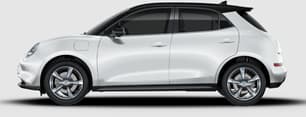
What's the difference?
When the GWM Ora showed up in Australia last year, it seemed to rely somewhat on its divisive cutesy looks and sub-$40K entry price to draw attention - and to some extent it worked.
Convincing Australians to buy an electric car is hard enough for any car company, let alone one that doesn’t have the brand cachet of Tesla or the traditional companies.
But an entry price under $40,000 doesn’t apply here, this is the GWM Ora GT: the top of the range for the small electric car.
It’s just had a massive price cut, but is it worth paying more than $10,000 over the price of a base Ora for some extra goodies when simplicity and fun styling was the original selling point?
The new Skoda Scala brings a trim line-up of just two models and the features list for both have been reshuffled with a little pruning here and a few welcome additions there.
The Select 85TSI on test for this review replaces the former Ambition base variant and offers very competitive pricing considering its European roots.
You would be forgiven, though, if the Skoda Scala was not the first make and model that came to mind in your new hatchback hunt. But with its minor facelift and a boot capacity that rivals medium SUVs, maybe it should be on the list.
The GWM Ora is a solid electric car for the city with an extremely competitive price, balanced with some flaws that might frustrate some - Android phone owners especially. But the GT variant doesn’t offer enough to justify how much more expensive it is than the variants below.
It has a slightly lower range, no more performance (not that it needs more power), a features list almost identical to the Ultra and arguably loses its appealing cutesy looks.
While the rest of the Ora line-up has its strengths and a cute but daring design, the GT effectively offers only its bark-over-bite styling changes.
If the Ora is on your shopping list, it’s certainly worth checking out the $43,990 Ultra, or even the $40,990 Extended Range if its list of features suits you. But if you for some reason enjoy the GT’s styling, that extra spend might be worth it.
The new Skoda Scala Select proves base models can be well-equipped and have a great price tag, which is not always the case at this grade level.
Its driving experience might not be as exciting as some rivals but it’s a great urban dweller nonetheless and it offers really good value overall.
Yep, as a step-up from the Ora Ultra, the GT’s main selling point is its styling. For a car with a 400km driving range, it’s so non-threatening it looks like it would get beaten up and have its lunch money stolen by dual-cabs if it left the city - but cute works, just ask Mini or Fiat.
Its headlights have a splash of Porsche 911 in them. There are some angles that even look a little like someone had an Abarth explained to them then tried to draw it. More than one friend has told me it reminds them of a VW Beetle.
None of that bothers me in particular, but the GT-specific additions to the Ora make it feel like a deeply unserious car.
The fake carbon trim is tacky on a car that has no performance improvement over its base variant sibling, the red strip under the number plate looks like a tongue poking out under an overbite, the wheels look like Tony Stark designed them, and the rear ‘wing’ and diffuser just don’t feel at home.
One thing that didn’t bother me as much as I thought it would was the lack of ‘traditional’ tail-lights, instead a light bar under the rear window takes that role.
The rest of the Ora range is cute, fun, and looks at home in the city where the Ora is at its best. The GT’s features are mostly the same as the Ultra, so the extra $3000 for the GT exterior doesn’t really feel like value.
Inside, however, the design is less in-yer-face. A tidy set-up features a Mini-style row of switches (for some of the climate control) under a bar that spans the dash with the vents integrated.
The steering wheel is big, arguably too big, behind it is the 10.25-inch driver display attached to the central multimedia display. Everything’s very tidy and minimalistic inside, even the gear selector is a round dial.
It looks like a reasonably fashionable interior, but when it comes to the functionality, it starts to fall apart.
The new Scala has had a minor facelift that sees a redesigned black grille with slim LED headlights, refreshed 17-inch alloy wheels and an extended rear windscreen.
The new Scala more than holds its own against its European rivals when it comes to looks and while it's more unassuming at the kerb side than its peers, there will be those who appreciate that it's not too cutesy-looking.
Head inside and there are similarities between its corporate cousin, the VW Polo with the sharply-designed dashboard and air vents but it’s softened by lovely grey fabric-accent panels and soft touchpoints that have been liberally scattered across the cabin.
The technology screens look premium, if small, and the black and grey cloth seats look a lot nicer than the standard black fabric you usually get in base models.
There's also a certain charm to seeing the traditional elements, like the gearshift and new physical buttons for the climate control. There's enough in the cabin to satisfy most.
I can see the appeal of the Ora, but there are some glaring issues that I suspect many will find frustrating over time during ownership.
I’ll start with the big one - Android Auto. Or the lack thereof. Apple CarPlay is available however, even wirelessly.
Being a car journalist in 2024 involves a lot of playing around with in-car tech, and it’s been an awfully long time since I wasn’t able to mirror my phone to a car’s central screen where those with an Apple iPhone could. About 70 per cent of the world uses a phone running Android, by the way. Mostly Samsungs, like mine, but pretty much anything else that isn’t an iPhone too.
It wouldn’t be as major an issue if there was a navigation function in the car’s native multimedia system, but there isn’t. Having only a Bluetooth connection and no map felt a little like taking a step back in time, with an old iPad tacked onto the dash. No Fruit Ninja though.
Smaller things come down to basic ergonomics. The touchscreen itself and the system on it are simple and easy enough to use, if a little unresponsive. The driver display is fairly simple and doesn’t fall too far into the trap of sub-menus on sub-menus.
Physically, the cabin is almost there - the seat and steering wheel adjustment, however, made it a little tricky for me to find a comfortable driving position.
I’m pretty much dead-on the average height of an Australian man, and the lack of tilt for the base of the seat meant no under-thigh support if I was to be the right distance to have a proper hold on the steering wheel - not telescopically adjustable, by the way.
Another interesting ergonomic fail is the placement of the drive mode select button (one of the GT’s few unique features) being to the right side of the steering column, near where you’d expect rarely-used controls like the headlight height adjust to be - or in this case a couple of centimetres from the button that kills the power to the battery if pressed while not in motion.
This caused severe embarrassment at a set of lights while searching for the drive mode switch, with no obvious way to start the car again, short of opening and closing the driver door.
Oh, and switching through the drive modes elicits a unique videogame-style chime or jingle for each mode. Gimmicky at first, potentially rather irritating after some time.
A positive of the interior layout, however, is the space in the rear seats is fairly generous for a small car - at almost six-feet tall behind my own seating position, I wasn’t lacking space to move and the seat itself is comfortable enough for a decent trip.
Behind that, a relatively limited 228-litre boot is probably less useful for a decent trip, though its 858L of space with the rear seats folded down is more handy in a pinch.
Ooh, the cabin of the new Scala offers fantastic practicality because it's class leading when it comes to space. There is no 'sardines in a tin' experience here, front and rear passengers get stacks of head- and legroom.
The only stumble on this front is the elbow room up front as you can at times jostle a co-pilot on the annoyingly sloping armrest.
Access is easy enough and you surprisingly don't 'fall in' or grunt when getting out, despite the low 149mm ground clearance.
The storage is good for a hatchback with the front getting a glove box that can fit more than just a manual, small middle console, two cupholders and a drink bottle holder in each door. As well as a sunglasses holder (always handy) and a medium-ish storage cubby in front of the gearshift that can accommodate a phone and wallet.
The rear enjoys two map pockets, two device pockets and a drink bottle holder in each door but misses out on a centre armrest and cupholders.
The boot is massive with its 467L of available capacity and we managed to fit luggage and golf clubs on a roadie this week without trouble.
There’s a temporary space saver tyre underneath the floor and while there’s no powered tailgate, it's not a difficult lid to operate. It even has a neat little toggle to help pull it down.
Other amenities feel well-rounded with two USB-C ports in each row, directional air vents, a 12-volt socket and reading lights.
The touchscreen multimedia system is responsive but looks tiny as it's almost the same size as my iPhone 15 Pro Max. This translates to smaller text and icon sizes as well as a smaller screen for the reversing camera.
There’s also not much in the way of customisation or extra features, like satellite navigation but the new wireless functionality for the Apple CarPlay and Android Auto makes it feel modern. Although the wireless function for the CarPlay drops in and out a lot.
The GWM Ora GT was once a mid-$50K car, once you got it on the road. Its former sticker price of $51,990 before on-roads has, along with every other variant in the range, been dramatically knocked into a more budget-friendly shape: $46,990 drive-away.
That’s pretty cheap for a top-spec electric car, or for an electric car in general in Australia, but it’s still $11,000 more expensive than the entry-level Ora Standard Range ($35,990 DA).
The Ora GT also shares most of the key draw cards on its features list with the Ultra.
Its panoramic sunroof, electric tailgate, heated and ventilated seats with massage function and its heated steering wheel are all available in the Ultra for $3000 less.
One of the only things the GT has in terms of functionality in the cabin is a light for the driver visor vanity mirror.
There are a couple of differences when it comes to driving functionality, and we’ll get to that in a later section of this review, but the rest of the tech in the cabin is standard across the range.
The 10.25-inch touchscreen and same-sized driver display, six-speaker sound system, wireless phone charger, electrically adjustable synthetic leather seats - it’s all in the base-level Ora.
What is missing, very notably, is Android Auto functionality. The Ora does however feature wireless Apple CarPlay.
There are two variants available for the Skoda Scala, and the Select on test for this review is the base model.
The Select replaces the previous base Ambition grade and is $1100 more affordable at $32,490, drive-away, and offers great value for money as it sits in the middle of its rivals, the Toyota Corolla Ascent Sport at $36,023, drive-away, and Volkswagen Polo 85TSI Life at $31,990, drive-away.
The features list has been reshuffled with a few previous extra cost options now included as standard fare, like front parking sensors, wireless Apple CarPlay and Android Auto, upgraded USB-C ports, keyless entry and start and dual-zone climate control.
However, previous standard items have been omitted from the list, like adaptive cruise control, floor mats and a 'Lane Centering Aid' while the previous 10.25-inch instrument panel has been replaced with an 8.0-inch screen.
Technology still feels well-rounded with the 8.25-inch touchscreen multimedia system that features a reversing camera, four USB-C ports, Bluetooth, AM/FM radio and an eight-speaker sound system.
All four variants of the Ora have the same outputs from its front-mounted electric motor - 126kW and 250Nm. Yes, even the GT.
What the GT does have over at least the base model is a larger battery shared with the Long Range and Ultra variants, but despite having the same weights and outputs, the GT is, on paper, claimed to be a tenth of a second slower to 100km/h than the rest of the range: 8.5 seconds versus 8.4sec for the cheaper models.
The Scala Select is a front-wheel drive with a seven-speed auto transmission. It has a 1.0L three-cylinder turbo-petrol engine that produces up to 85kW of power and 200Nm of torque.
At first glance you might think those outputs sound low and while most of its rivals have better outputs, there's plenty of oomph here to move the little Scala around.
That aforementioned larger battery is a 63kWh lithium-iron phosphate (LFP) battery, over the 48kWh unit in the Standard Range base variant.
According to GWM’s brochure, the GT’s electric driving range under WLTP is 400km, 20km less than the Long Range and Ultra (and like the acceleration time, for no obvious reason).
With a 400km claimed range and 63kWh battery, the Ora GT should return a power consumption figure of around 15.75kWh/100km, though on test we saw 16.4kWh.
GWM claims charging with 11kWh AC power will take 6.5 hours to jump from 10 to 80 per cent charge, while 80kW DC charging takes 50 minutes to do the same.
The new Select has almost hybrid fuel efficiency with its official combined cycle (urban/extra-urban) fuel figure of 5.4L/100km. In comparison, its hybrid rival, the Toyota Corolla isn’t too far away with its 4.0L usage.
Based on its 50L fuel tank, you should see a theoretical driving range of up to 925km, which is excellent for an urban dweller.
After doing a road trip combined with a fair amount of city-driving, my real world usage has popped out at 5.7L/100km. Which is a great result overall.
As is the case with the GT’s outputs and features, there’s nothing to suggest the GT would be fundamentally better to drive than any other variant. Unless all those kids at school were right about red bits making cars go faster.
The Ora’s front-drive layout paired with relatively immediate electric torque delivery, however, means you probably wouldn’t want it to be much more powerful with this particular mechanical setup.
The Ora, as a city car, does its job reasonably well in standard drive modes, though its sport mode is possibly a little too eager for day-to-day affairs - and the way it quite conservatively understeers on corners suggests there’s not much ‘sport’ driving to be done in this cute EV.
The steering itself feels fairly numb (again, fine day-to-day) and becomes heavier or lighter in different drive modes, but with no real advantage - the wheel itself is also a little on the large side.
Its suspension tune is comfortable enough for the low-speed streets on which this car is likely to find itself most often, where most city cars aren’t exactly riding on clouds, though can more obviously start to feel a little underdone on rougher roads at high speed.
It’s not a light car, after all, a hatchback that weighs 1580kg and has a short wheelbase isn’t going to be a dynamic masterpiece, though it does at least feel stable enough through corners thanks to its low centre of gravity.
It’s not going to encourage any heroic driving, but it’s also more likely to deter rather than outright punish any silly behaviour behind the wheel.
Hatchbacks are always a bit of fun to drive because of the dodgem car-esque handling and when the Scala is in Sport mode, it has enough pep to earn it a fun badge.
Out of Sport mode, the power delivery is still responsive enough for it to be a pleasant open-roader but you won't whoop with joy when you accelerate.
The steering is light without feeling loose and the Scala is nimble when cornering or in tight turns.
The ride comfort is very good and despite hitting some bad weather the Select didn’t miss a beat. It's a confident on-road experience because of its surefootedness.
There's a bit of road noise although its pretty quiet in the cabin, which also makes it a refined open-roader.
The visibility is decent and it’s easy to feel the dimensions of the car when you're in a skinny city laneway.
The Select gets a reversing camera with dynamic reversing guidelines and a clear quality feed but its tiny in the little screen.
The additional front sensors round out the parking experience considerably. You shouldn’t have any issue in parking this one!
The GWM Ora’s safety features are almost all standard across the range, which is great even if you don’t opt for the GT.
This means its seven airbags (dual frontal, side chest, curtain and centre) are all standard, as well as autonomous emergency braking, secondary collision avoidance, rear cross-traffic alert and forward collision warning, lane keep assist, traffic jam assist and even a surround-view parking camera. The Ultra and GT are the only variants with a front parking sensor and auto parking assist.
The features are all there, but some finer tuning when it comes to some driver assistance could be looked at - thus the slightly lower side of the scoring scale for a car that’s ticking all the boxes on paper.
The Scala has a maximum five-star ANCAP safety rating from testing done in 2019 and scored well across the four assessment areas.
It rated 97 per cent for adult protection, 87 percent for child protection, 81 per cent for vulnerable road user protection and 76 per cent for its safety assist systems.
However, this car only features six airbags, which is low in our day and age but you get a decent number of safety features included as standard, including biggies like rear cross-traffic alert, blind-spot monitoring and forward collision warning.
The base model also comes with a Lane Keeping Aid, lane departure warning, LED DRLs, driver monitoring, safe exit assist, seat belt reminders and front/rear parking sensors.
The Scala Select is no longer offered with adaptive cruise control, you just get the standard type, or a driver's knee airbag, either.
The rear seat features two ISOFIX child seat mounts and three top tether anchor points but two seats will fit best.
It has AEB with car, pedestrian and cyclist detection which is operational from 4.0-250km/h.
GWM offers a seven-year/unlimited kilometre warranty, as well as an eight-year/unlimited kilometre battery warranty. The former is quite decent for the industry, the latter relatively par when it comes to battery warranties.
Five years or 150,000km of roadside assistance is also included.
The Ora’s first five services, each coming in at 12 month/15,000km intervals, are capped price, all at $99.
The Scala is offered with a seven-year/unlimited km warranty, which is good for the class and you can pre-purchase a seven-year/105,000km servicing program for a flat $3650, which is competitive.
Servicing intervals are reasonable at every 12-months or 15,000km. You also get roadside assistance as a part of your servicing pack if you service on schedule.
The Scala likes to drink the good stuff, though, and Skoda recommends a minimum 95 RON premium unleaded petrol be used.