What's the difference?
I’m family testing the updated Genesis G70 this week, which has seen some tweaks to its technology and safety systems.
The G70’s release also sees the line-up trimmed to one highly-specified Sport Luxury grade, available as a four-cylinder Shooting Brake wagon or the V6 sedan on test here.
It competes with other mid-size sedans like the Audi A4, BMW 3 Series and Mercedes-Benz C-Class. So, how does the G70 handle life with a small family of three? Keep reading to find out!
It’s finally happened: Rolls-Royce has become so divorced from the everyday world of common folk that it's no longer even sharing the previously agreed meanings of words. Rolls has its own meanings, possibly its own language, which must be spoken with a plum on the tongue.
They’ve been heading here for a while. For example, at Rolls, “affordable” means the car we're driving today, the Rolls-Royce Ghost Series II, which is yours for just $680,000 (an indicative price, bumping to $800K for the Black Badge). And “iconic British marque” means, obviously, “BMW bought us in 2003, so there might be some German bits”.
It turns out that “driver-focused” means something different at Rolls-Royce, too. Thanks to a smattering of chassis innovations, Rolls says this updated 2025 Ghost is “the most driver-focused V12 Rolls-Royce ever”. Which is “a side of Ghost’s character that our clients increasingly and enthusiastically embrace”.
Don’t fall for it. The Ghost’s extra focus is not actually very focusy, and its additional dynamism is really only more dynamic in the way that a bed that could corner at all would be more dynamic than a normal bed. None of that matters.
The reason it doesn’t matter is because the Ghost Series II is wonderful. Indeed, it is very nearly perfect. Which is a word that even Rolls won’t quibble over.
The updated Genesis G70 3.3T Sport Luxury is beautiful to look at and drive. It features premium features, trims and great power but the cabin is tight on space. Which makes it a little awkward to use, so this will suit a small family best or families where this may not be the primary mover. That said, I love the after-care program and it suited my small family of three, so it gets an 8.0/10 from us.
In a disruptive era when the coachbuilder has pivoted to SUVs like the Cullinan, a sort of London black cab that’s been dipped in opulence, and succeeds despite itself, and the brand’s grand, million-dollar EV, the Spectre, the Ghost is a safe and familiar space.
A beautiful, long, broad, immaculate land boat. It’s a space Rolls inhabits with relish.
The Ghost Series II feels nothing like a track-day option when you’re behind the wheel. But it might do if you were stepping out of a Phantom. Or a Cullinan. Or a Wraith. Especially if you’re stepping out of the back doors.
It’s the perfect driver’s car. As long as all your other cars are also Rolls-Royces.
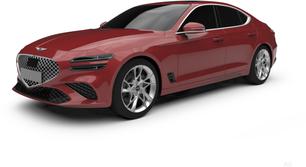
The G70 sedan is absolutely gorgeous to look at and the our test vehicle's 'Kawah Blue' paintwork makes the crisp pleating across the body stand out.
The G70 has a muscular stance, much like its BMW rival, but the rear is softer in its shaping.
The front looks sophisticated with the wide-set LED lights and black air-intake vents. The sporty 19-inch alloy wheels and red calipers behind them hint at what the powerful V6 engine can do.
The interior looks high-end with our test vehicle’s white quilted Nappa leather upholstery and a soft-touch black headliner. The dashboard looks solid and robust but the slick looking 10.25-inch touchscreen multimedia system and digital climate control panel elevate the overall design.
The only thing I didn’t like about the design was the ambient lighting. It’s limited to two panels on the roof and is a little distracting when you drive at night. I think if it was scattered more throughout the cabin, it would be less intrusive.
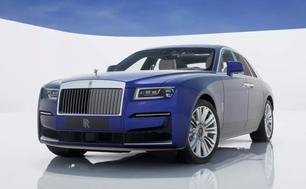
Yes, its exterior is more monolithic than before. The previous iteration was hardly fiddly, but the (apparently client driven) evolution here edges ever so gracefully towards what Rolls-Royce might secretly think of as brutalism.
The Ghost Series II’s generous 2148mm width is further emphasised up front, stretched across its upright prow, with slimline headlights adding definition and — surprisingly — a touch of villainy.
New, Spectre-inspired tail lamps and a discreetly inscribed double ‘R’ monogram add a reserved flourish from behind, and buyers can choose from two new 22-inch, nine-spoke wheel designs.
It’s subtle, no doubt. But it’s also impeccable.
The practicality is hurt a little by the space available for passengers. The front row benefits the most when it comes to head- and legroom but if you’re ferrying passengers in the back seat, you’ll have to scoot your seat forward to accommodate them.
Especially if they’re tall because my knees brush the back of the driver’s seat when it’s in my driving position and I’m only 168cm tall!
The individual storage options throughout the car are okay for the class with the front enjoying a small middle console and glove box, two cupholders and two small drink bottle holders in each door.
The rear gets map pockets, two cupholders in a fold down armrest and two very small storage bins in the doors.
The other amenities are great in both rows and a high-level of comfort will be found for adults with the heat and ventilation functions on the front seats and the heat function on the rear outboard seats.
However, the width of the rear seat and the tall transmission tunnel means the middle seat should be strictly reserved for a kid. Think of the G70 as more of a four-seater if you have adults to carry.
The boot has a 330-litre capacity and it’s not too hard to reach to the very back if items roll that way. The back seat has a 60/40 split and there is a temporary spare tyre underneath the floor.
In terms of technology, you get a USB-A and USB-C port up front, as well as, a 12-volt socket and wireless charging pad to choose from. Rear passengers get two USB-C ports and the boot features another 12-volt outlet.
The 10.25-inch multimedia system looks great and is easy to use with a responsive touchscreen. It also has built-in satellite navigation, wired Apple CarPlay and Android Auto and the system now features over-the-air updates and Genesis Connected Services functionality.
The digital climate panel is responsive and very simple to operate, which is handy when on the go. The 12.3-inch digital instrument cluster is semi-customisable and it’s handy that the 8.0-inch coloured head-up display pulls through satellite navigation directions and traffic sign information.
Inside, yes, there are bonkers touches in this most refined of automotive spaces, such as upholstery pinpricked by 107,000 'Placed Perforations' of 1.2mm in diameter, each individually examined, that replicate the shape of some clouds spotted over Rolls-Royce's Goodwood HQ.
Beside those flourishes of lunatic opulence, the more practical features feel pedestrian, but they’re comprehensive. The wireless Apple CarPlay and Android Auto, the seamless 'Central Information Display' and the 18-speaker 1400-watt audio, the upgraded Wi-Fi hotspot and the unobtrusive USB-C ports. The rear-seats flush with giant, streaming-optimised screens and heated and ventilated massaging seats.
Rolls acknowledges the generational movement of its clientele from back seat to front, with over 90 per cent of buyers now opting to — gasp! — steer themselves in a Ghost. But with back-seat savoir faire in its DNA, Rolls simply extends its hospitality to every seat.
The G70 3.3T Sport Luxury sedan on test here is priced at $88,000, before on-road costs, which is $7000 more expensive than the 2.0T Shooting Brake version. That positions it right in the middle of its nearest competitors and you get some fab features included.
The premium items include electric front seats with heat and ventilation functions, heated rear outboard seats, Nappa leather upholstery and other leather trims, a sunroof, a heated leather-wrapped steering wheel and a premium 17-speaker Lexicon by Harman sound system.
The update sees the G70 now have an intelligent speed limit assist feature, the 'Genesis Connected Services' app and over the air updates to its software.
Other standard features include keyless entry, keyless start, remote start from the key fob, a powered tailgate, 19-inch alloy wheels, a temporary spare wheel, dual-zone climate control and extendable sun visors.
The Ghost Series II is yours for an indicative price of just $680,000 (or $800K for the Black Badge) plus substantial on-road costs. The Ghost Series II extended (which we didn’t drive at the international launch in Provence) will slip in at around $20K less than the Black Badge before additional charges.
If they seem like big numbers, you’re probably the sort of person who looks at price tags, or who shops in shops that put price tags on things. These are not common traits of Rolls-Royce buyers, who may only be vaguely aware of the actual price of their vehicle, and whose historical impression of guillotines is generally unfavourable.
So, high six-hundreds is table stakes.
But you might also think the ‘standard’ Ghost, like all Rolls-Royces, is considered by most buyers to be a mere starting point, from which they’ll typically up-spec their ride from a sumptuous and expensive options list.
Spending another 10 percent of the purchase price on customisation is a bare-bones outlay for most owners, but even so, the evolved Ghost’s out-of-the-box features are so comprehensive as to be almost overwhelming.
First, because the Ghost has been Rolls-Royce’s driver’s car since the first (modern) generation arrived in 2010, specifically to cater to a weird (for Rolls clientele) new generation of buyers who wanted to drive their Rolls themselves.
So that price gets you, above all, that proven but superb 6.75-litre twin-turbo V12 engine, massaged via an eight-speed transmission and an AWD system that’s as rich and viscous as Crassus’s last libation.
There’s its subtly tinkered 'flight on land' 'Planar Suspension System' (note the unspoken dissonance between the terms ‘flight on land’ and ‘driver-focused'), with an ingenious 'Satellite Aided Transmission' system that uses GPS to pick the ideal gear with which to launch out of turns.
It works hand-in-velvet-glove with Goodwood's 'Flagbearer' camera system, which tracks the road ahead to chide potholes into submission in advance.
Because it’s a Rolls, though, that’s barely even the start of the story.
The coachwork is extraordinary, with new trim options including natural open-pore 'Grey Stained Ash' design elements, a sumptuous new bamboo rayon textile called 'Duality Twill'.
There a night-sky inspired illuminated fascia that apes elements of time-lapse celestial photography, part of the central glass panel that stretches the length of the dash.
Sure, you might expect that level of detail for the outlay. But for the outlay it’s far from missing anything you’d expect.
The G70 3.3T Sport Luxury sedan has a 3.3-litre V6 turbo-petrol engine with a maximum power output of 274kW and 510Nm of torque. The G70 sedan is a rear-wheel drive and features an eight-speed auto transmission.
The V6 engine responds eagerly, being able to do a 0-100km/h sprint time in just 4.7-seconds. Suffice it to say it’s fun to drive.
Rolls doesn’t like acceleration figures — too gauche, darling — but armed with that proven 420kW and 850Nm V12, the Ghost Series II has serious heft. Delivering max torque from 1600rpm — just 600rpm above idle — the effect is genuinely of one endless surge, a wafting cloud of momentum that subtly slips between gears as it exudes itself across the countryside.
The Black Badge edition, like all of its, er, ‘disruptive’ ilk offers a ‘Low’ button (‘Low’ means ‘Sport’ in Rollspeak), which bumps gearshift speeds by 50 percent when you plant your foot, and delivers a distinctly non-Rolls-like pop and burble on overrun. It also provides an extra 21kW and 50Nm, because Black Badge is mean and tough.
The compromise for getting all of the power is that she’s a thirsty gal and the official combined cycle fuel consumption figure is 10.4L/100km and my real-world usage came to 10.6L/100km.
However, that’s after mostly doing open-roading – expect the fuel usage to be higher in an urban setting.
Based on the combined cycle and the 60L fuel tank, expect a driving range of around 577km on average. Which means you’ll be filling up more on a longer journey than more efficient sedans.
Provence is not entirely a driver’s paradise, with every stretch of slightly twisty tarmac only a counterpoint to a motorway lined with Marseille lorries, Depardieu-esque men in tractors who refuse to move to the verge, and small villages where each kerbside corners sit millimetres from the foot of an adjacent boulangerie.
Which is to say it’s neither a place for economy runs, nor a location at which to run up the consumption numbers with a madcap series of impromptu hill climbs.
Our Ghost II drive returned around 16L/100km, which feels about right with that gorilla-in-a-tuxedo 6.75L V12, and is only slightly above the official figures of 15.8L/100km. Not great, could be worse.
The G70 sedan is a lovely car to drive with graceful handling and a good well of power to dip into.
That oomph is there when you need it and it’s as easy to drive in the city as it is on the open-road.
The responsive steering makes the G70 sedan feel nimble and well-balanced in turns, even when you accelerate out of a hair-pin corner.
The suspension is on the firm side and that can lead to a few grunts when you hit bigger bumps but the ride is not unpleasant, even for back-seaters.
The cabin is generally quiet but you can get road/wind noise at higher speeds. It’s not enough to intrude on chatting but you don’t forget it’s there, either.
The G70 sedan is easy to park because it has an outstanding 11m turning circle. The 360-degree camera system is clear and the front and rear parking sensors make light work of a tight car park.
The Ghost Series II drives like a magic carpet, serene and untroubled; in almost any stable other than that of Rolls, calling it a ‘driver’s car’ would have you throttled by their skunkworks. Everything is relative.
Still, it hides its considerable dimensions well. There’s never any doubt that you’re in a large saloon, as you white-knuckle the Ghost’s impeccably appointed steering wheel, but there’s always enough power to deliver creamily instant throttle response, even in the case of initially misjudged cambers.
Nor can the Black Badge hide the shimmy of that characteristic ‘flight on land’ body drift. The upside is that its manners are impeccable, even through the worst possible pieces of corrugation Provence can deliver.
If anything, the Ghost Series II’s big-hearted bulk adds to the fun factor, especially in some of Rolls-Royce’s more garish colour options, when gasping South of France MAMILs stare in amazement as a bright yellow, five-and-a-half metre Rolls passes them on the outside, scattering their various baguettes and garlands of onions.
The Genesis G70 has a great suite of safety features and it’s almost a case of what doesn’t it have.
But a real highlight is the blind-spot view monitor which pops a video feed of your blind spot onto your instrument cluster. Very handy to have in a city setting!
The G70 has a maximum five-star ANCAP safety rating from testing done in 2018, with the update now featuring 10 airbags, which is fantastic for the class.
Other standard safety features include blind-spot monitoring, blind-spot collision avoidance assist, driver attention warning, forward collision warning, lane keeping aid, lane departure alert, rear cross-traffic alert, rear occupant alert, adaptive cruise control with stop and go function and a tyre pressure monitoring system.
A clear 360-degree camera system as well as front and rear parking sensors also come standard.
The G70 has AEB (operational from 10–180km/h) with pedestrian and cyclist detection.
There are ISOFIX child seat mounts on the rear outboard seats and three top tether anchor points but only two child seats will fit. Front passenger comfort may be compromised for front occupants when a 0-4 rearward facing child seat is installed.
You get airbags, ESC, adaptive cruise, parking sensors and auto parking, and a rear camera. But don’t expect Rolls-Royce to allow the blighters at ANCAP to wreck one.
The Genesis after-purchase program is hard to beat and such a treat because you get five years or up to 50,000km complimentary servicing with the G70. How good is that?
The G70 also comes with a five-year/unlimited km warranty and the servicing intervals are every at 12-months or 10,000km, whichever occurs first. The interval could be annoying if you travel a lot but any annoyance will be softened by the fact that the services are free.