What's the difference?
I’m family testing the updated Genesis G70 this week, which has seen some tweaks to its technology and safety systems.
The G70’s release also sees the line-up trimmed to one highly-specified Sport Luxury grade, available as a four-cylinder Shooting Brake wagon or the V6 sedan on test here.
It competes with other mid-size sedans like the Audi A4, BMW 3 Series and Mercedes-Benz C-Class. So, how does the G70 handle life with a small family of three? Keep reading to find out!
It can be easy to dismiss electric cars as an imperfect solution to the world’s problems. But that would be missing one big point - they’re really, really fast.
Carmakers twigged that not everyone was enamoured with the environmental credentials of electric vehicles (EVs), especially luxury brands, and thus pivoted to the new sales tacit of performance and prestige.
Which is why Audi’s current performance flagship vehicle is not a mid-engined V10-powered replacement for the R8, but rather the all-electric RS e-tron GT. And for the new model year they have not only updated the range, bringing (you guessed it) more power, but also added a new hero model - the RS e-tron GT Performance.
It leads a new three-pronged line-up for the four rings brand, with the RS e-tron GT Performance sitting above the RS e-tron GT and the new S e-tron GT; the latter effectively replacing the previous ‘entry-grade’ model known only as the e-tron GT.
These arrive as part of a mid-life update for the model, with some minor styling tweaks (inside and out) along with enhancements to the battery and changes to the specifications.
The new range has just arrived in Australia and Audi will be hoping it can turn around the sales performance, which saw the outgoing e-tron GT and RS e-tron GT find just 84 customers in 2024. That was a decline of 75 per cent on 2023 sales, and nearly 200 less than the closely related Porsche Taycan.
The updated Genesis G70 3.3T Sport Luxury is beautiful to look at and drive. It features premium features, trims and great power but the cabin is tight on space. Which makes it a little awkward to use, so this will suit a small family best or families where this may not be the primary mover. That said, I love the after-care program and it suited my small family of three, so it gets an 8.0/10 from us.
While it may be a very different beast to the R8 supercar, it’s hard to argue that the e-tron GT offers performance that isn’t equal to anything Audi has previously produced. The immense acceleration and power, coupled with the brilliant and clever handling make this updated range, especially the RS pair, feel like something special.The fact that it will save you visiting a petrol bowser and might help cut harmful emissions is just a bonus.
Note: CarsGuide attended this event as a guest of the manufacturer, with travel, accommodation and meals provided.
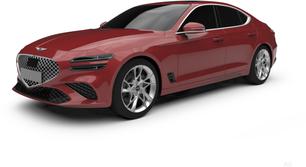
The G70 sedan is absolutely gorgeous to look at and the our test vehicle's 'Kawah Blue' paintwork makes the crisp pleating across the body stand out.
The G70 has a muscular stance, much like its BMW rival, but the rear is softer in its shaping.
The front looks sophisticated with the wide-set LED lights and black air-intake vents. The sporty 19-inch alloy wheels and red calipers behind them hint at what the powerful V6 engine can do.
The interior looks high-end with our test vehicle’s white quilted Nappa leather upholstery and a soft-touch black headliner. The dashboard looks solid and robust but the slick looking 10.25-inch touchscreen multimedia system and digital climate control panel elevate the overall design.
The only thing I didn’t like about the design was the ambient lighting. It’s limited to two panels on the roof and is a little distracting when you drive at night. I think if it was scattered more throughout the cabin, it would be less intrusive.
While there are some big changes underneath, on the surface the design tweaks are quite subtle.
There are some tweaks to the front grille, headlights, lower bumper and air intakes, but overall the look isn’t dramatically different. The more noticeable styling change is between the S and RS models, with the latter looking more sporty and dynamic thanks to a unique lower bumper design and the larger alloy wheels, which have a sportier look.
The biggest design changes are arguably the introduction of the switchable transparency roof on the RS and the option to use matt carbon camouflage.
The former is another shared element between the RS e-tron GT and Taycan, and it uses a special glass that can switch between being clear or opaque depending on whether you put a current through it. Cleverly, Audi is offering the option to have individual sections alternate between the two states, so you can customise it to your preference.
As for the grandly named matte carbon camouflage, it wasn’t highlighted in Audi’s presentation, but it’s the same material the Lamborghini developed over a decade ago and calls ‘forged carbon’ instead.
Unlike traditional carbon-fibre, which is made from injecting resin into sheets of fabric-like carbon fibre weave, forged composite uses a malleable paste of carbon sheets and resin. This technique is quicker to make and easier to shape into complex pieces, but lacks the visual impact of conventional carbon-fibre.
The biggest design change internally is the new steering wheel, which is a not-quote-squared-off rim that feels nice in your hand without being too thick. The RS models feature two new large red buttons - ‘RS’ and ‘Boost’ - which allow you to select the drive modes and activate the short boost function, respectively.
The practicality is hurt a little by the space available for passengers. The front row benefits the most when it comes to head- and legroom but if you’re ferrying passengers in the back seat, you’ll have to scoot your seat forward to accommodate them.
Especially if they’re tall because my knees brush the back of the driver’s seat when it’s in my driving position and I’m only 168cm tall!
The individual storage options throughout the car are okay for the class with the front enjoying a small middle console and glove box, two cupholders and two small drink bottle holders in each door.
The rear gets map pockets, two cupholders in a fold down armrest and two very small storage bins in the doors.
The other amenities are great in both rows and a high-level of comfort will be found for adults with the heat and ventilation functions on the front seats and the heat function on the rear outboard seats.
However, the width of the rear seat and the tall transmission tunnel means the middle seat should be strictly reserved for a kid. Think of the G70 as more of a four-seater if you have adults to carry.
The boot has a 330-litre capacity and it’s not too hard to reach to the very back if items roll that way. The back seat has a 60/40 split and there is a temporary spare tyre underneath the floor.
In terms of technology, you get a USB-A and USB-C port up front, as well as, a 12-volt socket and wireless charging pad to choose from. Rear passengers get two USB-C ports and the boot features another 12-volt outlet.
The 10.25-inch multimedia system looks great and is easy to use with a responsive touchscreen. It also has built-in satellite navigation, wired Apple CarPlay and Android Auto and the system now features over-the-air updates and Genesis Connected Services functionality.
The digital climate panel is responsive and very simple to operate, which is handy when on the go. The 12.3-inch digital instrument cluster is semi-customisable and it’s handy that the 8.0-inch coloured head-up display pulls through satellite navigation directions and traffic sign information.
Practicality is an important consolidation for the e-tron GT, it may have replaced the two-seater R8 as Audi’s definitive performance hero, but it’s a four-door sedan so it needs to be more family friendly. It’s especially relevant for Audi, as the brand has a history of brilliantly combining family needs with fast cars, namely its iconic wagons, the RS4 and RS6 Avants.
Audi also has a strong reputation for some of the best interior design in the industry, and the e-tron GT is arguably amongst its best work (at least in this reviewer’s opinion). It looks modern and stylish without leaning too far towards being different simply because it’s an electric car.
The new steering wheel fits the new design well, framing the digital driver’s display nicely. The display itself has a new RS-specific display for the higher-end models.
There’s a central infotainment touchscreen, but underneath this particular Audi skips the climate control touchscreen in favour of a digital readout and physical switchgear; a welcome relief for some, no doubt.
As for the seats, all three trim levels get the same style of sports seat trimmed in Nappa leather with a honeycomb stitch pattern. There are different finishes, both black and red leather, and some with contrasting stitching available through the optional design package. The RS performance package gets a unique ‘serpentine green’ stitching to stand out.
Small item storage in the front is adequate but not generous, which does make the e-tron GT feel more like a sports car at least, even if it doesn’t help practicality.
As for the rear, space is surprisingly good given the external dimensions and the nature of it being a low-roof sedan (rather than an SUV) with batteries underneath the floor. That’s largely because Audi has split the battery pack to allow for extra room in the rear for passengers’ feet, combating a common problem with electric sedans.
Headroom is adequate, and will be tight for anyone much taller than 180cm, but it will do the job of transporting the family in relative comfort. It is, by no means, the most spacious or family friendly model in the Audi range, but it does play its role as both a performance car and roomy sedan.
The boot is measured at 405 litres in the S but shrinks to 350L in the RS models, but both have the same 77L space under the bonnet, so space is (again) reasonable without being generous.
The G70 3.3T Sport Luxury sedan on test here is priced at $88,000, before on-road costs, which is $7000 more expensive than the 2.0T Shooting Brake version. That positions it right in the middle of its nearest competitors and you get some fab features included.
The premium items include electric front seats with heat and ventilation functions, heated rear outboard seats, Nappa leather upholstery and other leather trims, a sunroof, a heated leather-wrapped steering wheel and a premium 17-speaker Lexicon by Harman sound system.
The update sees the G70 now have an intelligent speed limit assist feature, the 'Genesis Connected Services' app and over the air updates to its software.
Other standard features include keyless entry, keyless start, remote start from the key fob, a powered tailgate, 19-inch alloy wheels, a temporary spare wheel, dual-zone climate control and extendable sun visors.
The 2025 range begins at $209,900 for the S e-tron GT, steps up to $264,900 for the RS e-tron GT and hits $309,900 for the new RS e-tron GT Performance (all prices exclude on-road costs).
While there is more power and equipment, that’s still a significant leap in price, with the previous e-tron GT starting at $181,784 ($28,116 cheaper) and the RS e-tron GT priced from $250,484 ($14,416 cheaper).
This pushes the Audi close to its most direct rival, the Porsche Taycan. Despite what the brands try to say publicly, the reality is these two are very closely related mechanically. Porsche now has two models cheaper than the S e-tron GT (the $174,500 Taycan RWD and $184,500 Taycan 4), while the Taycan 4S is priced just above it at $215,700.
Porsche’s rival to the RS e-tron GT is the $260,300 Taycan GTS, while it has the $306,900 Taycan Turbo to challenge the new RS e-tron GT Performance - plus the Turbo S and Turbo GT above it for those craving more power.
While the Audi isn’t bad value, it isn’t surprising that people in the market for an electric performance car from Germany are leaning towards the Taycan instead of the e-tron GT given the pricing structure.
In terms of specification difference between the three variants, the S e-tron gets 20-inch alloy wheels, adaptive air suspension, all-wheel steering, HD Matrix LED headlights with Audi laser lights, and a panoramic fixed glass roof.
Moving up to the RS e-tron GT adds unique 21-inch wheel design, a panoramic glass sunroof with a new switchable transparency, performance brakes with a carbide coating, and an RS-specific instrument cluster design.
The RS e-tron GT Performance crowns the range with its own 21-inch alloy wheels, active suspension and a specific RS Performance exterior electric sound system as standard.
There are a range of option packages too for all three models, which bundle extras together. The Sensory package ($6000) and Design package ($3800) are available for the S, the RS can be had with the Gloss carbon exterior styling package ($6000) and RS design package ($4500), and the new RS Performance has the matte carbon camouflage exterior styling package ($10,000) and a unique version of the RS performance design package ($4500).
The G70 3.3T Sport Luxury sedan has a 3.3-litre V6 turbo-petrol engine with a maximum power output of 274kW and 510Nm of torque. The G70 sedan is a rear-wheel drive and features an eight-speed auto transmission.
The V6 engine responds eagerly, being able to do a 0-100km/h sprint time in just 4.7-seconds. Suffice it to say it’s fun to drive.
The key number for the new model is 680kW - that’s what the new RS e-tron GT Performance produces from its dual electric motors. That makes it the most powerful production car Audi has ever offered, which is quite an achievement when you look back at some of the cars this brand has built over the years.
That power upgrade is an extra 205kW over the pre-facelifted RS e-tron GT, and comes with a whopping 1027Nm of torque.
The RS e-tron GT has been upgraded too, now making 630kW/865Nm, a 155kW improvement on the old model. Which is a good thing, because the new S e-tron GT has even more power than the original RS, underlining just how much Audi has focused on power for this mid-life enhancement. The new S packs a 500kW/717Nm punch, compared to the 475kW/830Nm the previous RS offered.
The compromise for getting all of the power is that she’s a thirsty gal and the official combined cycle fuel consumption figure is 10.4L/100km and my real-world usage came to 10.6L/100km.
However, that’s after mostly doing open-roading – expect the fuel usage to be higher in an urban setting.
Based on the combined cycle and the 60L fuel tank, expect a driving range of around 577km on average. Which means you’ll be filling up more on a longer journey than more efficient sedans.
Another one of the significant unseen changes for this update is the battery. Audi has overall the battery for this latest e-tron GT, so it now has higher energy density (168.3Wh/kg), more size (105kWh v 97kWh), faster charging (10-80 per cent in 18 minutes) and reduced weight (down 9kg).
Despite all the extra power, driving ranges for the three models are still all beyond 500km. The S e-tron GT has a claimed range of 558km, the RS e-tron GT can manage up to 522km and RS e-tron GT Performance can run 528km on a single charge, according to Audi.
As for the charging itself, Audi claims it now takes just 18 minutes to get from 10 to 80 per cent using an ultra-fast DC charger.
The G70 sedan is a lovely car to drive with graceful handling and a good well of power to dip into.
That oomph is there when you need it and it’s as easy to drive in the city as it is on the open-road.
The responsive steering makes the G70 sedan feel nimble and well-balanced in turns, even when you accelerate out of a hair-pin corner.
The suspension is on the firm side and that can lead to a few grunts when you hit bigger bumps but the ride is not unpleasant, even for back-seaters.
The cabin is generally quiet but you can get road/wind noise at higher speeds. It’s not enough to intrude on chatting but you don’t forget it’s there, either.
The G70 sedan is easy to park because it has an outstanding 11m turning circle. The 360-degree camera system is clear and the front and rear parking sensors make light work of a tight car park.
Befitting its role as Audi’s performance hero, the new range drives with a level of speed and precision you would expect from such a car.
Even the new S e-tron GT has a level of acceleration that not every sports car could keep up with (the official 0-100km/h claim is 3.4 seconds), which would be impressive on its own but is a standout when you consider this is a four-door sedan.
It also helps that the adaptive air suspension and all-wheel steering (which can help both low speed manoeuvring and high speed changes of direction) make for an incredibly responsive and agile handling vehicle.
And then you drive the RS e-tron GT Performance and the driving experience is a step up again with its 2.5s triple-digit sprint time. That’s largely because of the new active suspension system it uses, which features a hi-tech array of cameras, radars and sensors to ‘read’ the road ahead of it and adjust the ride accordingly.
The result is arguably one of the best riding, most comfortable electric performance cars on sale today. Typically the need to control so much weight, from the batteries, means the ride is often too firm. But with the active suspension, Audi has somehow managed to make the ride both compliant (on 21-inch wheels) but also very well controlled, which allows you to really drive with precision even at speed.
But it’s not just the suspension, as mentioned earlier, the RS models also get a new ‘Boost’ button on the steering wheel that offers an extra 70kW of power for 10 seconds. Along with the surge of extra performance there’s a large countdown timer on the digital dashboard when you press it to really give you a sense of urgency and speed.
Thankfully, with so much power the e-tron GT range has plenty of stopping power. The S comes equipped with steel brakes, which do a fine job. But for the faster RS models, you get a carbide coated rotor and you can option ceramic brakes for more resilient stopping power.
The Genesis G70 has a great suite of safety features and it’s almost a case of what doesn’t it have.
But a real highlight is the blind-spot view monitor which pops a video feed of your blind spot onto your instrument cluster. Very handy to have in a city setting!
The G70 has a maximum five-star ANCAP safety rating from testing done in 2018, with the update now featuring 10 airbags, which is fantastic for the class.
Other standard safety features include blind-spot monitoring, blind-spot collision avoidance assist, driver attention warning, forward collision warning, lane keeping aid, lane departure alert, rear cross-traffic alert, rear occupant alert, adaptive cruise control with stop and go function and a tyre pressure monitoring system.
A clear 360-degree camera system as well as front and rear parking sensors also come standard.
The G70 has AEB (operational from 10–180km/h) with pedestrian and cyclist detection.
There are ISOFIX child seat mounts on the rear outboard seats and three top tether anchor points but only two child seats will fit. Front passenger comfort may be compromised for front occupants when a 0-4 rearward facing child seat is installed.
Audi has equipped the e-tron GT trio with a respectable level of safety features, including adaptive cruise control with stop and go functionality, park assist plus, front and rear autonomous emergency braking, active lane assist, side assist with exit warning, collision avoidance assist and a 360-degree camera system for parking assistance.
Given its low sales volume, ANCAP has not crash tested the e-tron GT (or the structurally similar Taycan), so there is no score. But overall its level of equipment and Audi’s reputation and experience means we have no safety concerns over this particular model.
The Genesis after-purchase program is hard to beat and such a treat because you get five years or up to 50,000km complimentary servicing with the G70. How good is that?
The G70 also comes with a five-year/unlimited km warranty and the servicing intervals are every at 12-months or 10,000km, whichever occurs first. The interval could be annoying if you travel a lot but any annoyance will be softened by the fact that the services are free.
Audi offers its standard five-year/unlimited kilometre warranty for the three e-tron GT variants, but the battery gets a specific eight year/160,000km warranty. The five years of coverage is fairly standard for the luxury car segment, but short of the increasingly common seven-year warranties for mainstream brands.
As for the servicing, that’s included in the cost of the car, with Audi covering the first six years of maintenance for no additional charge. It helps that service intervals, without a complicated and oily engine, are stretched to two years or 30,000km.