What's the difference?
I’m family testing the updated Genesis G70 this week, which has seen some tweaks to its technology and safety systems.
The G70’s release also sees the line-up trimmed to one highly-specified Sport Luxury grade, available as a four-cylinder Shooting Brake wagon or the V6 sedan on test here.
It competes with other mid-size sedans like the Audi A4, BMW 3 Series and Mercedes-Benz C-Class. So, how does the G70 handle life with a small family of three? Keep reading to find out!
For many Australians, calling the new ZB a Commodore is tantamount to being forced to call your Mum’s new boyfriend ‘Dad.’
It's not built here, available in rear-wheel drive, there's no sign of a V8 or a sedan body, so why should we accept it as a worthy heir to the badge worn by Holden’s proudest model since 1978?
One big reason is that it was always going to be the next Commodore, even before Holden decided to stop building cars in Australia. Yes, it was even set to be built here.
Once the VE/VF Commodore’s Zeta platform was axed during General Motors’ post-GFC rationalisation, the next best thing was to align with the Opel/Vauxhall Insignia designed primarily for Europe.
Holden was actually involved with the new Insignia’s development from the beginning, which has led to some key details for the Commodore version and Australia, and a whole lot of input from our world-renowned Aussie engineering team.
So it’s a whole lot more Commodore than you may realise. Whether it lives up to its reputation is another matter.
The updated Genesis G70 3.3T Sport Luxury is beautiful to look at and drive. It features premium features, trims and great power but the cabin is tight on space. Which makes it a little awkward to use, so this will suit a small family best or families where this may not be the primary mover. That said, I love the after-care program and it suited my small family of three, so it gets an 8.0/10 from us.
So will the new Commodore become Australia's favourite car? I strongly doubt it, but it's not the car's fault, and it wouldn't be any different if it was a rear-wheel drive, V8, Australian-built sedan. Australian buying habits have just moved on, and diversified into a range of SUVs, small hatches and dual-cab utes.
Taken as an all-new entry in Holden's revitalised line-up though, the new Commodore ticks all the important boxes required of a mid-size to large passenger car these days. It may not be anywhere near as exciting as a 6.2-litre Redline sedan, ute or wagon, but it’s objectively a far better car overall, and you should definitely give it a drive before dismissing it.
The pick of the bunch in my eyes is the $39,490 RS Sportwagon with the 2.0-litre petrol engine. Yep, the best new Commodore is now a four-cylinder station wagon.
Be sure to check out what James Cleary thought of the new Commodore in prototype guise here:
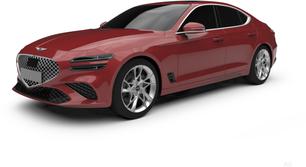
The G70 sedan is absolutely gorgeous to look at and the our test vehicle's 'Kawah Blue' paintwork makes the crisp pleating across the body stand out.
The G70 has a muscular stance, much like its BMW rival, but the rear is softer in its shaping.
The front looks sophisticated with the wide-set LED lights and black air-intake vents. The sporty 19-inch alloy wheels and red calipers behind them hint at what the powerful V6 engine can do.
The interior looks high-end with our test vehicle’s white quilted Nappa leather upholstery and a soft-touch black headliner. The dashboard looks solid and robust but the slick looking 10.25-inch touchscreen multimedia system and digital climate control panel elevate the overall design.
The only thing I didn’t like about the design was the ambient lighting. It’s limited to two panels on the roof and is a little distracting when you drive at night. I think if it was scattered more throughout the cabin, it would be less intrusive.
Aside from the move to a front-drive basis, the other key difference between the new Commodore and those of the past is its shift from a classic three-box sedan shape to a sleek, five-door Liftback. Even the Sportwagon has an elegant arc to its roofline, which is arguably their most appealing design element. There are no Ute or Caprice bodystyles, and there never will be.
The European-designed look is less macho than the bulging wheelarches of the VE and VF, but more in line with its European rivals like the Ford Mondeo, Volkswagen Passat and Skoda Superb.
The best way to identify specific models is by their wheels, with the trim levels split between a more elegant body trim on the entry, Calais, Calais-V and Tourer variants, and sportier body kits with side skirts and a rear spoiler on the RS, RS-V and VXR flagship.
The interior look is also best described as elegant, with fresh shapes that flow cohesively into the door trims and centre console. There’s a general air of quality about it, but it’s let down by some cheap-feeling controls and switches, particularly the climate control knobs.
The ZB’s overall size is bigger than you might think, with most dimensions fitting neatly between the VE/VF and the VT-VZ generation that preceded it.
You might be surprised to learn it’s no lightweight either, with the heaviest Calais-V Tourer actually outweighing the portliest VF by 31kg.
Interior dimensions are comparable with its predecessor, with the most significant differences being a narrower back seat thanks to its 36mm thinner body and 13mm less rear headroom in the Liftback (but 3mm more in the wagon).
Before the decision was made to source the new car from Germany, Holden was planning a longer wheelbase for Australia. One specific requirement that did reach fruition is the availability of a V6 engine, which isn’t fitted to European versions.
Under the skin it rides on GM’s E2XX platform, which is a significant evolution of the chassis that underpinned the previous Insignia and the now-defunct Holden Malibu.
Aside from having a say in every step of its design process, Holden engineers covered more than 200,000 kilometres of testing on Australian roads and at the Lang Lang proving ground.
This has been to fine tune the drivetrain calibrations, the steering, suspension, and even details like the sat nav and radio reception to suit our tastes and unique demands.
Specific suspension tunes have been developed for four cylinder models, the V6 Calais, V6 RS-V and the Tourer, with unique setups between Liftback and Sportwagon bodies.
The only version not to score an Australian suspension tune is the VXR, which was treated to a performance-focused setup at the Nürburgring in Germany.
The practicality is hurt a little by the space available for passengers. The front row benefits the most when it comes to head- and legroom but if you’re ferrying passengers in the back seat, you’ll have to scoot your seat forward to accommodate them.
Especially if they’re tall because my knees brush the back of the driver’s seat when it’s in my driving position and I’m only 168cm tall!
The individual storage options throughout the car are okay for the class with the front enjoying a small middle console and glove box, two cupholders and two small drink bottle holders in each door.
The rear gets map pockets, two cupholders in a fold down armrest and two very small storage bins in the doors.
The other amenities are great in both rows and a high-level of comfort will be found for adults with the heat and ventilation functions on the front seats and the heat function on the rear outboard seats.
However, the width of the rear seat and the tall transmission tunnel means the middle seat should be strictly reserved for a kid. Think of the G70 as more of a four-seater if you have adults to carry.
The boot has a 330-litre capacity and it’s not too hard to reach to the very back if items roll that way. The back seat has a 60/40 split and there is a temporary spare tyre underneath the floor.
In terms of technology, you get a USB-A and USB-C port up front, as well as, a 12-volt socket and wireless charging pad to choose from. Rear passengers get two USB-C ports and the boot features another 12-volt outlet.
The 10.25-inch multimedia system looks great and is easy to use with a responsive touchscreen. It also has built-in satellite navigation, wired Apple CarPlay and Android Auto and the system now features over-the-air updates and Genesis Connected Services functionality.
The digital climate panel is responsive and very simple to operate, which is handy when on the go. The 12.3-inch digital instrument cluster is semi-customisable and it’s handy that the 8.0-inch coloured head-up display pulls through satellite navigation directions and traffic sign information.
Another traditional Commodore trait to have taken a step backwards is its ability to carry three adults across the back seat. Admittedly only really an issue for taxi use, the ZB will certainly still swallow three, and likely three child seats, but less comfortably and more like the similarly sized Camry.
The Liftback’s reduced headroom didn’t matter for this 172cm tester, but if you were marginal in a VF you’d probably want to avoid spiking your hair.
The cabin ticks all the other important boxes for a modern family car, including twin cupholders front and rear, bottleholders in each door and two ISOFIX child seat mounts in the rear.
All get a good cluster of USB and 12V charge points, while the RS-V models upwards get a big bonus with wireless phone charging.
The Liftback's boot space is only slightly down on before at 490 litres, but the huge opening created by the five-door design is so much more useful in the real world. It also brings a split-fold back seat for the first time in a non-wagon Commodore.
The Sportwagon has lost around 100 litres in capacity though, but is still a very useful 560 litres to seat height or 793 litres to the roof.
Holden’s local team has also developed a range of optional accessories for the Commodore, which includes a bonnet protector, weather shield, towbar, boot liner, floor mats, headlight protectors, sill guards, locking wheel nuts, roof racks and a cargo net, but there’s no sign of a cargo barrier, nudge bar or bullbar at this stage.
The G70 3.3T Sport Luxury sedan on test here is priced at $88,000, before on-road costs, which is $7000 more expensive than the 2.0T Shooting Brake version. That positions it right in the middle of its nearest competitors and you get some fab features included.
The premium items include electric front seats with heat and ventilation functions, heated rear outboard seats, Nappa leather upholstery and other leather trims, a sunroof, a heated leather-wrapped steering wheel and a premium 17-speaker Lexicon by Harman sound system.
The update sees the G70 now have an intelligent speed limit assist feature, the 'Genesis Connected Services' app and over the air updates to its software.
Other standard features include keyless entry, keyless start, remote start from the key fob, a powered tailgate, 19-inch alloy wheels, a temporary spare wheel, dual-zone climate control and extendable sun visors.
Aligning with the Insignia’s European platform has bumped the Commodore right up to speed with the current status quo of features expected in such a family car.
Available Commodore firsts include standard auto emergency braking (AEB) on all models, adaptive cruise control, 360-degree / surround-view cameras, massage and ventilated seats, heated rear seats, wireless phone charging, LED headlights and a power tailgate on the wagons. Like most new cars, there’s no more CD player or DVD player with the radio and other multimedia options.
The broad model range is split into LT, RS, RS-V, Calais, Calais-V, VXR trim levels, while the off-road flavoured Tourer is split into Calais and Calais-V versions.
All bar the Tourer and VXR are available with either Liftback or Sportwagon ($2200 extra) bodystyles, while the 2.0-litre turbo engine is standard in the LT, RS and Calais. The V6 with all-wheel drive is available in the RS, RS-V, Calais-V, VXR and both Tourer trims, while the diesel engine is limited to the LT and Calais.
The base LT Liftback drops the Commodore entry point by $1800 with a list price of $33,690. The diesel engine is available in either bodystyle for an extra $3000.
Standard features include the aforementioned AEB, lane keep assist, lane departure warning, Apple CarPlay and Android Auto in addition to Bluetooth connectivity with a 7.0-inch multimedia screen, reversing camera, auto parking, a leather steering wheel, an eight-way power driver’s seat, proximity keys, auto headlights and wipers, air conditioning and 17-inch alloy rims.
The RS kicks off at $37,290, or $40,790 in V6 AWD guise, and brings sports front seats, steering wheel and body kit, blind-spot monitoring, rear cross-traffic alert and bigger 18-inch alloys, while the Sportwagon version gets a power tailgate.
The V6 AWD RS-V commands $46,990, and adds leather seats, heated front seats, paddle shifters a larger 8.0-inch multimedia screen with built-in GPS navigation system and DAB+ digital radio, a colour head-up display, wireless phone charger, interior ambient lighting, upgraded Hi Per strut suspension and a sportier rear bumper.
The $40,990 Calais is also available with the diesel engine for an extra $3000, or as the V6 AWD Tourer wagon for $45,990.
The Calais sits closer to the LT on features, but adds leather trim, front seat heaters, 8-inch multimedia screen with built-in GPS navigation system and DAB+ digital radio, wireless phone charging, blind-spot monitoring, rear cross-traffic alert and 18-inch alloys.
The Calais Tourer scores a ride height lift (overall height up 42mm) and off-road styled unpainted wheel-arch moulds and bumper caps.
The $51,990 Calais-V adds a Bose premium sound system, ventilated front seats, a massage function and powered side bolsters for the driver’s seat, heated rear seats, a sports steering wheel with paddle shifters, 360 degree cameras, colour head-up display, adaptive LED headlights and 20-inch alloys. The Liftback version gets an electronic sunroof, while the Tourer version gets a panoramic glass roof.
The top-spec VXR is closest to the RS-V in terms of features, but for $55,990 it adds VXR-specific sports seats with power adjustable bolsters and ventilation up front, heated rear seats, Bose premium audio, adaptive suspension, adaptive cruise control, Brembo brakes, VXR floor mats and sill plates, active LED headlights, 360-degree camera, electric sunroof, and 20-inch alloy wheels.
From launch, Holden is offering drive-away pricing across several models, with on-road costs included. The LT petrol Liftback is available for $35,990, while the RS Liftaback is being offered for $38,990 with the 2.0-litre turbo and $42,490 with the V6. The Calais Tourer is also being offered for $47,990 drive away.
MORE: Check out our ZB Holden Commodore price guide and price list here.
The available colours are spread across two whites, two reds, silver, grey, black and blue, with some only available on certain models. All bar the non-metallic white and red will cost you an extra $550, but there’s no sign of the green, purple, orange, or yellow we’ve seen over the past decade.
The G70 3.3T Sport Luxury sedan has a 3.3-litre V6 turbo-petrol engine with a maximum power output of 274kW and 510Nm of torque. The G70 sedan is a rear-wheel drive and features an eight-speed auto transmission.
The V6 engine responds eagerly, being able to do a 0-100km/h sprint time in just 4.7-seconds. Suffice it to say it’s fun to drive.
No, there’s no more V8, manual transmission or rear wheel drive, but the ZB’s options are more in sync with its newer rivals.
For the first time since the VH, or 1984, the base engine is a four-cylinder petrol unit, but uses modern tech like direct injection and a turbo to boost power statistics to more than triple that of the infamous Starfire engine. Also seen in the Equinox, the new turbo motor’s 191kW is also notably 6kW more than the 5.0-litre V8 in the VL Group A SS (Walkinshaw), and 1kW more than the 3.6-litre V6 was making in top-spec VZ Commodores – so pretty good horsepower for its engine size.
The real story is its healthy 350Nm of torque, which is also more than what the same VZs were making, but on tap from a useful 3000-4000rpm.
The latest version of the 3.6-litre Alloytec V6 that’s seen duty in VZ, VE and VF models makes a reappearance as the new performance leader, but mounted sideways and turning all four wheels this time. In ZB trim, it produces 235kW and 381Nm, the latter from 5200rpm.
MORE: Find all ZB Commodore specifications here.
For the first time, you can also choose a diesel option with LT and Calais trims, which is a version of the engine used in the previous Opel Insignia. You’ll also find it under the bonnet of the Jeep Cherokee and Compass, and its applications spread as wide as the Alfa Romeo 159 that ended production in 2011. In Commodore guise, the turbo 2.0-litre engine specs are 125kW and 400Nm (available from 1750-2500rpm), and therefore taking out the torque trophy for the ZB range.
Both petrol engines are paired with a nine-speed torque converter automatic transmission, while the diesel has an eight-speed gearbox. Both four-cylinder engines are front-wheel drive, while all V6 variants are all-wheel drive.
MORE: What’s the difference between 4X4, 4WD and AWD
The all-wheel drive system is actually quite clever, using what’s called a Twinster twin-clutch rear differential for finite torque vectoring, or sending the just the right amount of power to each wheel. The system varies torque distribution between 100 per cent front and a 50/50 split.
If you think the Commodore has gone soft, its towing capacity ratings also suggest otherwise, with a 2100kg maximum braked rating for V6 models matching the best offered previously. The four cylinder models are rated at 1800kg, which is 200kg better than what the previous 3.0-litre V6 and LPG models carried.
The compromise for getting all of the power is that she’s a thirsty gal and the official combined cycle fuel consumption figure is 10.4L/100km and my real-world usage came to 10.6L/100km.
However, that’s after mostly doing open-roading – expect the fuel usage to be higher in an urban setting.
Based on the combined cycle and the 60L fuel tank, expect a driving range of around 577km on average. Which means you’ll be filling up more on a longer journey than more efficient sedans.
As you’d hope, the ZB sets a new Commodore benchmark for fuel consumption, with the diesel models managing a best official combined figure of 5.6L/100km. The petrol four-cylinder models also pip the VF’s best combined fuel economy figure of 8.3L/100km with 7.4 and 7.6L/100km for the LT, RS and Calais Liftbacks respectively. The Sportwagon versions wear 7.7 and 7.9L/100km figures, while V6 versions span 8.9-9.3L/100km combined ratings.
It’s worth noting that the petrol four-cylinder engine needs premium 95RON unleaded to do its best, while the V6 is happy to run on regular 91RON unleaded. All versions have a 61.7-litre fuel tank.
The G70 sedan is a lovely car to drive with graceful handling and a good well of power to dip into.
That oomph is there when you need it and it’s as easy to drive in the city as it is on the open-road.
The responsive steering makes the G70 sedan feel nimble and well-balanced in turns, even when you accelerate out of a hair-pin corner.
The suspension is on the firm side and that can lead to a few grunts when you hit bigger bumps but the ride is not unpleasant, even for back-seaters.
The cabin is generally quiet but you can get road/wind noise at higher speeds. It’s not enough to intrude on chatting but you don’t forget it’s there, either.
The G70 sedan is easy to park because it has an outstanding 11m turning circle. The 360-degree camera system is clear and the front and rear parking sensors make light work of a tight car park.
The Commodore we know and most of us love is just as famous for its quality driving experience as its local production and motorsport successes. So, the ZB has some big shoes to fill in this area.
At the ZB’s media launch, we drove everything aside from the base LT or any diesel variant, over several hundred kilometres of pretty much every road condition.
I’ll cut to the chase. There’s a genuine quality to the way they handle Australian road conditions. We drove them back to back with a UK-spec model at Lang Lang, and while you’d expect the local car to excel at its own test facility, the rear and front suspension work in harmony to handle mid-corner bumps with far greater stability than the alternative. The electric power steering weighting was also lighter, but it didn’t seem to lose any precision.
You probably wouldn’t notice it driving to the shops every day or cruising on the highway, but this on-limit controllability could easily be the difference between life and death in an emergency.
The turbo four is a surprisingly capable and refined package, and would honestly be my pick if I were in the market. It’s smoother and more tractable than the V6, so feels like it would deliver speed more readily than the bigger engine unless you were going flat out.
Holden isn’t quoting official 0-100km/h acceleration figures, but we hear the petrol four is good for a 7.0 second-ish time, and the V6 will manage just over 6.0sec. So there’s really not much in it outright.
Therefore it’s a shame you can’t get the Tourer with the petrol four, but because the combination is available in Europe, Holden could shift the line-up if there’s enough demand.
The nine-speed auto does a pretty good job with either engine, and its electronic brain does a slick job of seamlessly adjusting its shift behaviour to your driving style.
Holden isn’t quoting ground clearance figures, but all have enough to handle dirt roads, and while the 17-inch wheel equipped models match the VF II’s 11.4m turning circle, be aware that the 18-inch wheel variants blow out to 11.7m, the 19s are 12.7m, and Holden doesn’t quote a figure for the 20-inch equipped Calais-V Liftback and VXR.
The only other surprise among the group we drove is the Calais-V Liftback, which is likely to be a bit too sharp in its ride for some luxury buyers on its big 20-inch alloy wheels. The Calais or one of the Tourers would be your best bet for comfort.
The VXR performance flagship is a completely different personality to the SS models of the past. It’s nowhere near as fast, but is more of a grownup package that’s easier to get the best out of.
Its more demure than the brash final VF IIs, and the V6 does make a pretty sweet note, even if half of it is coming from the speakers.
Nothing was ever going to replicate the romance and pride of the last SS, but all is not lost for fans of fast Holdens.
The Genesis G70 has a great suite of safety features and it’s almost a case of what doesn’t it have.
But a real highlight is the blind-spot view monitor which pops a video feed of your blind spot onto your instrument cluster. Very handy to have in a city setting!
The G70 has a maximum five-star ANCAP safety rating from testing done in 2018, with the update now featuring 10 airbags, which is fantastic for the class.
Other standard safety features include blind-spot monitoring, blind-spot collision avoidance assist, driver attention warning, forward collision warning, lane keeping aid, lane departure alert, rear cross-traffic alert, rear occupant alert, adaptive cruise control with stop and go function and a tyre pressure monitoring system.
A clear 360-degree camera system as well as front and rear parking sensors also come standard.
The G70 has AEB (operational from 10–180km/h) with pedestrian and cyclist detection.
There are ISOFIX child seat mounts on the rear outboard seats and three top tether anchor points but only two child seats will fit. Front passenger comfort may be compromised for front occupants when a 0-4 rearward facing child seat is installed.
All versions of the new Commodore come with a maximum five star ANCAP safety rating, which has been measured against 2017 standards. The VF’s five star rating was based on 2013 standards.
As mentioned above, all versions get standard AEB and ISOFIX child seat mounts, plus features like lane keep assist and departure warning, auto parking, a reversing camera with front and rear sensors and six airbags covering both rows of seats.
All versions also get a novel following distance indicator to help you gauge a safe distance from the car in front. This could serve as excellent driver training, and worth having a go with on a test drive.
RS variants upwards get blind-spot monitoring and rear cross-traffic alert, while only the Calais-V and VXR get 360-degree /surround-view camera setups.
The Genesis after-purchase program is hard to beat and such a treat because you get five years or up to 50,000km complimentary servicing with the G70. How good is that?
The G70 also comes with a five-year/unlimited km warranty and the servicing intervals are every at 12-months or 10,000km, whichever occurs first. The interval could be annoying if you travel a lot but any annoyance will be softened by the fact that the services are free.
Holden is currently offering a seven-year, unlimited kilometre warranty with roadside assistance to help boost sales, but be on the lookout for the return of this deal if you miss out this time. Normally, the Commodore carries the standard three year/100,000km warranty.
Service intervals are now 12month/12,000km, which have shifted from the previous 9month/15,000km terms.
Service costs are capped for the first seven trips to the workshop, with petrol models costing $259, $299, $259, $359, $359, $359 and $259, or a total of $2153 over seven years or 84,000km. The diesel is actually slightly better value at $259, $359, $259, $399, $359 and $399, or $2134 over the same period.