What's the difference?
Ford's small hatch, the Focus, is criminally under-bought in Australia. The latest model is one of the best hatchbacks on the road and when you chuck in the decent price, impressive equipment and absurdly powerful engine for its size, it's a winner.
But you lot? You don't buy it in nearly the kinds of numbers it deserves. Partly because there isn't a bait-and-upsell boggo model to lure you in, partly because it's got a badge that is not exciting Australians any more and partly because it's not a compact SUV.
Or is(n't) it? Because alongside the ST-Line warm hatch is the identically priced and therefore technically a co-entry level model; the Focus Active. Slightly higher, with plastic cladding, drive modes and a conspicuous L on the transmission shifter, it's a little bit SUV, right?
If Holden had a dollar for every time someone had criticised the new and international flavour of Australia’s formerly home-grown hero, it would surely have more than enough spare cash to blow the dust of that vast South Australian factory and restart local Commodore production immediately.
Hell, there’d probably be enough left over to relaunch the Camira while they were at it. And maybe even knock out a new Gemini or two.
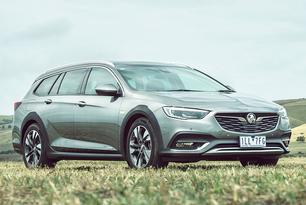
So we’re not going to do that again here. The all-new Commodore, in this case the Calais Tourer, is now here - granted having travelled further than the one it replaces - and so we’ll be playing this review with the straightest of bats.
Because the truth is, if you peel the badging - and thus the swirling emotion - off its elongated rump, then you’ll find this German-built Tourer is, really and truly, a very good thing.
Ten years ago, the idea that the higher-riding version of a hatchback would be a good city car would have been laughable. The Focus Active is pitched as a kind of SUV with its different low-grip driving modes, which you'll never touch if you stick to the city.
The Ford Focus is genuinely a brilliant car, no matter where you take it. The Active takes a terrific chassis, tweaks it for comfort but, ironically, doesn't lose much of the speed.
A best-of-both-worlds option that should have us questioning our SUV obsession, the Calais Tourer delivers plenty of practicality perks and a higher ride height in a dynamic and car-like package. The equipment levels are spot on, including the comprehensive safety package, and it you act smartly, you'll get a hugely long warranty to boot.
It sure is thirsty, though, and we can't help but think plenty of owners would be happier with a smaller, more-efficient engine.
For a fairly conservative hatchback, the Focus came under fire for what some termed its derivative styling. I quite like it, and not just because the styling work was led by an Australian. The front end is very much family Ford, as long as it's the European arm of the family, fitting in with its smaller sibling, the Fiesta. The Active scores the usual black cladding, higher ride height and smaller diameter wheels, in exchange for more compliant, higher-profile tyres. All of that takes nothing away from a design that I think looks pretty good.
The cabin is well put together, with just that oddly angled touchscreen causing me a bit of a twitch. The design is a fairly steady Ford interior with a lot of switchgear shared with the Fiesta, but it's all quite nice. The materials feel mostly pleasant and the hardwearing fabric on the seats feels right for this kind of car.
Less an SUV (happily), and more a high-riding wagon, the Calais Tourer borrows a little from the Subaru XV in its exterior design, sporting the same plastic cladding over each wheel arch. Clearly there is a whole heap of shared DNA between the Sportwagon and Tourer, and so it offers similar perks; like its SUV-shaming boot space.
Elsewhere, the Tourer shares the same soft and rounded edges as the rest of the Commodore range, and while it is genuinely quite handsome from most angles, it is at its best viewed front on, where a simple front-end is bookmarked at each corner by a narrow headlight on top, and an encased fog light below. It’s all a touch understated, sure, but it looks sharp in the metal.
Inside, it’s a clean and functional cabin design, with most of the touchscreen functions controlled by a simple row of four horizontal buttons, and with a gloss-black surround encasing the centre console. The thin leather wheel feels lovely under the touch, and the contrasting door trims and soft-touch materials find their way into the backseat, too.
The Focus is quite roomy compared to other cars in its class. The rear seat has good leg and headroom, with the feeling of space accentuated by large windows. Annoyingly, though, all that work put into making the rear a nice place to be is ruined by a lack of amenities like cupholders, USB ports or an armrest.
Front-seat passengers fare better with two cupholders, a roomy space at the base of the console for a phone and a wireless-charging pad. The front seats are very comfortable, too.
The boot starts at a fairly average 375 litres - clearly sacrificed for rear-seat space - and maxes out at 1320 litres with the seats down. While you have to lift things over the loading lip and down into the boot, it's one of the more sensibly shaped load areas, with straight up and down sides. Ironically, the smaller Puma has a noticeably larger boot.
The Tourer serves up identical storage space to its Sportwagon near-enough twin, with 793 litres of storage (to the roof line) with the rear seats in place, and 1665 litres with the rear seat folded down. That’s about 200 litres more than the regular Commodore hatchback.
Where the Tourer does differ from the Sportwagon is in its exterior dimensions, measuring 5004mm in length (versus 4986mm in the Sportwagon) and 1525mm in height (versus 1483mm). Width and wheelbase are identical, though (1871mm and 2829mm), and so the interior space dimensions - like headroom and legroom - are identical no matter which of the estate-style Commodores you opt for.
The key dimension here, though, is ride height, with the Tourer offering 20mm more ground clearance (42mm greater height overall) than the Sportwagon. That, combined with the on-demand all-wheel-drive system, allows for some light off-roading - though you won’t be conquering Everest.
Up front, expect two cupholders hidden under a gloss-black cover, as well as power and USB connections located in a central cubby. The back seat is home to two extra cupholders hidden in a pulldown divider, and there is room in each of the doors for bottles. The back seat is also home to air vents (but no temperature controls) and two USB charge points located just below the vents.
The Focus Active wears a $30,990 sticker but the several people I know who bought one haven't paid that much, so Ford dealers are obviously keen to do deals. Even at that price, it's got a fair bit of stuff. The Active has 17-inch wheels, a six-speaker stereo, dual-zone climate control, reversing camera, keyless entry and start, front and rear parking sensors, cruise control, auto LED headlights, LED fog lights, sat nav, auto wipers, wireless hotspot, powered and heated folding door mirrors, wireless phone charging, a big safety package and a space-saver spare.
Ford's SYNC3 comes up on the 8.0-inch screen perched on the dashboard, which weirdly feels like it's facing away from you slightly. It has wired Apple CarPlay and Android Auto, sat nav, DAB+ and also looks after various functions in the car.
The panoramic sunroof is a stiff $2000 and includes an annoying perforated cover rather than a solid one.
The Calais has long formed the most luxurious rung of the Commodore ladder, and the wagon-ish Tourer is without doubt the most practical version. It will set you back $45,990 ($47,990 drive-away) in the guise we’ve tested here, and $53,990 In Calais V specification.
Not to be sneezed at, then. But it does arrive with plenty of stuff to help justify your investment.
Outside, you’ll find 18-inch alloys, a handsfree auto-opening boot, heated mirrors, keyless entry with push-button start, a remote start function, rain-sensing wipers and automatic headlights with LED DRLs. Inside, expect leather seats that are heated in the front, a leather-wrapped wheel, dual-zone climate control, standard satellite navigation and a wireless charging pad for compatible phones.
On the technology front, an 8.0-inch touchscreen pairs with an eight-speaker stereo, and it’s both Apple CarPlay and Android Auto equipped. There’s also a genuinely impressive standard safety package, too, but we’ll drill down on that under the Safety sub-heading.
Ford does an excellent range of small turbo engines. The "normal" Focus range (such as it is, now the wagon has disappeared from the market) comes with a 1.5-litre turbocharged three-cylinder engine. Bucking the SUV-this-size trend (yes, I know it's not really an SUV), this punchy little unit delivers an impressive 134kW and 240Nm. They're both very decent numbers for such a small engine.
The big numbers continue with the transmission boasting eight gears, a number you don't often find in a hatchback. It's a traditional torque-converter auto, too, so those of you who have bad memories of Ford's old PowerShift twin clutches should worry no more.
Power goes to the front wheels only and you'll get from 0 to 100km/h in 8.7 seconds.
A really rather good 3.6-litre V6 engine Is parked under the bonnet, feeding 235kW at 6800rpm and 381Nm at 5200rpm to all four wheels as required, thanks to an on-demand all-wheel-drive system. The suspension is tuned specifically for its high-riding antics, too.
The grunt is fed through a nine-speed automatic, and while Holden doesn’t quote a specific zero-to-100km/h time, it’s no slouch from the lights.
The 3.6-litre engine means a braked towing capacity of 2100kg, and an unbraked max of 750kg.
Ford's official testing for the big window sticker delivered a 6.4L/100km result on the combined cycle. In my time with the Focus, I got 7.2L/100km indicated on the dashboard, which is a pretty solid result given the Focus spent a good deal of the time on suburban or urban roads.
With its 52-litre tank, you'll cover around 800km if you manage the official figure, or just over 700km on my figures.
Not so good, I’m afraid. The offical number is on the high-side at 9.1 litres per 100 kilometres on the claimed/combined cycle (though that's less than the equivalent Subaru Outback), but we were averaging a smidge under 14.0L/100km after what was admittedly quite a lot of city driving. Still, that’s high.
Emissions are pegged at 212g/km or C02, and the Tourer’s 61-litre tank will accept cheaper 91RON fuel, or an E10 blend.
Despite the very mild off-road pretensions, if it's a comfortable city ride you're after, the Active is the Focus to have. While the ST-Line isn't uncomfortable - not by a long way - the Active's more compliant tyres and higher ride height (30mm at the front and 34mm at the rear) iron out the bigger bumps without sacrificing much of the sportier car's impressive dynamic prowess, even with the low-rolling-resistance tyres.
The cracking 1.5-litre turbo is responsive and well-matched to the eight-speed auto. The big torque number pushes you along the road and makes overtaking much less dramatic than a 1.5-litre three-cylinder has any right to.
Ford's trademark Euro-tuned quick steering is also along for the ride, making darting in and out of gaps a quick roll of the wrist, which has the added benefit of meaning you rarely have to take your hands off the wheel for twirling. That darting is aided and abetted by the engine and gearbox, with the turbo seemingly keeping the boost flowing with little lag. It's almost like they planned it that way.
You have good vision in all directions, which almost renders the fact that the blind-spot monitoring is optional acceptable. Almost. It's very easy to get around in, easy to park and, just as importantly, easy to get in and out of. Compared to, say, a Toyota Corolla, the rear doors are very accommodating.
Really very good. That 3.6-litre engine (why they haven’t offered the Tourer with the smaller and smarter turbo engine is something of a mystery) might be a touch old-school and a touch thirsty, but it’s a rich and powerful thing, and it gives the Calais-stamped Tourer a perky personality that defies its dimensions.
The Calais Tourer was built in Germany, and fitted with an engine and transmission from the USA, before undergoing local tuning here in Australia (think bespoke steering and suspension tunes calibrated both at the company’s testing facility and after a 200,000km test on Aussie roads), and it’s the last of those Dr Frankenstein ingredients that have had the biggest impact here.
The Tourer’s ride is fantastic, perfectly poised between firm composure and everyday comfort, and - like most good wagons - it will honestly leave you wondering why so many people are clamouring aboard the SUV train when you can all the space with better dynamics in a humble estate.
The nine-speed ‘box is smooth and sharp in its operation, too. But the fuel use is a concern. Sure, we spent the bulk of our time in the city, where stop-start traffic naturally uses more fuel. But then, surely so would most owners?
The Active has six airbags, ABS, stability and traction controls, forward AEB (low speed with pedestrian avoidance and highway speeds), forward collision warning, lane-departure warning, speed-sign recognition and active lane-keep assist.
Annoyingly - and I can't for the life of me work out why this is a thing - despite some advanced safety features in the base package, you have to pay $1250 extra for blind-spot monitoring, reverse cross traffic alert and reverse AEB, which are part of the Driver Assistance Pack. No, Ford is not the only company to do this.
The back seat has two ISOFIX points and three top-tether anchors.
The Focus scored five ANCAP stars in August 2019.
You’ve got to hand it to the Lion for the standard safety package here, which includes the Holden Eye camera system as standard, adding auto emergency braking (AEB), lane keep assist, lane departure warning and forward collision warning. You’ll also find semi-autonomous parking, a reversing camera and rear parking sensors.
The Calais Tourer adds blind-sport monitoring and rear cross-traffic alert to that pretty comprehensive package. All of which helps the Commodore range qualify for the maximum five-star ANCAP safety rating.
Finally, you can add six airbags and two ISOFIX attachment points to the mix.
Ford offers a five-year/unlimited-kilometre warranty and a roadside-assistance package that consists of a membership to your local motoring organisation.
The first five services cost $299 each and also include a free loan car and a 12-month extension to your roadside assist membership for up to seven years.
Holden has recently relinquished the initial warranty offering, now including the Commodore in its seven-year, unlimited-kilometre warranty program, meaning it mixes with the very best in the aftercare business. For now, at least; normally, the Commodore carries the brand's standard three year/100,000km warranty. But be on the lookout for the return of this deal if you miss out this time.
Service intervals are pegged at 12 months or 12,000kms, and the Commodore falls under Holden’s extensive capped-price servicing program, and it will cost between $259 and $359 for each of the first seven annual services.