What's the difference?
BYD. The three letters which keep auto executives from the world's top brands up at night.
The brand’s meteoric rise in Australia from a trickle of imports to a torrent of Chinese-built EVs, outselling even Tesla in the first month of 2024, is testament to this relative newcomer’s ability to surprise and impress its buyers and the industry as a whole.
The car we’re looking at for this review, the Seal, could be its biggest challenge yet. Not only does it have to compete head-to-head with the car which put EVs on the map for mainstream buyers - the Tesla Model 3 - but it also has to vie for a share of the increasingly shrinking sedan market.
So, what’s the deal with the Seal? Is it any good? And, why did BYD choose to name it after a marine mammal? Read on to find out.
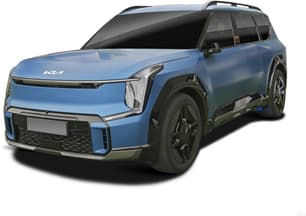
The Kia EV9 has landed and it’s a big bruiser-looking thing; all squared edges with a healthy dose of swagger thrown in.
It’s an upper-large SUV that can comfortably host a family of seven and features trimmings to rival a Christmas tree but it’s also the most expensive Kia to ever launch in Australia.
Did I mention it’s also only one of two cars in its class? That’s right, the nearest competitor is the all-electric Mercedes-Benz EQS450 SUV.
Yep, the Kia EV9 is fully electric but built like a tank. Yet is it breaking new ground or is it just the Carnival dolled up and sitting on electric underpinnings?
I’ve been driving it for the a week with my family of three to find out.
Those big auto executives have good reason to be worried, because the Seal is yet another impressive offering from China’s most formidable EV player.
It’s not perfect. In some ways it’s trying too hard to be a luxury car, and I think the software in particular could use a little work, but the Seal just does so much right I think it will be hard to be disappointed with one, particularly given its keen entry price.
In fact, if we had to pick one from the range, it would probably be this mid-spec Premium. The range and power on offer are stellar, and all for less money than an entry-level Model 3 or Polestar 2.
The Kia EV9 GT-Line earns some serious family points with its practical and luxuriously appointed cabin. Each row enjoys ample amenities and space and you can’t discount the ability to fit five child seats!
That’s where similarities with its Carnival sibling end because the driving performance is too mixed for my liking. Some of its safety features don’t react well in real-world situations but if you’re looking for an electric car that will fit a big family, this ticks that box.
My son thinks the EV9 is really cool with the ambient lighting and two sun roofs. He also loves having his own climate control and sun-blinds, so he gives it a 10/10.
The Seal looks great. It’s about as modern a take on the traditional three-box sedan as you can get. It’s low-slung with curvy lines and a sporty overall feel.
The design touches, like the headlight and DRL surrounds, side skirts, and wheels are maximalist compared to the minimalist vibes of the Model 3 and the Polestar 2. But I don’t necessarily think that's a bad thing as it offers buyers a genuine alternative.
I also like the way the brand has executed the LED lights and particularly the tail-light fittings. There’s also an admirable restraint when it comes to badging compared to a lot of this car’s Chinese rivals. It doesn’t give off the vibe of a cut-price product at all.
Inside there are elements which are appealing, and some things which fall short. First up, I do think the Seal wears its influences throughout the industry on its sleeve a bit.
The digital dash cluster theme, for example, seems to (poorly) emulate the Mercedes-Benz software, the little plastic crystal shifter piece on the inside seems to have been overtly influenced by a similar (actual crystal) piece available in Volvos, while the centre screen and dual wireless phone chargers are pretty obviously BYD’s take on the similar bits available in the Model 3.
Maybe in this sense, it’s trying a little too hard to be a luxury car and a tech-heavy electric vehicle, with items which aren’t quite up to the same quality (particularly the software). But then, it all works well enough, and can you complain at the price?
One thing I think BYD gets right though is the level of comfort on offer in the cabin and the clever little styling bits which remind you of its namesake.
The door handle pieces and integrated speaker bits are shaped like a Seal flipper. As are the dash-mounted air vents, and if you look closely even the plastic garnish on the steering wheel looks a bit like a top-down cross section of the animal.
I like it because its subtle rather than in-your-face as some of the Atto 3's design elements are.
The quality is also up to muster, big time. There wasn’t a creak, groan, or rattle from this car’s interior in my entire time with it, including on some of Sydney's worst roads. And the seats, which are designed like absolute thrones, are clad in lovely soft leather. You sink into them. Even the two-tone Alcantara finish through the doors and centre console is thoughtfully placed.
To be frank, the EV9 resembles a Lego car on steroids, but it turns heads. I’ve had more looky-loos peeking into the windows this week than any other car I’ve driven.
Once you get over the (very) square shape, there are some awesome design aspects to be had.
Like the flagship exclusive Matrix LED headlights and 'Ocean Blue Matte' paintwork that feels velvet-like under your hands. The black 21-inch alloy wheels and their aerodynamic covers look futuristic and cool.
The pronounced nose looks wide-set because of the positioning of the tall headlights separated by a strangely blank panel in the middle.
In fact, the whole exterior incorporates a slew of blank panels which reinforce the square look.
The flush auto door handles, big windows and dark roof give some cool-kid cred. The digital side mirrors are not for everyone but as a driver, you get used to them. The tech looks as though it's come straight out of sci-fi movie!
The interior is downright plush with the premium-looking upholstery and customisable 64-colour ambient lighting.
The dashboard has floating panels which create a cool 3D effect and even the badge on the steering wheel is illuminated.
There is a plethora of soft touchpoints throughout and the black headliner helps make the cavernous cabin feel almost cosy.
The Seal has a huge cabin, and in a lot of ways it feels like the large sedans of old. You can sit nice and low in the cabin, and there’s heaps of knee and headroom thanks to its width.
Soft-clad materials for resting your knees and elbows on go a long way towards keeping this car comfortable on longer journeys, and the presence of a digital dash and a holographic head-up display is nice to have compared to the bare-bones dash of the Tesla Model 3.
The wacky rotating central touchscreen feature makes an appearance from other BYDs, but again, it’s a bit silly and I’m not sure how much use you’ll get out of it. Even Apple CarPlay only works in landscape mode, so I didn’t find it useful.
Practicality features are abundant, with a large bottle holder in the doors, and two more in the centre console. One even has a floating floor, so you can push it down to accommodate large bottles if need be.
Dual wireless chargers are always a nice touch, and the bridge-style console has a large pass-through storage area underneath, which also hides the USB-C, USB-A, and 12V outlets. The armrest console box is nice and deep, too.
The back seat is enormous. Possibly one of the largest spaces in this segment. It comes at a cost to boot capacity, but your rear passengers won’t want for space no matter how tall they are.
At 182cm tall I had leagues of airspace behind my own driving position, and the wide cabin, accommodating seats, and flat floor mean the centre position is even useful for a full-sized adult.
Storage comes in the form of three pockets on the back of each front seat, a large bottle holder in the doors, two cupholders in the drop-down armrests, a small tray on the back of the centre console, and a small flip-out cover which reveals a USB-C and USB-A charging port for rear passengers. The rear seat even gets dual adjustable air vents, but no third climate zone.
The massive fixed glass roof looks the business and keeps the cabin airy, just like in the Model 3 and Polestar 2, but I find these big glass fittings tend to cook interiors in the Australian sun.
BYD tells us the tint is so heavy it has a ‘solar transmittance’ of just 16 per cent, but 16 per cent is still a lot in Australian summer. Thankfully, unlike its two rivals, BYD ships the Seal with a fold-out cover screen as standard.
Remember how I said the massive rear seat comes at a cost to boot space? At 400 litres the Seal’s boot is a bit compact, made worse by the fact it’s a sedan and not a liftback, so the access area is a bit narrow.
It could only fit the largest CarsGuide luggage case alongside the smallest one, but not all three including the medium case. This could be a blow to family buyers who need to fit a pram alongside other things.
Under the floor there’s an extra space great for the storage of your V2L adapter and AC charging cable, but there’s also only a tyre repair kit and no spare.
It’s large and you have ample space throughout the car. Even third rowers don’t miss out.
It feels quite van-like with the high seat positioning and extending centre console but you get a great view out of the massive windows.
The electrically-adjustable front seats are very comfortable but the mesh ergonomic headrests are a little too comfy!
The boxy steering wheel is nice to use but cut into my vision of the climate control screen from my driving position. I felt like I was looking around it a lot.
Individual storage is fantastic in all three rows. Up front you get a little pocket in the armrest and a huge shelf underneath the centre console.
The glove box is large, but curiously, has a small aperture. There are retractable cupholders in the centre console utility tray and drink bottle holders in each door.
The middle row has two drink bottle holders, four cupholders, two map pockets and a deep but narrow storage cubby at the back of the centre console.
Third rowers are not forgotten, either, with four cupholders and directional air vents to enjoy.
Amenities are great throughout the car and my son loves having the retractable sun-blinds and his own climate control in the middle row. It’s also an easy car to get in and out of, which we both enjoy!
The middle row's 60/40 split is a practical touch and they can be shifted manually or electrically with a one-touch button for access to the third row.
Speaking of which, there is an okay amount of room for my 168cm (5'6") height in the third row (if you push the middle row forward a smidge). And it doesn’t feel claustrophobic thanks to the wide windows.
If you have a pile of kids to shove in this car, you’ll be happy that this row also features two ISOFIX child seat mounts and two top tethers.
I wouldn’t want to be climbing into the third row to buckle in a kid, so reserve these seats for older kids.
The technology looks good but is simple to use which is always a good combination. There are plenty of charging options to choose from with each row getting two USB-C ports, while the front also enjoys a 12-volt socket and a wireless charging pad.
The touchscreen multimedia system is responsive and easy enough to use but the controls on this panel can be difficult to see and use. They’re not always responsive.
I like the satellite navigation and the way the head-up display pulls through the directions. There’s wired Apple CarPlay and Android Auto, too.
The digital instrument cluster is mildly customisable and easy to read. There is a little control panel on the driver’s door which houses the buttons for most of the added seat functions. But it’s hard to read as all the buttons are almost identical.
The boot is a good size when all seats are in use at 333L, which is plenty for my day-to-day errands, but pop the third row down and that jumps up to 828L.
Not as big as you might expect in a car of this size but that’s the compromise of going electric. The batteries have to go somewhere.
You do get a 52L frunk at the front, for cable storage. The loading space is level and you only get a tyre repair kit rather than a physical spare but it’s handy having the powered tailgate.
Just like its Model 3 rival, the Seal arrives in Australia in three variants - the base Dynamic, top-spec Performance, and the one we’re looking at for this review, the mid-spec Premium.
Price is, of course, BYD’s forte, with this mid-spec Premium (equipped with a long-range battery) even managing to undercut the entry-level Model 3 RWD.
Before on-road costs and state-based incentives you can have one of these from $58,798, while (at the time of writing at least) the enormously popular Model 3 RWD weighed in at $61,900. Its next closes rival, the Polestar 2 Standard Range, costs from $67,400, so value here is obvious.
The Premium’s long-range battery allows a WLTP-certified driving range of 570km between charges which is even one of the longest cruising ranges available on any electric vehicle in Australia right now.
The list of standard features is exhaustive, including 19-inch alloy wheels, LED headlights, a massive 15.6-inch multimedia touchscreen with wired Apple CarPlay and wireless Android Auto, a 10.25-inch digital instrument cluster, a holographic head-up display, dual wireless phone charging bays, built-in navigation and connected services, ‘genuine’ leather seat and wheel trim (a blend of synthetic and real leather), an eight-way power-adjustable seat for the driver, ventilated and heated front seats, dual-zone climate control, a fixed panoramic glass roof and keyless entry with push-start ignition.
The Seal also gets an impressive array of standard safety kit. More on this later.
The only options are premium paints and an alternate light blue theme for the interior which cost $1500 each.
This list of kit would even be impressive on a combustion car at this price, so the fact it’s also electric and offers one of the longest driving ranges on the market is a bonus.
The one area where I think it lacks a little is the stock software. It looks okay and, to be fair, functions a lot better than its Chinese contemporaries and even some other brands, but once you dig into it a little there are some clumsy menus, and it becomes painfully obvious it’s a simple Android reskin. A swing and almost a miss for something so integral to a car like this.
Why is it called the Seal? Well, in BYD’s home market of China, its range is so expansive it has split it up into two model lines, the Dynasty series (named after historical Chinese kingdoms) of which the Atto 3 is a member (it is called the Yuan Plus in China), and the Ocean series which the Seal and Dolphin belong to. The next BYD to arrive in Australia, a mid-size SUV likely to be called the Seal U, also belongs to the Ocean series.
There are three variants for the EV9 and our test vehicle is the flagship GT-Line model that will cost you $121,000, before on road costs. That makes it the most expensive Kia to date, with the top-spec Carnival Platinum diesel only costing $67,580 (MSRP).
However, it’s nearest rival, the Mercedes EQS450 SUV, sits at $194,900 making the EV9 look downright cheap with the $73,900 price difference.
Yes, you could argue the badges would always offer a little price difference but Kia has made a true flagship model in the GT-Line because it is stupidly well-specified. It’s almost a case of what doesn’t it come with!
In terms of luxury appointments, occupants enjoy two sunroofs and two-toned synthetic leather upholstery. The electric front seats feature heat and ventilation functions, adjustable lumbar support and the driver gets a massage function.
The front seats have a relaxation mode, which I liken to the reclining seats in business class (someone send me on a trip to confirm!).
If you recline, add the sounds of nature feature and pop on the massage function, it’s like you’re in a day spa. Delightful.
The middle row outboard seats are also heated and ventilated which adds a lot of comfort and there’s a heated steering wheel, too.
Other standard equipment includes 21-inch alloy wheels, flush door handles, digital side mirrors, privacy tinted rear glass, pixel matrix LED headlights, 14-speaker Meridian premium sound and remote parking assist.
Practical features include a powered tailgate, extendable sun visors, retractable sun-blinds and three-zone climate control.
The technology is upmarket with dual 12.3-inch digital screens covering instrumentation and multimedia. There's also a 5.0-inch ‘quick-look’ climate control panel. A full tech run-down will come later.
Each Seal variant gets its own drivetrain outputs, and the mid-spec Premium drives the rear wheels with a 230kW/360Nm electric motor via a reduction gear.
On paper, it’s slightly more powerful than the Model 3 RWD, with more power and less torque than the Polestar 2 Standard Range.
The EV9 GT-Line is a pure-electric AWD with dual motors, one located at each end of the car, producing a maximum power output of 283kW and 700Nm of torque. It has a lithium-ion battery with a big capacity of 99.8kWh.
Overall, the EV9 GT-Line is powerful and capable of sprinting from 0-100km/h in just 5.3 seconds. That’s impressive for such a heavy car with a 2500kg (braked) towing capacity.
Providing power is a sizable 82.56kWh lithium-ion battery pack, using BYD’s signature weight and space-saving ‘Blade’ form-factor, and the more affordable LFP (lithium iron ferrophosphate) chemistry.
On the charging front, the Seal Premium can top up at 150kW on a DC unit (using a Type 2 CCS connector) for a 10-80 per cent charge in roughly 40 minutes, while on AC its a disappointing 7.0kW.
The 7.0kW inverter means it’s hardly worth plugging the Seal in at a slow public charger when you visit the shops, as you’ll only get about 50km of range an hour. It’s for this reason most cars with batteries this size have 11kW inverters.
Unlike the Model 3 or Polestar 2, though, the Seal features a V2L system, allowing you to power household appliances from its Type 2 charging port.
Claimed energy consumption for the Seal is 14.6kWh/100km which is low, and about what we were seeing on test. It’s a little hard to tell because the trip computer only offers total consumption over the entire life of the vehicle, or for the last 50km, but not for a set trip interval. Weird.
It's a hulk of a thing to have to move around and the motors perform brilliantly, but my energy cycle figure surprisingly came out at only 21.4kWh, after mostly open-road driving.
The official combined energy cycle is 22.8kWh, so that's a solid result.
The driving range is up to 505km, which takes the sting out of any range anxiety.
The EV9 features a Type 2 CCS port as well as an 11kW AC charger and you can get from 10 to 100 per cent in just over nine hours.
On a 50kW DC charger, you’d see that time drop to just 83 minutes to get from 10 to 80 per cent and it will shrink to 24-minutes on a 350kW charger.
A cool feature is the vehicle-to-load capability, so you can charge and/or power larger appliances on the go. Hello camping!
I wasn’t expecting the Seal to impress me particularly. After all, it’s in this segment against tough competition, amongst recently updated versions of the Model 3 and Polestar 2, and while the previous BYDs I’ve driven have been a cut above their Chinese contemporaries, they also haven’t done a lot to stand out from the crowd.
Clearly, though, BYD has something to prove with its sporting sedan and the Seal is immediately impressive. The cabin is quiet and refined, the seating position is great it's smooth from take-off.
The steering has an artificial tinge to it removing a bit of feedback from the road, but proves at least quick and accurate at speed, and the handling is superb.
I kept pushing the Seal in my test drive, expecting gnarly characteristics to surface but they didn’t. This sedan grabs onto the road with excellent control and traction at the rear, spurred along by its long wheelbase, and improved tyre choice (Continental rather than the sub-par Chinese rubber worn by the Atto 3 and Dolphin).
While on paper it appears to have at least comparable motor output figures to the Polestar 2 and Model 3 - the Seal Premium doesn’t quite feel as rapid, its electric motor having a more relaxed vibe and responsiveness when you stomp on the go pedal.
This can be tweaked a little by dialling it up to Sport mode, and while it still doesn’t feel quite as breakneck fast as the Model 3, in particular, it’s plenty to be going on with.
The most impressive part of the Seal drive experience, though, is its ride. Ride is a constant problem for EVs as manufacturers go to lengths to tame the additional weight of batteries, but the Seal is the most impressive in its cohort, and by quite a margin.
It’s firm enough to be controlled, but has a lovely soft edge to it, so larger bumps, frequent corrugations, or sharper road imperfections don’t ruin your day.
The Model 3 and Polestar 2, even in their improved forms, are not this good. In a lot of ways the Seal’s suspension tune reminds me of the Mustang Mach-e. It has a soft edge, offset by a bit of secondary jiggle as the car settles, which is its only real blemish.
The Seal has no right being this good. It’s now not just matching its far more established rivals but doing some things significantly better.
Strangely for a large SUV, this car feels most at home in an urban environment. It’s in the city where it feels nimble and easy to manoeuvre. Zippy even, and you don’t notice it’s size.
But it’s a different story on the open road.
At higher speeds there is a lot of movement in the body and thanks to its floaty suspension the amount of roll in corners starts to make it feel cumbersome.
It has the power to handle mountain driving or overtaking, but remains a bit unsure of itself in these situations.
The steering is responsive and concise, which makes for a nice driving experience in the city and navigating a car park.
The cabin gets very little noise thanks in part to sound-absorbing acoustic glass and foam in the tyres. It makes for a fairly pleasant journey overall.
As a passenger, though, I began to suffer motion sickness thanks to the digital side mirrors! Not an issue when I’m driving, but even my husband, who has an iron stomach, commented on how distracting they are.
It’s nice having a column shifter, as it helps open up the storage in the centre console but it can make pressing the push-start button a bit awkward.
The EV9 has a decent 12.4m turning circle and is relatively easy to park. The 360-degree view camera system is clear and I love having the front and rear parking sensors on this big boy.
But to access the front camera, you have to be in Drive. You can’t select it on the touchscreen, which is a pain when you’re manoeuvring into a tight space.
If you’re not confident, the EV9 also features an updated park itself feature which means you can park it remotely from your key fob.
The Seal has an extensive list of today’s active safety equipment, including auto emergency braking (front and rear), lane keeping aids, blind-spot monitoring, rear cross-traffic alert, adaptive cruise control, traffic sign recognition and driver attention alert.
For the most part, these systems aren’t invasively annoying, which can’t be said for many products from rival automakers.
However, the traffic sign recognition and overspeed warning system conspire to intrude with constant beeping.
Mercifully, and unlike the equivalent system in Hyundai products, it’s a distant beep, but a consistent one nonetheless, as the traffic sign system frequently picks the wrong speed for whatever reason, and then chastises you for going over it.
Also, the adaptive cruise control system can’t hold a candle to the Model 3's. The system in the Seal amounts to the usual sort of adaptive cruise in most other cars, whereas the one in the Model 3 (regardless of how you feel about the brand’s outrageous claims) is properly next-level in its lane keeping and distance controls.
The Seal is equipped with seven airbags and was rated a maximum five ANCAP stars to the 2023 standards.
The EV9 has an extensive safety list and the blind-spot view monitor, which pops a video feed of your blind spot onto your dash, is a stand-out feature.
Standard safety items include blind-spot monitoring, lane departure alert, daytime running lights, forward collision warning, side collision warning, rear-cross collision warning, rear cross-traffic alert, intelligent seatbelt reminders, a 360-degree view camera system, as well as front and rear parking sensors.
There are other items but I need to call out their sensitivity issues.
The driver attention monitor doesn’t always activate when you have sunglasses on and alerts you via multiple warning sounds and alerts on the instrument cluster.
The lane keeping aid is rather aggressive, which makes for a jerky on-road experience, and the adaptive cruise control with stop/go functionality isn’t nice to use.
Even on the shorter distance setting, it slows down way too fast when approaching a car in front.
Also, annoyingly, this model features all the warning chimes and alerts that are linked to the traffic sign recognition tech.
Go over the speed limit by one kay, chime. Enter a school zone, several chimes. If the speed sign changes, chime. If the traffic sign changes, you guessed it, CHIME.
Suffice it to say I don’t like this feature.
There's an option in the car set-up menu that turns off the warning sounds but keeps the important sign information. However, it's not permanent and has to be selected every time you turn on the car.
In better news, the Kia EV9 has just been awarded a maximum five-star ANCAP safety rating and features nine airbags which includes curtain airbags covering all three rows and side chest airbags for the second row.
Usually, you only see side chest airbags on the front row, so this is great! It also sports a front centre airbag to protect the front row from head clash injuries.
The EV9 has autonomous emergency braking with car, pedestrian and cyclist detection as well as junction turning assist.
It's operational from 10 to 80km/h but surprisingly, the car-to-car avoidance is only operational from 10 to 60km/h.
That upper speed figure usually sits closer to 160km/h. Unless there is a typo on ANCAPs website…
Families will rejoice that there is a total of four ISOFIX child seat mounts (two in the middle row and two in the third row) plus a total of five top-tether anchor points.
The car is large enough to accommodate five child seats and there’s plenty of room for front passengers when a 0-4 rearward facing child seat is installed on the middle row. It’s pretty much a people mover at this point!
The long-term ownership aspect for a BYD product is still a bit of a mystery as the current crop of cars have only just landed in Australia in the last year or two, but if it offers you any peace of mind, the Seal is covered by a six-year/150,000km warranty with a separate eight-year/160,000km warranty for the battery pack.
In order to avoid having to have a traditional dealer network, BYD has partnered with MyCar to fulfil servicing. Visits to one of these locations is required once every 12 months or 20,000km whichever comes first, and pricing is fixed for the first eight years, working out to an annual average of $299.
The EV9 comes with a seven-year/unlimited km warranty, while its battery is covered for seven years, 160,000km. It’s normal to see an eight-year battery warranty term for EVs, though.
You can pre-purchase a three-, five-, or seven-year servicing plan, priced at $706, $1351 and $1997, respectively.
The seven-year schedule costs an average of $285 per service, which is good, but servicing intervals are more in line with a fuel-based car at every 12 months or 15,000km, whichever occurs first.