What's the difference?
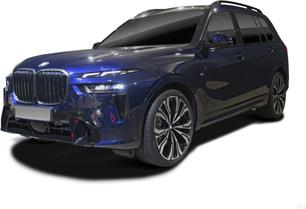
Large family-friendly luxury SUVs tend to be handsome in design but somewhat restrained. Until now. BMW has introduced a major facelift for its flagship SUV, the six- or seven-seat X7. Emphasis on face.
The new X7 adopts the striking but controversial front-end from the new 7 Series sedan, but the big, bold SUV is hiding some rather significant changes under the skin. Aside from a beefier diesel that now comes with mild hybrid tech, there’s also a redesigned cabin, massively upgraded tech, more standard features, oh, and a price increase.
Replacing a popular model is fraught with danger. Existing customers will tell you they love it, while focus groups of non-customers will tell you why they hate it and sometimes carmakers get caught trying to appease both groups.
Sometimes they’ll make it too big or change too much in the search for more sales and ultimately end up removing the elements that made it popular in the first place.
Which is why Audi has been extra careful with some subtle evolution for this new-generation Q3 SUV and Sportback. This isn’t just a popular model for Audi Australia, it has been the best-selling model for the German brand for more than five years, so getting it wrong would be a disaster.
When lined up against its direct rivals, the expensive X7 xDrive40d represents reasonable value for money.
It has a unique and bold look and a sumptuous, visually striking and well-appointed interior that has acres of space for family, friends, or for ferrying frequent flyers to the airport.
That wallop of performance from the big beefy diesel is the cherry on the top. This is how you do a mid-life update.
So is this new Q3 good enough to remain Audi’s number one choice? In a word, yes.
Audi has resisted the temptation that some brands fall into by making too many changes to a proven sales performer. This new Q3 isn’t radically different from the old Q3, but it has improved in almost every way.
It isn’t different enough to widely expand its appeal to a new wave of customers, but there’s no reason it won’t remain Audi’s most popular choice for the foreseeable future.
Note: CarsGuide attended this event as a guest of the manufacturer, with travel, accommodation and meals provided.
There’s quite a bit that’s interesting about the X7’s design. Especially looking at it front on.
BMW certainly took a bold step when it introduced its toothy grille design for the X7 and the 4 Series range.
But the Bavarian brand has made some even braver design moves recently by introducing a blocky front-end with split headlights on its new-gen 7 Series flagship sedan. That look has now found its way onto the face of the updated X7.
As with the 7 Series, it won’t be to everyone’s taste. But you can’t deny it has a lot of presence.
The tail-lights have been tweaked and look good, but the sheer size of the X7 - it’s 5.2 metres long and 1.8 metres tall - means there’s no disguising the fact that it is a big, boxy SUV.
Inside the update ushers in significant design changes. The old dash and cowl is gone in favour of the ‘Curved Display’ that connects the instrument cluster and multimedia.
New slimline air vents, LED backlit ‘X7’ graphics on the passenger side of the dash, and a new gear shift toggle that replaces the old shifter elevate the cabin and give it a much more modern vibe than the old X7 - one that’s in keeping with the excellent iX electric SUV.
The brief to the designers was seemingly pretty simple - don’t mess with a good thing.
According to the company, they want it to be recognisable as an Audi from 100m away, but at the same time, it makes sense not to make any radical changes to a design that is clearly a hit with buyers.
There’s still a new grille, which is slightly larger, while the daytime running lights (DRLs) are now mounted high, on the top corners of the front fascia.
Audi prides itself on its lights and the Q3 features multi-segment DRLS, with dynamic light effects, plus the rear badge lights up red with the tail-lights are turned on.
Digital matrix LEDs are available as an option on the quattro grades, which is a first for such a small Audi. While based on the technology already deployed in the bigger, more expensive Audi models, this is an updated system with micro LED matrix capabilities that are better able to light up the road ahead without blinding cars ahead or oncoming.
One very noticeable element to the design of this new Q3 is the size - which hasn’t really changed. Audi has resisted the temptation that so many brands have to upsize a compact model and has instead retained the same size that buyers clearly find appealing. It is slightly longer, approximately 4cm, but is still unmistakably a Q3 in looks and size.
Inside the Q3 is a different story, with the designers clearly empowered to create more change. The elements remain similar, but there have been more dramatic changes compared to the exterior to keep the Q3 looking contemporary and luxurious.
For example, there are still two large screens, just like the old model, but the virtual cockpit and multimedia screen are integrated into the dashboard together and more prominently, moving higher up the centre fascia.
It works well, as the interior looks and feels premium, and very much an Audi, albeit on a smaller scale.
To cap it off there are four interior colour packages to choose from, plus four different choices for the inlays, including two real wood options and an aluminium trim.
Regardless of the price point, a three-row SUV needs to be super practical and capable of family duties.
And if you want a BMW X5 but need a lot more space, this is the next logical step.
Let’s start in the front row. As mentioned, the new X7 gains the screen and tech set-up from other new BMW models like the iX and updated 3 Series. The Curved Display combines a 12.3-inch digital instrument cluster with digital speedo and a 14.9-inch multimedia screen.
You can customise the cluster layout and move things around on the multimedia screen, too. The latter is a touchscreen but you can also find what you need via the 'iDrive' controller in the console.
I have had some experience with this system in the iX and while it’s not without its flaws, it is a top notch system. There’s a lot to wrap your head around, but the use of app icons helps. And you can swipe through to your chosen screen.
It took far too long to work out how to find the trip computer, something that should be much easier to access, as well as a couple of other functions. And the climate controls are housed in the digital screen. I would always prefer a separate space with buttons for air-con.
But the graphics and displays - including the excellent head-up display - are excellent.
Other tech you get with the X7 includes the BMW’s 'Digital Key', which is an app that allows iPhone users to lock and unlock their car remotely, and BMW ID driver profile.
If you buy this car, just allow yourself some time to familiarise yourself with all that tech.
Elsewhere up front there’s a lovely new three-spoke steering wheel, and cute touches like the metal air vent toggles, black and metal touches and the choice of inserts.
The front seats are luxurious and comfortable and offer loads of side and thigh support. They have memory functions, too. There’s no shortage of headroom up front, either.
Storage-wise, the door will fit the largest of bottles, as well as other items thanks to generous door bins, while the central lidded box is also sizeable.
What about that second row?
The X7 xDrive40d usually comes standard with seven seats, but our test car was fitted with the $1500 captain’s chair option which drops seating capacity down to six people.
If you need the extra seating this is not the option for you, but it is great for families with bigger kids, and it would make for an excellent airport transfer car.
The seats are unbelievably comfortable and can be adjusted to suit your preference. They also have ISOFIX points and armrests.
Rear seat occupants have access to their own climate controls, air vents, USB ports, cupholders and ample door storage.
There is a massive amount of occupant space as well - stretch those legs out and enjoy it!
One of the X7’s selling points is that it is a genuine three-row SUV. That third row is not just for occasional use for very small children, like so many seven-seat SUVs. That row can be used every day.
Even with my six foot stature, I could easily climb in and out of the third row. That’s made even easier thanks to the mechanical seat functions.
Just hit the lever at the top of the second row seat and the motor moves the seat forward and up to ensure there’s a big enough aperture to get in and out of the rear seats.
You can also raise and lower the third row electronically via buttons on the boot wall - and they stow flush into the boot floor. Neat!
Once in the third row, there’s air vents, USB ports, bottle holders and storage and quite comfortable seats with more than enough leg and head room.
There’s even a third row section of the sunroof, operated from the second row. Lots of clever touches that people who use the third row will appreciate.
The boot has a few cool features, too, including a split tailgate.
You can even sit on the lower section - it can handle a load of up to 250kg - a perfect place to sit and watch the polo.
You can lower the suspension to aid loading larger items, and the X7 comes with a space-saver spare wheel.
Capacity is 300 litres with all seats in place, and I easily fit a pair of smaller suitcases in with that configuration. It increases to 2120L with the two rear rows folded.
The biggest change to the interior is the technology, with a new multimedia interface with new, larger tiles as well as new ‘Control Unit’ for the key driving functions.
The ‘Virtual Cockpit’ display is much simpler, with a nice, clean look, plus the option to have the satellite image on the screen, whether you’re in navigation or not. The multimedia screen is a good size (12.8 inches) and the menus are easy to navigate. The decision not to have physical controls for the climate control is disappointing, but thankfully there is a volume/on-off dial for the sound system.
The most notable difference is the so-called ‘control unit’ that integrates the indicators, wipers and gear selector on a single ‘bar’ mounted to the steering column. It’s another example of modern cars reinventing something we’ve all become accustomed to, but after a day of driving it quickly becomes second nature to adapt to the slightly different controls.
While it may be the same size, Audi has managed to find more room inside, particularly the rear, by redesigning the door pockets and sculpting out the seat backs. It’s still not the roomiest cabin, but the rear seats will be fine for younger families, couples and singles.
Another plus is the 40:20:40 split/fold rear seats for maximum practicality and adaptability, while all three have child seat anchor points (although if you do have three small children, I wouldn’t be recommending an SUV this size).
As for the boot, because Audi only measures to the top of the seats, it measures 488L in both the SUV and Sportback variants, so you’re not missing out on day-to-day practicality with the sportier-looking roof. However, if you drop the rear seats the cargo capacity expands to 1386L in the SUV but only 1289L in the Sportback.
We are way out of Kluger and Sorento territory with the BMW X7. This is a bus for cashed-up families.
The upper-large SUV was introduced in mid-2019, but as part of the mid-life update, BMW has changed up the model grades. There are still two, but the xDrive30d and M50i have been replaced by the diesel-powered xDrive40d M Sport, and the performance-focused V8 petrol-powered M60i.
For the purpose of this review, we drove the 40d M Sport, which gets a power boost over the outgoing 30d - more on that in a bit.
As a result of the significant update, BMW has increased pricing on both grades. For the xDrive40d, it now starts at $174,900, before on-road costs, which represents an increase of more than $30,000 over the old 30d.
If you’re after a bigger dollop of performance, the M60i will cost you $205,900.
While the xDrive40d pricing seems steep, it undercuts a couple of other big luxury diesel SUVs including the Mercedes-Benz GLS400d ($179,500 BOC) and the Toyota LandCruiser-based Lexus LX F Sport ($176,091 BOC).
The most affordable diesel-powered version of the new-generation Range Rover starts from $226,806, so in that regard, the X7 40d is the best value in its class!
As well as the updated powertrain and in-car tech, the X7 xDrive 40d now comes with a hefty standard features list including metallic paint, 22-inch wheels, the M Sport pack, five-zone climate control, Harman Kardon 16-speaker sound system, a drive recorder, comfort seats, ‘Comfort Access’, roof rails, electric sunblinds, panoramic glass sunroof, digital radio, a head-up display, ambient lighting, wireless Apple CarPlay and Android Auto, and leather interior.
Our test car was fitted with a number of options that pushed the price to just under $185,000. The extras included huge 23-inch alloy wheels ($3500), BMW Individual 'Dravit Grey' body paint ($2400), a trailer tow hitch ($2500) and second row captain’s chairs ($1500).
Note that if you opt for that tow hitch, you’ll lose the ability to open the hands-free tailgate with a kick motion.
A key to the popularity of the Q3 is the variety of choices available to customers. By offering a mixture of variants at different price points and with different levels of performance expands the appeal of the Q3 to as many potential buyers as possible. To that end there are no less than 10 variants to choose from, and that’s just for now, with more likely to join in the future.
At this stage the range includes both SUV and Sportback body styles, the choice of a 110kW, 150kW or 195kW engine with front- or all-wheel drive (or quattro, as Audi calls it). While still not confirmed, both a plug-in hybrid and a high-performance RS Q3 are both likely additions sometime in the future.
Starting with the 110kW model, standard equipment includes 18-inch alloy wheels, adaptive LED headlights, ambient interior lighting, keyless entry and ignition, leather-appointed upholstery and a 10-speaker sound system. The 110kW SUV is priced from $61,600 and the Sportback from $64,600.
Moving up to the 150kW quattro variant adds adaptive dampers, which the 195kW models also get, as well as 19-inch alloy wheels, and there’s an optional premium Sonos system for the more powerful models and a panoramic glass sunroof and a head-up display as part of a $4400 option package. Pricing for the 150kW begins at $70,200 for the SUV and $72,700 for the Sportback, while the 195kW is priced from $81,900 (SUV) and $84,400 (Sportback).
There’s also a Launch Edition available which adds between $5400 and $4400 to the price (depending on variant), but includes the S line exterior styling package, black exterior highlights, metallic paint, red brake callipers, a sound actuator and adaptive dampers. As the name implies, these are only available for launch of the new model, so will only be produced for the first two months.
It should also be noted that standard 110kW models won’t arrive until mid-year, once the factory in Europe is done producing the Launch Edition variants.
The X7 xDrive40d is powered by a 3.0-litre, in-line six-cylinder turbo-diesel engine, that gets a boost in power - it pumps out 259kW of power and 720Nm of torque - 64kW/100Nm more than the 30d.
It now also comes with 48-volt mild hybrid tech, which uses an electric motor integrated in the eight-speed automatic transmission.
It drives all four wheels via BMW’s 'xDrive' all-wheel drive system and it is fitted with air suspension for a cushy ride. Towing capacity is rated at 3.5 tonnes braked or 750kg unbraked.
If you are keen on off-roading in the X7, it has a 221mm ground clearance, and a fording depth of 500mm, but maybe best to keep it on the tarmac.
As mentioned above, there are three powertrains to choose from initially, with talk of a plug-in hybrid and hi-po RS Q3 just that (talk) for now.
The entry-level SUV and Sportback get a new 1.5-litre four-cylinder mild-hybrid, turbocharged petrol engine, which makes 110kW/250Nm and sends all that performance to the road via the front wheels through a seven-speed, dual-clutch automatic transmission.
Next up is the TFSI 150kW quattro, which is a bigger 2.0L turbo-petrol four-cylinder, producing (you guessed it) 150kW and 320Nm. It also has a seven-speed dual clutch but also unsurprisingly has a quattro, aka all-wheel drive.
Finally there’s the TFSI 195kW quattro, which has the same engine but tuned to make 195kW and 400Nm, also with the seven-speed, dual-clutch auto and all-wheel drive.
This is naturally the quickest Q3, at least until the RS Q3 arrives, taking just 5.7 seconds to accelerate 0-100km/h, compared to 9.1 seconds for the 110kW and 7.1 seconds for the 150kW.
According to BMW, the official combined cycle fuel figure for the X7 40d is 8.0 litres per 100 kilometres.
Our fuel figure after nearly a week of mixed city, freeway and country driving was 9.0L/100km, which isn’t too far off the mark.
It has an 80 litre fuel tank and an approximate driving range of 1000km.
While it may only be a mild hybrid, Audi has done its best to make the TFSI 110kW as fuel efficient as possible. To that end, in addition to the hybrid help this new 1.5-litre engine also features cylinder-on-demand.
The result is a claimed combined cycle fuel use figure of 5.7L/100km for the entry-level model.
Naturally the more powerful engines require more petrol. The 150kW models are rated at 7.3L/100km, while the 195kW has a claimed 8.1L/100km.
It’s worth noting that all three engines require a minimum 95 RON ‘premium’ fuel, which will only add to the cost at the pump in these times of high prices.
The 110KW/150kW models are fitted with a 55-litre fuel tank, while there is a bigger 60-litre tank for 195kW. That means theoretical driving ranges of approximately 960km for the 110kW models and just over 740km for the 150kW and 195kW offerings.
With a big plush SUV like this, you’d expect a comfortable ride. And for the most part, the X7 delivers that, while offering more than a bit of grunt, as well.
The X7’s height ensures a high driving position, and there’s plenty of glass for decent visibility.
Propelling a 2.5-tonne SUV could be a struggle for a lesser engine, but the meaty diesel offers ample torque and the mild hybrid set-up helps to reduce initial turbo lag significantly - that means it is responsive from a standing start.
I wouldn't have thought a vehicle of this size and shape was capable of a 5.9-second 0-100km/h time, but here we are.
As a result of all that torque and power, overtaking is a breeze - providing there is enough room on the other side of the road for both cars to fit.
That size and heft have an impact on cornering and dynamics. You simply can’t carve through tight corners in this car, but with that said, it’s more entertaining than you’d think.
Steering feel is weighted on the heavier side and it’s as sharp as it needs to be in a car like this. It would be weird if the steering was too pointy.
Ride quality is top notch - as it should be - and while the massive optional 23-inch wheels and low profile tyres mean you’ll notice potholes and the like, it largely soaks up imperfections with ease.
That level of refinement extends to the hushed ride, too. The cabin is a quiet and serene place to spend time - but not quite to the same degree as a 7 Series.
Parking in tight spots is a challenge, and manoeuvring in narrow streets could take a while, too. But you could tell that just by looking at the X7.
While it may not be an RS model or a more dynamic sedan, part of the price premium you pay for an Audi is a more polished driving experience.
With that in mind, what Audi calls ‘Progressive steering’ (which is a variable ratio steering rack) is now standard across the range. This decision was driven by a desire to make the Q3 feel ‘more hatch-like’ to drive, being more responsive to driver inputs.
It certainly felt quite nice to drive at the launch, where we drove across a wide variety of conditions, including long stretches on winding mountain roads. The 110kW Launch Edition was enjoyable to drive in these conditions, even if the other two options offer a sportier driving experience with their extra power and all-wheel drive.
It should be noted again, we only drove Q3s fitted with adaptive dampers as those are included on the Launch Edition, so we can’t tell you how the true entry-level TFSI 110kW model rides and handles.
One minor concern was there were some rattles in one of the three cars we tested, centred around the dashboard and front doors. It’s notable because we have experienced similar potential build-quality issues with Volkswagen and Skoda products recently. This raises some questions about an area Volkswagen Group products have traditionally excelled in.
Having said that, it was only a problem in one of the three cars we drove, so it could be an isolated incident. But it’s something we will have to keep an eye and ear open to in future test drives.
The X7 has size on its side when it comes to occupant protection, but it also comes with a decent level of safety gear as standard.
Features include auto emergency braking (AEB) with pedestrian and cyclist detection, a safe exit assist function to avoid 'dooring', and an advanced lane keeping aid, ‘Parking Assistant Professional’, ‘Trailer Assistant’, and hill descent control.
The X7 is yet to be crash tested by the local safety authority, ANCAP, or by Euro NCAP.
Audi claims this is the safest Q3 ever, with more safety equipment than before to ensure it meets modern customer demands.
There’s a 360-degree camera setup, reversing camera, adaptive cruise control and a host of other active safety features. But perhaps more importantly than just having these systems, they are locally tested and calibrated for local conditions.
This has quickly become an area where the premium brands are separating themselves from the mainstream. In the case of the Q3 we found that the lane keeping assist and adaptive cruise control worked better than your average mainstream model, so the local testing appears to have paid off.
Another safety feature worth mentioning is the new parking assistance system, which now includes ‘reversing assist’. This new technology can remember the last 50m of your trip and reverse backwards without your help. There’s also ‘trained assist’, which can learn up to five specific parking situations, that you can program and save. So, if you have a particular driveway or parking spot you can teach the car once and it can park itself in future.
The Q3 comes equipped with enough safety to score a maximum five-star rating from Euro NCAP and ANCAP. However, in a confusing twist, this is based on testing done to the 2025 protocols, even though the Q3 has only gone on sale in 2026. So future five-star ANCAP models will have been tested to a theoretically higher standard, which is something to consider when comparing models from other brands.
After copping a bit of flack from motoring media and buyers, BMW finally increased its warranty terms last year from three years to an industry standard five-year, unlimited kilometre warranty on its vehicles, including the X7.
Rather than a set servicing schedule, BMW offers condition-based servicing which is when the vehicle’s computer alerts the owner that it requires a service.
BMW doesn’t offer capped-price servicing, but does have a pre-paid 'Service Inclusive Package' with terms ranging from three years/40,000km to five years/80,000km and beyond.
A five-year basic package for the X7 costs $2800, which is not too bad considering the positioning of this model.
The Q3 is covered by Audi Australia’s standard five-year/unlimited kilometre warranty. This includes five years of roadside assistance too.
There is a standard five-year servicing plan for $3300, which is the same as the outgoing model, with servicing required every 12 months or 15,000km, whichever comes first.
Audi has an expansive, nationwide dealer network befitting its place as an established sales leader in the premium space.