What's the difference?
To say the BMW M4 CS is a hot ticket in Australia is something of an understatement.
Consider this. There is an even more expensive one, the M4 CS Edition VR46 – at a cool $346,900 – and it sold out in less than an hour. Now, granted, Australia only got four examples, but still, demand was running hot.
That car makes this one, the regular M4 CS, seem like an absolute steal. It's only $254,900 (yes, the word 'only' is doing a lot of heavy lifting in that sentence), and it shares the same upgrades, and makes the same monstrous power, as the VR46 – for Valentino Rossi’s 46th birthday – only it does it for around $100K less.
See? A bargain. At least, that's how I'd be justifying it to myself if I had a quarter of a million burning a hole in my pocket.
So, this or a Porsche 911? Read on.
Jeep Australia's first plug-in hybrid, the Grand Cherokee 4xe, has arrived at a time when the company’s sales figures need a decent shot in the arm.
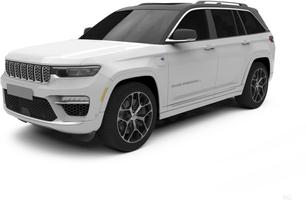
Though it’s seemingly spearheading a large and extra-large SUV hybrid push into the Aussie market, with the likes of a Toyota LandCruiser 300 Series hybrid on its way, the marque’s debut PHEV is only available here in the range-topping Summit Reserve spec, and only as a five-seater.
So, does the 4xe have enough of a jump on any large SUV hybrid rivals – including a rumoured but postponed Ford Everest hybrid – and is it enough to give the brand a much-needed boost?
Read on.
Brutal, bruising and utterly brilliant, the M4 CS will be an acquired taste due to its no-compromise approach, but those willing to take the leap will find a performance car like few others at their disposal.
A wise man* once said "Being first can sometimes feel like being wrong" and perhaps that's how it is with the 4xe, but at least Jeep Australia is giving the large SUV hybrid realm a good ol' try.
* Former CarsGuide Big Kohuna, Glen Knowles.
The company's first plug-in hybrid, the Grand Cherokee 4xe, is not perfect by anyone's standards, however, it is a definite move in the right direction.
It's a quiet and refined drive, it retains the brand's renowned 4WD capability, and even its hefty price-tag likely won't dissuade Jeep loyalists from giving it a go.
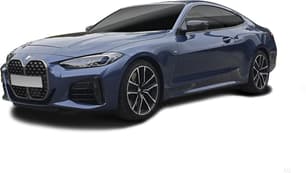
The M4 CS is familiar in all the right ways, but definitely looks significantly jacked up compared to its lesser siblings.
Part of that is the extensive use of carbon everywhere, from its bonnet panels to its roof, front lip, side skirting and boot spoiler. But also because of its super-muscular angles and creases, including the huge dome in its bonnet.
Also exclusive to this M4 CS is the light treatment, with the front LEDs lighting up with yellow highlights the brand says are supposed to be reminiscent of GT racing cars.
At the back, the rear lights are flush with fibre optic lighting, lending a flowing and unique light signature that looks epic at night.
Inside, it's a sea of carbon, with the lightweight racing seats, the dash inserts and the centre console all lined in it. It is a perfectly finished space, though, and one that's also flecked with red, including a 12 o'clock band on the thick-rimmed steering wheel, the seat backs, the contrast stitching and the paddle shifts.
Be warned, though, it takes some acrobatics to climb into or out of the CS. The seat bottoms have these super high edges that double as grab handles, but require some awkward contortions to navigate.
In short, it looks angry, this M4 CS, inside and out.
It all boils down to how you classify practicality in a car like this. I mean, the basic stuff is all there – it's got two doors, four seats and a boot capacity of 440 litres.
It measures 4801mm in length, 1918mm in width and 1399mm in height, and room for front seat riders is good, but less so for anyone you squeeze into the back. There are even ISOFIX points for a child seat.
But if you consider practicality the practical pursuit of performance, then the M4 CS has plenty of perks.
The Jeep Grand Cherokee Summit Reserve 4xe PHEV retains the regular model’s level of functionality but adds a reasonably classy touch to everything.
All seats offer adequate comfort, support and room.
There are plenty of storage spaces, cupholders etc, and charging points - two USB-A and two USB-C plus a 12V socket in the front and two USB-A and two USB-C plus a 230V point in the back.
Controls are generally easy enough to locate and operate although some buttons are positioned in awkward places – including drive-mode buttons under the steering wheel – and it sometimes takes a few finger-stabs at the multimedia touchscreen to get to where you want to go in the operating system.
In terms of packability, the rear cargo area has a listed 1067 litres of space, and, with the second row folded and out of the way, that space opens up to 2004 litres.
We're talking a $254,900 entry price for the M4 CS, which – despite my attempts at justification – is a lot. Remember, the regular M4 is $168,700, and the M4 Competition is $186,500, so we're talking a sizeable premium here.
BMW justifies that price increase in two ways. The first is scarcity, with the M4 CS limited to just 50 examples in Australia. And the second is by dialling up every aspect of the M4's performance to terrifying levels.
The engine outputs are up, the weight is 20kg down, there are better brakes, better seats, a louder exhaust, a stiffer chassis – it goes on and on.
We'll get to some of the performance stuff in a moment, but here's what else your money buys you with the M4 CS.
It starts outside with staggered alloys, 19-inch up front and 20-inch at the rear, wrapped in track-ready rubber. There's also hi-po 'M Compound' brakes with red calipers, lightweight carbon racing seats that are heated up front, an Alcantara-trimmed steering wheel, the 'M Carbon' exterior package with carbon bonnet and roof, adaptive 'M Suspension' and a titanium exhaust that howls like the winds of hell.
The less performance-focused stuff is similar enough to the other M4 models including a 12.3-inch centre screen with digital radio, Apple CarPlay and Android Auto, a second 14.9-inch screen that handles your driving data and a head-up display. There's also twin-zone climate control, Merino leather upholstery and ambient interior lighting.
But all of that is secondary, really. This is about performance, specifically of the brutal kind.
The five-seat Jeep Grand Cherokee Summit Reserve 4xe PHEV has a MSRP of $129,950 (excluding on-road costs).
Standard features include a 10.1-inch multimedia system (with Apple CarPlay and Android Auto), a 10.25-inch digital instrument cluster, 19-speaker audio system, quilted Palermo leather-trimmed seats, air suspension and 21-inch alloy wheels.
It also has a heated steering wheel, 12-way power-adjustable seats and four-way power lumbar adjustment with memory for driver and front passenger, driver and front passenger seat massage function and heated and ventilated seats (driver, front passenger and rear outboard passengers).
A Mode 2 charging cable is also included.
An 'Advanced Technology Group' pack is available as a $5500 option and that includes a head-up display, a 10.25-inch screen for the front passenger, wireless phone charger, and night vision camera.
Exterior paint options include 'Bright White', 'Diamond Black', 'Silver Zynith', 'Velvet Red', 'Baltic Grey', 'Rocky Mountain', 'Midnight Sky' and 'Hydro Blue'.
BMW has found yet more grunt lurking in its trusty 3.0-litre 'M TwinPower' six-cylinder petrol engine, with the M4 CS now pumping out 405kW and 650Nm.
That's a decent jump from the 390kW and 620Nm served up by the M4 Competition, and a giant leap from the outputs of the 'base' M4 – 353kW and 550Nm.
Predictably, then, the CS is the fastest of the lot, knocking off the run from 0-100km/h in 3.4 seconds, compared to 3.5 and 4.2 in the Competition and M4, respectively. The top speed is also dialled up to 302km/h.
All that power is channeled through an eight-speed automatic and sent to all four wheels on demand, with the help of an 'Active M Differential'.
The Jeep Grand Cherokee Summit Reserve 4xe PHEV has a 2.0-litre four-cylinder turbo-charged petrol engine, two electric motors (one on each axle) and a 17.3kWh battery.
Combined engine and electric outputs for power and torque are 280kW and 637Nm, respectively. The 4xe has it over any of its stablemates equipped with the 3.6-litre Pentastar V6 petrol engine because that yields 210kW and 344Nm.
The 4xe has an eight-speed automatic torque-converter transmission and regenerative braking.
Drive modes include 'Hybrid' (with combined engine and electric motor providing “maximum instant torque and impressive acceleration”, according to Jeep), 'Electric' (“zero emissions”) and 'eSave' (aims to save battery power).
There are a few options available when it comes time to charge the 4xe.
The 4xe vehicle has a Mode 2 charging cable so you can charge it at home in less than 10 hours, according to Jeep.
With a full charge, the 4xe has a claimed driving range, on electric charge alone, of 52km.
Jeep reckons a Mode 3 (wall box) single-phase electric vehicle charger will fully charge the 4xe in less than three hours.
If out and about and looking for a charge, a 4xe driver can use the onboard 'UConnect' system to locate an appropriate public charging station.
The M4 CS is fitted with a 59-litre fuel tank, which – given the BMW's official fuel claim of 10.2 litres per hundred kilometres – should deliver a driving range on a full tank of 541 kilometres.
But... BMW also says the regular M4 – you know, the one that makes 52 fewer kilowatts and 55Nm less torque – uses 10.1L/100km, so do with that information what you will.
As mentioned, the 4xe has a listed electric-only driving range of 52km.
On our official test day, we drove just under 50km on a full electric charge and then the rest of the trip was courtesy of the good ol’ petrol engine.
Jeep's official figure for the combined cycle is just 3.2L/100km, but that's predicated on keeping the hybrid battery charged at all times. On fuel-only we recorded 11.6L/100km.
The 4xe has a 72-litre fuel tank (you need 95RON premium to fill it), so going by that on-test fuel-consumption figure, you could reasonably expect to get a driving range of about 620km out of a full tank.
Add an approximate electric range of about 50km on a full charge to that figure and you have a total estimated driving range of 670km.
The hardest and angriest M4 of all time is, perhaps unsurprisingly, hard and angry. This is a race track specialist, but because I don't happen to own one of those, my first experience with the barking (and barking mad) M4 CS was navigating my way back from BMW's inner-city dealership.
Like it or lump it, you're going to read some Porsche comparisons here, because you're talking not too far off base 911 Carrera money, and suddenly I find the two Germans doing battle for a spot in my dream garage.
First things first, the BMW won't be much chop for daily driving for most people. Happily, I have a sickness for uncomfortable sports cars. It tells me that no compromises have been made in the pursuit of punishing performance.
A good thing, too, because the BMW, at city speeds, can be punishing. Everything feels heavy, the seats aren't overly comfortable – especially the hard bits that tend to dig in when cornering – and it stiff-arms its way over road imperfections, that exhaust booming and barking as it does.
Again, I loved it, and you probably will, too. But it's still not the kind of car I'd relish sitting in the morning peak hour rush in.
But escape the confines of the city and the BMW M4 CS suddenly makes a whole heap of sense. The acceleration is genuinely brutal, and wonderfully theatrical, with that quad-tipped titanium exhaust barking and snarling as you rocket towards 100km/h.
The steering is brilliant, with feedback fed to your wrists via that thick-rimmed wheel, and the entire experience feels sharp, super engaging and edgy.
You can push the M4 hard and fast, and I'm certain my limited talents would run out far before the BMW's would, but there's this thrilling sense of peril sparked by the aggression of the experience, that I love.
It's like the magic of a roller-coaster, I guess. Even if you know nothing is going to happen, you never really know, right? And in that lies the magic.
But back to original question, this or a Porsche 911? There's no doubt a Carrera is a better all-rounder, in terms of comfy commuting and race track fun, but this angry M4 is all shouty theatrics, all of the time.
I bloody love it.
We’re all time-poor, right? So, why should I take up your time and rattle on about the 4xe for a thousand words when I can get the essence of it across to you, the reader, in a few sentences? Call me, Mr Thoughtful.
This is generally a big, quiet and refined, easy-steering large SUV, but it feels bulky at times and tends to be quite fussy on irregular surfaces, exhibiting a jittery ride on even brief sections of light corrugations on dirt tracks.
The 4xe’s PHEV set-up is smooth and highly responsive on-road and you can switch between the aforementioned drive modes to suit the circumstance.
Driving range on electric only is listed as 52km. I only recorded a total distance of just under 50km, and it’s a very quiet and smooth drive while relying on electric power.
It regenerates power rather quickly down big hills and via braking, but we’d exhausted all electric charge by the time we’d reached our 4WD test track.
As expected, this Grand Cherokee tackled every off-road challenge without any strife.
The air suspension, set to full off-road height, is a bonus.
Our 4WD test track consists of difficult set-pieces, including one small steep rocky hill that I’ve seen heavily modified vehicles struggle to conquer and, to the Jeep’s credit, it climbed the incline, no sweat.
The 4xe’s efforts were only ever hampered by its 'all-season' Continental CrossContact tyres (275/45R21) which are much better suited to blacktop driving and the fact the 4xe costs upwards of $129,950 and I didn’t want to risk any damage to it.
The 4xe has a listed wading depth of 610mm but our test track was dry so I never had the chance to do any water crossings.
The Grand Cherokee has a solid enough rep as a towing vehicle but, take note, the 4xe is rated to tow 2722kg.
Expect no ANCAP rating here, I'm afraid. But the BMW 4 Series does wear a five-star rating from 2019.
The M4 CS gets six airbags (driver and passenger, side airbags, head airbags), along with what BMW calls its 'Driving Assistant Professional', which bundles active cruise control (with stop and go function), front and rear cross-traffic warning, 'Steering & Lane Control' and 'Lane Keeping with Side Collision Warning'.
The Jeep Grand Cherokee Summit Reserve 4xe PHEV has the maximum five-star ANCAP safety rating from assessment this year.
Safety gear includes AEB with pedestrian detection, blind-spot monitoring with rear cross-traffic alert, adaptive cruise control, lane-keep assist, driver monitoring, traffic sign recognition, intersection collision assist, and a surround-view parking camera.
The Summit Reserve spec brings with it 'ParkSense' parallel and perpendicular park assist and (low-level autonomous) 'Active Driving Assist'.
It has eight airbags including front, side, and knee (for driver and front passenger), sides (for second-row passengers) and full curtain airbags.
The Jeep Grand Cherokee Summit Reserve 4xe PHEV has a five-year/100,000km warranty and a lifetime roadside assist service.
Servicing is set at 12-month/12,000km intervals and capped price servicing keeps what you pay for each appointment at $399 for the first five.