What's the difference?
Spoilt. That's what we are. If you're in the market for a hot hatch, you can have your pick of German-built and French ones from as little as $27,000. There isn't a dud among them now that the VW Polo GTI has had a bit of an update and you can pick and choose your style. Audi's S1 is aiming to be king of the kids with its stiffly-priced S1.
Set the finances aside and consider for a moment what's on offer. As it turns out, a lot.
It’s easy to forget BMW was paddling into the growing electric vehicle wave when it was only a gentle swell. It took off early with the i3 city car, which believe it or not has been in the Aussie new car market for six years.
While the German maker has long been developing the concept of electrified powertrains in existing models, the i3 was the result of a dramatically different approach, showcasing the use of exotic materials and innovative packaging.
Like its i8 supercar sibling, the i3 won’t be replaced with a new-generation version, but BMW says it will continue to develop this high-tech hatch before it departs, and we spent a week in the sporty i3s to see how it stands up in 2020.
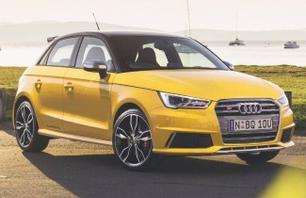
Cars this small shouldn't be this fast and useable at the same time, but the Audi S1 is. It isn't without its problems - the ride is harder even than the Fiesta ST which might weary some prospective buyers.
It's also a bit difficult to justify the price - in its basic form it's missing a few creature comforts that you'd expect in a $50,000 car - reversing camera, high-res screen, that sort of thing.
However, in the hot hatch world, those things don't matter. It has the bragging rights, the tech and the outright blinding speed to take on the bonkers Focus ST and equally zany Megane RS. And even the Audi S3.
Yes, it’s pricey for a small hatch, but this little BMW is a city car like no other. The i3s is tailor made for the urban environment, and six years on retains the quirkiness and charisma that stood it apart at launch, and it can still hold its head high among the current EV crop.
The A1 is so small it starts to strain Audi's design language. When you cram on the S-style bumpers and raccoon-eyed trim on the hatchback, it's starts to look a bit busy.
It isn't quite a shrink-wrapped A3 - Ingolstadt's designers know better than that - but it's full of Audi design cues, such as the strong, light-catching character lines, distinctive LED daytime running lights and fondness for big wheels.
Inside is along the themes of the A3, with what are becoming Audi's trademark; round eyeball air-con vents, the manual fold-down screen familiar to Q3 owners (but smaller) and a good clear dash. The handbrake jars slightly as it feels cheap to hold and wobbles a bit.
The S Sport seats are big and comfortable, and the top half of the backs are capped in plastic, which was colour-coded on our car. The rear passengers will certainly get an eyeful of whatever terrifying hue you've chosen, so choose wisely.
Despite the five doors, the back seats are occasionals, like the Mini the A1 is gunning for, and the boot is very small, but okay for shopping for couples or singles.
Built around a carbon-fibre reinforced plastic (CFRP) tub, the i3s is ultra-light (for a battery-electric vehicle), super strong, and unlike anything else on the road.
At just over 4.0m long, close to 1.8m wide, and a fraction under 1.6m tall, the i3s is compact, upright, and boxy. A classically polarising design, with some crossing the street to avoid it, and others (like me) loving its unique proportions and stand-out styling.
The nose is tall, short and upright, with the distance from the base of the front windscreen to the front axle (car designers call it the ‘dash-to-axle ratio’) unusually short.
That’s because the electric motor sits in the back of the car driving the rear wheels, with only a small front boot compartment required to house charging cables and other bits and pieces.
Despite the lack of anything of substance behind it, BMW’s signature ‘kidney grille’ is present and accounted for, with swoopy LED headlights (and DRLs) either side. Our test car’s ‘Fluid Black’ finish with ‘i Blue’ highlights dialed up the little car’s charismatic personality.
One of the i3’s most impressive party tricks is its counter-opening ‘clamshell’ doors, and the engineering trickery used to create a B-pillar free side opening (including the strength of the carbon body structure) means the high window line follows a jagged path from front to back, the rearmost hatch windows shrinking the rear glass area appreciably.
The i3s’s standard 20-inch (dual) five-spoke alloy rims, although slightly wider in this performance model, are alarmingly skinny. But taking the car’s relatively light weight (1245kg) and urban-centric purpose into consideration, the narrow, low-rolling resistance rubber makes sense.
With the roofline and sides of the car tapering distinctly towards the back, the rear view is suitably idiosyncratic, highlighted by flush-fit, vaguely U-shaped LED tail-lights.
The hatch window is small, and the bumper sits high to marry with the load space floor sitting on top of the motor and transmission.
And when it comes to moving inside, BMW offers a choice of three ‘interior worlds - ‘Loft’, ‘Lodge’, and ‘Suite’ - featuring renewable natural fibres, recycled plastics, naturally tanned leather, and open-pore wood (sourced from 100 per cent Forest Stewardship Council-certified forestry).
But irrespective of where everything comes from, the end result is inviting, comfortable and sub-zero cool. Our car’s ‘Suite’ interior was combined with ‘Oak dark matt’ wood, and ‘Vernasca’ brown leather to stunning effect.
A tunnel-free floor, gently curved dash and digital screens for instruments and media let you know you’re in something different and special. It might be six years old, but the i3 still feels contemporary and distinctive.
Starting at $49,900, Audi S1 is by far the priciest of the small-hatch based hotties, at least until Mini's madcap JCW arrives. This price is just almost double that of VW stablemate's forthcoming 2015 Polo GTI.
Standard on the manual-and-five-door-only S1 is a ten speaker stereo, climate control, ambient lighting, remote central locking, cruise control, satnav, headlight washers, auto headlights with xenon low beams, partial leather seats, leather-bound steering wheel, auto wipers and rear parking sensors.
Our Misano Red ($990 option) came with two extra packs. The Quattro Exterior Package ($3990) adds bi-xenon headlights with red trim, red brake calipers, spoiler, quattro logos on rear doors (ahem!) and five-spoke 18-inch alloys that are part matt black, part polished.
The Quattro Interior Package ($2490) adds S Sport front seats with Nappa leather and red backrest capping with quattro logo (ugh), more nappa around the cabin with contrast stitching, flat bottom steering wheel and red rings on the air vents.
There's an S Performance Package that brings the best of these two packs together for $4990, saving about $1500 and the embarrassment of the quattro logos.
Our test car also had aluminium air vents ($220), black contrasting boot lid ($300) and black roof ($720).
The A1 is so small it starts to strain Audi's design language
The grand total is a sobering $58,610. There's a couple more options that'll easily pop you over $60,000.
Audi's MMI is dash-mounted in the A1 as there's no room on the narrow centre console. As ever, it works well and doesn't take much getting used to. The satnav is a bit grainy on the smaller screen but is otherwise a competent unit.
Sound is from a ten-speaker stereo and you can stream across Bluetooth or plug in a memory card. The sound was good but the system did take a while to find the phone whenever we came back to the car.
For a compact, four-seat hatch the BMW i3s is all the money at $70,900, before on-road costs. Close to $20K more than even the top-spec ‘Premium’ version of Hyundai’s Ioniq electric hatch ($52,490), and even further away from Renault’s cute little Zoe ($49,490).
But a carbon monocoque body and high-tech powertrain don’t come cheap, and that’s where BMW’s ‘i’ model program has seemingly run out of juice.
Getting into the EV market early, BMW took a punt on niche vehicles using exotic materials, appealing to a relatively small group of premium buyers. And in glorious hindsight, that path has proved something of a dead end.
But putting all that to one side, it’s fair to expect a generous standard equipment list in a $70K-plus BMW, and the i3s comes to the party with a solid, if not spectacular batch of features.
Aside from the safety tech detailed later, Included is a 10.25-inch media touchscreen, managing audio, built-in nav (with real time traffic alerts), phone connectivity and more.
Other features include, wireless phone charging (for compatible devices), a rear-view camera, automated parking assist, active cruise control (with stop-go function), climate control air, driver’s digital display, ambient interior lighting, 20-inch alloy wheels, auto LED headlights, LED DRLs, indicators and tail-lights, keyless start, rain-sensing wipers, plus heated and folding power mirrors.
But there are a few surprises. It might be an electric car, but forget power adjustment of either front seat. And despite inclusion of Apple CarPlay (BMW says Android Auto will be available later in 2020) and digital radio, the audio system only has four speakers, all in the front doors (because of the clamshell arrangement detailed later).
Our test car featured the ‘Suite’ interior package ($2308) which brings ‘Vernasca Dark Truffle’ leather on the seats, instrument panel, doors and side trim, as well as ‘Oak dark matt’ wood trim, the steering wheel in black with a ‘Satin Silver’ contrast ring, floor mats (and general interior fabrics) in ‘Anthracite’, the roofliner in ‘Carum Spice Grey’, plus orange/white LED lighting for the door pull handles and front map pocket. A dual porthole-style glass sunroof adds another $2246, for an as-tested price of $74,454.
This is where the action is. The S1's tiny body packs a 2.0-litre turbocharged four-cylinder producing 170kW and 370Nm of torque. The S1 will streak to 100km/h in 5.9 seconds thank to the traction aid of quattro all-wheel drive.
All Audi S1s come with a six-speed manual
Despite a pretty solid hammering during its week with us, including more time than we'd have liked in Sydney traffic, the stop-start function helped deliver a pretty reasonable 10.2L/100km, however that's a long way over claimed 7.1L/100km.
All Audi S1s come with a six-speed manual, so dual-clutch haters can save the whining. The only downside from not having a self-shifter is the ECU can't deliver the boy racer farts, parps and crackles of the other S cars.
The i3s is powered by BMW’s ‘eDrive’ hybrid synchronous electric motor, producing 135kW at 7000rpm, and 270Nm from 0-4500rpm. Yep, that’s right, maximum torque is delivered the instant you depress the right-hand pedal, and we’ll get to what that brings to the driving experience a little later.
The unit incorporates a charging and generator function for braking energy recuperation, the latter delivering up to 50kW.
Drive goes to the rear wheels via a single-speed (fixed-ratio) automatic transmission.
The battery powering the whole show is a 352-volt/120 amp-hour (Ah) Lithium-ion unit with a (gross) energy rating of 42.2kWh.
If you're buying the S1 as a comfortable urban runabout with a cool badge, you're half right. While the seating for front passengers is certainly supportive, the hard suspension tune will ensure you're well aware of road surface imperfections.
The S1 is a rocket
Thankfully, what it missed out on in the ride department it makes up for in every other way - the S1 is a rocket. The 2.0-litre turbo jammed under the bonnet has almost no lag and is paired with a slick six-speed manual that is terrific fun to manhandle through the gears.
The way the S1 picks up speed when it's on boost is addictive and licence-endangering. A flattened accelerator in second or third will obliterate just about anything this side of $100,000 and you'll be having more fun in this than big brother S3 because the chassis is more adjustable and there's a bit more life.
You can hear the turbo sing to accompany the bassy exhaust growl. Hit the massive brakes hard and the car remains stable even over rutted roads. Turning the wheel brings almost-instant turn-in, mashing the throttle again a fun little wriggle. It's superb.
It's tremendous fun point-to-point on a twisty road
You'll have to be a bit patient with the throttle to get the wriggle, though - give it too much too early and it will want to push wide, the quattro system shuffling power around to try and quell understeer while the electronic diff fiddles with the braking system to do the same thing. It gets there in the end, but you're better off meting out the power with your right foot for maximum rewards.
It's tremendous fun point-to-point on a twisty road - despite being a bit heavy for its size (1415kg), it's as chuckable as the next best thing, the Fiesta ST.
It might not look like a conventional sports car, but the BMW i3s certainly accelerates like one, with a claimed 0-100km/h time of 6.9sec. The i3s is a smile-inducing hoot to drive.
Every one of this little hatch’s 270 newton metres of torque is available from the minute you hit the accelerator pedal, and remain in service until 4500rpm, at which point torque delivery drops off a cliff.
But peak power steps in at exactly 7000rpm, so if you’re determined to make that overtaking move you won’t be left in the lurch. In fact, BMW says it only takes the i3s 4.3 seconds to surge from 80km/h to 120km/h.
However, the i3’s forte is 100 per cent the city, rather than the open road. Its ‘point and squirt’ ability making it the perfect partner for the cut and thrust of the urban jungle.
The i3s features an upgraded ‘Sports Suspension’ incorporating firmer dampers, re-tuned springs and revised anti-roll bars. It’s also lowered 10mm, the track is widened (+21mm front / +2.0mm rear) and the wheels go plus one inch to 20-inch alloys.
The standard i3 (no longer offered in Australia) rolls on 19-inch rims shod with 155/70 rubber all around. And while the i3s’s 175/55 front and 190/50 rear tyres are still exceptionally narrow, from the side the low-profile Bridgestone Ecopias look like fan belts wrapped around pulleys rather than tyres around wheels..
No surprise then that ride comfort isn’t exactly cushy, and in signing on for the i3s experience you’ll need to be ready for more than occasional bumps and thumps.
But the pay-off is super-sharp dynamics, Suspension is by alloy struts at the front, and a five-link alloy set-up at the rear..The steering responds to inputs quickly yet smoothly, and with 48/52 front to rear weight distribution, the car always feels balanced, eager, and taut.
And if you really want to dial things up the ‘driving experience control’ allows a switch to Sport mode for a further tweak of the suspension, steering, and traction control set-ups.
A tight 10.3m turning circle makes for easy parking and stress-free U-turns. But if things get too tight, rapid three-point turns are assisted by the gear shift controller bring mounted on a chunky stalk on the right-hand side of the steering column. Too easy.
Braking is by vented discs front and rear, but they’re tiny. That’s because the ‘Brake Energy Regeneration’ system does most of the work.
Effectively turning the motor into a generator, the system not only slows the car dramatically but feeds energy to the battery in the process. It takes a while to get used to the sensation, but soon becomes a fun, and surprisingly easy game to use the brake pedal as little as possible… often not at all, for long periods.
Six airbags, stability and traction control, ABS, brake assist and distribution all add up to a five star ANCAP rating.
The i3 scored a maximum five ANCAP stars when it was assessed at the time of its local launch in 2014, and the standard safety spec has been boosted since then.
Active tech includes ‘the usual suspects’ such as ABS, EBD, and ESC, as well as city-speed AEB (with 'Forward Collision Warning', and 'Traffic Sign Recognition'). reversing collision avoidance, a reversing camera, and tyre pressure monitoring.
If all that doesn’t prevent an impact, passive safety tech includes, dual front, side chest and side curtain airbags.
There are also top-thether points and ISOFIX anchors to secure child seats/baby capsules in both rear seating positions, as well as a first aid kit and warning triangle..