What's the difference?
Spoilt. That's what we are. If you're in the market for a hot hatch, you can have your pick of German-built and French ones from as little as $27,000. There isn't a dud among them now that the VW Polo GTI has had a bit of an update and you can pick and choose your style. Audi's S1 is aiming to be king of the kids with its stiffly-priced S1.
Set the finances aside and consider for a moment what's on offer. As it turns out, a lot.
The smallest car in Skoda’s local line-up is also its most affordable, but only just.
When the current generation Fabia launched with the halo Monte Carlo variant at almost $40,000, it was a bit of a surprise for a small hatch from what’s seen as an affordable brand.
Now, there’s a new entry-level version of Skoda’s bub and, while it’s not nearly as cheap as it once was, it offers a choice that’s more within reach for anyone keen on a premium small car.
Can the Fabia Select convince customers looking at the likes of the Mazda 2 or Suzuki Swift to go Euro and cross the $30,000 threshold?
Cars this small shouldn't be this fast and useable at the same time, but the Audi S1 is. It isn't without its problems - the ride is harder even than the Fiesta ST which might weary some prospective buyers.
It's also a bit difficult to justify the price - in its basic form it's missing a few creature comforts that you'd expect in a $50,000 car - reversing camera, high-res screen, that sort of thing.
However, in the hot hatch world, those things don't matter. It has the bragging rights, the tech and the outright blinding speed to take on the bonkers Focus ST and equally zany Megane RS. And even the Audi S3.
Once you get past the shock of the Fabia no longer being a sub-$25K car (because let’s face it, what is anymore?), the fact that it remains refreshingly simple to live with and engaging on the road should be celebrated.
It has its downsides if you need space, and you can buy a light (or even small) SUV for the same price, but you’ll be compromising in other areas.
The Skoda Fabia can’t do everything, but what it can, it does well. Plus, it’s certainly less common than the similarly priced Toyota Yaris.
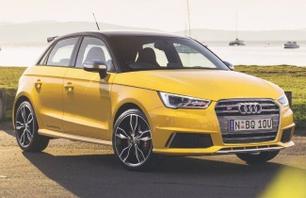
The A1 is so small it starts to strain Audi's design language. When you cram on the S-style bumpers and raccoon-eyed trim on the hatchback, it's starts to look a bit busy.
It isn't quite a shrink-wrapped A3 - Ingolstadt's designers know better than that - but it's full of Audi design cues, such as the strong, light-catching character lines, distinctive LED daytime running lights and fondness for big wheels.
Inside is along the themes of the A3, with what are becoming Audi's trademark; round eyeball air-con vents, the manual fold-down screen familiar to Q3 owners (but smaller) and a good clear dash. The handbrake jars slightly as it feels cheap to hold and wobbles a bit.
The S Sport seats are big and comfortable, and the top half of the backs are capped in plastic, which was colour-coded on our car. The rear passengers will certainly get an eyeful of whatever terrifying hue you've chosen, so choose wisely.
Despite the five doors, the back seats are occasionals, like the Mini the A1 is gunning for, and the boot is very small, but okay for shopping for couples or singles.
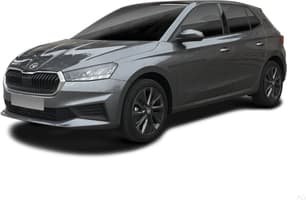
The Fabia’s design hasn’t departed dramatically from its predecessor, but the evolution into the current generation has the little Skoda looking more mature and smoother than before.
Some elements like its grille and headlights are a little sleeker and the car looks less boxy, but still has a unique Skoda design language that’s instantly recognizable.
Its chrome grille trim and its set of unusual 16-inch alloy wheels are the clues that this is the entry Select, plus the lack of much badging.
Inside, the change in generation is most obvious in the step-up in materials and some of the aforementioned tech (screens in particular), though the steering wheel is a carry-over even if it doesn’t look dated.
The new instrument display cowl which features the model name on its side, the round air vents, and the fabric across the dash bring the interior into the current decade, though the centre stack’s modernity is betrayed by climate controls that could have existed in 1998.
There are a fair few hard plastic surfaces, though none of them are in poorly thought-out places and don’t let the cabin down too much.
Starting at $49,900, Audi S1 is by far the priciest of the small-hatch based hotties, at least until Mini's madcap JCW arrives. This price is just almost double that of VW stablemate's forthcoming 2015 Polo GTI.
Standard on the manual-and-five-door-only S1 is a ten speaker stereo, climate control, ambient lighting, remote central locking, cruise control, satnav, headlight washers, auto headlights with xenon low beams, partial leather seats, leather-bound steering wheel, auto wipers and rear parking sensors.
Our Misano Red ($990 option) came with two extra packs. The Quattro Exterior Package ($3990) adds bi-xenon headlights with red trim, red brake calipers, spoiler, quattro logos on rear doors (ahem!) and five-spoke 18-inch alloys that are part matt black, part polished.
The Quattro Interior Package ($2490) adds S Sport front seats with Nappa leather and red backrest capping with quattro logo (ugh), more nappa around the cabin with contrast stitching, flat bottom steering wheel and red rings on the air vents.
There's an S Performance Package that brings the best of these two packs together for $4990, saving about $1500 and the embarrassment of the quattro logos.
Our test car also had aluminium air vents ($220), black contrasting boot lid ($300) and black roof ($720).
The A1 is so small it starts to strain Audi's design language
The grand total is a sobering $58,610. There's a couple more options that'll easily pop you over $60,000.
Audi's MMI is dash-mounted in the A1 as there's no room on the narrow centre console. As ever, it works well and doesn't take much getting used to. The satnav is a bit grainy on the smaller screen but is otherwise a competent unit.
Sound is from a ten-speaker stereo and you can stream across Bluetooth or plug in a memory card. The sound was good but the system did take a while to find the phone whenever we came back to the car.
The Skoda Fabia has fallen prey to the same upward-creeping prices as many other light cars have, quite hard.
What was a sub-$25,000 car in its previous generation’s entry grade is now a $32,390 offering, plus on-road costs.
For an entry-level light hatch, the Fabia Select has a decent list of features, though is decidedly more basic than the already-launched Monte Carlo ($39,690 MSRP).
The headline tech features in the base Fabia include an 8.25-inch touchscreen covering multimedia functions, with wireless Apple CarPlay and Android Auto, an 8.0-inch driver display, two USB-C ports, plus drive mode selection and a host of safety features (covered later in this review).
For reference, the Monte Carlo gets a larger 10.25-inch digital instrument cluster and a 9.2-inch multimedia touchscreen.
The Select makes do with manual-adjust cloth seats, but does have keyless entry and start, a leather ‘sports’ steering wheel, automatic windscreen wipers, an auto-dimming rear view mirror and auto LED headlights and LED tail-lights.
Skoda says the Select’s features list aims to line up as “similar to rivals’ mid-specification models” and it’s about bang on. But its price might still be a turn-off for some seeking a budget-friendly light car.
This is where the action is. The S1's tiny body packs a 2.0-litre turbocharged four-cylinder producing 170kW and 370Nm of torque. The S1 will streak to 100km/h in 5.9 seconds thank to the traction aid of quattro all-wheel drive.
All Audi S1s come with a six-speed manual
Despite a pretty solid hammering during its week with us, including more time than we'd have liked in Sydney traffic, the stop-start function helped deliver a pretty reasonable 10.2L/100km, however that's a long way over claimed 7.1L/100km.
All Audi S1s come with a six-speed manual, so dual-clutch haters can save the whining. The only downside from not having a self-shifter is the ECU can't deliver the boy racer farts, parps and crackles of the other S cars.
The Fabia’s turbocharged 1.0-litre, three-cylinder, petrol engine makes 85kW and 200Nm in this guise, mated to a seven-speed dual-clutch transmission driving the front wheels only.
Given the Fabia weighs 1265kg, getting to 100km/h in under 10 seconds - which it should be able to do, just - might depend on how many passengers you have.
While it’s not very fast or powerful, the Fabia’s outputs sit about average for its class and price.
If you're buying the S1 as a comfortable urban runabout with a cool badge, you're half right. While the seating for front passengers is certainly supportive, the hard suspension tune will ensure you're well aware of road surface imperfections.
The S1 is a rocket
Thankfully, what it missed out on in the ride department it makes up for in every other way - the S1 is a rocket. The 2.0-litre turbo jammed under the bonnet has almost no lag and is paired with a slick six-speed manual that is terrific fun to manhandle through the gears.
The way the S1 picks up speed when it's on boost is addictive and licence-endangering. A flattened accelerator in second or third will obliterate just about anything this side of $100,000 and you'll be having more fun in this than big brother S3 because the chassis is more adjustable and there's a bit more life.
You can hear the turbo sing to accompany the bassy exhaust growl. Hit the massive brakes hard and the car remains stable even over rutted roads. Turning the wheel brings almost-instant turn-in, mashing the throttle again a fun little wriggle. It's superb.
It's tremendous fun point-to-point on a twisty road
You'll have to be a bit patient with the throttle to get the wriggle, though - give it too much too early and it will want to push wide, the quattro system shuffling power around to try and quell understeer while the electronic diff fiddles with the braking system to do the same thing. It gets there in the end, but you're better off meting out the power with your right foot for maximum rewards.
It's tremendous fun point-to-point on a twisty road - despite being a bit heavy for its size (1415kg), it's as chuckable as the next best thing, the Fiesta ST.
If you’re someone who doesn’t need a big car and likes an engaging drive, the Fabia ticks those boxes.
In fact, it feels like it punches above its weight. Well, not literally, because while it actually weighs in at over 1.2 tonnes, it feels lighter than even that.
Tight corners don’t faze the Fabia, and its steering and suspension both feel more dialled-in than a car with 85kW has any right to.
Yep, even though its engine is only slightly more powerful than some budget sports cars from the 1980s it feels peppier than it should.
It has some low-speed hesitancy thanks to its transmission - taking off from a stop sign if you’re not in Sport mode can be annoying - but with shift paddles (or a manual gearbox… ) the Fabia could be a hidden gem for enthusiasts.
Its suspension is firm, but not sharp enough that it allows bumps and rough roads to make their way into the cabin as shocks or rattles, and even holds its own on unsealed surfaces at sensible rural speeds.
The Fabia feels playful even on a commute, and the follow-through from the rear-end on a spirited bit of cornering speaks volumes about its chassis, even in urban driving.
Six airbags, stability and traction control, ABS, brake assist and distribution all add up to a five star ANCAP rating.
The Fabia wears a maximum five-star ANCAP safety rating from assessment in 2021, under recent but now-surpassed criteria.
That’s not to say its safety kit is outdated, as occupant protection scored well (58 per cent for adults, 81 per cent for children) while pedestrian and active safety were also adequate (70 ad 71 per cent, respectively).
The Fabia Select comes with autonomous emergency braking (AEB), pedestrian and cyclist detection, multi-collision braking, driver monitoring, lane assist, rear cross-traffic alert and six airbags - though no front-centre airbag.
It also features cruise control, though it’s not adaptive and requires a little more attention than most new cars - not necessarily a bad thing, mind you.
On the road, its safety tech is unobtrusive, leaving you to focus on driving while knowing there are features there to keep you safe should the unexpected happen.