What's the difference?
The e-tron S was inevitable.
The marriage of the latest automotive trends – sporty electrified SUVs with specific performance bits, the e-tron S is as much rooted in Audi’s future as it is in the present.
Having been one of the earliest fully electric German cars in the space, and now with a few years of age on it. Can the e-tron S shine as one of the best? Read on to find out.
This new Hyundai Ioniq 6 N asks one important question for the brand - how far can Hyundai go?
Not in the sense of driving range, but rather how far can the brand go in terms of both performance and price. The Ioniq 6 N pushes the limit on both, offering supercar levels of power and performance and at a price that continues to take the brand into unchartered territory.
This is the follow-up to the groundbreaking Ioniq 5 N, the all-electric performance SUV that launched in 2024. But, as you’d expect, in the intervening time Hyundai has been able to make improvements to push the Ioniq 6 N to new levels.
The Ioniq 5 N dramatically raised the bar for Hyundai, offering up to 478kW of power and 770Nm of torque, way beyond the 242kW/348Nm offered by the brand’s i30 N hot hatch. This was Hyundai’s ‘Godzilla moment’, when the Skyline GT-R changed the image of Nissan forever.
Now the Ioniq 6 N looks to push things even further. And it does so as the sole Ioniq 6 model grade in 2026, with the rest of the range currently unavailable in Australia, as the local operation waits for the facelifted model to arrive sometime in the future.
The e-tron S looks mean, feels premium, and blends serious power with surprising grace under pressure. I still can’t shake the feeling I had with the standard e-tron, though, that this car is an Audi sports SUV first and an electric car second, and its weight holds it back from being as fun to drive as I think some rivals are.
If you love Audi and you want to go electric without stepping into something too unfamiliar it’s a great option. If you want an electric car which takes full advantage of what the next generation of technology can offer, keep an eye out, there’s plenty of fresh metal on the way.
In the Ioniq 6 N Hyundai has built an incredibly quick and high-capable performance car. But that doesn’t mean it’s flawless and an obvious recommendation over its rivals.
Its looks remain divisive, and while obviously each individual will need to judge the design of the Ioniq 6 N themselves, objectively speaking there is a lot to like about this latest addition to Hyundai’s N stable.
Yes, it’s very fast, but with all the N modes switched off it’s also a very quiet and relaxed sedan with a premium look and feel. So it will play the dual role of track terror and everyday family transport well.
But it needs to be for the price, which is really testing the limits of Hyundai’s brand appeal. It obviously won’t be a best seller, but with the less-polarising Ioniq 5 N only selling approximately 300 cars since its launch, this could be a very niche proposition, reserved only for those who crave its special kind of electric performance.
Note: CarsGuide attended this event as a guest of the manufacturer, with accommodation and meals provided.
The e-tron S looks properly mean, with its adjustable ride-height suspension and enormous wheels combining nicely with the extra subtle sporty highlights to make for a squat SUV which clearly means business.
The width is especially evident with those accentuated wheelarches and the lines set by the lower wing to draw your eyes out to its edges. In profile it's easy to see its long wheelbase and tapered rear roofline, giving even the SUV a slinkier frame than you may be used to when looking at the comparatively boxy Q5.
The thing that strikes me about Audi’s e-tron range, though, is how little a departure it is. It ambiguously slots somewhere above the Q5 and below the Q7, but sticks very closely to the German brand’s styling script.
Sure, it looks a bit lower to the ground, and a bit meaner than you might expect for an EV, but it’s not as much of a departure as Jaguar’s I-Pace or BMW’s iX.
I suppose the biggest advantage here is nobody is going to say the e-tron’s overall visage is controversial, and certainly, it will appeal to existing fans of Audi’s design.
Inside it follows much the same theme, with all the key touchpoints and styling elements nearly identical to other Audis in the range, if not very similar.
It feels like a sensible, refined place in the cabin, with the only whacky pieces being the extra touchscreen for the climate unit and the strange thumb-operated shifter mounted on a floating piece which looks and feels like it could be the throttle control for a jet engine.
The dash is a bit more integrated and modern than in the conservative Q5 or Q7, with the air vents leading to the digital instrument cluster as part of an aesthetic three-terrace design which runs across the entire dash and into the doors.
The screens which appear in place of wing mirrors take a bit of getting used to. Aside from those notable departures, the interior continues the theme of sticking closely to the Audi formula, providing a more modern space which will still be familiar to existing fans of the brand.
The original Prophecy concept, which previewed the Ioniq 6, was a thing of beauty, a case study in elegance and simplicity. The final production version of the Ioniq 6 is a case study in awkwardness, with a design that polarised opinions.
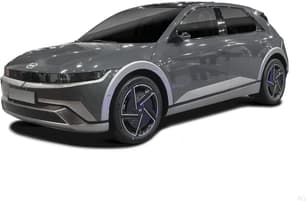
For the Ioniq 6 N Hyundai has been given a second chance to try and make it look more appealing and less divisive. To that end they’ve added this gloss black bumper with an integrated splitter, highlighted by the N-specific fluro orange strip, as well as unique fenders and 20-inch forged alloy wheels.
The facelift also introduces much more appealing slimline headlights that help reduce the awkwardness.
At the rear, there’s a new rear bumper design, with more black to try and hide some of its most awkward lines, plus an unmissable rear wing to further attract your attention. And while it undoubtedly provides a sportier, more dynamic look, it actually provides up to 100kg of downforce.
Inside, Hyundai has made a number of key enhancements to ensure the Ioniq 6 N looks suitably sporty. There’s a sports steering wheel, complete with a pair of N buttons to immediately activate the more dynamic driving modes, plus sports seats and even a soft knee pad built into the side of the centre console, so you can brace yourself when you're lapping the track at speed.
There’s a 12.3-inch multimedia touchscreen in the centre, which houses all of the various car settings, including the very detailed N performance driving modes. This is where you can either program the N buttons or dial up the individual settings.
There’s also track-themed graphics that appear on the head-up display, if you really want to do your best Oscar Piastri impression.
As an electric vehicle, the e-tron has certain advantages over its combustion equivalents, and overall makes for an accomplished family-sized SUV. But there are areas where more could be done to take advantage of its high-voltage features and abundant footprint.
Up front in the cabin is a good place, with both occupants treated to lavish seats with plenty of head and legroom, great adjustability, and plenty of width in the cabin.
The finishes are beyond premium with thick chunks of well-padded leather meeting your elbows, hands, and knees at every point. As always the lovely Audi switchgear exists in most places, but the removal of solid toggles and buttons in favour of an extra touch panel feels unnecessary.
There’s still a physical volume knob, and while the climate touchscreen is plenty large enough to have a shortcut button for every function without needing a sub-menu, it feels like you have to move your eyes too far from the road to know you’re going to jab it in the right spot.
Even the main touch panel has an interesting haptic feedback effect for each press, designed to mimic the solidly-sprung button hardware the brand has used in the past.
The screen looks amazing and is fast and sharp, key hallmarks of computer hardware that's up to the task, although the resolution is so high the touch elements when using Apple CarPlay end up being a little small and hard to stab at while you’re trying to keep your eyes on the road.
For storage there’s a big bottle holder and bin in the doors, a large cutaway with a storage tray, dual bottle holders, and power outlets in the centre, with a further smallish storage area under the armrest console.
Unlike some EVs there’s no huge cutaway under what was traditionally considered the transmission tunnel, although there is a small bay with the USB-C ports.
The rear seat feels good for space, with an almost flat floor and decent legroom and width, although headroom could be better.
There are netted pockets on the backs of the front seats and decently-sized bottle holders in the doors, with a further set in the drop-down armrest.
The quad-zone climate with its own touch panel and adjustable centre vents is a nice touch in the rear, as is the set of USB-C ports below. The hard backings to the front seats and built-in sun blinds our car had will even be great for kids.
The boot measures in at 660 litres, which is high for the segment. It fit our three-piece CarsGuide demo luggage set with room to spare, and that's despite the massive battery pack under the floor.
There’s auxiliary storage, too, with a further bay under the boot floor and a second small tray situated under the bonnet, both useful for keeping your charging paraphernalia.
The cabin is very practical too, despite its sportiness. There’s good storage spaces, including a pair of cupholders and a tray built into the centre console.
There’s also USB-C charging ports in the front and back of the cabin to keep small electric devices charged, as well as a smartphone wireless charging pad.
By relocating the controls usually found on the door (windows, mirrors, unlock/lock buttons), the door pockets have been sculpted out to create more width and space for the front seat occupants.
It’s comfortable and roomy too, especially in the back, where Hyundai has taken advantage of the Ioniq 6’s bespoke electric underpinnings to have a flat floor with good knee and legroom.
The boot measures 371 litres, which is on the smaller size for a mid-size sedan, and well short of the class leaders, like the 524L Toyota Camry.
A base, before-on-road costs asking price (MSRP) of $168,400 for the e-tron S in SUV form puts this sporty model a step above two of its most notable rivals, the Mercedes-Benz EQC (currently tops out at $141,300), and Jaguar I-Pace (currently tops out at $155,550), but below the menacing, full-fat BMW iX M60 (at $222,900), or the incoming updated Tesla Model X Plaid ($206,449).
To be fair here, only the iX M60 and Model X are pitched as performance variants in their respective ranges, with the Mercedes and Jaguar lacking either an AMG or SVR model respectively to represent their performance line-ups.
To that end, the e-tron S ups the ante when it comes to its power output with an impressive 370kW/973Nm across three motors, two at the rear, and one at the front. More on this in the Drivetrain part of this review.
Suffice it to say, it’s a lot of power. The e-tron is high-spec across the range, too, with the S scoring massive 21-inch alloy wheels, ‘Valcona’ leather interior trim, a heavily digitised cabin consisting of a 12.3-inch digital instrument cluster, 10.1-inch multimedia touchscreen, and a second 8.6-inch touch panel for the car’s climate functions.
The e-tron S also gets wireless Apple CarPlay and Android Auto connectivity, with matching wireless phone charger, built-in navigation, a 16-speaker Bang and Olufsen sound system, full LED lighting for the head and tail-lights and throughout the cabin, quad-zone climate control, heated front seats with power adjust, and a panoramic sunroof.
Finally, the S also has performance enhancing features like progressive (variable ratio) steering and adaptive air suspension.
Obviously, with the high level of standard gear, there’s not as much to put on the options list, although our car also had the weird $3500 ‘Virtual Exterior Mirrors’ which grant it concept-car like cameras with adjustable touch-panels inside the car in place of standard wing mirrors.
I don’t like these, but Audi says nearly half of all e-tron buyers are choosing them. More on this later.
There’s also the option to upgrade the car’s AC charger from 11kW to 22kW which could be very appealing if you have a public station nearby capable of putting out such power. This option will set you back a further $6900.
The last item on the list is the 'Sensory Package' ($9600) which bundles improved Matrix LED headlights in with soft close doors complete with puddle lamps, extended Nappa leather trim in the cabin, rear sunshades and heated rear seats. Our car had this option pack, too.
While it pushes the boundaries in terms of performance, it also stretches the appeal of Hyundai as a brand. Priced from $115,000 plus on-road costs, it’s the same price as the Ioniq 5 N but that still makes it one of the most expensive Hyundai’s ever sold. Only the $119,750 Ioniq 9 is pricier.
For the asking price, beyond the performance elements, standard equipment includes LED headlights and tail-lights, 20-inch alloy wheels, dual-zone climate control, an eight-speaker Bose premium sound system, a 12.3-inch multimedia touchscreen, wireless Apple CarPlay and Android Auto and Hyundai’s Digital Key2.
There is only a single specification and the only option is the choice to delete the sunroof, free-of-charge (although, given carmakers typically charge extra for a sunroof, it seems a little sneaky to not get any discount for removing it).
However, if you want to make your Ioniq 6 N more special, there is also a carbon package available through the accessories department. It adds an even larger rear wing and unique front splitter and side sills (all in carbon fibre, of course) for an additional $27,000, pushing the price past $142,000 before on-road costs.
While it may be expensive for a Hyundai, in terms of how many dollars for how much performance, it’s arguably one of the better value performance cars on the market. Would be rivals include the $187,900 Mercedes-AMG C63, $156,990 Alfa Romeo Giulia Quadrifoglio and $169,100 BMW M3, although the latter will get a full electric vwersion in its next generation.
The S-branded e-tron sets itself apart from the rest of the range with a seriously powerful set of three motors. There are two on the rear axle, and one on the front axle.
The total combined output of this collection is 370kW/973Nm, which for a combustion car, would be unprecedented.
To be fair, these figures are under a ‘boost’ mode, with the car generating a still strong 300kW/800Nm in most situations.
The three motor drivetrain allows for an electric version of Audi’s ‘quattro’ all-wheel drive system which the brand says can react to changes in 30 milliseconds and move torque appropriately.
The system is rear-biased, and in the name of efficiency the front motor is only used when required under acceleration or cornering.
As mentioned earlier, while it may be expensive for a Hyundai, if you want a car capable of making 478kW and 770Nm you’ll typically need to spend a lot more than $115,000. This makes the dual-motor electric powertrain the star of the show in many respects.
Those figures are the maximum performance available when you use 'N Grin Boost', a 10-second burst of ultimate power. The ‘normal’ performance is a still an incredibly impressive 448kW and 740Nm.
These come from a 166kW front motor and 282kW rear motor, to give you all-wheel-drive capabilities.
That’s enough for the Ioniq 6 N to do the 0-100km/h sprint in just 3.2 seconds with N Grin Boost activated (0.2 seconds faster than the Ioniq 5 N). Top speed is limited to 257km/h, which is obviously too much for the road, but Hyundai is pitching this as a track car and in that sense it will struggle to keep up with some supercars at the end of long straights, but that’s probably a minor quibble in the grand scheme of things.
Like most electric cars, the Ioniq 6 N has a single-speed transmission. But like the Ioniq 5 N, Hyundai has developed an artificial ‘manual’ gearbox, which it calls N e-shift. By torque limiting the engine to create a false ‘rev limit’ there are eight virtual gears for you to use via the paddles on the steering wheel.
But this is only part of the story, Hyundai has included a number of N-specific driving settings for the powertrain beyond N Grin Boost and N e-shift. N Torque Distribution has 11 different settings that allows you to adjust the torque split between the front and rear axles up to 95 per cent in one way or the other.
Then there’s N Drift Optimiser, which helps you do big skids, on the safety of a track, of course. Plus N Launch Control to shock your mates with V8s at the drag strip and N Track Manager to keep track of your lap times.
It all sounds very complicated but Hyundai has done a nice job of integrating the systems into the car and making the menu easy to navigate. And because these systems are largely digital, rather than mechanical, it actually helps make the car easier to drive in some regards.
The e-tron may be electric, but it’s also a performance car. To that end, its energy consumption, relative to the field, is behind the pace.
In fact, at a whopping 27.8kWh/100km, driving the e-tron around feels like the electric equivalent of steering a big V8.
It produced one of the highest consumption numbers I have seen from any EV during my time with it. Considering this number is even below the WLTP consumption number, which is 28.4kWh/100km, that's not great.
For comparison, the Mercedes-Benz EQC's official number is just 20.8kWh/100km, while the Jaguar I-Pace consumes 21.2kWh/100km according to the WLTP procedure.
Yes, they aren’t performance cars in the same sense, but it’s still a big difference.
I made sure to take it out and stretch the e-tron’s legs to assess its performance in its more sporty driving modes, but the majority of my time with the car was spent in a more comfort-oriented setting and with the regenerative braking set to maximum.
Possibly as a result of its real-world consumption, my car was showing about 350km of range on a full charge, a little below the official WLTP number of 364km, although it is worth noting the enormous 21-inch alloys do their part to reduce the range. The car ships with 20-inch wheels in Europe.
The good news is the e-tron is capable of charging fast, with its max DC charging speed set at 150kW (allowing for a 5.0-80 per cent charge time for its 95kWh battery of 30 minutes), and its AC charging speed set at 11kW, which allows a slow-charging time of around seven hours.
If you intend to park on the street or live in a unit where installing charge infrastructure is impossible, I would strongly recommend you consider the 22kW AC charging upgrade which will cut the AC charge time in half.
While there are few public stations currently capable of the full 22kW in Australia, it will future-proof your car for ideal convenience charging for when they're more commonplace.
To power this track-focused EV, Hyundai has had to upgrade the 84kWh battery with specialised heating and cooling systems.
Range is rated to 487km, which is good without being great. And, unsurprisingly, if you access all the power available you will end up using the battery quicker, much like you’ll use more fuel if you drive an internal combustion engine hard.
For track use, Hyundai suggests a ‘20-20-20’ cycle of 20 minutes of track driving, 20 minutes of cooling and then 20 minutes of charging to ensure you get maximum out of a track day. Although we were able to do closer to 30 minutes of track driving from a single charge.
To make this possible, there is a special N Battery mode, which is able to maximise track usage by managing the cooling and output depending on the scenario. There are Drag, Sprint and Endurance settings, with Drag making the battery warmer for sudden acceleration, Endurance trying to keep it cooler to extend on-track range and Sprint automatically applying N Grin Shift when needed.
It’s an incredibly complex system but it speaks to the challenges of making an EV capable of the rigours of high-speed driving consistently.
In terms of charging, the key detail to know is, with the maximum charger, you can go from 10 to 80 per cent charge in as little as 18 minutes, according to Hyundai’s claim, and is compatible with either 400V or 800V charging infrastructure.
Does the e-tron live up to the promise set by sporty Audis which have come before it? The answer is interesting.
There is no doubt the e-tron S is rapid, at times absurdly so. If you stick it in the required S mode and hunker the suspension down, planting the accelerator makes its claimed 0-100km/h sprint time of 4.5 seconds suddenly very real.
It lurches ahead without so much as a squeak from its enormous tyres, grabbing the road with its front axle as it warps you forward.
So yes, this electric performance car is no doubt quick. It is also heavy. Weighing in at a tare mass of 2830kg, the e-tron S is quite literally massive.
The trouble is, while its powerful electric motors are great at overcoming this gravitational obstacle in a straight line, it’s in the corners and at low speeds where you feel every bit of it.
The e-tron crashes over larger bumps, it’s suspension struggling to deal with the combination of its weight and low-profile tyres, while it can also feel cumbersome in the corners around town.
The suspension is better at levelling things out once you gain a bit of pace, and the tyres work with the all-wheel drive system to put in a Herculean effort when carving up bends at speed, but there’s the ever-present lurch of weight always working against you.
This feeling isn’t helped by the steering tune, which even in its most comfort-oriented setting feels hefty and slow to turn. In the default sport mode, ‘dynamic’, it takes effort to push this car around corners.
Despite the unsettling feeling of it, though, the car holds on for dear life, and I never once felt as though the tyres were remotely in danger of breaking traction when put under pressure.
Is it a performer, then? Absolutely, there’s something mind bending about a vehicle so heavy going so quickly.
Does it feel fun to drive? Less so. I enjoyed the connectivity of the Porsche Taycan offers at speed more than I enjoyed the e-tron S, and its weight and girth demand a nice wide piece of tarmac for you to really wring it.
It’s far from a darty and engaging car like the Q5 can be despite its mammoth power outputs.
Elsewhere, the drive experience feels very Audi, though. The touchpoints and feedback are mostly familiar, as are the software and ergonomics.
The virtual wing mirrors are more of an inconvenience than anything else. This car is already hard to see out of, with big C-pillars and a tall belt line, and the digital exterior mirrors offer what feels like a limited angle of vision and make it extra hard to see out at night.
Some things fall to the wayside a little. The e-tron’s drive system almost hides the regenerative braking setting several menus deep, which, once activated, allows you to set it using the paddle-shifters on the wheel.
Audi says the regen will account for nearly 30 per cent of the car’s range, which is odd because even at the highest setting it feels a bit mild, relying on the user to manually operate the brake for a ‘blended braking’ mode to make up the difference.
It’s a bit of a stretch from the single-pedal driving modes offered on some rival cars.
My theory here, as with this car’s look and feel, is the e-tron is primarily designed to be familiar to an existing Audi customer, or someone coming out of a purely combustion premium rival.
To put it bluntly, the Ioniq 6 N is sickeningly fast. Literally, it can make you feel car sick from the passenger seat if the driver unleashes the power a little too frequently, which isn’t hard because the Ioniq 6 N offers near-instant torque.
The dual motors mean this swooping sedan launches out of corners with a ferocity usually reserved for supercars - it is that quick under hard acceleration. But pure acceleration is only part of the story when it comes to a proper performance car.
As impressive as the Ioniq 5 N is, it was always going to be handicapped by its taller SUV body, meaning the handling was somewhat dulled by its size and shape. The lower, more aerodynamic Ioniq 6 N is therefore noticeably more dynamic and responsive to drive.
The suspension and steering tune isn’t specifically tuned for Australian conditions, instead it’s based on the globally developed setup designed for the Ioniq 5 N, which Hyundai Australia did have input into.
Despite not being tuned specifically for Australia it still rides with impressive compliance for such a performance-orientated electric car. Even on the choppier back roads we tested it on, it feels controlled and compliant while still being responsive, without feeling uncompromising or uncomfortable.
But to really experience the true performance potential of the Ioniq 6 N, you need to hit the racetrack. Thankfully, Hyundai Australia allowed us to test it to its limits at Sydney Motorsport Park.
Free from speed limits the immense power can be unleashed and to make the experience even better you can use the N e-shift and the N Active Sound+ - three separate artificial soundtracks that are designed to mimic engine noise.
There is one that can broadly be described as ‘futuristic’ and another that is meant to sound ‘electric’ but neither are good enough to bother with. Instead, if you stick to the one that sounds like Hyundai’s petrol engine you’ll enjoy it.
While it is clearly an artificial sound, and there will be haters who just don’t like it (and they can leave it switched off), Hyundai has done a brilliant job mimicking the sounds of a proper petrol performance car. So much so that when you lift off the accelerator, you actually hear a ‘snap, crackle, pop’ from the rear of the car, as if there is an actual exhaust making the sound.
What the noise does do is really help you with a sense of speed, as does the N e-shift, not only helping you drive faster but also just making the experience more fun.
For the serious track-day drivers the amount of adjustability in the Ioniq 6 N is brilliant. In particular the N Torque Distribution system, which allows you to shift the drive split front-to-rear on the move. Experimenting with this system, there is a clear difference between the handling not only as you switch between modes, but if you’re really, really serious, you can even adjust it during your on-track run. As the tyres get hotter, shifting more drive rearwards helps the car rotate better and punch out of the corners easier.
However, while Hyundai may have designed it as a track-capable, ‘Corner Rascal’, as they like to say, the reality is, most of the time you’ll be driving, you won’t be on a racetrack.
Even so, N Road Sense is a special setting that is able to recognise a double curve road sign and urges the driver to activate N mode and have more fun, so it’s always looking to encourage you to have a good time.
But what about when you’re not driving fast? How does the Ioniq 6 N stack up as a daily drive? Well, one of the elements of performance EVs that I personally appreciate, is how quiet and relaxed they are when you don’t need to go fast. Unlike an internal combustion performance engine, which can feel like a caged animal at suburban speeds, an EV with 448kW is as smooth and quiet as an EV with 148kW.
It means it plays both its roles - weekday commuter transport and weekend fun machine - with equal ability.
The regular e-tron range is considered very safe by ANCAP which awarded it a maximum five stars with strong scores across all categories in 2019, although it does exclude the S which was not released at the time of testing.
The S has the same suite of active safety features as the rest of the range, though, which includes freeway-speed auto emergency braking (up to 250km/h) with pedestrian, cyclist detection, and intersection assist, lane departure warning with lane keep assist, blind-spot monitoring with rear cross-traffic alert, adaptive high-beams, adaptive cruise control (with eco-assist and stop-and-go functions), as well as a clear exit warning.
The 360-degree camera suite is welcome, as is airbag coverage for the front, side for both front and rear rows, as well as curtains.
ISOFIX points feature on the rear outboard seats, and there are top tethers across all three rear seats.
The Ioniq 6 N gets a comprehensive list of driver assistance systems, under the umbrella of Hyundai SmartSense.
Among the safety gear included is forward collision assistance, blind spot collision avoidance and the brand’s mild-autonomous functionality, 'Highway Drive Assist 2', which can both maintain speed and lane centring under certain conditions.
The car is also equipped with Hyundai Bluelink, the brand’s connected car service, which includes an ‘SOS’ function that can call the emergency services if you’re in an accident where the airbags deploy.
While there is no questioning the amount of technology Hyundai has put in the car, like so many other models in the range, the systems need more fine tuning to make them class-leading. There are still too many ‘beeps and bongs’ from the Ioniq 6 N, to the point of becoming distracting. While the lane keeping assist can be too uneven at times, needing more work to get it better calibrated for smoother driving.
The entire Ioniq 6 range has a five-star ANCAP safety rating, based on a 2023 test, and given there are no major structural changes (beyond some body stiffening), there is no reason to think the N model would be any worse.
Audi has followed its Volkswagen parent in upgrading its warranty to five years and unlimited kilometres, finally leaving BMW and its three-year warranty behind.
The e-tron’s high-voltage battery components are covered by a separate eight-year and 160,000km warranty, but the big win, especially in this premium segment, is the first six years of servicing (covering three 24 monthly or 30,000km visits) is free.
Oh, and your public charging is largely free for the same period too, as Audi throws in a six-year ChargeFox subscription.
Six years pretty much cost-free? Audi, how far you’ve come.
Hyundai covers the Ioniq 6 N with its usual seven year/unlimited kilometre warranty, with any non-competitive racetrack usage also covered. So you can do a track day, including the official N Australia organised ones, with peace of mind.
This applies even if you upgrade your tyres and brake pads in search of faster lap times, as long as you don’t enter into a competition, Hyundai will look after most mechanical on-track problems.
Service intervals are every two years or 30,000km, whichever comes first. Hyundai offers a ‘lifetime’ servicing plan that covers the first four years, but with only two services required - one for $645 and the second for $667.
As one of the best-selling brands in the country, Hyundai has an expansive nationwide dealership network, including extensive rural coverage and service centres trained to deal with EVs.