What's the difference?
The third-generation Volkswagen Tiguan is likely to be the most important new vehicle Volkswagen launches in 2025.
The popular mid-sizer has proven to have impressive staying power for the brand, with the outgoing version still impressing buyers despite being nearly a decade old.
What does this ground-up new version change? Does it have what it takes to maintain the nameplate’s reputation in one of Australia’s most hotly contested market segments? And what are some surprises this time around?
We went to its local launch to find out.
Jeep's Renegade might be late to the mini-SUV party but it comes with a pretty impressive back catalogue to suggest that this is a SUV that can cash the cheques its name can write.
The top of the range Trailhawk can write even bigger cheques than the lower models, bringing with it a range of off-road tech toys to let you really get down and dirty.
The new Tiguan is as confident as ever in its identity, even in such a crowded mid-size SUV space where there are so many models worthy of your attention.
No matter which version you choose, this is still the mid-size SUV for a driving enthusiast who doesn’t quite have premium dollars to spend.
While it may not quite expand its appeal as much as the brand hopes precluding a hybrid variant, those who are choosing this as their family hauler for the right reasons won’t be disappointed.
Note: CarsGuide attended this event as a guest of the manufacturer, with travel, accommodation and meals provided.
Rugged, dependable and good off-road are the most obvious qualities of the Trailhawk. It stands out from the rest of the mini-SUVs by being able to do the S and the U with plenty of vigour.
It's just a shame that its on-road manners can't match that of its big brother, the Cherokee. Unless you're planning on proper off-roading, the Trailhawk might not be quite what you're looking for.
The new Tiguan is a bit of a mind-bender. Its new design seems to make it feel smaller than the outgoing vehicle, despite it being both slightly wider and longer.
This, I have decided, is because the design creates a visual effect, where the upper curvier parts seem to shrink it down, and the additional length makes it seem narrower than the more boxy visage of the previous model. Also, it’s 20mm shorter than the previous design, which we’re told combines with the new bodywork to make for a 15 per cent drag reduction.
Either way, it’s nice not to see a mid-size SUV not continually engage in an arms race to get bigger and bigger. Volkswagen will also introduce the dedicated seven-seat Tayron later in 2025. It’s a half-size up and replaces the outgoing Tiguan Allspace, and this time it features a much more distinct design from its Tiguan sibling.
The third-generation Tiguan not only embraces a more curvy design aesthetic than its predecessor, but it also features many more contemporary design elements. The headlights and curvy accents over the wheelarches feel like they more closely associate this SUV with the new ID.4 and ID.5 EVs, while the light bar across the front on some grades combines with the new light bar across the rear to give it a trendy silhouette. It tops things off with the ‘Tiguan’ letterwork on the tailgate, and, as usual, a sporty spoiler fitting giving the rear hatch a bit of depth.
As usual, VW’s array of gloss-black, chrome or plastic garnishes on the outside, depending on grade, offer a subtle and tasteful finish to the exterior appearance.
The inside is revolution rather than evolution, now heavily screen-centri, and featuring an array of lighting features like many of its rivals.
The screens look the part and have fast and mostly straightforward-to-navigate software, while the seat designs are a real highlight, being both aesthetically pleasing and nice to the touch in all grades.
The ambient lighting features add a sense of presence to the cabin, and unlike the outgoing car, the new one feels a bit more driver-centric thanks to the design of the dash and screens effectively pointing their way down the road from the driver’s point of view.
It does away with the sparse feeling of the previous car, elevating things a notch with an increase of nice materials throughout.
While some may find the abundance of gloss-black finishes a bit harder to maintain, it’s hard not to feel like this new Tiguan is a major generational jump from the previous one. Mission accomplished, VW.
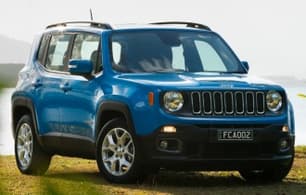
In what is absolutely not a coincidence, the Renegade immediately conjures up the Wrangler. Upright grille from the Willys Jeep (references abound here), round headlights, squared off wheel arches to mimic the Wrangler's guards, short overhangs and big rear view mirrors.
The 17-inch wheels look completely lost in the wheelarches which are even more cavernous owing to the Trailhawk's 50mm of extra ride height. The wheels are also a bit cheap looking but will probably survive the belting the car is intended to take.
Less rugged is the interior, despite a fairly self-conscious effort to make it look and feel chunky. The front seats are flat and unsupportive with the rears just as lacklustre making sure everyone is sliding around together. Luckily, front passengers get a dash-mounted grab handle.
It seems quite well put together, however, but with carpets and easily-marked plastics, you'll hope your passengers don't bring the mud in with them too often. And the "Since 1941" stamped into the steering wheel can go.
The dashboard is reasonably clear and has plenty of information to share via the screen between the dials but whoever thought marking the redline with a water splash graphic in bright orange should probably rethink their design decisions.
Storage is limited to two cupholders up front, door pockets in each door and nets on the front seat backs.
Volkswagen is attempting to broaden the appeal of the Tiguan this time around. As such, it hasn’t jacked prices up massively like some recent new-generation versions of rivals, despite a comprehensive cabin tech overhaul and big lift in standard equipment.
As a result, the range is vast, with six variants covering a wide price spectrum and, as the brand says (or hopes), a wide range of potential buyers.
Kicking it off is the base model 110TSI Life, which, at $44,990 plus-road costs, is only $1000 more than the outgoing version. It sports a carryover 1.4-litre turbocharged four-cylinder engine, although it has a new version of VW’s seven-speed wet dual-clutch automatic sending power to the front wheels, replacing the derided dry dual-clutch that marred the base version of the old car.
Standard equipment on the base car is high, including 19-inch alloys, a full array of LED lights both for the headlight clusters and rears, it also includes a 12.9-inch multimedia touchscreen with wireless Apple CarPlay and Android Auto, a 10.25-inch digital instrument cluster with the brand’s signature digital cockpit software, tri-zone climate control, ‘comfort’ cloth seats (said to be benchmarked against the best in-class) with manual adjustments, a leather-trimmed multifunction steering wheel, dual wireless phone chargers, ambient dashboard lighting and even an electric tailgate.
The mid-spec Elegance grade can be chosen with either the 110TSI engine in front-wheel drive, or the new 150TSI 2.0-litre engine in all-wheel drive, priced at $50,690 and $60,690 respectively. It increases the equipment to include chrome styling on the exterior with alternate 19-inch wheel designs, rear privacy glass, improved LED headlights with a lit-up centre strip and dynamic cornering functions, leather interior trim, power adjustments with heating, ventilation, and message functions for the front two seats, and a heated steering wheel.
Alternatively, there is the 150TSI R-Line which starts at $55,690, representing a $4600 price reduction compared to the outgoing 162TSI R-Line. It is also all-wheel drive only and features an R-Line styling pack inside and outside, with sporty but manually adjusted cloth bucket seats featuring integrated headrests up front (which miss out on the heating and ventilation of the Elegance grade), black headlining, an R-line steering wheel with additional contouring, 19-inch alloys in a sportier design, a wider wheel and tyre package for enhanced grip, and the VW’s signature progressive steering tune.
Both 150TSI cars also add adaptive chassis control and hill descent control as standard, with an additional off-road and snow driving mode, while the Elegance specifically scores a larger 15-inch multimedia screen.
Finally, topping out the range is the new 195TSI R-Line priced at a massive $70,490. Not only does this grade score its own 195TSI engine sourced from the Golf GTI, but it also adds everything available in the range, swapping out the 150TSI R-Line’s cloth seats for the leather-trimmed, heated, cooled and massaging ones otherwise only available on the Elegance, along with the larger 15-inch screen, sporty steering wheel and R-Line appearance package inside and out, along with its own set of 20-inch alloy wheels.
Option packs include a black styling pack for the R-Line at $1500, a panoramic sunroof available on the Elegance and R-Line grades at $2100, and the Sound and Vision package, which adds premium audio and the larger 15-inch multimedia screen to the 110TSI variants for $2700.
This makes the Tiguan range span from surprisingly good value at the low end, to a real enthusiast-only proposition at the pinnacle, with VW even pitching the 195TSI R-Line at the lower-end BMW X3 and Mercedes-Benz GLC buyers.
In reality many of its mainstream rivals should include options like the dominant Toyota RAV4 ($42,260 - $58,360), Subaru Forester ($38,690 - $50,140), Nissan X-Trail ($38,025 - $59,265), Hyundai Tucson ($39,100 - $61,100) and Kia Sportage ($32,995 - $55,420).
The surprise, some will note, is all of the Tiguan’s rivals have at least one hybrid variant, where VW has chosen to stick with combustion only for the time being for its new-generation mid-sizer.
The Renegade range starts at $28,000 for the 1.6-litre Renegade Sport manual front-wheel drive, climbing between $2000 and $3000 through the Sport Auto, Longitude Auto, Limited Auto with a final jump of $4000 to the 2.4-litre auto-only Trailhawk.
Standard is a nine-speaker stereo with Bluetooth and USB, 17-inch alloys, dual-zone climate control, reversing camera, rear parking sensors, keyless entry and start, cruise control, electric front seats with heating, satellite navigation, automatic bi-xenon headlights, auto wipers, leather trim, roof rails, front and middle bash plates, full size spare, heated leather steering wheel, privacy glass, trailer sway control and tyre pressure monitoring.
The lairy Omaha orange is $500, part of an eleven colour palette with only two no-cost paint options (black and white).
You can add lane departure warning, auto-parking and a black painted roof for $500 each, a removable and retractable roof called My Sky Roof for $2200 or a more conventional electric sunroof for $1900.
The Beats-branded nine-speaker stereo is run via Fiat-Chryser's UConnect system, accessible through the 6.5-inch touchscreen. While it improves with every attempt, it's still quite clunky and when the sat-nav is added, becomes a bit of a mess.
Thankfully, not every function has been crammed into the touchscreen interface, so you'll spend more time with your hands on the wheel rather than working out which bit of the screen has the climate control.
There are three engine options in the Tiguan range, and it is notable none are even mild hybrids (MHEVs) in 2025.
The base engine present in 110TSI variants is even a carryover 1.4-litre four-cylinder turbocharged petrol engine, providing 110kW/250Nm to the front wheels. The big news for these base cars is the dry-clutch DCT has been swapped out for the better-performing wet-clutch version, which also has various improvements made to it for this iteration. Notably, VW has stripped-out the stop-start system with this engine and transmission combination.
The brand says it opted not to use the more recent 1.5-litre MHEV version of this engine as it simply didn’t need it to meet Australia’s new emissions standards and it would have added a prohibitive amount to the cost of entry-level variants to justify its inclusion in the range.
Next up is the new 150TSI engine. It is a 2.0-litre turbocharged four-cylinder unit, which replaces both the 132TSI and 162TSI engines from the previous-generation model. It provides 150kW/320Nm and drives all four wheels via the same seven-speed dual-clutch automatic. This engine also reintroduces stop-start.
At the top of the range, solely available on the R-Line, is the 195TSI engine. VW says this offers buyers of the previous Tiguan R somewhere to go, but also an option for those who wanted more than the previous 162TSI R-Line offered. The 2.0-litre four-cylinder turbocharged 195TSI engine is sourced from the Golf GTI and produces 195kW/400Nm, driving all four wheels via the same seven-speed dual-clutch. It reduces the 0-100km/h sprint time from 7.1 seconds to 5.9 seconds.
It is a shame in the current environment VW hasn’t chosen to make a splash with the 1.5-litre plug-in hybrid (PHEV) variant, which is available overseas. This Tiguan features a 25kWh battery paired to the 110kW engine to make for an estimated 100km electric-only driving range. It even features both 11kW AC charging and 50kW DC charging for convenient top-ups.
If you want it, tell your dealer. VW tells us they’re working on a business case for the PHEV in the background, but if you want electric driving for now, it’s pointing current customers to the ID.4 (from $59,990 before on-roads).
The Trailhawk is powered by Fiat's 2.4-litre four naturally-aspirated four-cylinder producing 129 kW and 230 Nm. Jeep reckons you'll get 7.5L/100km on the combined cycle. Our mostly city driving with a longish motorway run produced an 11.0L/100km average over a week.
The transmission is a nine-speed ZF automatic driving all four wheels.
The Trailhawk also has Jeep's five mode Selec-Terrain system which should cover pretty much every eventuality – Auto, Sport, Mud, Sand and, just for the Trailhawk, Rock. The Trailhawk is rated to tow 400kg unbraked and 907kg braked.
The Tiguan range has some significant upgrades from behind the wheel this time around, but there are a handful of areas where I was surprised to find it didn’t quite live up to expectations.
Firstly, the seating position and driver-centric cabin design make the Tiguan feel like more of a driver’s car than ever before. The bucket-style seats and the high beltline combine to make the seating position feel like more of a hatchback than an SUV. Yet visibility out of the cabin is healthy thanks to large windows and mirrors.
As you set off, the Tiguan feels smoother through its drivetrain than its predecessor, thanks to the new dual-clutch automatic being sandpapered when it comes to its initial engagement and shift-mapping. Even the base 110TSI, which can sometimes struggle for initial torque thanks to a dollop of turbo-lag, has a decent roll-on, and with no stop-start system this time, it’s much more friendly when hopping on the accelerator from a standstill.
The steering tune is great in all grades, helping to make this new Tiguan feel light and reactive, despite its slightly expanded dimensions. This lightness is a trait which shines through on this new version, making it feel much less pedestrian than almost all of its rivals.
On the base variant, this can be to its detriment at times, with the 110TSI engine occasionally overcoming the grip of the front tyres when a lot is asked of it, however all-wheel-drive versions are much more confident in their footing, not only delivering power in a more linear fashion, but also putting it to the ground more smoothly.
R-Line variants, with wider and more expensive tyres, are reactive, grippy, and simply outstanding to drive in this mid-size segment, with the 195TSI bringing a strong additional lump of torque and a throatier engine note.
Indeed, this version of the Tiguan leans into the nameplate’s best traits and solidifies its position as the driver’s option in the segment. The 150TSI R-Line in particular stood out as raucous amounts of fun for a mid-sizer for a fair price, as it could be driven significantly harder than the more powerful 195TSI.
However, this new Tiguan was also not without some disappointments. The amount of road noise in all grades was notable, and while VWs are usually known for their balanced ride quality, all Tiguan variants also featured a certain seemingly inherent firm response to sharper blemishes in the road, perhaps a cost for the otherwise superb body control.
These blemishes in driving ambiance were relatively minor in scale, but surprising to find nonetheless.
The Trailhawk name suggest that things are going to get muddy – compared to the rest of the range, the range-topper rides 50mm higher and has exposed, easy-to-reach tow hooks in the fairly unlikely event you get stuck. It also has a 20:1 low-range crawl ratio and Active Drive 4x4 which means it can switch between front and all-wheel drive. It'll also wade through almost half a metre of water. It's a genuine mud-plugging proposition and will take on some much bigger machinery out in the bush.
On the road, where we spent all our time in the Renegade, it's not what you'd call particularly inspiring. There's a number of sources of noise that contribute to a less than quiet cabin and having to constantly correct your course at freeway speeds adds to the tiring nature of the Renegade.
It's much better at lower speeds, pottering around but then again, its nine-speed transmission needs a lot more work on the shift mapping because it seems to forget which gear it needs to be in when you sink the right foot. If you don't need the Trailhawk's extra off-road goodies, consider the 1.4 litre Limited or Longitude.
Every new Tiguan gets the full array of modern active safety kit, including freeway-speed auto emergency braking with vulnerable road-user protections and intersection features, lane-keep assist, blind-spot monitoring, both rear and front cross traffic alert, a 360-degree parking camera suite, driver attention alert, traffic sign recognition, adaptive cruise control and exit warning.
It also features an emergency assist feature, and there’s a suite of nine airbags, including a centre airbag. VW is anticipating a maximum five-star ANCAP rating, although at the time we put this review together, the SUV’s score was yet to be released.
Seven airbags (including driver's knee bag), traction and stability controls, roll mitigation, blind spot monitoring, ABS and brake assist.
The Renegade does not yet have an ANCAP star rating although it scored five EuroNCAP stars in 2014.