What's the difference?
Car companies don’t normally overhaul a vehicle so rapidly and comprehensively. But the updated Subaru Solterra EV is an exception. It had to be done and this isn’t just an update, it’s an act of survival for Subaru… and Toyota.
You knew the Solterra’s identical twin is the Toyota bZ4X, right? Together Subaru and Toyota developed an electric SUV. Subaru’s is the Solterra, Toyota’s is the bZ4X - same car, different styling, mostly.
The problem was the vehicle couldn’t compete with rivals like the Zeekr 7X and Tesla Model Y on price, driving range, power or charging speed.
Subaru and Toyota knew this had to be fixed ASAP. And so we now have the new Solterra. But is this revised version good enough? Read on to find out.
The new Lexus GX 550 showcases a brand new design for its third-generation iteration but the model is new to the Australian market.
And while it hasn't been as hotly anticipated as its cousin, the Toyota Prado, it's still one that should excite. It's a capable full-time four-wheel drive that manages to look good on- and off-road! It feels like a breath of fresh air.
Will it find itself more likely adorning the garage of a city slicker? Perhaps, but you can't deny it has some star power now with its design and it couldn't have come soon enough. Especially when you compare the flagship Sports Luxury grade my family and I have on test to its European luxury rivals, the BMW X7 and Land Rover Defender.
The updated Subaru Solterra is now good enough to compete with rivals such as the Tesla Model Y and Zeekr 7X. The price is right as are the driving range and motor outputs.
There's room for improvement in terms of cabin packaging. The car doesn’t cater for taller, larger people up front, with the steering wheel placement and wide centre console. Cabin storage could also be much better.
Still, the Solterra is superb to drive. One of the best EVs I’ve piloted at this price.
The new Lexus GX 550 Sports Luxury looks fantastic and has enough mod cons to satisfy a family but it’s not as luxurious as you’d expect from a premium brand and the fuel economy and driving range will turn off some. But if you’re still interested, there’s a lot here that will make you happy and it’s one of the smoothest 4WDs I’ve driven.
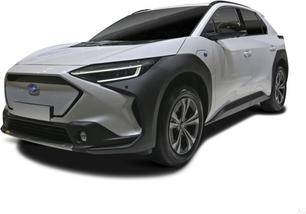
The Solterra is a mid-sized SUV with sporty coupe-like styling and this update has seen the front of the car receive a new look which to my eyes is better than the previous face.
The rest of the car’s exterior remains mainly unchanged in the design.
If you aren’t a fan of the Solterra’s look then check out Toyota’s bZ4X, which is its twin and has slightly more conservative styling, and while I do like the Subaru’s face, I think Toyota’s tail-light treatment is cleaner.
The cabin is modern with a large central media screen, a high-placed instrument display and a wide centre console with dual phone chargers. But the squareish steering wheel steals the show, completing the futuristic vibe.
This update has seen the centre console re-designed with the dual chargers added and the gear-shifter moved backwards away from the media display.
The cabin doesn’t have much in the way of glitzy touches, with dark materials dominating throughout. Hard plastics abound, but the interior still looks and feels premium.
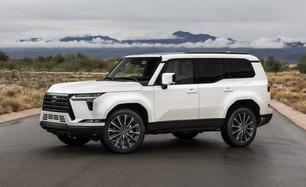
The new GX 550 looks massive and while it shares the same platform as the Toyota LandCruiser 300 series, it doesn't share all of its bulk. They both stand at 1980mm wide but differ on length (5015mm vs 4980mm) and height (1670mm vs 1950mm), respectively.
The new design is fabulously rugged but each body panel looks meticulously crafted and is just the right size. This just means the proportions look right and your eye sort of glides over the big body rather than stopping on any one feature.
But having said that, there are a lot of nice features to focus on, like the long LED headlights and rear strip light, auto-folding side steps, 22-inch alloy wheels and sharply styled rectangular side mirrors.
The tailgate window can also be opened if you need to pop something into the boot but don't want, or have the space, to open the tailgate itself.
The styling takes a minor nose dive once you hit the cabin, though, because it doesn't look as sumptuous as you'd expect in a premium SUV.
I love the utilitarian and military vibe of the vertical dashboard, chunky air vents and relatively small windscreen. It looks great but some trims are plasticky and the touchpoints, while soft, are not Lexus-plush.
However, the technology looks gorgeous with an integrated 14-inch multimedia display and a 12.3-inch digital instrument cluster. The fixed sunroof with its two settings (clear or opaque) is also a lovely feature.
But on a whole, the GX 550's European rivals outclass it with their flashier cabins.
The steering wheel’s square design is like that for a reason - it’s designed to provide the driver with a clearer view of the instrument cluster. But as noted in the past with other vehicles that choose this set up, the ergonomics don’t work for everybody - especially if you’re tall like me (I’m 189cm).
In my case the top of the steering wheel obstructs my visibility of the display, which shows vehicle speed among other crucial info.
There’s also a problem with the clearance of the steering wheel and my legs. This is caused by a combination of my height, the low steering wheel and the limitations of how much it can be raised, the low-hip point in the seating position and the shape of the wheel.
Add an overly wide centre console and space for larger and taller drives becomes even more cramped.
Moving the shifter back in this update also makes it more difficult to use for me and the mechanism is quite clunky.
Second row space is a much better story, with a flat floor, good headroom and lots of legroom even for me behind my driving position. The rear door aperture isn’t great and this has made installing child car seats and the corresponding child difficult.
Cabin storage could also be better. There’s no glove box, but there is space under the centre console, although this is now where the large driver’s manual lives. There’s a large centre console bin, big door pockets and four cupholders (two up front and two in the second row).
The second row has directional air vents and USB ports. There are USB ports up front, too.
Boot capacity isn't enormous at 421 litres in the entry-grade and 410 litres in the Touring. There’s no front boot, either. Under the bonnet is the Solterra’s front motor and electrical hardware.
The Solterra is a five seater SUV, so no third row here.
The cabin of the new GX 550 is fairly practical with plenty of head- and legroom in each row (yep, even the third!). When you first hop in, it can feel a big snug on elbow-room but this feeling quickly dissipates.
Despite a 215mm ground clearance, access is pretty good for the front and middle rows due to the wide door apertures and side-steps. Third row access is a bit awkward for an adult but my eight-year old loved scampering back there this week.
The electric front seats are comfortable with their extra functions and I like the way the massage feature extends to the seat cushion as it limits fatigue on longer journeys. However, you sit on top of them rather sink into them which makes it feel a little trucky at times.
The wide middle row has a bench seat that will be comfortable for kids but an adult might get a sore behind on a long trip. The transmission tunnel also compromises foot room for adults but the seat is wide enough to make use of all three top-tether anchor points (there are ISOFIX mounts too).
It was a little bit of an effort to lift my big booster seat into the back because the GX 550 sits so tall but otherwise, there's plenty of room around a child seat for them not to feel like a sardine.
Individual storage is made up of a glove box that fits an owner's manual, a small shelf in the dashboard and a middle console that doubles as a cool box (mini fridge) and can fit up to four cans or bottles in it.
Each row gets four drinkholders and two USB-C ports but the front also enjoys a 12-volt socket and wireless charging pad. There's a 220V domestic plug port in the boot for larger appliances, too.
It's sometimes awkward to use the wireless charging pad because it's easy for your phone to slide around on it and it quite often disengaged from charging.
My son enjoyed all of the other amenities in the middle row, like the reading lights, climate control, two USB-C ports and retractable sunblinds and I applaud carmakers when they position rear directional air vents in the pillars and/or roof. It just makes it so much easier to cool down sweaty kids!
The 14-inch multimedia display has clear graphics and a responsive touchscreen. The layout is easy enough to get used to after spending some time with it and the sat nav is simple to use.
I like that the sat nav directions can be pulled into the 12.3-inch digital instrument cluster and head-up display.
There is a Lexus connected services app, which you get a three-year subscription to. It's easy to connect to the wireless Apple CarPlay and there is also wireless Android Auto.
The system also has Bluetooth and digital radio, which is a delight to use through the 21-speaker Mark Levinson sound system.
The cabin is rounded out by the well-shaped boot which has a massive 1063L of capacity when the third-row is folded. That's been more than enough for my family's needs this week and my German Shepherd was pretty comfy back there, too. The powered tailgate has a kick-function and there is a full-size spare wheel underneath the car.
The updated Solterra is offered in two grades. An entry-grade model, simply called Solterra, lists for $63,990 and above that is the Solterra Touring for $69,990. That’s up to seven thousand dollars more affordable than pre-update.
We tested the top-of-the-range Touring, which comes loaded with standard features, the only option being leather seats.
If you were wondering if you needed to spend the extra money on the Touring you might be pleased to know both grades have exactly the same powertrain and the entry-grade comes with plenty of standard features.
Coming standard on the entry grade Solterra are 18-inch alloy wheels, LED headlights and LED tail-lights, power mirrors, puddle lamps, a powered tailgate with kick-sensor (new with the update) and roof rails.
There’s also synthetic leather seat trim, heated and eight-way power-adjustable front seats, a heated leather steering wheel, heated second row seats, dual-zone climate control, a 14-inch multimedia touchscreen (new) and 7.0-inch driver display, wireless Android Auto and Apple CarPlay, dual wireless phone chargers (new) and a six-speaker sound system.
The Solterra Touring comes standard with all this but adds 20-inch alloy wheels, a panoramic sun roof, ventilated front seats (new) and a 10-speaker Harman Kardon sound system.
The Touring also features a 220V vehicle-to-load (V2L) power outlet.
The Lexus GX 550 shares the same platform as the recently introduced Toyota Prado but both models are now based on the same 'body-on-frame' platform shared by the beastie Toyota LandCruiser 300 Series. So it's bigger and features a more rigid chassis than before.
Surprisingly, that hasn't translated to a massive price tag for the GX 550 and you can pick up the flagship grade on test for this review for $128,200, MSRP.
Which sounds inexpensive when you compare it to the BMW X7 xDrive 40i M Sport which is priced from $171,300 MSRP but the Land Rover Defender 110 P400 X-Dynamic HSE is a lot closer at $128,815 MSRP.
The only issue here is that shared platform, because while they don't share the same powertrain, the flagship Toyota Prado Kakadu ($99,990 MSRP) is still almost $30K more affordable and boasts a similar equipment list. So, ask yourself, is it the brand and engine you're after or the new good looks?
The standard equipment is well-rounded with a 14-inch touchscreen media display with satellite navigation and wireless Apple CarPlay and Android Auto.
A fully digital 12.3-inch instrument cluster, colour head-up display, three-zone climate control and a 21-speaker Mark Levinson sound system round out multimedia requirements.
Other technology includes a digital rear view mirror, two USB-C ports in each row, a 12-volt socket, a 220-volt domestic outlet and a wireless charging pad.
There are two particularly handy features for families, the 'cool box' (basically a mini fridge) middle console and rear retractable sun-blinds.
The fixed panoramic sunroof features two settings allowing you to make it clear or opaque. The electric front seats feature heat, ventilation and massage functions and the rear outboard seats are heated as well. The third row electrically adjusts and there are multiple buttons throughout the car to access this feature.
Upgraded leather-accented upholstery is standard in the flagship grade and is available in three combinations. The Sports Luxury also features 22-inch alloy wheels, a full-size spare wheel and a powered tailgate with kick-function.
The Solterra has two electric motors and as before there is one driving the front wheels, and one driving the rear wheels for all-wheel drive. Toyota’s bZ4X twin can be had in two-wheel drive and AWD.
The big news is the motors are now more powerful. Much more powerful. Combined output is 252KW (up from 160kW). That’s a huge increase but power is still less than the output of a Model Y or Zeekr 7X.
The front motor now makes 167kW/268Nm, while the rear motor produces 88kW/169Nm. Acceleration from 0-100km/h is about five seconds and that’s almost two seconds faster than the old version.
All GX 550 grades share the same 3.5L V6 twin turbo-petrol engine which produces up to 260kW of power and 650Nm of torque.
This 4WD has high- and low-gearing, as well as a bunch of driving modes to suit most occasions, like 'Eco', 'Comfort', 'Sport' and 'Sport+'.
The 10-speed automatic transmission shifts through its gears smoothly and it always feels like it's engaged in the right gear. Which isn't always the case for a big SUV!
The Sports Luxury is fitted with a towing hitch and cover but unlike the base Sports grade which has a 3.5-tonne braked towing capacity, this model only has a 3130kg capacity which might not appeal to families with big toys to tow.
The updated Soltera’s battery size has increased to 74.7kWh. That’s up from 71.4kWh and means driving range has increased.
The new, larger lithium ion battery delivers a range of 566km (WLTP) in the entry-grade Solterra (up from 414km). That addresses a big concern about the old car. The Touring has a range of 517km and any range above 500km is acceptable in my book.
Also big news is the increase in maximum AC charging capacity from 11kW to 22kW. DC charging capacity is the same at 150kW with 0-80 per cent charge in about 30 minutes.
Consumption officially ranges from about 14.6kWh/100km in the entry-grade Solterra to 16.0kW/100km in the Touring. The Touring we tested was reporting 17.0kW/100km according to the trip computer after 163km of testing in mainly urban conditions.
I didn’t have high hopes for fuel economy because the official combined (urban/extra-urban cycle figure is a hefty 12.3L/100km but after mostly open-road driving, with some urban stuff mixed in, my real-world average came in at 11.8L.100km! This figure is based on my actual km travelled (358km) and litres of fuel used (42.41L).
While I’m surprised by the fuel usage result, I wouldn’t say this car has good fuel economy compared to its diesel-powered counterparts but it’s not terrible!
The GX 550 has a relatively small fuel tank compared to its Toyota cousins at 80L and based on the combined fuel cycle, you’ll get a theoretical driving range of up to 650km.
Not all that great. Not for a big family mover and not if you’re typically driving in the city, where fuel usage will be a lot higher.
The GX 550 only accepts premium unleaded petrol (95 RON), too.
The Solterra may slightly lag behind rivals in some areas such as range and power output, but where most rivals can barely touch it is when it comes to driving.
Currently there aren’t many electric vehicles that are good to drive, except for more prestige offerings from brands such as BMW, Mercedes-Benz and Porsche.
The Solterra is one of the best electric vehicles I have driven at this price point and it’s down to the outstanding platform it shares with the Toyota bZ4X which provides superb ride comfort, great handling and excellent steering.
Acceleration is strong and traction from the all-wheel drive is good.
Sure, while the driving position needs improvement, the car itself is excellent to drive.
Visibility is also good and sound intrusion is minimal. We noticed some materials making noises in the cabin. Although this is common, with no engine to mask it, it becomes more noticeable in EVs.
Oh my goodness the Sports Luxury is a masterclass on 4WD refinement! You never feel the bulk or weight of this massive SUV when you’re driving it. The power delivery is effortless and there’s lots of grunt available when you hit hills.
The handling is also very good with responsive steering and enough road feedback as a driver to make you feel comfortable with what the car is doing. There is some roll in corners but it can tackle more corners at speed than I thought it would.
The high driving position makes me feel like I can see a long way ahead yet while visibility is mostly good, it can be compromised when you have the side window shades and the third row headrests up. Which is why I love the digital rear view mirror.
Overall, ride comfort is good with forgiving suspension and low cabin noise, even at higher speeds. It’s pretty easy to chat with all rows and there’s not a lot of engine noise which adds to the refinement. I do like hearing a V6 rumble but that’s just a personal preference.
I was a little worried about hitting my local Westfield car park but this is a nimble SUV to manoeuvre and parking it is a breeze with the 360-degree camera system and parking sensors.
The Solterra has been awarded the maximum five-star ANCAP rating - but that was given under 2022 testing criteria and the bar has been raised quite a lot higher since then.
Still, the level of safety technology is high with AEB, lane keeping assistance, blind spot warning and rear cross traffic alert onboard.
Front and rear parking sensors are standard on both grades, as is a 360 degree camera view. Auto parking is standard on the Touring.
A digital rear vision mirror is also standard on both grades providing a clear and unobstructed view.
There are seven airbags present, including a front centre bag. And there are three child seat top tether points across the second row with ISOFIX anchors in the two outer positions.
The new GX 550 hasn’t been tested by ANCAP and is unrated but its cousin, the Toyota Prado, which shares the same platform just achieved a maximum five-star rating from assessment in 2024. It's fair to expect a good result for this model.
Overall, the Sports Luxury has a long list of standard safety equipment and features nine airbags which is good for a family SUV.
Safety equipment includes adaptive cruise control, lane departure alert, lane keeping aid, traffic sign recognition, emergency steering assist, driver monitoring, safe exit assist, emergency call functionality, blind-spot monitoring, rear cross-traffic alert and tyre pressure monitoring.
The GX 550 has autonomous emergency braking (AEB) with pedestrian, cyclist, motorcyclist and junction turning assist.
The Solterra is covered by Subaru’s five-year, unlimited-kilometre warranty which is falling behind the seven-year warranty offered by many now. The battery is covered by an eight-year, 160,000km warranty.
There is also five years of capped price servicing with each yearly/15,000km service costing between $130-$300. That’s a very reasonable price.
Lexus offers the GX 550 with a five-year/unlimited km warranty, which is fairly standard compared to its Euro rivals.
You get five years capped-priced servicing which costs $5950 but the servicing schedule is a bit of a bear at every six months or 10,000km, whichever occurs first.